The Dematerialization of the American Economy

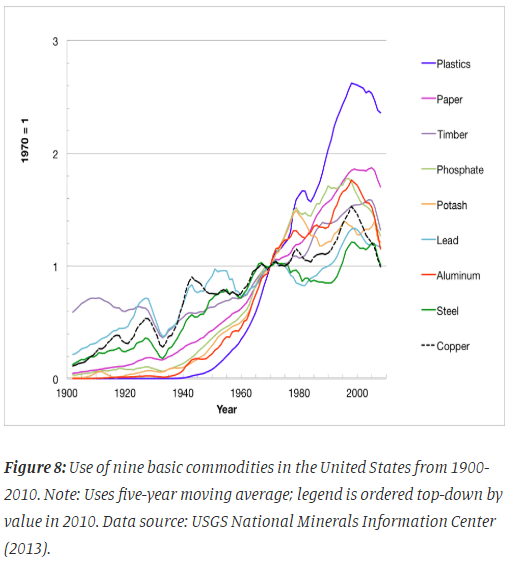
In my last post, I described several different ways in which the American economy is producing more from less: corn production has dramatically increased even as corn acreage has leveled off; the use of basic commodities in the U.S. is shrinking; U.S. water withdrawals have plateaued; carbon emissions are dropping even as GDP continues to increase.

Capture72

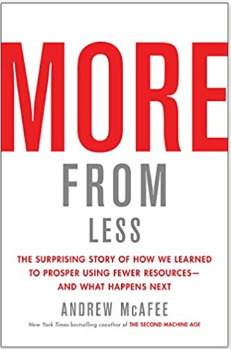
What causes all of this dematerialization?  Andrew McAfee makes a persuasive case that dematerialization is driven by both capitalism and technological progress.  Here are several examples:

  • Fertile Farms. In 1982, 380 million acres of the U.S. was under cultivation.  In 2015, total farm acreage had dropped by 45 million acres.
  • Thin Cans. In 1959 a Coors beer can weighed 85 grams.  By 2011 this was reduced to 12.75 grams.
  • Gone Gizmos. Today a single pocket sized iPhone contains an altimeter, atlas, barometer, calculator, camcorder. camera, clock radio, compact discs, compass, GPS device, mobile telephone, tape recorder, etc., etc.
  • Taking Stock of Rolling Stock. In the 1960s major railroads owned thousands of railcars, only 5% of which moved on any one day.  If that could have been increased to just 10% per day, only half as many rail cars would have been needed.  Today each piece of rolling stock has a radio-frequency identification tag and the country’s 450 railroads have real-time visibility over their rolling stock.

What is going on?

  • We want more all the time but not more resources. Economic growth has become decoupled from resource consumption.
  • Materials cost money that companies would rather not spend. Competition forces companies to operate as efficiently as possible.
  • Innovation is hard to foresee. Neither the fracking revolution nor the world-changing impact of the iPhone were forseen in advance.
  •  As the Second Machine Age progresses, dematerialization accelerates. The Industrial Era allowed us to overcome the limitations of muscle power.  Our current era of great progress in computing allows us to overcome the limitations of mental power.

Conclusion.  “We are now lightening our total consumption and treading more lightly on our planet.  We’re accomplishing this because of the combination of technological progress and capitalism, which let us get more from less.”

Follow me on Twitter 
Follow me on Facebook 

More from Less: There is Hope for Planet Earth

It is impossible to comprehend the world (in my opinion) without a coherent theoretical framework.  As my readers know, I am an economic conservative and a social moderate.  I am also an eternal optimist.  I am naturally attracted to ideas which fit into this general framework.
Capture70

For example, I am impressed by a number of recent authors, see here and here, who provide convincing evidence that the world is gradually getting better in many different ways: more affluence, less poverty, less violence, better sanitation, more equality, etc.

Furthermore I have just recently become aware of the work of two authors, Jesse Ausubel and Andrew McAfee, who provide strong evidence that humanity has started to become a better steward of planet earth.  Mr Ausubel, “The Return of Nature: how technology liberates the environment” and Mr. McAfee, “More from Less” give many examples of the “dematerialization” of the American economy.  For example:

  • U.S. corn production has dramatically increased in recent years even as corn acreage has leveled off (see chart).

    Capture64

  • The amount of land worldwide used for agricultural production is shrinking (see chart).
    Capture71
  • The use of basic commodities in the U.S. is shrinking (see chart).

    Capture67

  • Total U.S. water withdrawals have plateaued in absolute terms and are shrinking dramatically relative to GDP (see chart).

    Capture68

  • U.S. carbon emissions are dropping even as GDP continues to rise (see chart and also here).  Of course, it is well understood that global warming is a huge threat to human civilization and we have to continue to shrink carbon emissions far more than we have already.

    Capture69

Conclusion.  The world’s leading economy has turned the corner on the use of many raw materials and is now “post peak”.  As other countries become more affluent their economies will likely behave in a similar manner.  This trend will continue for fundamental economic reasons, mostly without onerous governmental regulation.  Why is this?  Stay tuned!

Follow me on Twitter 
Follow me on Facebook 

Controlling the High Cost of American Healthcare II. What are the Options?

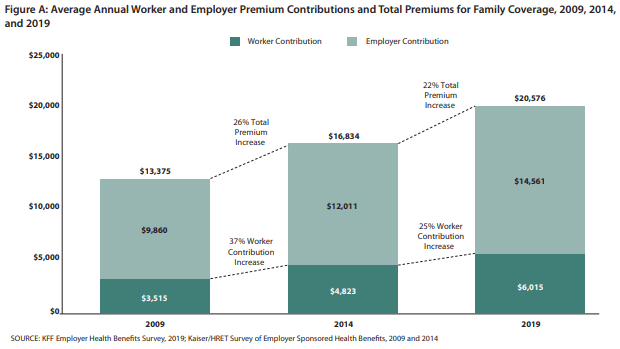
As the readers of this blog know, I focus on what I consider to be our country’s biggest problems.  Right now the biggest problem of all is our rapidly growing and largely out-of-control national debt.  The only way we will solve our debt problem is to control the growth of entitlement spending, especially for public healthcare programs such as Medicare and Medicaid.  But the basic problem with these programs is the overall cost of healthcare in the U.S. which is far more expensive than in any other developed country.

Capture62

What are our options for controlling healthcare costs in the U.S.?

  • In “Overcharged”, the authors claim that $1 trillion of the total annual cost of U.S. healthcare of $3.5 trillion, is due to fraud, waste and abuse. There are thousands of whistleblowers in the healthcare industry who share in funds recovered from fraud but recovered funds are just a drop in the bucket to what is lost.
  • The price of new drugs can be outrageous. For example, the drug Soliris, to treat a rare blood disease affecting 10,000 people in North America and Europe costs $440,000 per patient per year for the rest of their lives.  Clearly at least some government regulation of drug prices is justified.
  • “Healthcare is expensive because it is insured.” If individuals paid directly for routine healthcare, costs would go way down.  Medical tourism and retail clinics such as Urgent Care would flourish, doctors would compete on price, and cost of treatment would drop dramatically. Of course, we would all still need high deductible catastrophic insurance for major health problems such as heart attacks and cancer.

    Capture63

  • There are a variety of different models for healthcare systems in other developed countries but they all have one thing in common: “What other countries have learned is that without some form of price regulation, there is no effective check on prices.”

Summary.  There are various ways to lower the cost of healthcare in the U.S. such as cracking down harder on fraud and abuse, doing a better job of regulating new drug approvals and encouraging direct payment for routine healthcare by increasing the use of catastrophic health insurance.  But these approaches are all hard to implement and the only practical alternative is for government price regulation of some sort.  Healthcare prices must be dramatically lowered and if the free market can’t get the job done, then government price regulation will inevitably result.

Follow me on Twitter 
Follow me on Facebook 

Is Life in America Getting Better?

I am trying to resolve two well-documented but apparently contradictory recent trends in the U.S. economy:

  • First of all, the American middle class is thriving (see here and here) where it is shown by the AEI’s Mark Perry that the middle class is only shrinking overall in the sense that the upper-income class is growing rapidly. Furthermore the lower-income class is really shrinking because so many lower-income households are moving into the middle class.

    Capture51

  • Secondly, the American dream is fading in the sense that “absolute income mobility,” the fraction of children who earn more than their parents, has fallen from 90% for children born in the 1940s to only 50% for children born in the 1980s. The authors of these studies, Raj Chetty et al, point out that a more equal distribution of GDP growth across all income groups would reverse more than 70% of the decline in mobility.

    Capture61

But now consider additional recent work (see here and here) by Richard Florida which shows that income inequality is growing the fastest in large metropolitan areas in the blue states.  In particular:

  • Blue states like California, New York and Illinois, whose economies turn on finance, trade and knowledge, are richer than red states. Red state economies based on energy extraction, agriculture and suburban sprawl, may have lower wages, higher poverty rates and lower levels of education than those of blue states but their residents benefit from a much lower cost of living, especially for housing.
  • For the large number of blue state urbanites who work in low-paying retail, food preparation and service jobs, and also for tradespeople, teachers and civil servants, the American dream of home ownership, or even an affordable rental apartment, is increasingly out of reach.

Conclusion.  The traditional American middle class is thriving overall but hurting quite badly in some of the most attractive large urban areas where the cost of housing is increasingly out-of-sight.  This obviously hurts their upward social mobility.

Follow me on Twitter
Follow me on Facebook 

How Are Things Going in the U.S.?

This blog deals primarily with fiscal and economic issues, but sometimes takes a broader point of view.  Today let’s take an overall look at how things are going in the U.S.

Capture58

Here is what is going right:

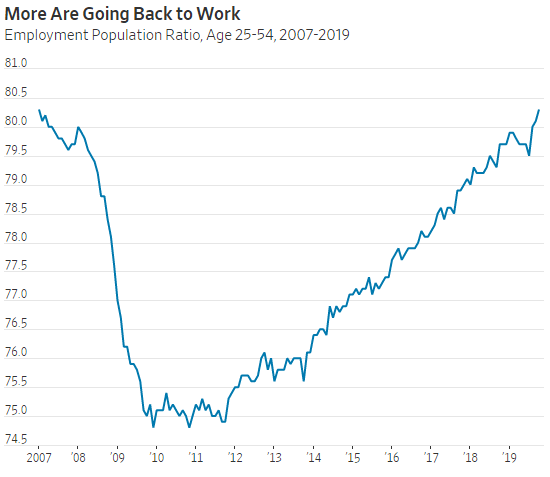
  • Our economy is quite strong.  Economic growth was 2.9% last year and is predicted to be 2.8% this year.  The unemployment rate, now 3.7%, has been under 4% for many months.  This has led especially to more opportunities and wage gains for low skilled workers.
  • The middle class is thriving as people at all income levels are moving up.
  • Technology. America totally dominates the new technology (think Amazon, Apple, Facebook, Google and Microsoft) which is rapidly improving the quality of life worldwide.
  • Democracy is thriving around the world especially as our biggest rivals are dealing with major democratic protests at home.

But there are very serious problems as well:

  • Our biggest problem (by far!) is the national debt.  It is out of control, growing rapidly, and very difficult to address politically.  Its main cause is government spending for entitlements, especially for public healthcare programs such as Medicare and Medicaid.
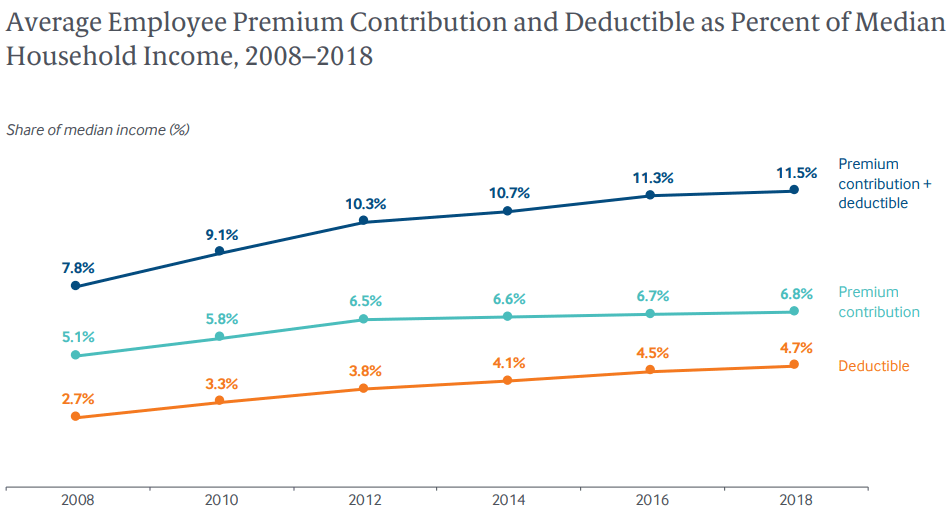
  • In addition, the cost of private healthcare is devastating for many American families.  Hospitals especially have become way too expensive (more on this soon).
  • Opportunity and social mobility for low income and minority children is meager  and needs to be much improved (more later).
  • Global warming is a huge problem. Arctic ice is shrinking, sea levels are rising, the ocean is becoming more acidic, and weather events such as hurricanes are becoming more intense.  Fortunately, public awareness and concern about global warming are growing rapidly and action is being demanded by more and more people.  The U.S. is providing world leadership by putting a strong emphasis on switching to renewable energy.

Summary.  Things are going very well in the U.S. and I am overall optimistic that our serious problems will be addressed.  However I am pessimistic about our massive debt problem.  Most likely it will be publicly ignored until interest rates increase substantially and we have a new and much worse fiscal crisis.  The longer it takes for this scenario to develop, the worse it will be when it inevitably happens.

Follow me on Twitter
Follow me on Facebook 

The American Middle Class Is Thriving

There is a common myth today, often stated in the media, that the U.S. middle class is stagnant and even in decline.  According to this myth today’s middle class families have a lower standard of living than middle class families headed by our parents or grandparents in the mid-twentieth century.
Capture53

This often repeated story is simply wrong.  The following chart, based on the latest census report, shows that the middle class is only shrinking in the sense that the upper middle class is growing so rapidly.  Likewise, the percentage of low-income families is shrinking because so many low-income families are moving up to middle income.

Capture51

Consider the additional charts derived from the same census data:

  • While median family income (adjusted for inflation) is steadily increasing, average household size is steadily decreasing.
    Capture54
  • This means that the median income per household member is increasing even faster.Capture57
  • Real median family income for U.S. married couples with both spouses working full time is growing amazingly fast. (Hey guys, get married and encourage your wife to work too!)Capture55
  • What income inequality? The share of total income earned by the top 5% and top 20% of U.S. households has hardly changed in the past 25 years.Capture56

Summary.  The middle class is only disappearing in the sense that middle income households are gradually moving up into a higher income group.  The share of U.S. households earning more than $100,000 (in 2018 dollars) has more than tripled since 1967.  Likewise the share of households earning $35,000 or less (in 2018 dollars) has greatly diminished.  If you want to steadily increase your income, what you need to do is get educated, get married, and both you and your spouse work.  It’s shouldn’t be that difficult to figure out.

Follow me on Twitter 
Follow me on Facebook 

It’s Better than It Looks

I have recently discussed two new books which are pessimistic about the future of world democracy and America’s role in leading it.

  • Robert Kagan’s “The Jungle Grows Back” rightly points out that the amazing progress of the past 75 years is the result of a unique set of circumstances. “The question is not what will bring down the liberal order but what can possibly hold it up. … The liberal world order is as precarious as it is precious.”
  • Jonah Goldberg’s “The Suicide of the West” makes the case that “we are living in a miraculous time” which is “not normal in humanity’s natural environment. … We stumbled into this miracle without intending to and we can stumble out of it.”

As much as I respect the knowledge and scholarship of these two authors, I reject their pessimistic outlook for the future.  I am an optimist for the following reasons:

  • There is a general consensus, by Kagan, Goldberg, and many other authors of the enormous human progress which has taken place in the past three centuries. Prosperous people have more leisure time to appreciate freedom and work to improve their form of government.

    Capture50

  • The U.S. has many strengths in the continuing struggle to support and expand democracy. Russia is declining, both in population and economic output.  Chinese population will peak by 2027 and China will soon have more old than young people.  The U.S. continues to increase its population by admitting a million (legal) immigrants per year.
  • The future of democracy is bright.  The biggest threat to the American way of life is complacency.

Summary.  Despite all of America’s serious problems, it has so many inherent strengths,  that it is likely to maintain its free and prosperous way of life for many years to come.  As long as we are vigilant and don’t take it for granted!

Follow me on Twitter 
Follow me on Facebook 

Don’t Let Pessimism Overwhelm Idealism

“On what principle is it, that when we see nothing but improvement behind us, are we to expect nothing but deterioration before us?”
Thomas Babington Macauley, 1800 – 1859

In addition to my primary sources for this blog,  the New York Times and the Wall Street Journal, I also read a fair number of new books, often reviewed by these two newspapers.  I have just finished reading “Suicide of the West: how the rebirth of populism, nationalism and identity politics is destroying American democracy,” by Jonah Goldberg.

Capture49

Mr. Goldberg’s main premises are:

  • We are living in an unnaturally prosperous time. Our prosperity is not merely material but political and philosophical.  We live in a miraculous time, by historical standards, where every human born is recognized by law and culture as a sovereign individual with inalienable rights.  This is not normal in humanity’s natural environment.
  • We stumbled into this miracle without intending to and we can stumble out of it.
  • Human nature not only exists but it is fundamentally unchanging.
  • If we do not account for, and channel human nature, it will overpower and corrupt the institutions that make prosperity possible.

Mr. Goldberg carefully documents the amazing human progress which has taken place since the eighteenth century, as have several other authors, see here, here, and here.

Here is how I evaluate Mr. Goldberg’s argument:

  • First of all, I agree with his description of our country’s many shortcomings: ingratitude for the miracle, history of slavery, the vast administrative state, the perniciousness of occupational licensing, bonfires of asininity at elite universities, the rising tide of protectionism, the family’s losing war against barbarism, Trumpian populism, government’s increasing centralization, etc., etc., etc.
  • But he is too hung up on the politics of the moment, and the failures of government. The “miracle” developed out of the fundamental economic principle of specialization and exchange and will be able to withstand less intrinsic human and societal imperfections.
  • There is a deep yearning for freedom and democracy around the world, see here  and here.  America doesn’t have to be perfect to serve as a beacon to others.  We just have to avoid being complacent.

Summary.  Jonah Goldberg’s “Suicide of the West” should be read and digested by everyone who values the American way of life and wants America to continue to prosper and lead the world into an even brighter future.

Follow me on Twitter 
Follow me on Facebook

The Future of Democracy Is Bright

The fall of the Berlin Wall and the collapse of the Soviet Union in 1989 were high points for democracy world-wide. In 1992 Francis Fukuyama even proclaimed “The End of History.”

capture35

But in the meantime China has grown much stronger and a declining Russia is stirring up trouble by throwing its weight around.  It is very important for the U.S. to stand up to threats from these and other autocratic regimes around the world.  In doing so we have many strengths.

Some experts say that nevertheless democracy is in decline.  But consider:

  • Hong Kong has been in heavy revolt for many weeks.  It was promised many freedoms by China for 50 years when it separated from Great Britain in 1997.  The whole world is watching closely and China will suffer great international damage if it cracks down on Hong Kong with military force.
    Capture48
  • As many as 60,000 Moscow residents have been demonstrating for several weeks against the Russian government’s attempt to dictate who can or can’t be a candidate for municipal office.  Many Russian people clearly want a truer form of democracy than they have at the present time.
  • The power of autocratic Premier Recep Erdogan was successfully challenged by the new mayor of Istanbul, Ekrem Imamoglu.  This could push Mr. Erdogan to implement political and economic reforms in this crucial NATO member.
  • Premiers Hugo Chavez and Nicolas Maduro have destroyed the Venezuelan economy with their corrupt socialistic policies and millions of residents have fled to nearby countries.  The U.S. is attempting to force democratic change by putting sanctions on the international sale of Venezuelan oil.

Summary.  The development and widespread implementation of democracy around the world since the end of WWII is a hugely positive sign of human progress.  This deep human longing for freedom continues to manifest itself.  No country, no matter how autocratic or corrupt, is immune from its force.  This bodes very well for the future of free society.

Follow me on Twitter 
Follow me on Facebook 

Donald Trump’s Biggest Failing: it’s Debt, not Racism

President Donald Trump is accused of many things: lying, willful ignorance, exaggerated feelings of self-importance, mean-spiritedness, childishness, using racially divisive language, white supremacy, etc.  He has such a domineering personality that it is easy to make these charges in a credible manner.

Policy-wise the situation is different.  He is doing some things quite well.  For example:

  • Economic growth has been robust with a currently low unemployment rate of 3.7%.
  • He is cracking down hard on China for unfair trading practices and theft of intellectual property.
  • He has imposed stiff economic sanctions on international bad actors such as North Korea, Iran, Russia and Venezuela.

His biggest failing, in my opinion, is ignoring rapidly growing spending deficits which are adding so dramatically to our exploding national debt.  The problem is that:

Capture46

  • After falling for several years, deficits are now increasing again. The deficit for the current 2019 fiscal year will be close to $1 trillion and growing.
  • Right now interest rates are so low that our debt is almost “free money.” But interest rates will inevitably rise at some point and then interest payments on the debt will explode and make our annual deficits that much worse.
  • When the next recession hits, which could be soon, tax revenues will fall and social spending will increase, making the deficits that much worse.

    Capture47

  • Deficit and debt make a very difficult political problem because fixing it requires cutting spending and/or raising taxes, neither of which is a politically popular option. This means that it will be difficult to solve this problem until a severe fiscal debt crisis occurs which will require unpleasant emergency action.  But it is a President’s responsibility to address our most serious problems.

Summary.  President Trump has many critics who accuse him of various faults and deficiencies.  But his biggest failing, which will have the most negative effect on his legacy, is his unwillingness to address our country’s most severe long term problem: out-of-control deficit spending and rapidly accumulating debt.

Follow me on Twitter
Follow me on Facebook