A Vivid Example of Fiscal Irresponsibility at the Federal Level


An article in the Friday, August 14 edition of the Omaha World Herald, “Why are the BRT stations so expensive? Officials explain the $260,000 price tag,“ describes a new $30 million bus rapid transit plan for Dodge Street with 27 individual sleek, modern bus stop shelters along the route at a cost of $260,000 each.  Half of the new $30 million plan will be paid for by the city of Omaha and half by the Federal Transit Authority which has an annual budget of $8.6 billion.
Capture1 The issue is not whether Omaha should spend $15 million in local funds to achieve a $30 million bus system upgrade. We can expect city officials to make a responsible decision on this matter. The real issue is why the FTA should have annual budget of $8.6 billion to begin with when it is paying for, and therefore encouraging, extravagantly designed bus transit systems all over the country.
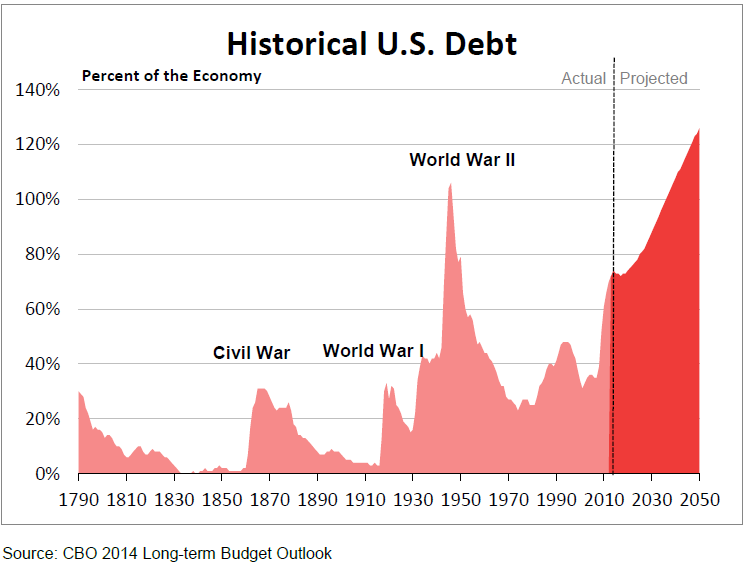
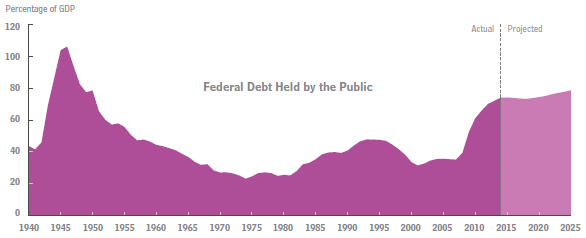
CaptureThe U.S. deficit for the 2015-2016 budget year, ending on September 30, is predicted to be about $450 billion dollars. This adds to the approximately $13 trillion public debt (on which we pay interest) which, at 74% of GDP, is the highest it has been since the end of WWII (see the above chart from the Congressional Budget Office).
It is the responsibility of Congress and the President to figure out how to get the budget under better control. All aspects of federal spending can and should be tightened up, including entitlements (Social Security, Medicare and Medicaid) and discretionary spending (everything else).
The Federal Transit Administration is wasting money on unnecessarily extravagant bus transit systems. Such fiscal irresponsibility means that its budget should be cut significantly. Many other similar examples exist in the federal government. We need people in Congress who can identify these fiscal boondoggles and effectively agitate for needed cutbacks.
How to Avoid a New, and Much Worse, Financial Crisis


Is it possible for the U.S. to effectively address its enormous debt problem in today’s contentious political environment? Two weeks ago I discussed in “America’s Fourth Revolution” why the political scientist James Piereson thinks this is impossible. He is very persuasive but I think he is too pessimistic.
CaptureSince then I have discussed several different things we should do to turn around this perilous situation:

  • If spending for just Medicare and Medicaid (two very expensive entitlement programs) alone fell by 25% over ten years, as a percentage of GDP, and then stayed in line with GDP after that, the U.S. would actually have a budget surplus in 2040.
  • Just recognizing the magnitude of our debt problem would do wonders in public awareness.
  • If the Tea Party were able to grow beyond a protest movement and unite the country behind a majoritarian agenda of work, mobility and opportunity, it would be much more effective in achieving its fiscally conservative goals.
  • Another significant way to save money, and get better results at the same time, is to turn over more and more programs to the states. A good way to do this is with block grants to the states for federal programs in such areas as welfare, education and Medicaid. This would give the states more flexibility to get the job done in an efficient and cost saving manner.

What we need to do to turn our debt situation around is to greatly shrink our annual deficits below their current level of about $450 billion per year. If the debt is growing slower than the economy, then it will shrink as a proportion of the economy. This is what happened after WWII (see above chart) and it needs to happen again now!

Perfecting Our Union: Ending the War Against the States


“The powers not delegated to the United States by the Constitution, nor prohibited by it to the States, are reserved to the States respectively, or to the people.”                                                 The Tenth Amendment to the U.S. Constitution

As the readers of this blog know, I am very concerned about our massive (public) debt, now at 74% of GDP, the highest since the end of WWII. One way to get federal spending under better control is to give more power back to the states (which are required to balance their budgets), as described by Adam Freedman in his new book “A Less Perfect Union: the Case for States Rights.”
CaptureHere are some of the many advantages of doing this, according to Mr. Freedman:

  • Better schools, roads and infrastructure, as states are freed from wasteful federal mandates. The Common Core, for example, should be considered as federal guidelines and not as an attempt to require a specific curriculum.
  • Lower taxes, as states engage in a virtuous competition for citizens and businesses.
  • Improved stewardship of natural resources, as decisions reflect local priorities on land use.
  • Less crowded prisons, by returning criminal jurisdiction to the states, where penal reform is light-years ahead of Washington.
  • An end to national gridlock, as the most divisive social issues devolve to state and local decision-makers. A good example here is the current interest by states and localities to enact their own minimum wage laws. This is far superior to raising the national minimum wage law in a one-size-fits-all manner.


The way to implement a program of giving responsibility back to the states is with block grants. A plan to do this for social welfare programs was formulated by the House Budget Committee just one year ago. It is often suggested to do something similar with federal education programs and with Medicaid as well.
Moving programs back to the states will improve their quality and help get costs under much better control. It makes much sense to move in this direction!

Prominent Myths about Our National Debt


As the 2016 presidential election contest begins to heat up, the Committee for a Responsible Federal Budget and its outreach arm, Fix the Debt, have issued a new “Fiscal FactChecker: 16 Budget Myths to Watch Out For in the 2016 Campaign.”  Here are four of the major myths:

  • We Can Continue Borrowing Without Consequences. “Low interest rates are a temporary consequence of the struggling global economy and near term Federal Reserve actions – not a permanent fixture.”

    Capture4

  • There is No Harm in Waiting to Solve Our Debt Problems. “The longer policy makers wait to control debt, the more difficult it will become. For example, reducing debt to around the historical average of about 40% of GDP by 2040 would require tax increases or spending cuts of about 2.6% of GDP per year, if enacted today, or starting at $1,450 per person per year. Waiting a decade to begin would require adjustments of over 4% of GDP.”
  • Deficit Reduction is Code for Austerity, Which Will Harm the Economy. “Most advocates of fiscal responsibility in the U.S. have called for gradual reductions in long-term deficits so that the debt grows slower than the economy. These changes tend to have minimal near-term effects as well as the potential to significantly grow the size of the economy over the long term.”
  • We Can Fix the Debt Solely by Taxing the Top 1%. “The top 1% of earners, households that make at least $450,000 annually, earn a substantial share of national income, about 13% on an after tax basis, and further tax increases on this group could help. But these increases would need to be combined with reductions in spending growth and/or broader tax increases to fully address the nation’s fiscal challenges.”

Just a few days ago, I described a persuasive argument, “America’s Fourth Revolution,” that our hyper-partisan and dysfunctional political system will be unable to rectify our debt problem until we have another and much more severe financial crisis. The above discussion of budget myths from CRFB actually suggests a way forward to solve our debt problem.
We have a choice. Which path will we take?

The Fiscal Time Bomb Is Still Ticking!


The Congressional Budget Office is by far the most objective source of detailed information about the federal budget, playing a valuable role in the super-charged political atmosphere of Washington D.C.  It has just released a new annual report, “The 2015 Long-Term Budget Outlook,” projecting our fiscal health for the 25 year window, 2015-2040, based on current policy. It is a scary scenario indeed.
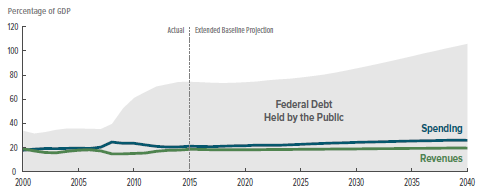
CaptureAs shown in the above chart, our public debt (on which we pay interest) has increased from 38% of GDP at the beginning of the Great Recession in 2008 to 74% today.  Although it will remain steady at this high level for about five years, it will then resume a steady increase, reaching a level of about 100% of GDP by 2040.
As many observers, including myself, have pointed out, when interest rates eventually return to their normal historical level of around 5%, interest payments on this huge, and rapidly increasing, debt will double or triple from their current low level, causing a very painful budget shortfall.
Simple prudence suggests that the only responsible course of action is to put our debt on a downward path, as a percentage of GDP, in order to minimize this looming problem to the greatest possible extent.
Capture1CBO gives some useful guidelines for what is required to do this:

  • Just to keep the debt at its current value of 74% of GDP by 2040 would require an annual 6% increase in revenue or a 5½% decrease in spending. This would amount, for example, to a $210 billion spending cut for 2016.
  • To reduce the debt to 38% of GDP by 2040, its average over the past 50 years, would require an annual 14% increase in revenues or a 13% decrease in spending. The spending cut for 2016 would be $480 billion.

These examples show the enormity of the fiscal mess we have gotten ourselves into.  Under current policy it will require a big effort just to stay even with where we are right now, without showing any debt reduction over the next 25 years!
Our only hope is to change current policy.  But how?

Fixing the Debt: Creating a Greater Sense of Urgency


As I have mentioned before, I am a volunteer for the nonpartisan Washington D.C. think tank “Fix the Debt.”  As such I give presentations to civic organizations in the Omaha area about our debt problem and what we can and should do about it.  I have now given four such talks and have another one coming up next week.
Capture
What is most difficult for me is to try to convey a sense of urgency about addressing this problem. Most people deplore deficit spending in a general sense but not nearly enough people think that dealing with it should take priority over current presumably pressing spending needs such as, for example, depletion of the highway trust fund, expanding military spending, or improving early childhood education, just to be specific.
So here is how I am going to try to create a greater sense of urgency.  Several months ago I had a post entitled, “The Slow Growth Fiscal Trap We’re Now In” in which I said (in brief summary) that our current economic condition of

  • slow growth means
  • low inflation which leads to
  • low interest rates which in turn leads to
  • massive debt which eventually leads to a new and much more severe
  • fiscal crisis.

This is the predicament we’re now in.  Do we consciously maintain a slow growth economy, with all the unemployment pain and stagnant wages which this entails, or do we speed things up, enabling more people to go back to work, and also deal with the higher inflation and interest rates which this will entail?
Faster growth may well eventually come on its own anyway and then we’ll be forced to fix our fiscal problems at a time when they’ll be much worse than they are now.
Isn’t it clear that it is much better to act now in a responsible manner rather than to wait and have to react hurridly later on when the problem is much worse?

Should We Raise Taxes or Cut Spending?


Tax Day is a good time to remind ourselves about our perilous fiscal situation.  With a public debt (on which we pay interest) of $13 trillion and with annual deficits of just under $500 billion adding to the debt each year, we have a huge problem which is not being adequately addressed by Congress.  The solution is to either raise taxes or cut spending or do a combination of both.
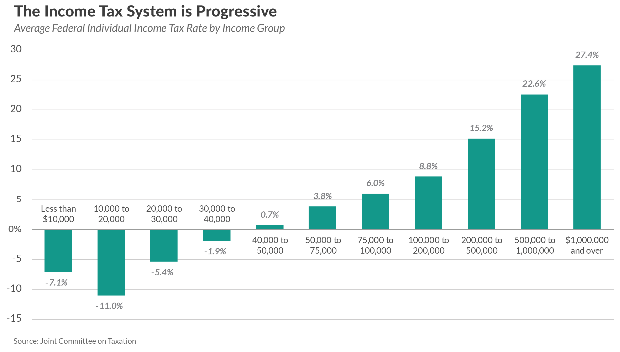
CaptureIs it feasible to raise taxes, presumably on the rich?  The problem in doing this is that our tax code is already very progressive as indicated by the above chart. The top 20% already pay 84% of all income taxes.  It’s just not feasible to expect to be able to raise their taxes by a very large amount.  In addition, Middle- and lower-income people are in a tight fiscal situation, because of the slow economy, and can hardly be expected to see their own taxes increase.
Capture1The alternative to raising taxes is to cut spending and there are many opportunities to do this.  The organization Citizens Against Government Waste has just identified a collection of government programs whose elimination would save $639 billion in the first year alone.  Taxpayers for Common Sense has a long list of potential spending cuts which would save $267 billion in the first year.
Amazingly, neither of these lists of possible cuts includes any mention of entitlement programs.  Before very long, major savings in entitlement programs must certainly be achieved in order to put the federal government on a sustainable fiscal course.
In fact, spending should be trimmed all across the board, wherever possible, in order to get our annual deficits on a steadily downward course.  It is critical for this process to get under way as soon as possible and to continue until fiscal balance is achieved by entirely eliminating deficit spending altogether.

The Republican Budgets Focus on Entitlement Savings


Last week, both the House and the Senate passed ten year budget plans which would bring the federal budget into balance by 2025.  I have devoted several recent blog posts to discussing these budget proposals and how they address our very serious debt and deficit problems.
CaptureThere are several important points to make:

  • Under both of these Republican plans, overall spending will continue to increase by an average of 3.3% per year, from $3.8 trillion in 2016 to just over $5 trillion in 2015. The President’s budget would increase spending to $6.17 trillion by 2025 and would achieve no balance between spending and revenue.
  • Most of the savings in the Republican budgets, as indicated in the above chart, come from the mandatory (entitlement) programs of Social Security, Medicare and Medicaid. Medicare would be transformed into a subsidy program along the lines of the exchanges set up under the Affordable Care Act. Medicaid would be turned into a block grant program administered by the states. Social Security would be studied by a bipartisan commission to recommend operating efficiencies.
  • Other social welfare programs would be affected to a much smaller extent. For example, the Supplemental Nutrition Assistance Program (SNAP), or Food Stamps, has seen a growth of recipients of 69% between 2008 and 2013 while the poverty rate increased by just 16.5% during the same period. The Republican budgets would block grant Food Stamps to the states in order to achieve operating efficiencies.
  • It is true that both the House and Senate budgets would increase military spending by about 10%. But so would the President’s budget and we live in a very dangerous world. Military defense is one of the most very basic functions of our federal government.

Our country is in dire fiscal condition with large annual deficits projected indefinitely into the future, contributing to an exploding national debt.  It is heartening that our political system is responding to this threat to our future security and prosperity.  Let’s hope that House and Senate majorities continue to keep a sharp focus on the urgent task of fiscal restraint.

An Open Letter to Representative Brad Ashford


You’re off to a great start in Congress!  You’ve clearly established that you’re independent minded and that you vote your conscience.  I expected that you would act in this way and that is why I supported you during last year’s election campaign.  We need more people like you in Congress.
As you perhaps know, I am a non-ideological fiscal conservative and social moderate.  I am, like you, mainly interested in finding practical, workable solutions to difficult and complicated problems.  But I do have one guiding principle to which I strongly adhere.  I believe that, as a general rule, every level of government should refrain from spending more money than what it can pay for with tax revenue.
CaptureUnfortunately our federal government has gotten away from this principle in recent years.  This is clearly demonstrated in the above chart which shows an already very large national debt getting much, much worse in the coming years.
There is a movement in the new 114th Congress to address this perilous situation which we have gotten ourselves into.  I am referring to the bills drafted by the Budget Committees of both the House of Representatives and the Senate which would produce balanced budgets over the ten year period, 2015 – 2025.
It was reported in today’s Wall Street Journal that the full House voted yesterday to approve the budget bill by a 228-199 margin but without any Democratic votes.  This means that either you voted against the Budget Bill or you did not vote on it.
I don’t believe that any one vote is so important that it constitutes a decisive litmus test determining my support of a candidate in a future election.  However, as I mentioned above, I feel very strongly that we must greatly shrink our very large budget deficits and that now, not later, is the time to get started on this urgent task.
I hope to be able to support your re-election campaign in 2016 and beyond.  That is why I am writing to you at the present time.

Status Quo on the Budget Is Not Good Enough!


As I like to remind readers, I am a non-ideological fiscal conservative.  I am not hard core anything.  I just want to find practical, workable solutions for difficult and complicated problems.  There is basically only one exception to my generally moderate outlook.  I detest huge amounts of deficit spending except for unusual circumstances.  Most of the time we should be willing to either raise taxes and/or cut spending to do what needs to be done and to live within our means.
This is why the current efforts by the Budget Committees of both the House and the Senate to devise a plan to balance the budget, i.e. eliminate deficit spending, over a ten year period is so exciting to me.
An analysis in today’s New York Times suggests that Congress should be content to just extend the so-called Ryan-Murray Budget from 2014-2015.  “Ryan-Murray didn’t decisively move the needle one way or the other, which is why it was able to attract bipartisan support.  Rather it preserved the status quo.  In a world of divided government and polarized politics, keeping the government running without a lot of brinkmanship and high drama may be the best we can hope for.”
CaptureAs I pointed out in my last post, current policy will raise government spending by 5.1% annually over the next ten years.  The President wants to increase spending by an additional $1 trillion over this time period.  The Republican budgets, which lead to balance in ten years, still allow spending to increase by 3.3% annually.  The difference between the two plans is illustrated in the above chart from last Sunday’s Omaha World Herald.
Congress is finally in a position this year to start digging us out of the deep fiscal hole we have fallen into.  Let’s hope that too much “bipartisan” status quo thinking doesn’t get in the way of progress!