Boosting the Middle Class


My last two posts, here and here, have dealt with the contention by Richard Reeves  that the real inequality gap in the U.S. is not between the top 1% (the wealthy) and the bottom 99% but rather between the top 20% (the upper middle class) and the remaining 80%.
The top 20% are the highly educated doctors, lawyers, business managers, successful entrepreneurs, academics, journalists, etc. who thrive in the global economy, largely shielded from the intense market competition faced in the non-professional occupations. Basically the upper 20%, with incomes of $112,000 and up, have it made.
The question is then, how do we give a boost to the people in the middle- and lower-income brackets so that more of them can enjoy much of the same prosperity as the top 20%?


The answer is to:

  • Make the economy grow faster than the slow 2% annual GDP growth we have had since the end of the Great Recession in June 2009. With sensible tax and regulatory reform, we should be able to achieve a growth rate of 2.5% per year.  This will create more jobs and better paying jobs.
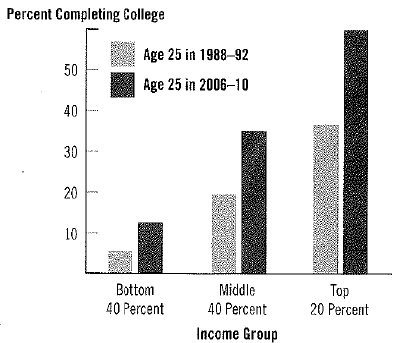
  • Improve educational opportunities by, for example, making early childhood education widely available to low-income families, attracting the best teachers to the poorest schools with targeted bonus pay, and funding college more fairly by requiring that all student debt repayment be income-based.
  • Fundamentally reform the American healthcare system in order to reduce healthcare costs from the current 18% of GDP to about 12% which is the average for other developed countries. This will save the American economy $1 trillion per year in unnecessary and extravagant costs, which could be put to much better use for higher worker pay, expanded social services and shrinking annual deficit spending.

Conclusion. The U.S. is a very prosperous country but clearly we can do an even better job to improve the quality of life for many more Americans.

Follow me on Twitter 
Follow me on Facebook 

Can Economic Prospects for the Middle Class Be Improved?


Donald Trump was elected President last fall because of his surprising and unexpected strength with blue-collar workers. These folks have had a rough time in the 21st century economy: high unemployment, unstable marriages, opioid addition, lower longevity, etc.

My last post discusses a new book by Richard Reeves which makes the case that the real inequality in the U.S. is between the top 20% (the upper middle class) and the lower 80%.  The upper middle class are mostly the well-educated professionals who benefit from the modern high-tech global economy.  Mr. Reeves believes that this elite group is so entrenched with privileges as to be self-perpetuating. His response to this situation is to try to expand opportunity more widely by, for example:

  • Reducing unintended pregnancies through better contraception by making LARCs (long-acting reversible contraceptives) more widely available to free more young women from the burden of unwanted children.
  • Expanding access to early childhood education including home visitation to give a big preschool boost especially to kids from low-income families.
  • Getting better teachers for unlucky kids by giving teachers a substantial bonus to teach in high poverty schools. This will attract better teachers to the more challenging schools.
  • Funding college more fairly. Free college is a terrible idea. It would just be yet another boondoggle for the upper middle class. All student debt repayment should be income-based. The status of vocational postsecondary learning (at community colleges) should be elevated.

Conclusion. The idea here is not to pull down those who are well off but rather to give more people the opportunity to succeed in the modern economy. Of course, faster economic growth is another way to create more and better paying jobs.  But faster economic growth has its own limitations and, at any rate, is difficult to achieve with a rapidly aging population.  I will return to this topic soon!

Follow me on Twitter 
Follow me on Facebook 


The Origins of Trumpism III. The Upper Middle Class


Like everyone else, I am trying to understand how such a sleazy and personally obnoxious individual as Donald Trump was elected President of the United States. We know that his core supporters are white working-class voters.  We also know that our relatively stagnant 21st century economy has been very difficult on blue-collar workers.


But here is another thread.  The author, Richard Reeves, in the new book “Dream Hoarders” makes a strong case that the real inequality gap in the U.S. is not between the top 1% (the wealthy) and the bottom 99% but rather between the top 20% (the upper middle class) and the remaining 80%.
Consider:

  • The top 20% consists of households with an income above $112,000 per year (see chart). Such households saw a $4 trillion increase in incomes between 1979 and 2013. A third of this income rise went to the top 1%. But this still left $2.7 trillion for the next 19%. The lower 80% saw an income rise of $3 trillion over this same period.
  • The top 20% are the highly educated doctors, lawyers, business managers, academics, think tankers, journalists, etc. These are the people who flourish in a global economy, largely shielded from the intense market competition faced in the nonprofessional occupations.
  • Donald Trump tapped into the anxiety of the lower 80%. He received 58% of the total white vote but 67% of the votes of whites without a college degree.
  • The upper middle class tend to perpetuate their inherent advantages. They tend to have stable marriages and live in the best neighborhoods with the best public schools. They can afford to send their kids to the best colleges. Most of their kids will remain in the upper middle class.

Conclusion. Such a thriving and self-perpetuating upper middle class can cause severe resentment amongst the bottom 80% who have to work much harder to make ends meet. How should this very difficult problem of entrenched elitism be addressed?  Stay tuned!

Follow me on Twitter 
Follow me on Facebook 


Time to Start Over on Healthcare Reform


The Affordable Care Act, established in 2010, greatly expanded access to healthcare in the U.S. However, in spite of its name, it has done nothing to control the rapidly increasing cost of healthcare which is the core of our debt problem.


The new Senate plan, struggling to gain enough support to pass, puts Medicaid on a budget but doesn’t even attempt to address wider aspects of the healthcare cost problem.
A wider approach is the best way to proceed and perhaps now it is the only way to succeed in getting something done. Mr. Peter Suderman, who writes for Reason magazine, proposes several principles for a new approach:

  • Work for broader coverage but not necessarily universal coverage. This allows focusing on other important features such as:
  • Unification, not fragmentation, is what should be emphasized. Medicare and Medicaid are paid for directly by the government. Employer provided coverage, subsidized through the tax code and costing $250 billion per year, is the biggest problem in the U.S. healthcare system. It incentivizes employers to provide ever more generous insurance while insulating individuals from the true cost of care. It discourages job switching and entrepreneurship. Medicare ends up paying out far more than individuals have paid in.
  • Health insurance coverage is not the same as healthcare. For non-catastrophic, non-emergency expenses, affordability should be emphasized, rather than subsidies. Health savings accounts are a good way to accomplish this.
  • Focus on government assistance for the poorest and sickest. This means upgrading Medicaid, and coverage for pre-existing conditions, at the same time as putting Medicaid, Medicare and employer provided care all on a fixed, but reasonable, budget.

Conclusion. The cost of American healthcare is a huge problem. Hopefully the Senate will begin to address this fundamental problem as it struggles to pass a healthcare reform bill.

Follow me on Twitter 
Follow me on Facebook 


America’s Most Serious Problem: Excessive and Growing Debt


I know that I repeat myself a lot. I am a fiscal conservative and social moderate.  This puts me in the middle of the political spectrum from left to right.  I support social welfare programs if they are legitimately helping the less fortunate among us.  I am especially supportive of programs for African-Americans because of the racial bias they experience.


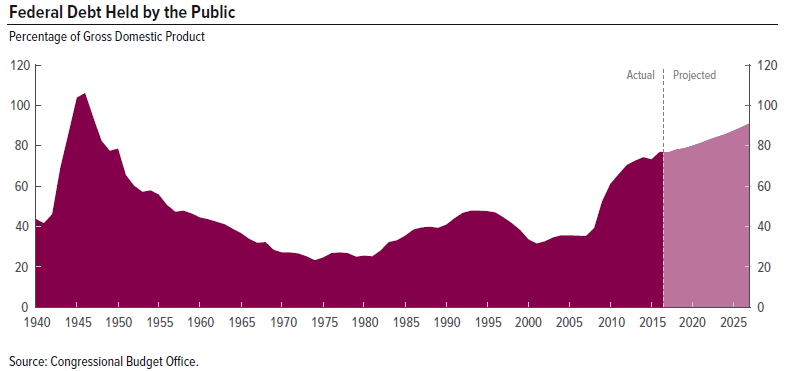
Unfortunately our national leaders have collectively lost a sense of fiscal responsibility in recent years.  Looking at the standard debt chart (above) produced by the Congressional Budget Office, it is clear that indifference to debt commenced under President Reagan and has waxed and waned ever since.  The debt has been growing especially fast ever since the Great Recession in 2008 and now stands at 77% of GDP, the highest since the end of WWII.  Shrinking the debt (as a percentage of GDP) is now America’s most urgent problem.


As I have discussed before, it is the entitlement programs of Social Security, Medicare and Medicaid, as well as interest payments on our increasing debt which will continue to worsen the debt problem in the coming years  without strong corrective action.
All entitlement programs need to be reformed to impose cost control. Right now the two healthcare bills in Congress propose that the funding mechanism for Medicaid be changed so that it will be on a fixed (federal) budget from now on, rather than be continued in its current open-ended form.
Medicare is an even more expensive program than Medicaid.  It would be better to fix both of these programs at the same time, but it is better to fix Medicaid alone than to do nothing at all.
It would be even better to replace our employer provided healthcare system with a uniform, but limited, health insurance tax credit for all (including for the self-employed) and to make all of these major changes at the same time.  This would be the fairest way to proceed.

Conclusion. The current GOP plan to curtail healthcare costs could be much improved.  It is only a small step in the right direction.

Follow me on Twitter 
Follow me on Facebook 

The Need to Put Medicaid on a Budget II. Our Growing Debt


Most of the controversy generated by the healthcare bill passed by the House, and the one now being considered by the Senate, concerns the way Medicaid is funded. The current system whereby states are reimbursed by the federal government for a percentage (national average 53%) of their Medicaid expenses would be replaced by putting the federal contribution on a strict per-capita basis, indexed to the annual rate of inflation.
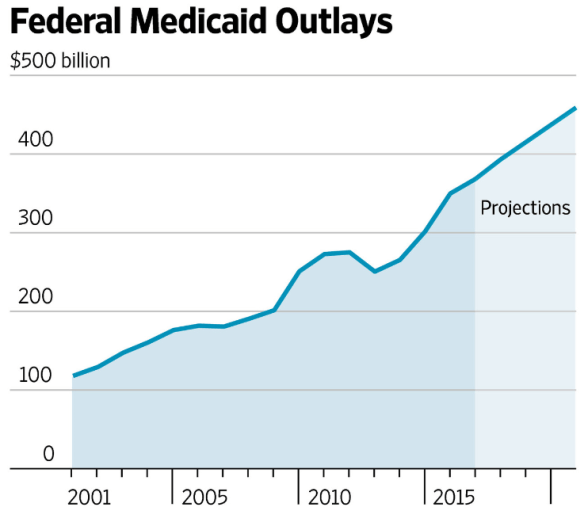
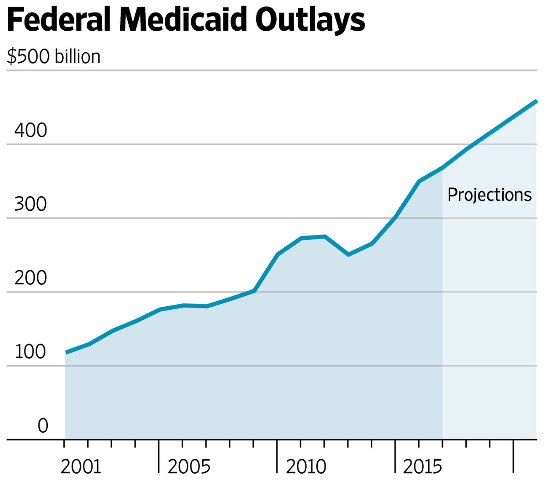
Medicaid is a vast program now serving 73 million low-income and disabled Americans and is doing a good job especially for the elderly and the disabled with special needs. But it costs the federal government nearly $400 billion per year and the cost is growing rapidly.  It is essential to get open-ended Medicaid spending under much better control and one good way to do this is to put the federal contribution on a fixed budget.


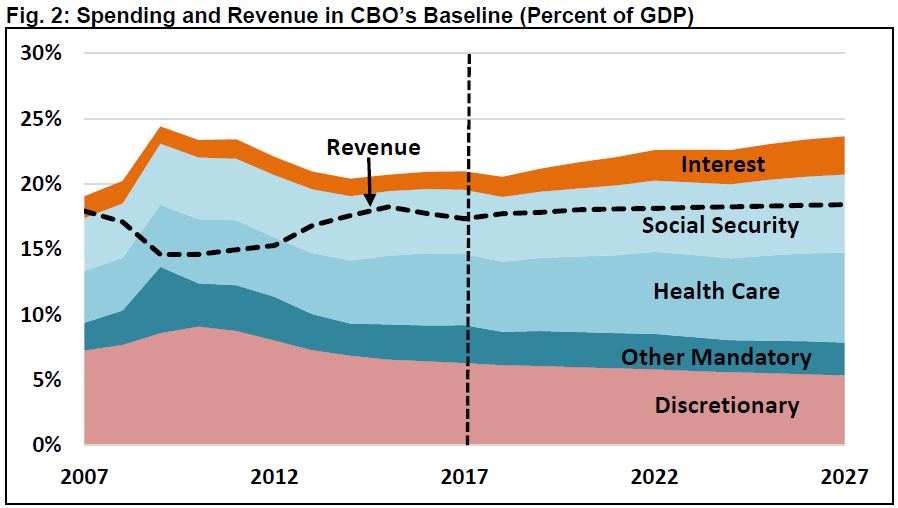
The Congressional Budget Office has just issued its latest Budget and Economic Outlook report.  It shows the ever-worsening fiscal condition for the U.S., unless current policy is changed.


For example:

  • The deficit for 2017 is predicted to be $693 billion or 3.6% of GDP.
  • Deficits will grow dramatically over the next decade with trillion dollar deficits returning by 2022.
  • Debt held by the public (on which interest is paid) will grow by $11.2 trillion between now and 2027, from $14.3 trillion today.
  • Spending will grow from 20.9 percent of GDP in 2016 to 23.6 percent in 2027, while revenues will rise from 17.8 percent in 2016 to 18.4 percent by 2027.
  • The vast majority of spending growth over the next decade (83%) is the result of rising costs for health care, Social Security, and interest on the debt.

    Conclusion.  
    The national debt is growing much too fast. The only way to turn this dangerous situation around is to reform all entitlement programs, including Medicaid, to get their costs under much better control.
Follow me on Twitter: https://twitter.com/jack_heidel
Follow me on Facebook: https://www.facebook.com/jack.heidel.3

The Need to Put Medicaid on a Budget

The GOP healthcare plan, both the House version and the Senate version, are highly imperfect. Yet they each do one thing which is badly needed. They put Medicaid on a budget. The current open-ended Medicaid program, whereby each state is reimbursed by the federal government for a percentage of its costs (the average is 53%), would be replaced by an annual per-capita payment which would increase only at the rate of inflation. It is estimated that the new per-capita budget would reduce federal Medicaid payments by about 25% after 10 years.


In order to get the federal debt under control, all three major entitlement programs, Social Security, Medicare and Medicaid, must be reined in and the current GOP plan would start doing this for Medicaid.
Reining in spending like this will force states to alter the way they regulate and administer Medicaid and the New York Times columnist Ron Lieber points out some of the challenges which will arise if Medicaid has to operate more efficiently:

Nursing homes. One third of people who turn 65 will eventually end up in a nursing home. Furthermore, 62% of nursing home residents cannot pay for nursing homes on their own. The average annual cost of a semi=private room is $82,000.
Home and community-based care. Medicaid is required to pay for nursing homes and may also pay for home and community-based care which is much less expensive and lets seniors stay in their own homes.
Optional services for low-income people and the disabled. Optional services besides long-term home care include dental care for adults, therapy for disabled children at school, prosthetic limbs and prescription drugs.

Conclusion. Changing Medicaid from open-ended funding to a strict federal budget which grows at the rate of inflation will put a large burden on state Medicaid administrators and require some difficult tradeoffs to control spending. But this is absolutely essential as a first step towards controlling the rapid increase of entitlement spending.

Follow me on Twitter:
Follow me on Facebook:

Can the GOP Produce on Healthcare?


The House of Representatives, after much struggle, was finally able to pass a healthcare bill, The American Health Care Act.  Now it’s the Senate’s turn to pass its own version and it, too, is turning out to be a struggle.


The healthcare policy expert, Avik Roy, considers the Senate bill to be a huge step forward:


  • Medicaid is finally put on a budget with annual increases in spending, starting in 2025, tied to the overall rate of inflation. In return, states will gain substantial latitude to use funds more effectively and efficiently.
  • Tax Credits in the Senate bill are means adjusted and will also encourage younger people to enroll for coverage. This is an improvement over the AHCA.
  • Expanded coverage. Mr. Roy predicts that passage of the Senate bill would increase (not decrease as the CBO predicts) the number of Americans with health insurance five years from now. This will result because the near poor in states like Texas and Florida, which have not expanded Medicaid, will be eligible for the new means-tested tax credits.
  • The 10th Amendment is strengthened because so much more authority for regulating healthcare insurance is transferred to the states. This represents huge progress because states are so much more fiscally responsible than the federal government (they have to balance their budgets)!


Conclusion. There are certainly many imperfections in the Senate bill.  It does nothing to limit tax credits for employer-sponsored insurance.  This is sorely needed to put the overall cost of American healthcare on a sustainable course.  It does nothing to help low income people who struggle with high deductibles (for example, by helping to set up Health Savings Accounts). It also does nothing to rein in the cost of Medicare, such as by introducing means adjusted premiums and allowing Medicare to negotiate lower drug prices.
Nevertheless it is a huge step forward in controlling excessive healthcare costs as well as expanding health insurance coverage to more Americans in a fiscally responsible way.

Follow me on Twitter: https://twitter.com/jack_heidel
Follow me on Facebook: https://www.facebook.com/jack.heidel.3


Is the U.S. Military Big Enough?


An Op Ed in the Wall Street Journal recently by former vice president Dick Cheney and his daughter Liz, “Congress and Obama Depleted the Military,” argues that the Trump budget request of $603 billion for Defense for the 2017 – 2018 FY is not nearly enough to build an adequate U.S. military force.  Furthermore, the Cheneys argue that the Budget Control Act of 2011, which set up the ten year sequestration plan for discretionary budget items, should be repealed.
According to the Cheneys, “Providing for the defense of America is the most sacred constitutional obligation of the U.S. Congress.  If Congress fails in this, no balanced budget, no health-care reform, no tax reform, no entitlement reform will matter.”


The Cheneys are correct that the defense of America is the highest priority of our federal government.  But fiscal responsibility is also a high priority, especially when our public debt (on which we pay interest) now stands at 77% of GDP, the largest it has been since the end of WWII, and rising.
So the real question is: how large should our defense budget be to provide for a secure defense of our national interests?  A recent article in the New York Times  points out that:

  • Our current defense budget of $596 billion is more than the total of the next seven highest defense budgets combined.
  • We have 1.3 million active duty troops with 200,000 deployed in more than 170 countries.
  • The U.S. has 2,200 fighter jets, 193 of which are fifth generation, F-35 Lightening II aircraft.
  • The U.S. Navy has 275 surface ships and submarines, including 11 aircraft carriers, far more than any other single country.

Conclusion. The current U.S. military force is large and diversified. In fact there is strong evidence that it could operate more efficiently.  It is more than adequate to defend our crucial national interests.

Follow me on Twitter 
Follow me on Facebook 

Redesigning the American Health Care System to Lower its Cost II. Medicare


By far the biggest problem our country faces is long term debt. The public debt (on which we pay interest) is now 77% of GDP, the highest since the end of WWII, and steadily growing worse.  The fundamental driver of our debt problem is the cost of healthcare, public and private.
My last post describes two major reforms which are needed to get the cost of healthcare under control. The first, and most important, is to replace the tax exemption for employer provided care by a universal tax credit limited to the cost of catastrophic health insurance (with a high deductible).  This fundamental change would be accompanied by allowing tax preferred Health Savings Accounts for use in paying routine medical expenses.  The purpose here is to make all of us more responsible for the cost of our own healthcare.


The second big change which is needed is a

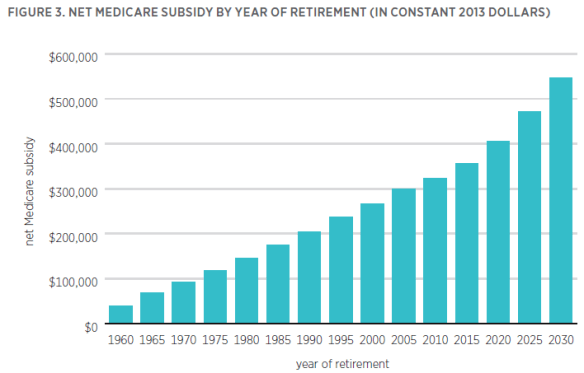
  • Redesign of Medicare. Medicare is currently being subsidized by the federal government at a net cost (after FICA taxes and premiums paid) of over $400 billion per year, and this cost will continue to increase rapidly without a change in policy.

The best way to reform Medicare is to first modify the tax exemption for employer provided care, as mentioned above, and then gradually migrate Medicare onto this new system.  However, in the meantime there are more direct ways to make Medicare less expensive:

  • Community-rated premiums. Medicare premiums should not vary based on age or health status but they should vary based on an enrollee’s income.
  • Defined contributions and beneficiary choice. Enrollees would apply the government contribution to their choice among competing options for Medicare coverage.
  • Facilitating healthcare savings. Tax-preferred Health Savings Accounts would be made available to Medicare enrollees to pay for routine medical expenses up to a deductible amount.

Conclusion. The current Medicare program is rapidly becoming too expensive for the federal government to fund with general tax revenues. A few simple and sensible changes will put Medicare on a sustainable course.

Follow me on Twitter 
Follow me on Facebook