Do Charter Schools Improve K-12 Education?


President-elect Donald Trump has nominated a charter school advocate from Michigan, Betsy DeVos, to be his Secretary of Education. This raises the obvious question, do charter schools improve K-12 education? A recent study by Stanford University’s Center for Research on Education Outcomes (CREDO) suggests that they do in general, although very unevenly.

capture86
As summarized and elaborated upon by the Economist, here are the results:

  • Charter schools work well for low-income children in cities. In 41 urban areas (see map), students learned 40 more days of math and 28 more days of reading every year on average. Black and Hispanic children performed especially well. Where they have worked well such as in Boston, New York City and Washington D.C., students make gains up to 100 days per year.
  • One lesson learned is that autonomy needs to be coupled with accountability. When charter schools expand with little oversight, as in Arizona, results can be worse than in regular schools.
  • A second lesson is that leadership matters. Business practices such as performance tracking and incentives achieve better test scores. A successful charter organization such as KIPP (Knowledge is Power Program) opens new school only when it spots a leader capable of running it.
  • A third lesson is how to scale up the type of education provided by the best charters. These have five qualities: frequent feedback for teachers, tutoring, longer school days and terms, effective use of data to track student progress, and a relentless focus on academic achievement.

Conclusion. Charter schools are a valuable state and local educational option. Many charters are succeeding very well and the factors which lead to success are increasingly well understood. At the very least the competition created by charter schools leads to better performance by public schools. The answer to the question in the title is yes!

Follow me on Twitter
Follow me on Facebook

Trump’s Cabinet Choices Bode Well for the Economy


President-elect Donald Trump made faster economic growth one of his major campaign themes and the direction of Trumponomics is already beginning to take shape.  His major cabinet choices so far auger well for the fundamental changes which are needed to speed up economic growth:
capture64

  • Steven Mnuchin for Treasury. Mr. Mnuchin says that “the number one problem with Dodd-Frank is that it is way too complicated and cuts back lending.” Making loans is “the engine of growth to small- and medium-sized businesses.”  He also believes that 3% – 4% GDP growth is possible with tax and regulatory reform.
  • Tom Price for Health and Human Services. Mr. Price has some excellent ideas for getting American healthcare straightened out, in order to make it more consumer-oriented as well as less costly for individuals, businesses and the government (i.e. the taxpayers).
  • Scott Pruitt for the Environmental Protection Agency. Mr. Pruitt is a lawyer who has fought EPA overreach as the Attorney General of Oklahoma. Mr. Pruitt will end up improving the environment because “he will make sure that the rules issued by the EPA are rooted in law and thus won’t be overturned in court.”
  • Betsy DeVos for Education. Ms. DeVos, a school reformer from Michigan, is a strong supporter of vouchers and charter schools. K-12 school reform is absolutely essential to better prepare low-income and minority students for the high tech and global economy which awaits them after graduation.
  • General James Mattis for Defense and Senator Jeff Sessions for Attorney General are also excellent choices for strengthening America’s national security and moral fabric.

Conclusion. I have been advocating fundamental changes in fiscal and economic policy for years now and, thanks to the election of Donald Trump, things are moving rapidly in this direction. It is a good time to be optimistic about the future of our country.

Follow me on Twitter
Follow me on Facebook

The Trump Trade Agenda


Trumponomics is taking shape: tax reform, regulatory reform and infrastructure spending.  The likelihood of President-elect Donald Trump and Congress working together on these major initiatives is so great that the dollar and the U.S. stock market are surging. This complicates the Trump trade agenda:

  • The yuan is now being driven down against the dollar.  China will face even more pressure to devalue in the year ahead as the U.S. Federal Reserve raises interest rates and the dollar continues to strengthen. Stronger U.S. growth will also increase the demand for Chinese goods, making our trade deficit with China even greater.

    capture85

  • One way to increase U.S. manufacturing employment is to figure out how to train workers for the 334,000 manufacturing jobs which are now vacant.  Wages are stagnant is America today not because we have too few taxes and restrictions on international trade but because we have too many taxes and restrictions on domestic trade here at home.
  • When the U.S. entered the North American Free Trade Agreement, Mexican taxes on U.S. imports fell from 12.5% to zero, Canadian taxes fell from 4.2% to zero and U.S. taxes on Mexican and Canadian imports fell from 2.7% to zero.  In other words, NAFTA improved America’s competitive position.
  • Pro-growth economic policies are the key to higher wages From 1900 to 2000 employment in agriculture declined from 41% of the workforce to 1.9%. But the number of jobs in the country rose fivefold and average real income rose eightfold. All because of pro-growth economic policy. The same thing can happen again with respect to manufacturing employment in the 21st century.
  • Eliminating direct currency manipulation and special interest provisions in existing trade agreements will benefit American workers, raise world living standards and reinforce the impact of Mr. Trump’s primary recovery program.

Conclusion. Restricting international trade won’t bring back high-paying manufacturing jobs. But faster overall economic growth will create more jobs and better paying jobs as businesses have to compete more vigorously for qualified employees.

Follow me on Twitter
Follow me on Facebook


Trumponomics Is Taking Shape


As the readers of this blog well know, I am very concerned about the fiscal and economic direction our country has been taking in recent years. I voted for Hillary Clinton in the 2016 presidential election because of Donald Trump’s crude and sleazy behavior.  However we need basic change in the U.S. and Mr. Trump is clearly a change agent.
As the new Trump administration begins to take shape, here is what I see happening:

  • Treasury Secretary designee, Steven Mnuchin, says that tax cuts for both upper-income and middle class taxpayers will be offset by “less deductions that pay for it.”  Revenue neutral tax rate cuts will increase both consumer and investment spending, without increasing our debt, and will give the economy a huge boost.
  • Health and Human Services Secretary designee, Rep Tom Price, is an expert on health-care and wants to replace the Affordable Care Act with a new healthcare program which provides more consumer choice at a much lower cost.

    capture83

  • The Great Rebuilding Infrastructure investment is needed but it should be accomplished with a lower corporate tax rate and repatriated profits of multinational corporations to avoid increasing the deficit.
  • Holdback on excessive fiscal stimulus.  With the unemployment rate down to 4.6%, a dollar which has already appreciated 40% since 2011, and tax cuts on the way, inflation and higher interest rates are in the offing. Let’s not overdo it.

    capture84

  • Living on borrowed time.  As shown in the above chart, interest rates are very, very low and are likely to rise significantly in the near future. When this happens, our massive public debt (on which we pay interest) of 76% of GDP will become very expensive to service. Ouch!


Conclusion.  One can see a Trump agenda emerging which has the potential to be very successful if it is coupled with overall spending restraint.

Follow me on Twitter
Follow me on Facebook

Getting American Health Care Straightened Out II. Medicare


One of the major problems facing the United States today is the high cost of healthcare. We spend almost 18% of GDP on healthcare, both public and private, almost twice as much as any other developed country.  A big reason for the high cost is the low out-of-pocket consumer spending on health services in the U.S. 
My last post discusses a general plan, involving catastrophic health insurance and health savings accounts, for getting the overall cost of healthcare under control.

capture82Once we have a handle on the overall problem, we then need to focus on the cost of the Medicare entitlement program for retirees.  The problem here is easy to understand.  In just 15 years enrollment in Medicare will increase to over 80 million beneficiaries from 57 million today.  Likewise there are 3.1 workers per beneficiary today and there will be only 2.4 in 2030 (see above chart).

capture4
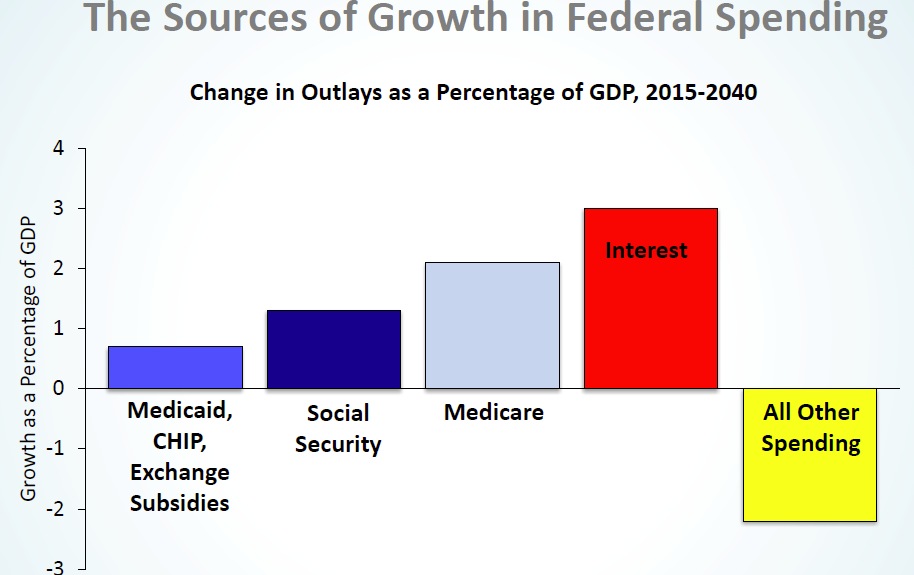
The second chart demonstrates that Medicare will be the major component of increases in federal spending in the coming years (with the other entitlements of Social Security and Medicaid following right behind).
So the question is: how do we control Medicare spending within the context of overall health-care reform?  Here is a proposal from James Capretta of the American Enterprise Institute:

  • Medicare recipients would receive fixed payments toward the coverage option of their choice, based on their age, income and health status. The traditional Medicare program would be one of the choices. Enrollees choosing less costly coverage options would see a reduction in their premiums.
  • Premium payments would be comparable to subsidies and tax credits received from the reformed Affordable Care Act.
  • Privately run managed care plans provide benefits at far less cost than traditional Medicare. Beneficiaries would share in the savings.

Conclusion. It needs to be emphasized as strongly as possible that the point of Medicare reform is to lower costs to both individuals and the government, sa that Medicare can be preserved indefinitely into the future.

Follow me on Twitter
Follow me on Facebook

Getting American Health Care Straightened Out


Donald Trump was elected to be our next president because of the huge desire for change amongst the American electorate. Many things need changing, but among the most important is our healthcare system.  The problem is that we are spending 18% of our GDP on healthcare, twice as much as any other developed country.  The Affordable Care Act has increased access to healthcare but does very little to hold down costs.  This is one reason why it is so unpopular and needs to be substantially modified.
capture10President-elect Trump has nominated Representative Tom Price (R, Ga) to head up Health and Human Services in his cabinet.  Rep. Price is an expert on healthcare and is a leading advocate for replacing the ACA with something more workable.  He will soon be in position to lead the charge for healthcare reform.
The two American Enterprise Institute scholars, James Capretta and Scott Gottlieb,  have some good ideas for what needs to be done.

  • Provide a path to catastrophic health insurance for all Americans. The idea is that all Americans who do not get health insurance through employers, or Medicare or Medicaid, should be eligible for a refundable tax credit sufficient to pay for a basic level of catastrophic (i.e. with a high deductible) insurance coverage.
  • Accommodating people with pre-existing health conditions. Everyone who maintains continuous (catastrophic, as above) coverage would be allowed to move from employer coverage to the individual market without facing exclusions or higher premiums based on health status.
  • Allow broad access to health-savings accounts. There would be a one-time federal tax credit to encourage all Americans to open an HSA to pay routine medical bills. Families typically spend up to 22% less on healthcare after switching to an HSA.
  • Deregulate the market for medical services. Providers need freedom from regulation to provide packages of services better tailored to people’s needs. Such provider flexibility will further reduce costs through additional marketplace competition.

Conclusion. The major reason why our healthcare is so expensive is because we, as individuals, don’t have enough “skin in the game,” in the sense of paying for routine medical expenses directly out of our own pockets. The reforms outlines above would correct this very problem.

Follow me on Twitter
Follow me on Facebook

What to look for in President Trump’s First Budget


As a new administration prepares to take office in January, one of the key indicators of President Trump’s approach to government will be his first budget. This is especially true since the Republican controlled Congress is likely to take a Republican President’s budget seriously.

capture79
One of our nation’s chief fiscal watchdogs, the Concord Coalition, has summarized the most important things to look for:

  • What is the overall fiscal target? President Obama’s recent budgets have aimed at stabilizing the debt as a share of the economy. House Republicans have aimed for a more ambitious goal of balancing the budget within ten years, gradually reducing the debt as a share of the economy. What path will Mr. Trump recommend?
  • What specific tax cuts will be proposed and what are the likely revenue effects? During the campaign Mr. Trump proposed tax cuts amounting to $5.9 trillion in revenue loss over ten years. Even with dynamic scoring, taking the stimulatory effects of his tax cuts into effect, the revenue loss is still $3.9 trillion over ten years. Such huge revenue losses will make our debt much worse than it is already and won’t be approved by Congress.
  • What will the budget recommend for the federal debt limit? Currently the debt limit is suspended until March 16, 2017 when it will return at whatever level it is on that date. Congress will then have several months to reset it. Whatever the President recommends will send a strong signal, positive or negative, to the financial markets.
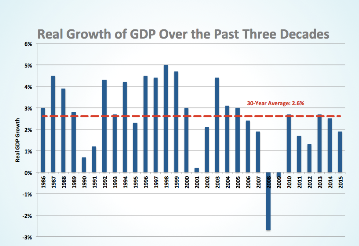
  • What economic growth rates will the budget assume?   GDP growth has averaged 2.6% for the past 30 years. Any predicted long term growth rate higher than this will lack credibility without strong justification.

Conclusion. Mr. Trump has the opportunity to institute the change in course which so many Americans would like to see. His first budget will set the tone and provide an important clue as to whether or not he is serious about doing this.

Follow me on Twitter
Follow me on Facebook


The Republican Way Forward: Restoring Constitutional Order


We have a pretty good idea of what President-elect Trump’s priorities are:

  • Faster Economic Growth, accomplished with tax and regulatory reform, to create more jobs and higher paying jobs for the blue-collar middle class.
  • Rethinking NAFTA and TPP to make sure that American companies and workers are not being penalized by unfair trade agreements.
  • Immigration Reform to make sure that law-breaking illegal immigrants are deported and then figuring out some sort of legal (guest worker?) status for the remainder.

What remains to be determined is the role of Congress under the new administration. Utah’s Senator Mike Lee makes a very strong argument that one of the biggest problems with American government is the weak authority of Congress in recent years and the need for Congress to reassert itself.

capture11
With a new president who is more populist than partisan, now is an excellent opportunity for Congress to do exactly this. Here is what Congress should do:

  • Reinstitute annual budgeting and appropriations for executive branch agencies. This is essential for controlling how the funds are spent.
  • Pass new legislation for healthcare, tax reform, immigration policy and financial regulation, giving up lazy policy delegation to the executive branch and relearning the art of legislating and collective choice.
  • Cry foul if President Trump tries to settle these and other momentous matters through Obama-style executive decrees without legislative input.

Conclusion. Our system needs the disruption which Donald Trump will provide and that is why he got elected.  But at the same time Congress has a golden opportunity to restore its prerogatives which have withered away in recent years.  It would be a shame if Congress doesn’t take this golden opportunity to get this done.

Follow me on Twitter
Follow me on Facebook

The Importance of Shrinking Our Debt and How to Do It


President-elect Donald Trump is on record as favoring tax and regulatory reform in order to speed up economic growth and I have made it clear that this can be accomplished without increasing our debt.
But what is really needed is to grow our economy faster and actually shrink our debt at the same time.  It will be very difficult, essentially impossible, to accomplish this with growth alone or even by raising taxes because the magnitude of our debt, 76% of GDP and rising, is so great.

capture70
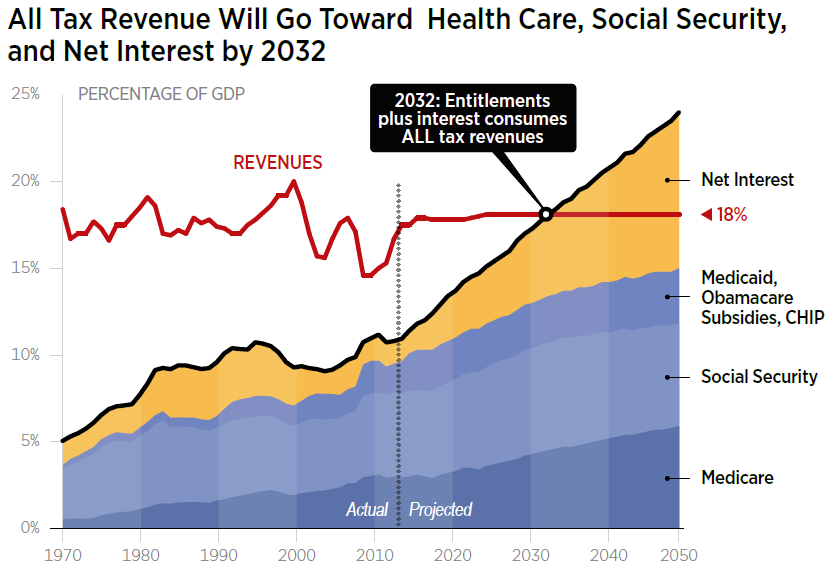
There is really only one way to begin to shrink the debt and this is to get entitlement spending under control.  The above chart shows that, without major changes, by 2032 all tax revenue will go towards healthcare, Social Security and net interest. Here is what needs to be done:

  • Social Security is already paying out $100 billion per year more than it collects in payroll taxes. Its Trust Fund will run dry in 15 years unless major changes are made and all benefits will drop by about 25% when this happens. We need to either increase the eligibility age for full benefits and/or raise the income cap on payroll taxes. These changes can be phased in but the sooner we get started the less painful it will be.
  • Medicare is an even bigger problem than Social Security. Either we have government rationing, i.e. “death panels,” or else rationing by price meaning some form of premium support. This simply means that we will all have more “skin in the game,” in the sense that we will all have a financial incentive to minimize our own healthcare expenses.
  • Medicaid should be block granted to the states so that the federal government is not obligated to a fixed match for all state Medicaid expenses. Again, cost control is the object of such a change.

Conclusion. It needs to be emphasized as strongly as possible that the reason for stringent cost control of entitlement programs is to preserve them for posterity, not destroy them.  Our prosperous way of life is severely threatened by our unwillingness to recognize this problem.

Follow me on Twitter
Follow me on Facebook


Can the Economy Grow Faster without Increasing Our Debt?


As I have been saying over and over on this blog for several years, America’s two major fiscal and economic problems are:

  • Slow Economic Growth, averaging just 2% since the end of the Great Recession in June 2009.
  • Massive Debt. Our public debt, on which we pay interest, is now $14 trillion or 76% of GDP, the highest it has been since the end of WWII.

President-elect Donald Trump campaigned on the issue of slow economic growth and will surely work with the Republican Congress to institute various tax and regulatory reform measures needed to speed up growth.

capture15But during the campaign Mr. Trump also introduced a specific tax reform plan which would lead to an estimated $4.4 trillion in new debt over the next ten years. Such a very large amount of new debt is highly undesirable and hopefully will be rejected by Congress.
In fact, as described by the Tax Foundation, there are some very good ways to use tax reform to improve growth without increasing debt. Fox example:

  • Allowing the full and immediate expensing of capital investments will grow the economy by 5.4% at a cost of $881 billion over ten years.
  • Lowering the top corporate tax rate to 20% will grow the economy by 3.3% at a cost of $718 billion over ten years.
  • Eliminating all itemized deductions except the charitable and mortgage interest deductions will slow economic growth by only .4% and increase tax revenue by $2,268 billion over ten years.

Conclusion. Just these three specific tax reform measures would grow the economy by about 8% while producing $600 billion in new tax revenue over a ten year period.  There are other ways as well of achieving similar growth and revenue levels.  The point is that the changes our country needs can be accomplished without increasing the national debt and perhaps even reducing it instead.

Follow me on Twitter
Follow me on Facebook