A Vivid Example of Fiscal Irresponsibility at the Federal Level


An article in the Friday, August 14 edition of the Omaha World Herald, “Why are the BRT stations so expensive? Officials explain the $260,000 price tag,“ describes a new $30 million bus rapid transit plan for Dodge Street with 27 individual sleek, modern bus stop shelters along the route at a cost of $260,000 each.  Half of the new $30 million plan will be paid for by the city of Omaha and half by the Federal Transit Authority which has an annual budget of $8.6 billion.
Capture1 The issue is not whether Omaha should spend $15 million in local funds to achieve a $30 million bus system upgrade. We can expect city officials to make a responsible decision on this matter. The real issue is why the FTA should have annual budget of $8.6 billion to begin with when it is paying for, and therefore encouraging, extravagantly designed bus transit systems all over the country.
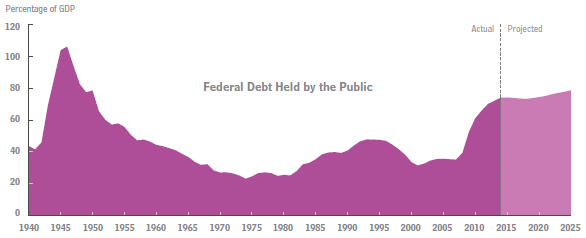
CaptureThe U.S. deficit for the 2015-2016 budget year, ending on September 30, is predicted to be about $450 billion dollars. This adds to the approximately $13 trillion public debt (on which we pay interest) which, at 74% of GDP, is the highest it has been since the end of WWII (see the above chart from the Congressional Budget Office).
It is the responsibility of Congress and the President to figure out how to get the budget under better control. All aspects of federal spending can and should be tightened up, including entitlements (Social Security, Medicare and Medicaid) and discretionary spending (everything else).
The Federal Transit Administration is wasting money on unnecessarily extravagant bus transit systems. Such fiscal irresponsibility means that its budget should be cut significantly. Many other similar examples exist in the federal government. We need people in Congress who can identify these fiscal boondoggles and effectively agitate for needed cutbacks.
How to Avoid a New, and Much Worse, Financial Crisis


Is it possible for the U.S. to effectively address its enormous debt problem in today’s contentious political environment? Two weeks ago I discussed in “America’s Fourth Revolution” why the political scientist James Piereson thinks this is impossible. He is very persuasive but I think he is too pessimistic.
CaptureSince then I have discussed several different things we should do to turn around this perilous situation:

  • If spending for just Medicare and Medicaid (two very expensive entitlement programs) alone fell by 25% over ten years, as a percentage of GDP, and then stayed in line with GDP after that, the U.S. would actually have a budget surplus in 2040.
  • Just recognizing the magnitude of our debt problem would do wonders in public awareness.
  • If the Tea Party were able to grow beyond a protest movement and unite the country behind a majoritarian agenda of work, mobility and opportunity, it would be much more effective in achieving its fiscally conservative goals.
  • Another significant way to save money, and get better results at the same time, is to turn over more and more programs to the states. A good way to do this is with block grants to the states for federal programs in such areas as welfare, education and Medicaid. This would give the states more flexibility to get the job done in an efficient and cost saving manner.

What we need to do to turn our debt situation around is to greatly shrink our annual deficits below their current level of about $450 billion per year. If the debt is growing slower than the economy, then it will shrink as a proportion of the economy. This is what happened after WWII (see above chart) and it needs to happen again now!

Perfecting Our Union: Ending the War Against the States


“The powers not delegated to the United States by the Constitution, nor prohibited by it to the States, are reserved to the States respectively, or to the people.”                                                 The Tenth Amendment to the U.S. Constitution

As the readers of this blog know, I am very concerned about our massive (public) debt, now at 74% of GDP, the highest since the end of WWII. One way to get federal spending under better control is to give more power back to the states (which are required to balance their budgets), as described by Adam Freedman in his new book “A Less Perfect Union: the Case for States Rights.”
CaptureHere are some of the many advantages of doing this, according to Mr. Freedman:

  • Better schools, roads and infrastructure, as states are freed from wasteful federal mandates. The Common Core, for example, should be considered as federal guidelines and not as an attempt to require a specific curriculum.
  • Lower taxes, as states engage in a virtuous competition for citizens and businesses.
  • Improved stewardship of natural resources, as decisions reflect local priorities on land use.
  • Less crowded prisons, by returning criminal jurisdiction to the states, where penal reform is light-years ahead of Washington.
  • An end to national gridlock, as the most divisive social issues devolve to state and local decision-makers. A good example here is the current interest by states and localities to enact their own minimum wage laws. This is far superior to raising the national minimum wage law in a one-size-fits-all manner.


The way to implement a program of giving responsibility back to the states is with block grants. A plan to do this for social welfare programs was formulated by the House Budget Committee just one year ago. It is often suggested to do something similar with federal education programs and with Medicaid as well.
Moving programs back to the states will improve their quality and help get costs under much better control. It makes much sense to move in this direction!

The Future of the Tea Party


As I constantly remind the readers of this blog, America has huge fiscal and economic problems which need to be addressed right away. In a recent post, “America’s Fourth Revolution,” I described the pessimistic view of the political scientist, James Piereson, that our polarized and dysfunctional political system will not be able to successfully confront our stagnant economy and massive debt and establish a pathway to recovery.
CaptureThe president of the American Enterprise Institute, Arthur Brooks, does see a way for this to happen as explained in his new book, “The Conservative Heart: how to build a fairer, happier and more prosperous America.” It is the Tea Party which could do this! Its “future relevance depends on whether it can shift from being a protest movement to becoming a social movement.”
According to Mr. Brooks there are four steps to making the transition from minority to majority and turning a protest movement into a broad-based social movement. They are:

  • Launch a rebellion
  • Declare majoritarian values
  • Claim the moral high ground
  • Unite the country behind an agenda

These were the steps taken by our own founding fathers over two hundred years ago and by the civil rights movement some fifty years ago. The Tea Party has already launched a rebellion against big government, taxes, spending, etc. Now it needs to take the second step of declaring its support for the majoritarian values of work, mobility and opportunity. The third step is to seize the moral high ground:

  • Too many Americans have been marginalized and left behind in recent years.
  • It is neither fair nor compassionate to content ourselves with an economic recovery that only accrues to top earners.
  • Obamacare is hurting too many people by forcing them out of full-time work and into part-time work.
  • Huge debt may require spending cuts that fall the hardest on the poor.
  • We need education reform, especially in big cities, because the welfare of poor kids is more important than job security for poor teachers.

The Tea Party should spend less time protesting big government and more time showing how conservative principles help the most vulnerable members of society!

Prominent Myths about Our National Debt


As the 2016 presidential election contest begins to heat up, the Committee for a Responsible Federal Budget and its outreach arm, Fix the Debt, have issued a new “Fiscal FactChecker: 16 Budget Myths to Watch Out For in the 2016 Campaign.”  Here are four of the major myths:

  • We Can Continue Borrowing Without Consequences. “Low interest rates are a temporary consequence of the struggling global economy and near term Federal Reserve actions – not a permanent fixture.”

    Capture4

  • There is No Harm in Waiting to Solve Our Debt Problems. “The longer policy makers wait to control debt, the more difficult it will become. For example, reducing debt to around the historical average of about 40% of GDP by 2040 would require tax increases or spending cuts of about 2.6% of GDP per year, if enacted today, or starting at $1,450 per person per year. Waiting a decade to begin would require adjustments of over 4% of GDP.”
  • Deficit Reduction is Code for Austerity, Which Will Harm the Economy. “Most advocates of fiscal responsibility in the U.S. have called for gradual reductions in long-term deficits so that the debt grows slower than the economy. These changes tend to have minimal near-term effects as well as the potential to significantly grow the size of the economy over the long term.”
  • We Can Fix the Debt Solely by Taxing the Top 1%. “The top 1% of earners, households that make at least $450,000 annually, earn a substantial share of national income, about 13% on an after tax basis, and further tax increases on this group could help. But these increases would need to be combined with reductions in spending growth and/or broader tax increases to fully address the nation’s fiscal challenges.”

Just a few days ago, I described a persuasive argument, “America’s Fourth Revolution,” that our hyper-partisan and dysfunctional political system will be unable to rectify our debt problem until we have another and much more severe financial crisis. The above discussion of budget myths from CRFB actually suggests a way forward to solve our debt problem.
We have a choice. Which path will we take?

Higher Ed: Higher Costs, More Inequality. What to do?


Several months ago I discussed “How the American Education System Contributes to Inequality.” It so happens that students from high-income families graduate from college in much greater numbers and also with much less debt, compared with students from low-income families.
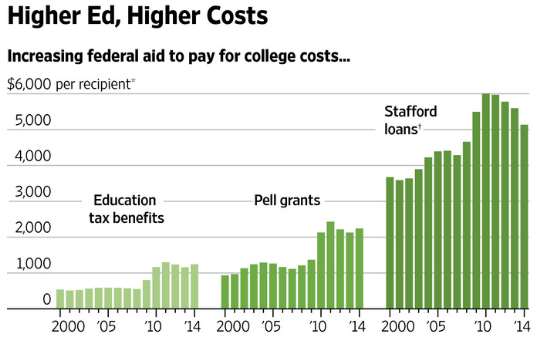
CaptureA new study from the New York Federal Reserve has found a connection between a rapid increase in student aid in recent years and the rapid increase in college costs. In particular:

  • A $1 increase in the subsidized loan cap leads to a tuition increase of 65 cents, and
  • A $1 increase in the Pell Grant limit leads to a tuition increase of 55 cents.
  • Furthermore, private schools, both nonprofit and for-profit, are bigger offenders than public schools, even though declining state subsidies for higher education primarily affect public universities.
  • At the present time undergraduates can borrow a maximum of $57,500 from the federal government.
  • Under the decade-old Grad Plus program, graduate students can borrow any amount their school charges. In the seven years before Grad Plus, undergraduate tuition was rising faster than grad school costs. In the seven years after, the reverse occurred.
    Capture1Clearly this is an untenable situation. The solution, in my opinion, is to strictly limit the total amount of federal loans for both undergraduate and graduate students and force schools to compete on price. For example:
  • Limit the total amount borrowable by an undergraduate, from the federal government, to $30,000, the average amount borrowed today, and then let it adjust it each year for inflation.
  • Limit the total amount borrowable by a graduate student to $60,000, the average amount borrowed today, adjustable each year by inflation.
  • Students who want to borrow additional funds may do so on the private market, with no subsidies or guarantees provided by the federal government.

Such a program would provide much needed financial discipline to colleges and universities and reduce and stabilize ballooning student loan costs for the federal government.

Can America’s “Fourth Revolution” Be Avoided?


My last post, “America’s Fourth Revolution,” presented a persuasive argument by the political scientist, James Piereson, that our currently dysfunctional political system will be unable to solve our most fundamental problems of massive debt, accompanied by a rapidly aging population and slowing economic growth. This will result, according to Mr. Piereson, in a severe crisis leading to a fourth revolution, overthrowing the New Deal liberal consensus which has prevailed since 1932.
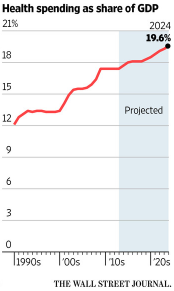
It is commonly understood that entitlement spending: Social Security, Medicare and Medicaid, is the main driver of our rapidly growing national debt. A recent report from the Centers for Medicare and Medicaid Services, summarized in the Wall Street Journal, shows that U.S. healthcare spending is likely to rise from just under 18% today to 19.6% of GDP in 2024.
Capture2Barron’s editor, Thomas Donlan, has just reported that the Director of the Congressional Budget Office, Keith Hall, stated in a recent hearing of the Senate Budget Committee that if spending for Medicare and Medicaid, as a percentage of GDP, fell by 25% over ten years, and then stayed in line with GDP after that, the U.S. would have a budget surplus of 2% of GDP in 2040 instead of the otherwise projected deficit of 6.6% of GDP. Furthermore debt held by the public would fall to 24% of GDP, a remarkable achievement.
This is significant because one country, The Netherlands, spends 12% of GDP on healthcare, and every other country in the world (except for the U.S.) spends less than 12%.
Conclusion: all the U.S. needs to do, so to speak, is to bring healthcare costs in line with the rest of the world and our entire deficit spending problem would be solved! Nobody is claiming that this will be easy but it certainly is within the realm of possibility. It is also far superior than waiting to act until we have another fiscal crisis and thus risking a huge change, a revolution, in our way of life.

America’s Fourth Revolution


The Manhattan Institute’s James Piereson has written a fascinating new book, ”Shattered Consensus: The Rise and Decline of America’s Postwar Political Order” in which he argues that the New Deal liberal consensus has broken down and will soon be replaced by a new model containing several specific features. The coming new model will be the result of a Fourth Revolution of comparable scope to the first three:

  • A Democratic-expansionist regime from 1800 until 1860 which dissolved in the midst of the slavery and secession crisis.
  • A Republican-capitalist regime from 1860-1930, which was brought down by the Great Depression.
  • A Democratic-welfare regime from 1932 until the present, although with faltering support after 1980.

America’s third regime is in the process of fading out or collapsing for three reasons:

  • Debt. The national debt of $18 trillion today, at about 100% of GDP, is comparable to the debt at the end of WWII. But once the war ended the government cut spending and stopped borrowing and the U.S. economy grew at 4% for the next 20 years. Nothing comparable to this major debt reduction is in sight today.
  • Demography. Today there are about 160 million people in the U.S. workforce of whom 120 million have full time jobs. The workforce will grow by 1 million per year for the next ten years while the number of people turning 65 will grow at nearly twice that rate. The nation will soon reach a point where 150 million working people will be paying payroll taxes to support 80 million people on Social Security and Medicare. Political leaders are doing nothing to address this looming crisis.

    Capture5

  • Slowing Economic Growth. The chart above shows how the U.S. economy has been slowing since the 1960’s. Since the end of the Great Recession in 2009, GDP has grown at only 2.2% and is likely (CBO) to continue growing indefinitely at this slow rate under current policies. The second chart shows the enormous difference between 2% growth and, for example, even 3% growth over time.

    Capture6Why don’t Congress and the President deal with these problems now, before they reach the point of crisis?   It’s because Congress has become increasingly polarized, with Democrats having moved leftward and Republicans moving rightward. Polarization is characteristic of regimes as they begin to tear themselves apart in conflicts which defy resolution within the existing structure of politics.
    My approach on this blog is that these very severe problems can be solved by politicians working together in a cooperative way. Mr. Piereson makes a very persuasive case that this is not likely to happen and that it will take a huge new crisis, a revolution, to straighten things out.
    I hate to say so but he may be right.

Should the National Minimum Wage Be Raised?


A recent column by David Brooks in the New York Times, “Minimum Wage Muddle,” is a good summary of the pros and cons of raising the minimum wage for the whole country. Mr. Brooks refers to a recent Congressional Budget Office report that a hike in the minimum wage to $10.10 per hour might lift 900,000 out of poverty but would also likely mean a loss of 500,000 jobs.
Capture5As suggested in a recent post, one of the things we could do to get beyond our political dysfunction at the national level is to:

  • Put a greater emphasis on state-centered federalism both to encourage experimentation and innovation in the American system and to remove issues from the national agenda which contribute to division, stalemate and endless controversy.
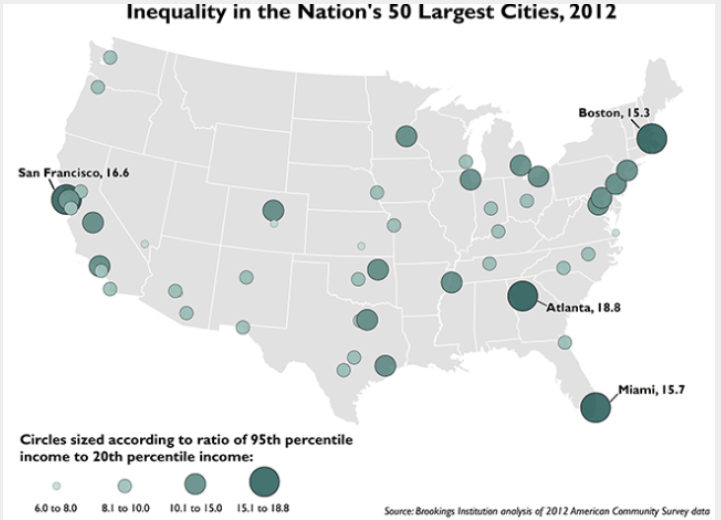
    Capture4Considering that income inequality varies so greatly from one part of the country to another, (see above), it makes a lot of sense to federalize the minimum wage issue. In other words, let cities and states set their own minimum wage levels based on their own local circumstances.
    For example, the state of Nebraska, with very little inequality and where I live, has just raised its minimum wage to $8/hour ($9/hour beginning January 2016). Nebraska’s lowest in the country unemployment rate of 2.6% means that hardly anyone will lose their job.
    As Mr. Brooks says, “Raising the minimum wage will produce winners among job holders from all backgrounds, but it will disproportionately punish those with the lowest skills, who are least likely to be able to justify higher employment costs.”
    Conclusion: raising the national minimum wage is not the best way to address the inequality and fairness issue. A better way is to create more jobs by boosting the economy overall. Then help low wage workers take home more money with a (perhaps expanded) Earned Income Tax Credit. Cities and states can establish their own individual minimum wages however they wish.

Richer and Poorer


As I often remind readers, this blog is primarily concerned with three basic fiscal and economic problems facing the U.S. They are: 1) our stagnant economy, 2) our massive debt, and 3) income inequality. Today I discuss inequality. The March 16 2015 issue of the New Yorker contains an extensive article on this topic by Jill Lapore, “Richer and Poorer.” However it suffers a common defect of only presenting one side of a complex issue.
There are facts about inequality which more people need to be aware of. For example:

  • The scope of income inequality is greatly reduced once incomes are adjusted for government transfers and federal taxes as shown in the following chart from the Congressional Budget Office.
    Capture
  • There is a strong correlation between inequality and growth as shown by the second chart just below from the World Bank.
    Capture2
  • Globalization has had a dramatic effect on incomes world-wide as low skill work has shifted from the developed world to the developing world as shown in the chart below from the Wall Street Journal. Hundreds of millions of people in the developing world have been lifted out of poverty at the cost of lost jobs to low skill workers in the U.S. and other developed countries.
    Capture3Any effective strategy for decreasing income inequality needs to be reality based. Yes, it exists but its severity is exagerated. The Americans who need help the most are the ones unlikely to either attend or graduate from college. What they need most is vocational training to prepare them for the millions of high skill jobs going begging in the U.S.
    The best thing we can do to decrease income inequality in the U.S. is to get our economy growing faster. Since the end of the Great Recession in June 2009, it has grown at the historically slow rate of 2.2% of GDP and this slow rate of growth is predicted (by the CBO) to continue indefinitely under current government policies. A return to the historical 3% growth rate would create jobs and better jobs for millions of the unemployed and under-employed as well as providing bigger raises for the middle class as employers have to compete for qualified workers.
    How can we make the economy grow faster? I have addressed this critical issue many times and will return to it soon.