The Just Approved 2016 Federal Budget II. A Long Term Disaster


I have been writing this blog, “It Does Not Add Up” for three years now.  It deals with fiscal and economic policy at the national level.  Of the many problems in this area, there is one which looms larger than all the others.  It is our out-of-control annual deficit spending which is in turn leading to a rapidly exploding national debt, now roughly $13 trillion or 74% of GDP.
Capture1My last post considers the details of the recently passed 2016 Federal Budget and how it will add $158 billion to the deficit in just 2016 alone.  The Committee for a Responsible Federal Budget estimates that the 10 year total in additional debt will be about $1.7 trillion.
As the above chart shows, such a huge additional debt in just ten years will lead to a total public debt in 2040 equal to 175% of GDP.  Such an enormous debt is obviously unsustainable and will almost surely lead to a new, and much worse, financial crisis long before the year 2040 arrives.
As the chart also shows, we need to be moving in exactly the opposite situation to keep our debt under any semblance of control.  Reducing deficit spending by $2 trillion over the next ten years would serve to “stabilize” the debt at 72% of GDP in 2025.
To actually end deficit spending, and therefore balance the budget, would require reducing the deficit by a total of $5 trillion over ten years.  This is exactly what the Republican Budget Resolution from Spring 2015 proposed to do.  Needless to say, this desirable goal has fallen by the wayside.
The Republicans are promising a fresh start and better process next year.  We can only hope that they are more successful in the new year.

Follow me on Twitter: https://twitter.com/jack_heidel
Follow me on Facebook: https://www.facebook.com/jack.heidel.3

Republican Congress Approves Irresponsible Budget


Congress has adjourned for Christmas having passed a final budget for the 2016 Fiscal Year extending through next September. It puts into place for this year the two year spending agreement reached between Congress and the President in October.  However Congress started out the year by passing a ten year budget plan resolution leading to a balanced budget by 2025.  The budget just passed leads instead to a deficit of $1.1 trillion in 2025.
CaptureHere are the details as described by the nonpartisan Committee for a Responsible Federal Budget:

  • Revenue: decreased under new budget by a $650 billion (over ten years) by making various temporary tax deductions permanent.
  • Discretionary Spending: increased by $50 billion for the current budget year (by breaking the sequester cap).
  • Medicare: instead of saving $430 billion over ten years, Medicare spending is increased by $95 billion over ten years.
  • 2025 Deficit: instead of shrinking to zero in ten years, it is now projected to be more than $1 trillion in 2025.
  • 2025 Debt: currently the (public, on which we pay interest) debt is 74% of GDP. The ten year balanced budget plan would reduce the debt to 56% of GDP. Instead, the debt is now on track to reach 80% of GDP by 2025.

Granted the Republican Congress hopes to develop a tax reform plan in 2016 which would lower tax rates for everyone, paid for by closing many of the loopholes and deductions just approved last week. One very good way to do this has recently been proposed by the Tax Foundation. The TF plan would boost economic growth and thereby increase tax revenue substantially over ten years.
The problem is that real tax reform is unlikely to happen without a Republican president in office.  If a Democratic president is elected in 2016, then the dire predictions made by the CRFB (above) are likely to remain valid for the foreseeable future. Our fiscal and economic future remains quite precarious at the present time!

Follow me on Twitter: https://twitter.com/jack_heidel
Follow me on Facebook: https://www.facebook.com/jack.heidel.3
Debunking Several Social Security Myths


The Committee for a Responsible Federal Budget has just published a new report, “Debunking 8 Social Security Myths on Its 80th Birthday.” Here are several of the “myths” they report on:

  • Myth: Social Security does not face a large funding shortfall. Fact: Social Security’s trust funds are projected to run out of reserves within 20 years. Although the Social Security Trust Fund currently contains $2 trillion, it is being depleted at a rate of close to $100 billion per year. The looming insolvency is a result of the growing costs associated with an aging population.
  • Myth: Today’s workers will not receive Social Security benefits. Fact: Even if policy makers do nothing, the program will still pay about three-quarters of scheduled benefits. Once the trust fund is depleted, benefits would be paid only from incoming payroll tax revenue.

    Capture

  • Myth: We don’t need to worry about Social Security for 20 years. Fact: there is a very high cost involved in waiting to reform Social Security. Substantial changes are needed to avoid the benefit cuts referred to above. The sooner we make these changes the less onerous they will be for both recipients and payroll tax payers (see above chart).Capture1
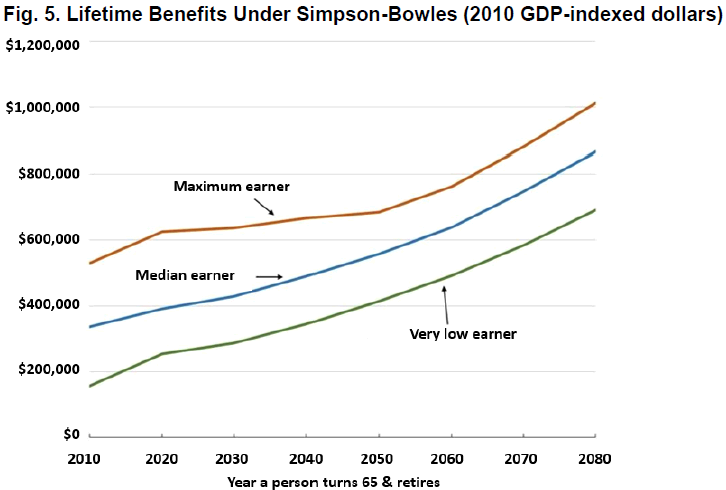
  • Myth: Social Security reform is code for slashing benefits, especially for the poor. Fact: under most reform plans, benefits would continue to grow faster than inflation. Most reform plans do not cut benefits from their current levels but rather slow the growth of benefits to reduce some of the pressure that wage-growth and rising life-expectancy place on the program. Under the Simpson-Bowles Plan, for example, benefits for low-wage earners will grow much faster, proportionally, than for higher-wage earners (see above chart).

Conclusion: It should be clear from the above discussion that Social Security can be fixed so as to continue to provide retirement benefits indefinitely into the future. It should also be clear that the sooner the needed reforms are implemented the less painful they will be for all concerned. We should tell our Congressional representatives that we want them to act now!

Prominent Myths about Our National Debt


As the 2016 presidential election contest begins to heat up, the Committee for a Responsible Federal Budget and its outreach arm, Fix the Debt, have issued a new “Fiscal FactChecker: 16 Budget Myths to Watch Out For in the 2016 Campaign.”  Here are four of the major myths:

  • We Can Continue Borrowing Without Consequences. “Low interest rates are a temporary consequence of the struggling global economy and near term Federal Reserve actions – not a permanent fixture.”

    Capture4

  • There is No Harm in Waiting to Solve Our Debt Problems. “The longer policy makers wait to control debt, the more difficult it will become. For example, reducing debt to around the historical average of about 40% of GDP by 2040 would require tax increases or spending cuts of about 2.6% of GDP per year, if enacted today, or starting at $1,450 per person per year. Waiting a decade to begin would require adjustments of over 4% of GDP.”
  • Deficit Reduction is Code for Austerity, Which Will Harm the Economy. “Most advocates of fiscal responsibility in the U.S. have called for gradual reductions in long-term deficits so that the debt grows slower than the economy. These changes tend to have minimal near-term effects as well as the potential to significantly grow the size of the economy over the long term.”
  • We Can Fix the Debt Solely by Taxing the Top 1%. “The top 1% of earners, households that make at least $450,000 annually, earn a substantial share of national income, about 13% on an after tax basis, and further tax increases on this group could help. But these increases would need to be combined with reductions in spending growth and/or broader tax increases to fully address the nation’s fiscal challenges.”

Just a few days ago, I described a persuasive argument, “America’s Fourth Revolution,” that our hyper-partisan and dysfunctional political system will be unable to rectify our debt problem until we have another and much more severe financial crisis. The above discussion of budget myths from CRFB actually suggests a way forward to solve our debt problem.
We have a choice. Which path will we take?

Could the U.S. End Up Like Greece?


The whole world is watching while Greece decides between two unpleasant alternatives.  Will it further tighten its belt in order to stay in the Eurozone?  Or will it default on its massive debt, reintroduce the drachma and go through a severe recession likely accompanied by hyperinflation?   Greece has put itself into this precarious position by accumulating a debt of 180% of GDP.  It’s current situation would be much worse if it were not getting by with the low interest rate of 1.7% from the European Central Bank.
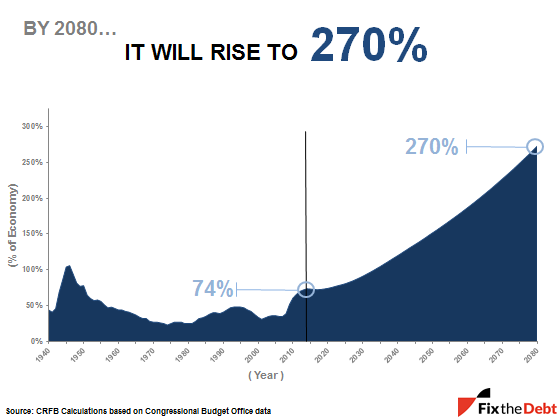
CaptureCompare Greece (see chart above) with the U.S. debt situation.  Our current public debt (on which we pay interest) is 74% of GDP.  This is the highest it has been since the end of WWII.  And, thanks to Federal Reserve policy, we are now paying an historically low interest rate of 1.7% on this debt.
The problem is that (under current policy) our debt will keep growing larger and larger until, by 2080, it would reach the enormous level of 270 % of GDP.  Our very low interest rate level of 1.7% will almost surely rise in the near future to a more normal level of 5%.  As interest rates do begin to rise, and long before the debt reaches 270%, interest payments on the debt will have increased to a much higher level, crowding out other spending.
Notice that, according to the above chart, our debt will reach the Greek level of 180% around the year 2055.  But with higher interest rates, it would be exceedingly reckless to assume that we won’t arrive at Greece’s currently perilous state much sooner than that.
Understanding that we have a very serious long term debt problem, it is imperative to begin to address it now, because the longer we wait:

  • the older our population gets
  • the higher the debt will rise
  • the less time we’ll have to phase in changes
  • the slower our economy will grow, and
  • the fewer tools we will have to fix it

The answer to the question in the title is: Yes, we could easily end up like Greece if we are foolish enough to postpone action on our own debt problem for much longer.

It’s Time to Bite the Bullet and Set up a Balanced Budget Plan

As a result of the 2014 elections, both the U.S. House of Representatives and the Senate are controlled by Republicans.  The House Budget Committee and the Senate Budget Committee are now gearing up to produce plans to balance our federal budget over the next ten years.  Accomplishing this goal will be a formidable challenge.
CaptureMaya MacGuineas, President of the Committee for a Responsible Federal Budget, has recently testified before Congress as to how hard it will be to get this job done.  The gist of her testimony:

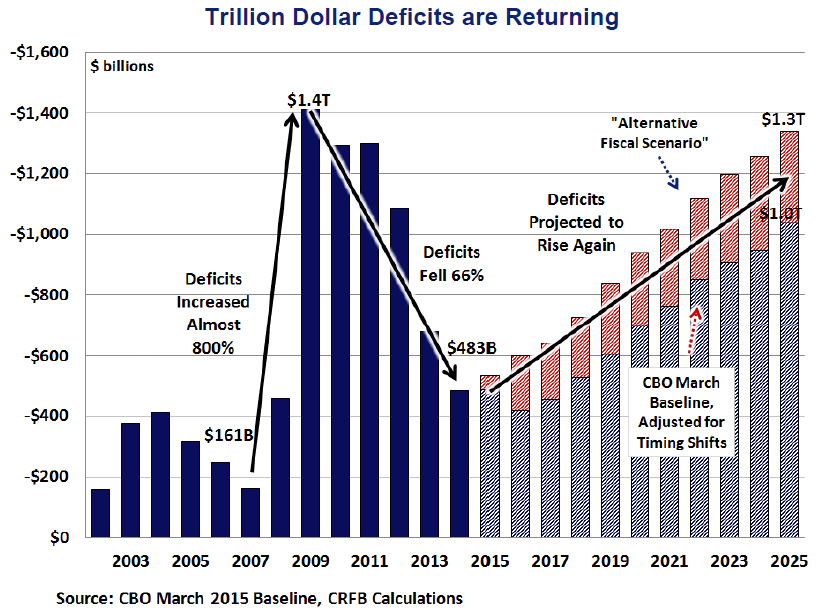
  • Even though the deficit has dropped by two-thirds since the 2009 peak, our deficit and debt problems are far from solved, as indicated in the above chart.
  • CBO estimates that under current law the deficit will rise from $485 billion in 2014 (2.7% of GDP) to more than $1 trillion (3.8% of GDP) by 2025.
  • If nothing is done to slow down these runaway deficits, annual interest payments on the debt will rise from $230 billion this year to $810 billion in 2025. Even with a balanced budget by 2025, interest payments will take up $630 billion in that year.

Capture1

  • As the chart above shows, it will require a ten year savings of $5.5 trillion to bring the budget into balance by 2025. Even to reduce the debt to 60% of GDP by 2025 (compared to 74% today), will take a ten year savings of $4.7 trillion.
  • As if this isn’t hard enough by itself, there will be additional “speed bumps” along the way, whose additional one-year costs alone are $210 billion. See chart below.

Capture2Clearly it will require much pain and shared sacrifice to find trillions of dollars in budget savings over a ten year period as well as avoiding additional costly speed bumps.  But the longer we wait to get started the harder it’s going to be to get the job done.  We need to stop delaying and get started on a budget recovery program this year!

What Will It Take to ‘Fix the Debt’?


I have recently become a volunteer for the national bipartisan organization, Fix the Debt. It is the outreach arm for the Washington think tank, Committee for a Responsible Federal Budget, which is an offshoot of the Simpson-Bowles Commission from several years ago.
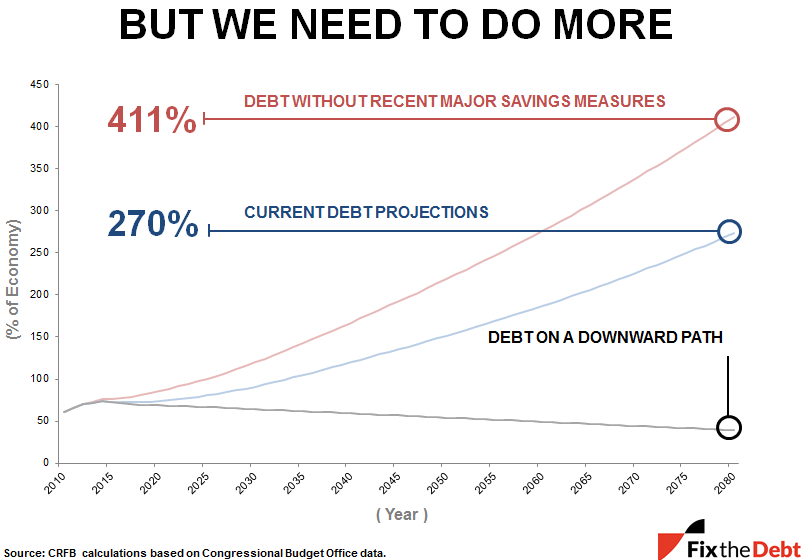
As such, I give presentations to local civic organizations about our national debt and what needs to be done to get it under control. Typically the audience will readily appreciate the seriousness of our debt problem.  What they want to talk about are practical ways to address it.  They have their own ideas and want to know what I think as well.  My first message is that we don’t have to pay off the debt or even balance the budget going forward.  Realistically we need to shrink our annual deficits in order to put the debt on a downward course as a percent of our growing economy,  as shown in the chart just below.

Capture It will be a huge challenge to accomplish even this!  Here are my ideas, in very general outline, on how to get this done:

  • Entitlements (Social Security, Medicare and Medicaid) are the biggest single problem because our population is aging so fast. Furthermore, in order to control the growth of Medicare and Medicaid, we have to do a much better job of controlling the overall cost of healthcare in the U.S. For example, even though healthcare costs slowed down to an increase of only 4.1% in 2014, this is still more than twice the rate of inflation!
  • The second thing we need to do is to make our economy grow faster than the roughly 2.3% growth we have achieved since the end of the Great Recession. The main way to get this done is through broad-based (and revenue neutral) tax reform at both the individual and corporate levels, by reducing tax rates, paid for by closing loopholes and limiting deductions.
  • Finally, there is enormous waste and inefficiency in the federal budget, with huge redundancy and overlap of programs between different federal departments. Responsibility for such programs as education, community development, transportation and social welfare, for example, should be returned to the states with block-grant funding to replace rigid federal control.

I have discussed each of these major reform ideas in much detail in previous blog posts and will continue to do so.  As large as our fiscal problems are, I remain optimistic that they can and will be successfully addressed.

Fix the Debt II. The National Debt and You


As I reported earlier, I am a volunteer for Fix the Debt, the outreach arm for the Washington DC think tank, Committee for a Responsible Federal Budget. I recently attended a workshop in D.C. put on by Fix the Debt and, in return, I have agreed to make presentations about our debt problem to local organizations during the coming year.  Today I gave my first such talk to a local Kiwanis Club.
CaptureThe message is that a large debt means:

  • Lower Wages and Fewer Job Opportunities. The growing debt “crowds out” productive investments in people, machinery, technology and new ventures. For example, the Congressional Budget Office estimates that the average wage in 25 years will be $7000 lower if debt is on an upward path compared to a downward path (see above chart).
  • Increased Costs of Home, Auto, Student and Credit Card Loans. Although interest rates are currently low, they will almost certainly rise as the economy recovers, and they will rise much higher if debt continues to grow.
  • Less Room for Investment in Infrastructure, Research, and the Next Generation. The CBO projects that interest costs will nearly quadruple from $220 billion in 2013 to $800 billion in 2025. By 2030, 100% of all revenue will go towards interest payments and mandatory spending.
  • A Threatened Social Security Net. Both Social Security and Medicare are on a road to insolvency. By 2033 both Medicare’s hospital insurance trust fund and the Social Security trust fund will run out of money.
  • An Increased Likelihood of a New Fiscal Crisis. If investors lose confidence in our ability to service debt, there will be tanking markets, sharply rising interest rates, mass unemployment and rapid inflation.
  • A Missed Opportunity to Grow the Economy. Debt reduction, tax reform and modest entitlement reforms have the potential to increase economic growth by 9.5% by 2035. Think of all the new jobs this would create!

Do you belong to a club or other civic organization in metro Omaha which brings in outside speakers?  If so I’d be happy to bring Fix the Debt’s message to your group.  Shoot me an email at jackheidel@yahoo.com!

Is Health Care Spending Really Under Control?


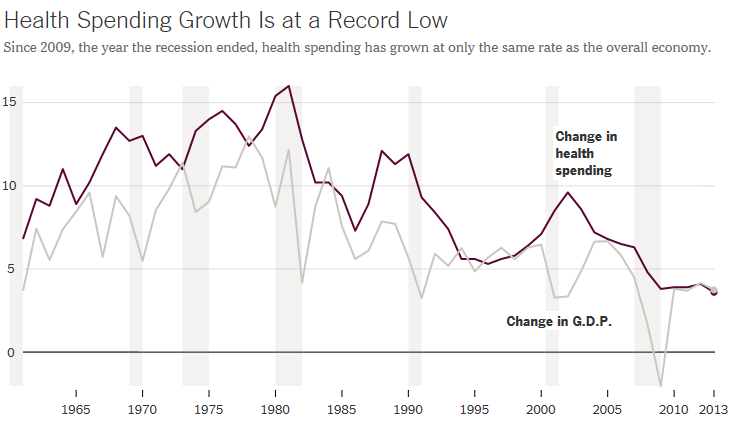
The New York Times has two recent articles about health care spending, “Good News inside the Health Spending Numbers” and “The Battle over Douglas Elmendorf – and the Inability to See Good News.”  These two articles focus on the fact, clearly evident in the chart just below, that the rate of increase in overall health care spending has slowed down since 2009.  In fact health care spending has been a constant 17.4% of GDP for the past four years, while it increased by 1.9% of GDP in the four years before that.  More precisely, health care spending rose by 3.6% in 2013, down from 4.1% in 2012.
CaptureIt is, of course, very good news that increases in health care spending have dropped dramatically since the recession in 2007-2009, but is it really surprising that this has happened in the midst of so much economic pain, with a very high rate of unemployment as well as stagnant incomes for most Americans?  In fact, even in these circumstances, health care spending is still growing at twice the rate of inflation, which has been under 2% during this same time period.
A more realistic view of health care spending has just been presented to the Health Subcommittee of the House Committee on Energy and Commerce by Marc Goldwein, from the non-partisan Committee for a Responsible Federal Budget, a Washington D.C. think tank focused on fiscal responsibility.  Mr. Goldwein makes the following points:

  • Despite the recent slowdown in health care spending, it remains incredibly important that policymakers pursue reforms to reduce future projected health care costs.
  • Policymakers should focus first and foremost on health care “benders” that would improve incentives in order to slow the overall growth of health care spending.
  • Policymakers should next look to health cost “savers” which reduce federal costs by better allocating resources within the federal health programs.
  • Given the aging of the population, health reforms will be necessary but not sufficient to put the debt on a sustainable long-term track.

Slowing down the rate of growth of health care is going to be a huge challenge for our national leaders.  I will elaborate on how to do this in forthcoming blog posts.