Why the U.S. Debt is so Scary III. The Disconnect


Most of my readers know that I am a candidate in the May 15 Nebraska Republican Primary for the U.S. Senate, against the incumbent Deb Fischer because she is ignoring our enormous and out-of-control national debt. In fact she has recently voted twice, for the new tax law and new budget, to increase our annual deficits by hundreds of billions of dollars per year.
The only way to “fix the debt” is to begin shrinking our annual deficits.  She is moving us in exactly the wrong direction that we need to go.
My last two posts, here  and here, explain why our debt is so scary: we risk losing our status as the world’s leading economic power and, furthermore, a new crisis could occur much sooner than many people expect.


Unfortunately for the future of our economy, the new tax law is gaining support amongst the American population, with approval having now reached 50% and disapproval having sunk to 45%. Yes, the new tax law will increase economic growth in the next two years before the extra stimulus fades away.  But the additional debt will greatly hurt our economy in the long run.


Conclusion. The national Republican leadership has sold the American people a bill of goods. At a time when economic growth is already picking up speed, the Republican Congress has stepped on the gas to yield an additional short term stimulus at the great risk of long term harm.  This is highly irresponsible a endangers the Republican Party’s reputation for fiscal responsibility.

Why the U.S. Debt is so Scary II. A Crisis Could be Nearer Than We Think


I am a candidate in the May 15 Nebraska Republican Primary for the U.S. Senate because the incumbent, Deb Fischer, is doing nothing about our enormous and out-of-control national debt. In fact, she has recently voted twice, for the new tax law and budget, to make our debt even worse than it already was. My last post quotes a reader of my blog as saying that deficit hawks need to make our soaring debt sound scary to ordinary citizens who don’t understand how it will affect their own lives.
The analyst Desmond Lachman from the American Enterprise Institute makes it sound even scarier by predicting a new 2008-2009 style crisis within the next year.  According to Mr. Lachman there are two basic reasons to fear another full-blown global economic crisis soon:

  • First, we have in place all the ingredients for such a crisis. The housing price bubble before the 2008-2009 crisis has been replaced by a global asset price bubble, for both stocks and bonds. A second key ingredient is that the global debt-to-GDP level is significantly higher than in 2008.

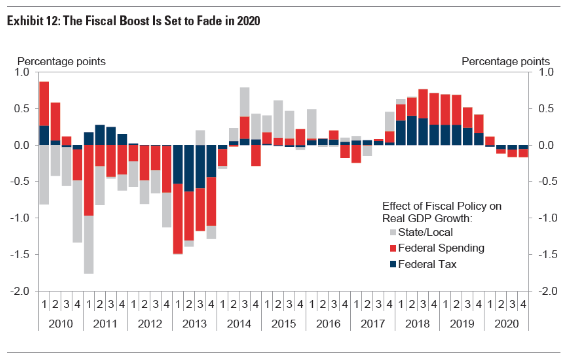
  • Second, due to major mistakes by the Federal Reserve and the U.S. Administration, the U.S. economy is in danger of soon overheating, which will bring inflation in its wake. With very low unemployment, the Fed has let low interest rates linger for too long. And the U.S. economy has now received a double fiscal stimulus with unfunded tax cuts and a new two-year spending boost.
  • The Federal Reserve now has two unattractive choices. It can raise interest rates quickly and burst the global asset bubble, or it can proceed at a slower pace and ignore the very serious inflation risk.

Conclusion. With a very high and rapidly growing national debt, along with unusually low interest rates which will be pushed up soon one way or another, we should prepare ourselves for another crisis in the near future.

Why the U.S. Debt is so Scary


From a reader of my blog:

Deficit hawks need to make the national debt seem like something scary that will personally affect people. As of now, most Americans find it boring and unrelatable because they don’t perceptibly feel its effects in their daily lives. How does it affect the John Q. Public GOP voter who is not so keen on immigrants, has a mortgage, loves the military, and despises abortion until his daughter gets knocked up in her mid-teens? John Q. Public doesn’t fully grasp that an out of control debt will cause the market to raise interest rates unilaterally leading to serious inflation in USD terms.

This will clearly dislodge the USD as the world’s reserve currency, opening the door for either the Chinese Yuan or Bitcoin to become the world’s new reserve currency. So, when the US debt bubble bursts, John Q. Public will basically be working in a factory for the equivalent of 6000 current USD per year, and I don’t think John Q. Public grasps this reality. Maybe John will croak before this comes to pass, but John Q. Public II will pay the price toiling away here in the heartland to make iGadgets for the Chinese middle class.


I am a candidate in the May 15 Nebraska Republican Primary for U.S. Senate because the incumbent, Deb Fischer, is doing nothing to reduce our enormous and out-of-control national debt.  In fact she is consistently voting to make it worse!  My challenge is to convince enough voters that our debt really is an extremely serious problem.

Conclusion. Eventually our huge and rapidly growing debt will catch up with us and we will have a fiscal crisis much worse than the Financial Crisis of 2008.  We don’t know when this will happen but the longer we ignore the problem, the more inevitable it becomes that it will end up very painfully.

The Republican Party is Jeopardizing its Moral Credibility


I have been a Republican for most of my adult life because I have usually considered the Republicans to be the party of fiscal responsibility. But is this still true? Consider:

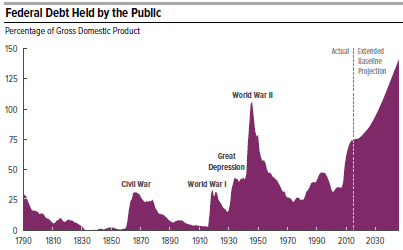
  • Our national debt now stands at 77% of GDP (for the public part on which we pay interest) and was already predicted to reach 98% of GDP in 2027, just ten years from now. Now, with the new tax law and the new budget deal, deficits are likely to reach 109% of GDP by 2027.

  • In numerical terms, our current $20.5 trillion debt was already set to increase by $11 trillion over the next ten years. The new tax law will add $1 trillion to the debt (after taking new growth into account). The new budget deal adds another $1.7 trillion.  In other words new debt, on top of our existing debt, will be close to $14 trillion over the next decade.

  • The Republican Party now controls the Presidency and both houses of Congress and therefore has absolutely no excuse for such fiscal extravagance.

I am a candidate in the Nebraska Republican Primary for U.S. Senate against the incumbent, Deb Fischer, because she is offering no resistance to this flagrantly rotten charade. Last fall, it would have taken only three Senators to stop the trillion dollar giveaway in the new tax law and not one single Republican Senator voted against it.

Conclusion. The Republican Party is now endangering its critical role in making sure that the federal government acts in a fiscally responsible manner. I shudder to think what will happen to our country without a major party offering fiscal restraint.

Nebraska Senator Deb Fischer is Fiscally Irresponsible!


I am a candidate in the May 15 Nebraska Republican Primary for the U.S. Senate against the incumbent Deb Fischer because she is ignoring our enormous and out-of-control national debt.  In fact, she is doing much worse than just ignoring it; she is actively making it much worse.  For example:

  • Fischer voted for the new tax law which increases our debt by $1 trillion over ten years even after new growth is taken into account.  The main features of the new law are excellent but need offsets to avoid losing tax revenue.

  • The budget just approved by Congress and signed by President Trump, for this year and next, will increase the debt by $300 billion. It means that the deficit for FY 2018 will be $800 billion followed by $1.2 trillion for FY 2019 (see first chart).  In FY 2027, just ten years away, the annual deficit is projected to increase to $2.1 trillion (see second chart).

  • On Senator Fischer’s watch, for the six Fiscal Years 2014 – 2019, the new debt is likely going to be $4.5 trillion (just add up the totals for these years in the chart above). This means that by the end of her six year term in office, 20% of our entire debt of $22.5 trillion, will have been accumulated while she was in office!

Conclusion. The national debt now $20.5 trillion and growing rapidly, is by far our biggest long term problem. We badly need representatives in Congress who will stop ignoring this awful problem and start doing something about it.  That is why I am a candidate for the U.S. Senate.

The Urgency of Reducing the Cost of American Healthcare


Just a few days ago I announced my candidacy in the Republican Primary for U.S. Senate against the incumbent Deb Fischer who is doing nothing to reduce our badly out-of-control national debt and, in fact, just voted to increase it by $1 trillion over the next decade.
It is the high cost of government spending for Medicare, Medicaid and the tax exemption for employer-provided care which is the main driver of federal debt.
But healthcare is also getting very, very expensive for American workers and retirees as well.  In my last post, I reported that:

  • A family of four paid $26,944 for healthcare expenses last year which was 44% of median family income of $59,039.

And now the Kaiser Family Foundation has reported that:

  • In 2013 a Medicare beneficiaries’ average out-of-pocket healthcare spending was 41% of their average per capita Social Security income. This will rise to 50% in 2030.

Conclusion.  American healthcare is expensive for workers, retirees and taxpayers. In other words, it is expensive all the way around, for everybody.  There isn’t a lot of slack left to give way.  The cost of healthcare will impoverish our whole country if we can’t get it under control.  Stay tuned for proposed solution.

The Outrageously High Cost of American Healthcare

On January 24 I announced my candidacy in the Republican Primary for U.S. Senate against the incumbent Deb Fischer who is doing nothing to reduce our badly out-of-control national debt and, in fact, just voted to increase it by $1 trillion over the next decade.
It is the high cost of government healthcare spending for Medicare, Medicaid and the tax exemption for employer-provided care which is the main driver of federal debt.


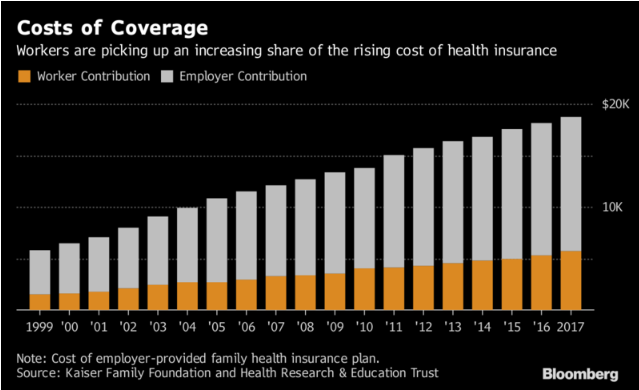
But now look at a recent report from Bloomberg Markets on the outrageously high cost of employer-provided health insurance for American workers:

  • The average worker paid $5,714 in 2017 out of a total cost of $18,764 for a family plan. Deductibles last year averaged $5,950 per individual and double that per family.
  • In the past five years insurance premiums increased by 19% while worker pay increased by 12% and inflation increased by just 6%.
  • A family of four paid $26,944 for healthcare expenses (including out-of-pocket) last year which was 44% of median household income of $59,039.
  • Health insurance premiums are up 11% in 2018.

Conclusion. I have been predicting a fiscal crisis in the relatively near future over federal debt. But we actually have an immediate crisis on our hands over the horrendous cost of employer-provided healthcare.

Why My Campaign for U.S. Senate Is Focused on the Debt Issue


Today I announced my candidacy in the 2018 Republican Primary for U.S. Senate against the incumbent Deb Fischer because she is doing nothing to reduce our national debt which is badly out-of-control. My announcement speech was completely focused on the magnitude of our debt problem and what I think can and should be done about it.


Several members of the press who covered the event asked why I didn’t talk about other issues as well.  My response to them:

  • The debt issue is why I am in the race, what clearly distinguishes me from Fischer, and where I think she is vulnerable.
  • Of course there are other important issues and I am willing to discuss them when asked.
  • But to bring up other issues on my own diminishes the fundamental importance of the debt issue.

Conclusion. I am an unconventional candidate. I am running more against the debt than I am running against Deb Fischer.  I have nothing against her.  I merely want to get our debt problem fixed before it does great damage to our country and she is standing in the way.

An Example of What High Debt Will Do to Our Country


Tomorrow morning I will officially announce as a candidate in the Republican Primary for the U.S. Senate seat now held by Deb Fischer, because she is making no effort to reduce our national debt which is badly out of control.
So I will be making a transition from blogger  to candidate . My posts will become shorter as I spend more time on campaign activities.


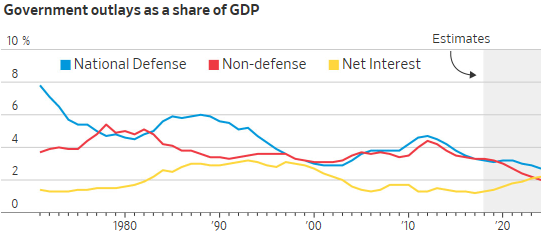
Today take a look at a WSJ article comparing outlays for defense, non-defense and net interest payments on our debt.  It shows how interest payments on our debt are likely to exceed spending on all discretionary non-defense programs by 2022.
Conclusion. This is a dire warning of how our spending priorities will become highly distorted if we are unable to shrink our debt.

Ignoring the National Debt Endangers Our Country


Here is the preliminary version of my campaign announcement, now scheduled for Wednesday, January 24, for the Nebraska Republican Primary for U.S. Senate:

“This may sound overly dramatic but if we ignore the debt much longer, it will endanger the future of our country.

This is exactly what the new tax law does, in spite of its otherwise good features, by increasing the debt by $1 trillion over the next decade.  And 51 Republican Senators voted for this new law, including Nebraska’s Deb Fischer who is running for reelection this year.  I am running for her seat to challenge her about our ballooning debt because she is doing nothing about it and has just voted to make it worse!

First of all, the chart below shows why our debt situation is so serious. It now sits at 77% of GDP (for the public part on which we pay interest), the highest since WWII, and is predicted by the Congressional Budget Office to keep getting steadily worse, hitting almost 100% of GDP by 2027.

Right now interest rates are so low, less than 2%, that our debt is almost “free” money.  But this cannot and will not last much longer.  Inflation has already started to increase and the Federal Reserve has started to raise interest rates.

Rising interest rates mean much higher interest payments on our debt. This will put an enormous strain on the federal budget, choking off spending for many of the things such as education, scientific and medical research, infrastructure and social programs which so enhance our quality of life.

And furthermore, these much higher interest payments on the debt will continue, and even grow worse, indefinitely into the future, placing a huge burden on future generations, our children and grandchildren.

The solution is to shrink our annual deficits ($668 billion in FY2017 and likely over $700 billion for 2018) down to a much more manageable level so that our debt will also shrink as a percentage of GDP.

I emphasize that this can be done in a sensible, non-disruptive way by simply curtailing spending increases in most government programs without actual budget cuts, and thereby reducing our huge annual deficits over a period of several years.

The Affordable Care Act expands access to healthcare (which is good!) but does nothing to control cost (which is bad!).  American healthcare needs major changes.  One way to do this is to abolish the employer mandate and migrate from employer provided health insurance to personal insurance with age-based, instead of income based, tax credits.  Medicaid can move to the same age-based (refundable) tax credit system. Also fix Medicare by making Medical Savings Accounts readily available for Medicare Advantage plans and then encouraging migration from regular Medicare to Medicare Advantage.

Such major changes as I have proposed above likely will be considered controversial.  However, which is better, to implement major changes in a rational, careful manner while there is time or rather to wait for a new fiscal crisis, much worse than the Financial Crisis of 2008, which will inevitably occur down the road if we continue to ignore the debt?

Summary. The U.S. has a horrendous debt problem which is getting worse all the time.  We badly need representatives in Congress who will stop ignoring our debt and make reducing it a very top priority.  This is why I am challenging Deb Fischer as she runs for reelection. “

Follow me on Twitter 
Follow me on Facebook