Why Fiscal Responsibility at the Federal Level Is So Difficult


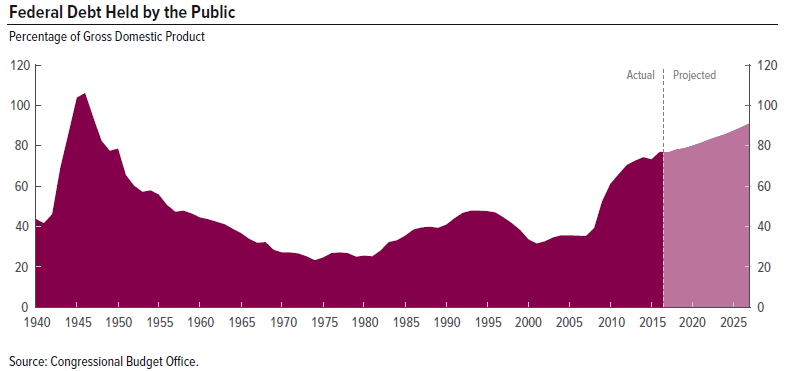
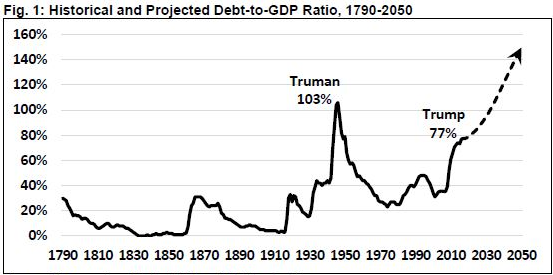
The United States faces many challenging problems but the biggest one of all is our national debt, right now 77% of GDP, the largest since right after WWII, and predicted by the Congressional Budget Office to keep getting steadily worse without major changes in current policy.
The only practical way to reduce the debt is to start shrinking our annual deficits, $680 billion for the current 2017, down to a much lower level, ideally close to zero, over a limited time period, perhaps ten years or so. This urgent need will, of course, be very difficult to accomplish.
For example:

  • Military spending. The military analyst, Mark Helprin, makes a cogent argument  that the most effective way to defuse the North Korean nuclear threat is for President Trump to ask Congress “for an emergency increase in funding to correct the longstanding degradation of American military power.” This would, among other things, provide for “a vigorous acceleration of every aspect of ballistic-missile defense.”

  • Omaha Rapid Bus Transit. Omaha NE (where I live) is spending $15 million in local funds for a $30 million bus system upgrade, subsidized by the Federal Transit Authority, which has an annual budget of $8.6 billion. The new ORBT will have sleek 60 foot-long buses as well as 27 individual modern bus stop shelters at a cost of $260,000 each. The system will be operational in 2018 and Mayor Jean Stothert says, “I’m looking forward to being one of the first riders.”

Conclusion. Who can argue with upgrading ballistic-missile defense at a time when we are threatened by a madman in North Korea?  And, it is nice for Omaha to have a sleek modern rapid  transit bus system on Dodge Street but should it be 50% subsidized by the federal government at a time when the U.S. is drowning in debt?  There will always be enormous pressure on Congress to increase funding for popular projects.
Who is going to stand up and say no?
Follow me on Twitter 
Follow me on Facebook 

The Major Challenges Facing the U. S. II. National Debt


My last post, “The Major Challenges Facing the United States,” came to the conclusion that, while the U.S. has many big problems to address, our national debt is the biggest problem of all, because it will be so hard to deal with through the political process.
Our total national debt is now $19.9 trillion. The so-called public debt, on which we pay interest, is $15 trillion, or 77% of GDP, the highest it has been since right after WWII.  Furthermore it is predicted by the Congressional Budget Office to keep getting steadily worse, reaching 90% of GDP by 2025 and 150% of GDP by 2047 unless current policy is substantially changed.
Right now our debt is almost “free” money since interest rates are so low.  But when interest rates return to more normal levels, interest payments on the debt will skyrocket by hundreds of billions of dollars per year, likely leading to a new fiscal crisis, much worse than the Financial Crisis of 2008.
The only sane solution to this humongous problem is to start shrinking our annual deficits, this year at about $685 billion, down close to zero over a period of several years.  This will require a painful combination of spending curtailments and perhaps some tax increases as well.


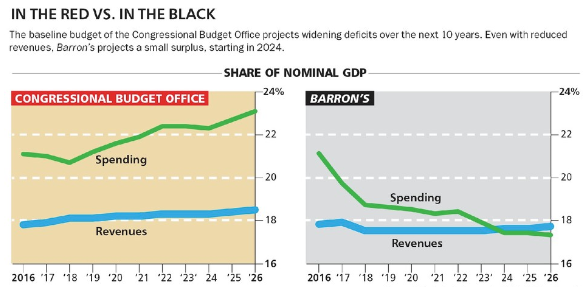
One possible way to accomplish this herculean task has been laid out by Barron’s economic journalist Gene Epstein, see here and here.  Mr. Epstein’s plan would balance the budget in ten years by decreasing projected spending by $8.6 trillion, with 60% of spending curtailments coming from the entitlement programs of Social Security, Medicare and Medicaid and the rest from both military and domestic discretionary programs.
It needs to be strongly emphasized that under the Epstein plan spending would not actually decrease from one year to the next, but would rather grow at a slower rate, from $3.9 trillion in 2016 to $4.7 trillion in 2026.  His plan would decrease the public debt from 77% of GDP today to 58% in 2026.

Conclusion. The U.S. faces the very unpleasant problem of excessive debt which will just keep getting worse and worse without making some relatively unpleasant adjustments in the way that the federal government spends money. The sooner we get started in this process the better off we will be.

Follow me on Twitter 
Follow me on Facebook 

The Democrats and the Economy II. A Path Forward


On Monday the Democratic Congressional leadership held a rally in rural Berryville, Virginia. They laid out a program designed to appeal to the middle class and blue-collar workers who voted for Donald Trump.  However many of their proposals involve expensive government programs and therefore would add significantly to the national debt.


What is needed is a greater emphasis on free-market ways of helping middle- and low-income workers such as:

  • Increasing basic economic growth which has stalled to a relatively slow 2% per year of GDP since the end of the Great Recession in June 2009. For example:
  • Revenue neutral tax reform, lowering rates for both individuals and corporations, paid for by closing loopholes and shrinking deductions, would have many benefits. It would stimulate business investment, create new demand by lowering the taxes paid by the approximately 2/3 of taxpayers who do not itemize deductions, and provide an incentive for multinational corporations to bring their foreign profits back to the U.S. for reinvestment.
  • Targeted deregulation of the financial sector by exempting main street banks from the onerous requirements of the Dodd-Frank Act would enable these smaller banks to lend more money to small businesses.
  • Fundamental healthcare reform to lower costs from the current 18% of GDP to the approximate 12% average of other developed countries. This would save the American economy $1 trillion annually which could be spent far more productively. The Democrats are on the right track here by refusing to accept Republican half measures.
  • Improve educational opportunities such as early childhood education for low-income families, expanded career education and job training in high school and community colleges, and more emphasis on income-based repayment for student college debt. There would be some cost involved here.
  • Modest increase in the national minimum wage from the current level of $7.25 per hour to perhaps $10 per hour and then index it to inflation going forward. The Democratic proposal for a national $15 per hour minimum wage would put too many people out of work.

Conclusion. This collection of proposals involves both Democratic and Republican ideas and should be implementable with a bipartisan effort.

Follow me on Twitter 
Follow me on Facebook 


America’s Most Serious Problem: Excessive and Growing Debt


I know that I repeat myself a lot. I am a fiscal conservative and social moderate.  This puts me in the middle of the political spectrum from left to right.  I support social welfare programs if they are legitimately helping the less fortunate among us.  I am especially supportive of programs for African-Americans because of the racial bias they experience.


Unfortunately our national leaders have collectively lost a sense of fiscal responsibility in recent years.  Looking at the standard debt chart (above) produced by the Congressional Budget Office, it is clear that indifference to debt commenced under President Reagan and has waxed and waned ever since.  The debt has been growing especially fast ever since the Great Recession in 2008 and now stands at 77% of GDP, the highest since the end of WWII.  Shrinking the debt (as a percentage of GDP) is now America’s most urgent problem.


As I have discussed before, it is the entitlement programs of Social Security, Medicare and Medicaid, as well as interest payments on our increasing debt which will continue to worsen the debt problem in the coming years  without strong corrective action.
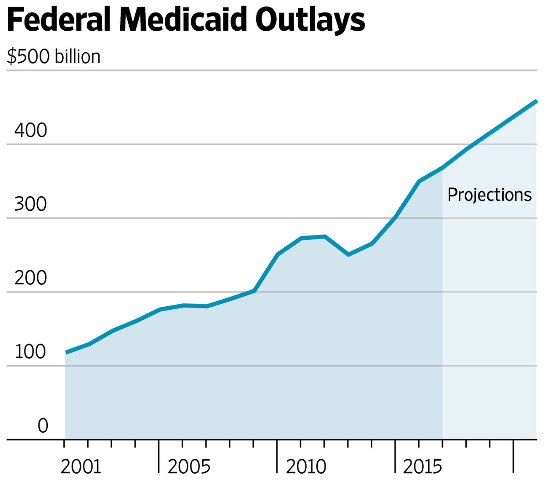
All entitlement programs need to be reformed to impose cost control. Right now the two healthcare bills in Congress propose that the funding mechanism for Medicaid be changed so that it will be on a fixed (federal) budget from now on, rather than be continued in its current open-ended form.
Medicare is an even more expensive program than Medicaid.  It would be better to fix both of these programs at the same time, but it is better to fix Medicaid alone than to do nothing at all.
It would be even better to replace our employer provided healthcare system with a uniform, but limited, health insurance tax credit for all (including for the self-employed) and to make all of these major changes at the same time.  This would be the fairest way to proceed.

Conclusion. The current GOP plan to curtail healthcare costs could be much improved.  It is only a small step in the right direction.

Follow me on Twitter 
Follow me on Facebook 

The Need to Put Medicaid on a Budget II. Our Growing Debt


Most of the controversy generated by the healthcare bill passed by the House, and the one now being considered by the Senate, concerns the way Medicaid is funded. The current system whereby states are reimbursed by the federal government for a percentage (national average 53%) of their Medicaid expenses would be replaced by putting the federal contribution on a strict per-capita basis, indexed to the annual rate of inflation.
Medicaid is a vast program now serving 73 million low-income and disabled Americans and is doing a good job especially for the elderly and the disabled with special needs. But it costs the federal government nearly $400 billion per year and the cost is growing rapidly.  It is essential to get open-ended Medicaid spending under much better control and one good way to do this is to put the federal contribution on a fixed budget.


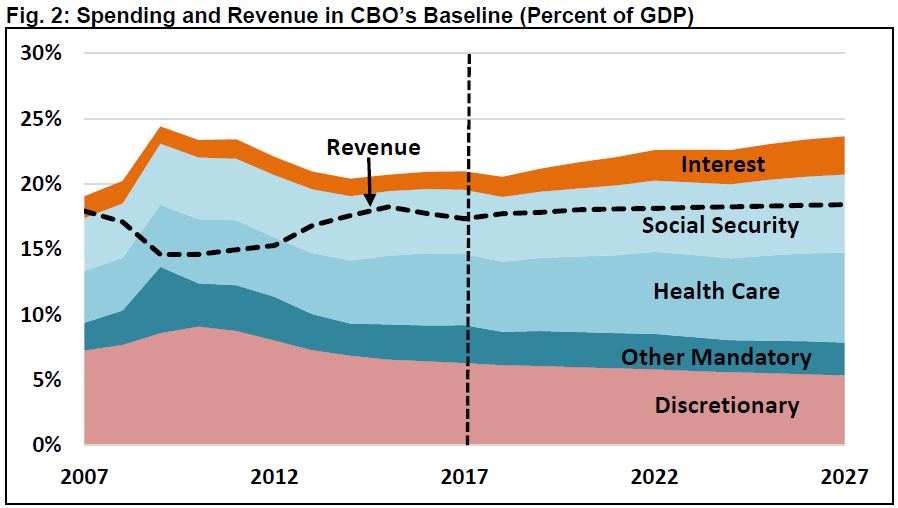
The Congressional Budget Office has just issued its latest Budget and Economic Outlook report.  It shows the ever-worsening fiscal condition for the U.S., unless current policy is changed.


For example:

  • The deficit for 2017 is predicted to be $693 billion or 3.6% of GDP.
  • Deficits will grow dramatically over the next decade with trillion dollar deficits returning by 2022.
  • Debt held by the public (on which interest is paid) will grow by $11.2 trillion between now and 2027, from $14.3 trillion today.
  • Spending will grow from 20.9 percent of GDP in 2016 to 23.6 percent in 2027, while revenues will rise from 17.8 percent in 2016 to 18.4 percent by 2027.
  • The vast majority of spending growth over the next decade (83%) is the result of rising costs for health care, Social Security, and interest on the debt.

    Conclusion.  
    The national debt is growing much too fast. The only way to turn this dangerous situation around is to reform all entitlement programs, including Medicaid, to get their costs under much better control.

Follow me on Twitter: https://twitter.com/jack_heidel
Follow me on Facebook: https://www.facebook.com/jack.heidel.3

The Need to Put Medicaid on a Budget

The GOP healthcare plan, both the House version and the Senate version, are highly imperfect. Yet they each do one thing which is badly needed. They put Medicaid on a budget. The current open-ended Medicaid program, whereby each state is reimbursed by the federal government for a percentage of its costs (the average is 53%), would be replaced by an annual per-capita payment which would increase only at the rate of inflation. It is estimated that the new per-capita budget would reduce federal Medicaid payments by about 25% after 10 years.


In order to get the federal debt under control, all three major entitlement programs, Social Security, Medicare and Medicaid, must be reined in and the current GOP plan would start doing this for Medicaid.
Reining in spending like this will force states to alter the way they regulate and administer Medicaid and the New York Times columnist Ron Lieber points out some of the challenges which will arise if Medicaid has to operate more efficiently:

Nursing homes. One third of people who turn 65 will eventually end up in a nursing home. Furthermore, 62% of nursing home residents cannot pay for nursing homes on their own. The average annual cost of a semi=private room is $82,000.
Home and community-based care. Medicaid is required to pay for nursing homes and may also pay for home and community-based care which is much less expensive and lets seniors stay in their own homes.
Optional services for low-income people and the disabled. Optional services besides long-term home care include dental care for adults, therapy for disabled children at school, prosthetic limbs and prescription drugs.

Conclusion. Changing Medicaid from open-ended funding to a strict federal budget which grows at the rate of inflation will put a large burden on state Medicaid administrators and require some difficult tradeoffs to control spending. But this is absolutely essential as a first step towards controlling the rapid increase of entitlement spending.

Follow me on Twitter:
Follow me on Facebook:

What Should the Federal Government Do about Infrastructure?


President Trump has proposed spending $1 trillion over the next decade on public and private investment in infrastructure. The CATO Institute’s Ryan Bourne has just published an excellent analysis of the whole issue.  Here are the highlights:

  • Any new federal spending must take into account that federal public debt now stands at 77% of GDP and is likely to keep rising given the demographic pressures on entitlement spending. This means that the long-term outlook for public finances is dire.
  • With a current low unemployment rate of 4.4% and a high of 6 million job openings, the economy does not need more government stimulus at the present time.

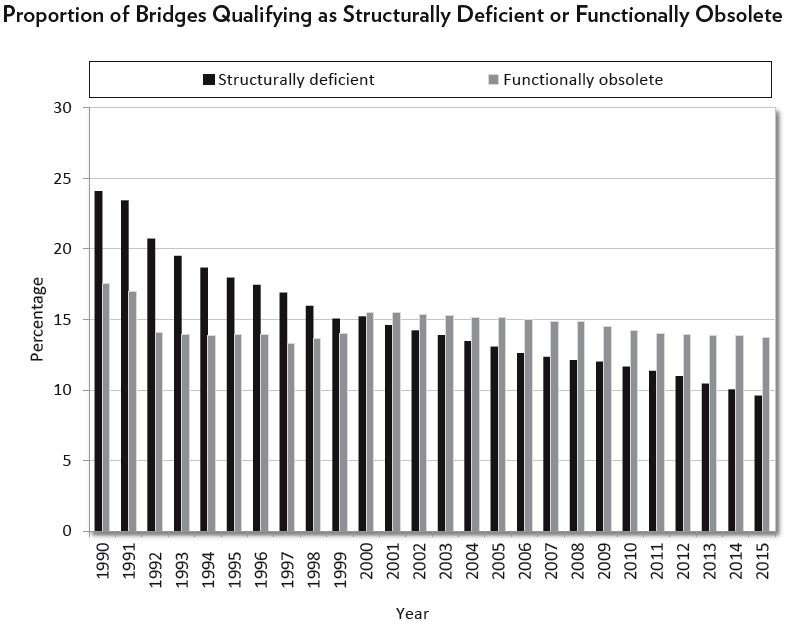
  • Bridge quality has improved substantially since 1990 (see chart) although roadway congestion has become more acute (second chart). Rail and transit systems appear to be the main areas with observable deterioration.

  • The difference between state highways (which are in good condition), local roads (which are in fair condition) and transit systems (which are in poor condition) is simple: state road maintenance is paid almost entirely out of user fees (gasoline taxes), local road maintenance is paid for by a combination of taxes and user fees (motor vehicle registrations and parking meters) while transit maintenance is paid for almost entirely out of taxes.

The above indicates that the following policy framework should be followed:

  • Privatize areas where government is not needed such as airports, air traffic control systems and railways (Amtrak).
  • Localize decision making as far as possible such as decentralizing responsibility for transportation infrastructure back to the states.
  • Remove payment barriers for charging users. This could reduce the cost of capital investment required for highway systems by 30%.
  • Level the playing field for private sector funding. Currently interest income received for investing in municipal bonds is tax free which is not the case for private debt.

Conclusion. “Rather than imposing further costs on taxpayers, the Trump Administration should prioritize localizing decision making, removing regulatory barriers to private investment, encouraging use of user fees and removing tax exemptions for public investment.”

Follow me on Twitter 
Follow me on Facebook 

How to Achieve a Balanced U.S. Budget


President Trump’s proposed 2018 Budget lays out a plan to achieve a balanced budget over a ten year period. I strongly endorse this goal whether or not the Trump budget is a realistic way to get this done.
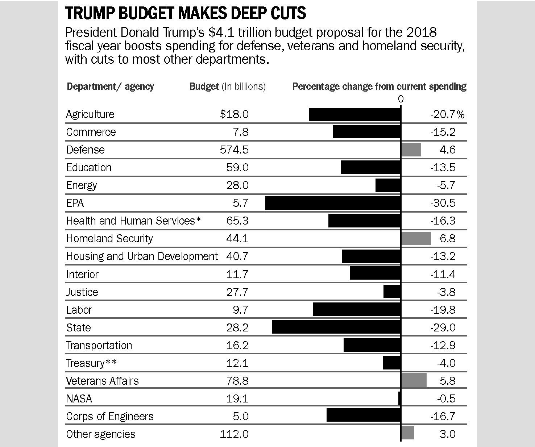
The virtue of the Trump budget is to tackle waste and inefficiency across many different domestic programs (see chart below).


Its main defect is that neither healthcare reform nor tax reform has yet been implemented and the cost and/or savings of these two major initiatives are not yet known.
In the meantime the only way to think about balancing the budget is conceptually in terms of how it might be done.  Barron’s economic analyst Gene Epstein has done this recently.


Mr. Epstein proposes:

  • $8.6 trillion worth of spending cuts over ten years, of which 40% would come from programs other than Social Security and healthcare. By achieving a balanced budget in ten years it would lower our public debt (on which we pay interest) from 77% today to 58% in 2027.
  • By raising the age limit for full SS benefits to 67 (already enacted) at a faster pace, and indexing initial benefits to price inflation rather than wage inflation, $200 billion can be saved over ten years. Another $300 billion can be saved by phasing in a 25% reduction in SSDI benefits.
  • Cutting the estimated improper payment rate for Medicare of 12.1% in half would save $400 billion over ten years. Raising the premiums for Medicare Part B and Part D to 35% of costs from the current 25% of costs would save $400 billion.
  • Another $600 billion would be saved by turning Medicaid into a block grant program to the states and giving the states much more flexibility in how it is spent.
  • $950 billion could be cut from the military budget by cutting back on overly expensive new weapon systems as well as closing unnecessary military bases, both foreign and domestic.
  • Many cuts in government subsidies to individuals and businesses would save $1 trillion. Grants in aid to sates could be cut by $500 billion.

Conclusion. There are many different ways to curtail federal spending. It has to be done and the sooner we get started the less painful it will be for all concerned.

Follow me on Twitter
Follow me on Facebook


Objections to the Trump Budget


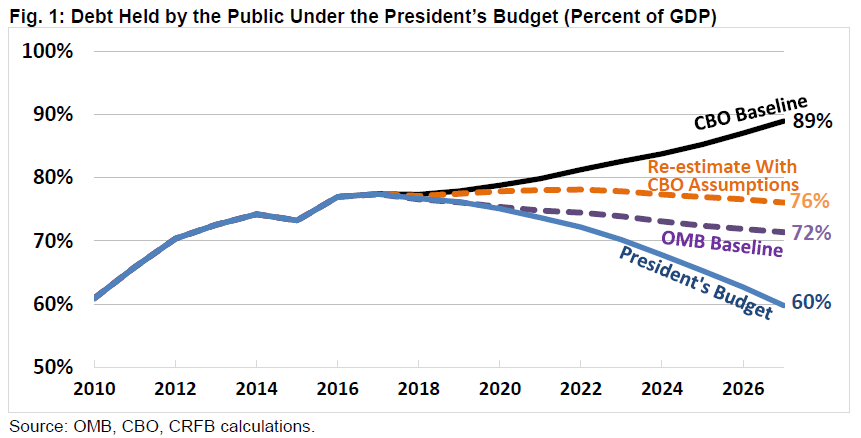
President Trump’s budget for 2018 presents a plan to achieve a balanced federal budget in ten years, by 2027.  This is a highly desirable goal but there is much skepticism about whether or not his budget is realistic, see here and here.


My thoughts on this important matter are:

  • Fiscal restraint is a common sense necessity, and is not austerity. Our public debt (on which we pay interest) now stands at 77% of GDP, the highest since WWII, and will continue to increase without major changes in public policy. Right now the debt is almost “free” money because interest rates are so low. As interest rates inevitably go up in the near future, interest payments on the debt will skyrocket and become a huge drain on our federal budget and make annual deficits even worse than they already are.
  • 3% annual GDP growth, as assumed in the Trump budget, is almost certainly too optimistic. However the Trump Administration is on track to achieve significant deregulation  and averaging 2.5% growth over the next ten years is doable.
  • Insufficient entitlement reform is a big drawback for the budget. It will be very difficult, essentially impossible, to achieve and sustain a balanced budget without modifying Social Security and Medicare to make them self-financing. Turning Medicaid into a block grant program to the states would finally put Medicaid on a sensible budget.
  • Requiring able-bodied welfare recipients to work is a good idea and is the basis for cutbacks in social welfare programs.
  • The Departments of State, Interior, Education and Justice should be able to absorb cutbacks and operate more efficiently.

Conclusion. There are many good initiatives built into the Trump budget. Unfortunately there are also some invalid assumptions and glaring omissions.  It does not represent a bona fide plan to balance the budget in ten years but at least it recognizes the importance of doing so.

Follow me on Twitter
Follow me on Facebook

Is Trump Serious about Shrinking the Debt?

The newly released Trump budget for Fiscal Year 2018 claims that it will lead to a balanced budget in ten years.  This is a highly desirable goal.  However the projected $4.5 trillion in spending cutbacks for many popular programs, as well as the projected 3% GDP growth for the next ten years, are both unrealistically optimistic.  Nevertheless, at least the Trump Administration is moving in the right direction.


Here is a good summary by Donald Marron in National Affairs of why it is so important to keep deficits and debt under control:

  • Prolonged deficits and mounting debt will undermine economic growth by interfering with investment in the private sector.
  • Prolonged deficits risk fueling inflation as the government lowers the value of the dollar by printing more of them.
  • High levels of debt held by foreign lenders put us at the mercy of foreign countries.
  • The growing debt exposes America to greater “rollover” risk with the increasing reliance on short term debt which frequently has to be rolled over.
  • Rising debt limits flexibility for increased spending in times of recession or other emergency. For example, when the Financial Crisis occurred in 2008, the debt level was just half of its current level. This meant the government could risk higher deficit spending in order to stimulate the economy.
  • Deficits have an unfortunate tendency to feed on themselves. Our current deficit level of approximately $500 billion per year is so large that it can only be significantly reduced with great pain. The only possible way to make deficit reduction politically feasible is to spread this pain widely amongst the public as shared sacrifice. This will be very hard to do.
  • Deficits and debt are grossly unfair to future generations who are stuck with servicing the debt and/or struggling to pay it down.

Conclusion. The Trump Administration recognizes the strong need to get deficits and debt under control. Unfortunately its current budget just submitted is not a realistic plan to get this done.

Follow me on Twitter
Follow me on Facebook