What Is Slowing Down Today’s Economy?


We will soon have a new President and, even though his election was somewhat of a fluke, he will obviously want to help the blue-collar workers who elected him.  The best way to do this is to make the economy grow faster.
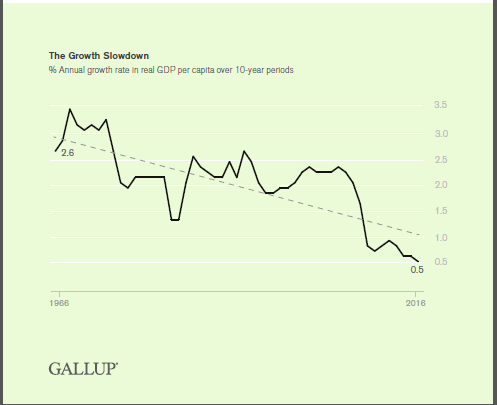
The Gallup economist, Jonathan Rothwell, has just issued an excellent analysis of some of the major reasons for our current slow economy, “No Recovery: an analysis of long-term U.S. productivity decline.”
capture91
Says Mr. Rothwell:

  • The problem is severe. U.S. GDP growth per capita has declined from 2.6% in 1966 to .5% today. Small differences expand into vast gaps in potential living standards. 1% growth for the next 35 years would expand household income from $56,000 in 2015 to $79,000 in 2050 (inflation adjusted), whereas 1.7% growth would raise household income to $101,000 in 2050.
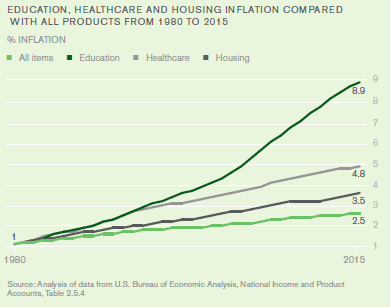
  • Changes in living standards are fundamentally linked to changes of how the quantity of goods and services relate to their cost. Deterioration in the quality-to-cost ratio for healthcare, housing and education is dragging down economic growth. These three sectors alone have increased from 25% of GDP in 1980 to 36% of GDP in 2015.capture92
  • The cost of healthcare is 4.8 times as high today as in 1980, the cost of education is 8.9 times as high today as in 1980 and the cost of housing is 3.5 times as high today as in 1980. These compare to an overall cost increase of all items of 2.5 times today compared to 1980.
  • These three sectors have all gotten more expensive (without getting more productive), thereby absorbing more of families’ incomes, making it harder to satisfy other wants.
Conclusion.  We all want schools that work, adequate housing, and quality healthcare.  The problem is how to achieve these ends in a much more affordable manner.  Stay tuned!
Follow me on Twitter
Follow me on Facebook

Trump’s Economic Challenge


As I like to remind my readers from time to time, I am a non-ideological fiscal conservative. I simply want to solve our two most fundamental fiscal and economic problems:

  • Slow economic growth, averaging just 2.1% since the end of the Great Recession in June 2009,
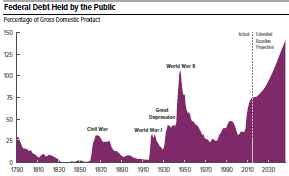
  • Massive debt, now at 76% of GDP (for the public part on which we pay interest), the highest since the end of WWII,

by whatever means it takes.
Donald Trump won the presidential election contest because he convinced blue-collar white voters that he would do something about their declining economic prospects.  But can he actually deliver for them?
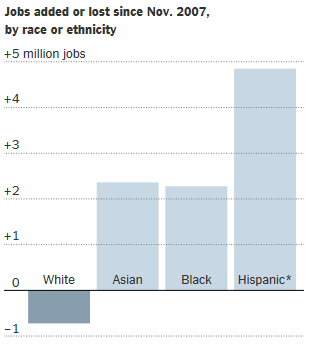
capture87Yesterday’s New York Times has an excellent analysis of this problem by the economic journalist, Eduardo Porter, “Where were Trump’s votes?  Where the jobs weren’t.”  Mr. Porter points out that, in fact, Hispanic, Black and Asian workers have all done much better than white workers since November 2007 (see above chart).
capture88He also points out that all three of these minority groups live primarily in metropolitan areas where jobs have been growing much faster than in nonmetropolitan areas (see above chart).
He further points out that while the number of manufacturing jobs has been flat since 1978, the number of service jobs has been increasing rapidly and that most of these new service jobs are in the cities where minorities are clustered (see below).
capture89The question then is what Mr. Trump (or anyone else!) can do to help his largely rural blue-collar constituency?  Mr. Porter recognizes that faster economic growth will have to come from investments in technology and human capital.  But he thinks that this will happen mostly in the cities and thus help minorities proportionally more than whites. Conclusion. Helping blue-collar whites is Mr. Trump’s fundamental economic problem.  Faster overall economic growth will help to some extent.  Trade restrictions will not help.  Immigration restrictions might help but could also hurt the overall economy if employers can’t hire enough workers. Better education and vocational training will help in the long run but not immediately.  This is a very tough problem to solve!

Follow me on Twitter
Follow me on Facebook

The Trump Trade Agenda


Trumponomics is taking shape: tax reform, regulatory reform and infrastructure spending.  The likelihood of President-elect Donald Trump and Congress working together on these major initiatives is so great that the dollar and the U.S. stock market are surging. This complicates the Trump trade agenda:

  • The yuan is now being driven down against the dollar.  China will face even more pressure to devalue in the year ahead as the U.S. Federal Reserve raises interest rates and the dollar continues to strengthen. Stronger U.S. growth will also increase the demand for Chinese goods, making our trade deficit with China even greater.

    capture85

  • One way to increase U.S. manufacturing employment is to figure out how to train workers for the 334,000 manufacturing jobs which are now vacant.  Wages are stagnant is America today not because we have too few taxes and restrictions on international trade but because we have too many taxes and restrictions on domestic trade here at home.
  • When the U.S. entered the North American Free Trade Agreement, Mexican taxes on U.S. imports fell from 12.5% to zero, Canadian taxes fell from 4.2% to zero and U.S. taxes on Mexican and Canadian imports fell from 2.7% to zero.  In other words, NAFTA improved America’s competitive position.
  • Pro-growth economic policies are the key to higher wages From 1900 to 2000 employment in agriculture declined from 41% of the workforce to 1.9%. But the number of jobs in the country rose fivefold and average real income rose eightfold. All because of pro-growth economic policy. The same thing can happen again with respect to manufacturing employment in the 21st century.
  • Eliminating direct currency manipulation and special interest provisions in existing trade agreements will benefit American workers, raise world living standards and reinforce the impact of Mr. Trump’s primary recovery program.

Conclusion. Restricting international trade won’t bring back high-paying manufacturing jobs. But faster overall economic growth will create more jobs and better paying jobs as businesses have to compete more vigorously for qualified employees.

Follow me on Twitter
Follow me on Facebook


What to look for in President Trump’s First Budget


As a new administration prepares to take office in January, one of the key indicators of President Trump’s approach to government will be his first budget. This is especially true since the Republican controlled Congress is likely to take a Republican President’s budget seriously.

capture79
One of our nation’s chief fiscal watchdogs, the Concord Coalition, has summarized the most important things to look for:

  • What is the overall fiscal target? President Obama’s recent budgets have aimed at stabilizing the debt as a share of the economy. House Republicans have aimed for a more ambitious goal of balancing the budget within ten years, gradually reducing the debt as a share of the economy. What path will Mr. Trump recommend?
  • What specific tax cuts will be proposed and what are the likely revenue effects? During the campaign Mr. Trump proposed tax cuts amounting to $5.9 trillion in revenue loss over ten years. Even with dynamic scoring, taking the stimulatory effects of his tax cuts into effect, the revenue loss is still $3.9 trillion over ten years. Such huge revenue losses will make our debt much worse than it is already and won’t be approved by Congress.
  • What will the budget recommend for the federal debt limit? Currently the debt limit is suspended until March 16, 2017 when it will return at whatever level it is on that date. Congress will then have several months to reset it. Whatever the President recommends will send a strong signal, positive or negative, to the financial markets.
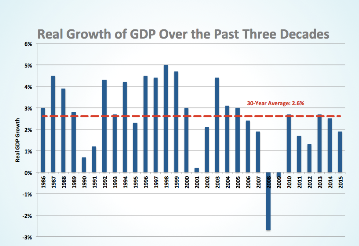
  • What economic growth rates will the budget assume?   GDP growth has averaged 2.6% for the past 30 years. Any predicted long term growth rate higher than this will lack credibility without strong justification.

Conclusion. Mr. Trump has the opportunity to institute the change in course which so many Americans would like to see. His first budget will set the tone and provide an important clue as to whether or not he is serious about doing this.

Follow me on Twitter
Follow me on Facebook


Can the Economy Grow Faster without Increasing Our Debt?


As I have been saying over and over on this blog for several years, America’s two major fiscal and economic problems are:

  • Slow Economic Growth, averaging just 2% since the end of the Great Recession in June 2009.
  • Massive Debt. Our public debt, on which we pay interest, is now $14 trillion or 76% of GDP, the highest it has been since the end of WWII.

President-elect Donald Trump campaigned on the issue of slow economic growth and will surely work with the Republican Congress to institute various tax and regulatory reform measures needed to speed up growth.

capture15But during the campaign Mr. Trump also introduced a specific tax reform plan which would lead to an estimated $4.4 trillion in new debt over the next ten years. Such a very large amount of new debt is highly undesirable and hopefully will be rejected by Congress.
In fact, as described by the Tax Foundation, there are some very good ways to use tax reform to improve growth without increasing debt. Fox example:

  • Allowing the full and immediate expensing of capital investments will grow the economy by 5.4% at a cost of $881 billion over ten years.
  • Lowering the top corporate tax rate to 20% will grow the economy by 3.3% at a cost of $718 billion over ten years.
  • Eliminating all itemized deductions except the charitable and mortgage interest deductions will slow economic growth by only .4% and increase tax revenue by $2,268 billion over ten years.

Conclusion. Just these three specific tax reform measures would grow the economy by about 8% while producing $600 billion in new tax revenue over a ten year period.  There are other ways as well of achieving similar growth and revenue levels.  The point is that the changes our country needs can be accomplished without increasing the national debt and perhaps even reducing it instead.

Follow me on Twitter
Follow me on Facebook

What Trumponomics Will Look Like (Hopefully!)


Donald Trump won the presidential election because of his strong support from blue-collar workers who feel aggrieved by the U.S. economic system. Many have lost their jobs in recent years due to technology and globalization.  Many others have suffered wage stagnation.  Helping this large group of voters is surely Mr. Trump’s primary mandate from the election.

capture79
The best way to do this is to make the economy grow faster by implementing smart policies such as:

  • Corporate tax reform. Reducing the top rate from 35% to about 20% will make the U.S. competitive with other developed countries and induce American multinational companies to bring their overseas profits back home for reinvestment. This will create more jobs and better paying jobs. This can be paid for by eliminating various deductions.
  • Business tax reform. Allow full expensing of capital investments, paid for by eliminating the deductibility of interest payments. This will strongly encourage more business investment and therefore increase worker productivity.
  • Individual tax reform. Lower marginal tax rates across the board by 10%, paid for by eliminating most deductions. This would give an automatic increase in pay to the two-thirds of taxpayers who do not itemize deductions and, since most of the pay increase would be spent, grow the economy by stimulating demand.
  • Regulatory reform. Much can be done to alleviate the regulatory burden on business, see here and here.
  • International trade rules. “Tearing up NAFTA” would be a huge mistake because the U.S. exports $600 billion annually to Canada and Mexico with a trade deficit of only $40 billion. But NAFTA can be updated with side agreements to address concerns of fairness. Expand retraining programs for workers who lose their jobs to foreign competition.
  • Immigration reform. Secure our southern border and deport the illegal immigrants who are lawbreakers as Mr. Trump wants to do. Then give guest worker visas to law-abiding employees of legitimate businesses and use eVerify to enforce them.

Conclusion. Changes such as these will give a big boost to the economy and therefore create many new jobs and better paying jobs.

Follow me on Twitter
Follow me on Facebook


Bush Failures Led to Obama and Obama Failures Led to Trump


As I have previously stated, I voted for Hillary Clinton because Donald Trump is so crude and sleazy even though our country will now greatly benefit from the change which Mr. Trump represents.  This is the way the political process often works.

capture79 Consider that after eight years of George Bush we had:

  • Ongoing war in Iraq and Afghanistan, of which the Iraq war was an unnecessary mistake.
  • $2.5 trillion of additional debt, even after Mr. Bush started out with a budget surplus, compliments of Bill Clinton.
  • An expensive new Medicare Part D prescription drug plan which just makes overall Medicare even less affordable than it already is.
  • The Financial Crisis of 2007-2008 which the Bush Administration could have seen coming if they had been more vigilant.


Under such political circumstances, the 2008 election of the Democratic nominee, Barack Obama, over the Republican nominee, John McCain, was almost inevitable. But then in the next eight years we have experienced:

  • Slow economic growth averaging only 2% per year, ever since the end of the Great Recession in June 2009. The unemployment rate has fallen to 4.9% but there is still a lot of slack in the labor market which holds wages down. This is the main reason for the huge support Mr. Trump had from white blue-collar workers in the election.
  • Massive debt, now 76% of GDP (for the public debt on which we pay interest), the highest since right after WWII and double the debt in January 2009 when Mr. Obama entered office. Such a high debt level means greatly increased interest payments as soon as interest rates go up which they are likely to do anytime. The high annual deficits contributing to the debt mean little budget flexibility for new programs.

Conclusion. Democrats like to say that slow economic growth is “the new normal” which can only be overturned with budget busting new fiscal stimulus. This is a pessimistic point of view which refuses to consider other alternatives.  This is what led to Ms. Clinton’s defeat on November 8.

Follow me on Twitter
Follow me on Facebook

We Need Fundamental Change and Now We’re going to Get It!


I want to emphasize that I voted for Hillary Clinton on Tuesday because Donald Trump has such a sleazy and mercurial personality. But Mr. Trump was clearly the change candidate and we need change big time.  His strongest base of support is the white working class which has not really recovered from the Great Recession of 2008-2009 and he will surely try to help out these people.

capture79
Here are the changes we need in order of importance:

  • Grow the economy faster. Tax reform, individual and corporate, and regulatory reform are what are most needed. Mr. Trump and the House Republicans are in rough agreement on both of these major initiatives and hopefully the new Republican led Senate will go along. The best kind of tax reform means to lower tax rates and shrink deductions enough to avoid losing tax revenue. This can be accomplished if a real effort is made to do it this way.
  • Begin to shrink our massive debt. This can only be done by major entitlement reform, meaning to control the costs of Social Security, Medicare and Medicaid. Medicare should be transitioned over from a single payer system to a premium support system, consistent with a reformed Affordable Care Act. Healthcare costs can only be contained by giving consumers more skin in the game, meaning higher deductibles supplemented with health savings accounts.
  • More assertive foreign policy. Worldwide peace and stability depend on our own economic and military strength. Right now China, Russia and Iran think they can push us around. President Trump will not let this happen.
  • Trade and immigration policy. Most knowledgeable people agree that international trade is generally beneficial. We simply have to do a better job of retraining American workers who lose their jobs to foreign competition. The key to immigration reform is tougher border security plus an effective guest worker visa program.

Conclusion. The Republican House of Representatives has an excellent plan, “A Better Way,” for American economic, fiscal and social renewal and Mr. Trump is largely supportive of it. This augers well for fundamental progress in the next four years.

Follow me on Twitter
Follow me on Facebook

Election Day 2016: The Fourth Anniversary of this Blog


I have now been writing this blog for four years, beginning right after the presidential election of 2012. I was a candidate in the May 2012 Republican Primary for the 2nd Congressional District of Nebraska.  I campaigned on the platform to “eliminate the deficit.”  I lost to the incumbent Lee Terry who was in turn replaced in office by the Democrat Brad Ashford in 2014.

capture79
The overriding theme of my blog is “how to restore fiscal responsibility to our national government.”   I discuss two fundamental and related issues:

  • Massive Debt now 75% of GDP, the highest level since right after WWII, and predicted by the Congressional Budget Office to keep rising steadily under current policies.
  • Slow Economic Growth averaging just barely 2% per year since the end of the Great Recession in June 2009. Although the unemployment rate is down to a respectable 4.9%, the labor participation rate is also lower than usual. Faster growth would mean more jobs and better paying jobs. It would also mean more tax revenue to shrink our annual deficits.

How should these problems be addressed?  In briefest outline:

  • Balanced Budget Amendment to the Constitution. This is a drastic measure but I see no other way to get the job done. The pressure on Congress is always to create new programs and spend more money, not less. A BBA could be designed in a flexible manner to allow emergency overrides. It could also be phased in by, for example, having an effective date three years after ratification. It so happens that 28 states (out of 34 needed) have now called for a Constitutional Convention to propose such an amendment. (http://bba4usa.org/)
  • Tax Reform, lowering rates for individuals and corporations, paid for by shrinking deductions, would do wonders for encouraging business investment and entrepreneurship, as well as encouraging American multinational companies to bring their foreign earnings back home for reinvestment.

Conclusion. Much more can be done but this would be a very good start.

Follow me on Twitter
Follow me on Facebook

Clinton Is Not As Bad As Trump


I’ve been saying for several months that I would endorse one of the two main presidential candidates before the election and that “Donald Trump Should Withdraw from the Presidential Race” because of his personal sleaziness and that, in any case, I could not vote for him.
But it is worse than this.  As the Wall Street Journal stated recently, “Mr. Trump would start out with more than half of the country disliking him, and most of his advisors lack governmental experience.  Too many blunders or an early recession (especially one caused by trade restrictions) could cause voters to sweep out the GOP Congress in 2018, setting up a return to an all-progressive government in 2020.” In other words the disaster of 2009-2010, when President Obama had a filibuster-proof Congress, could easily happen all over again.

capture79
Mrs. Clinton has said that she wants, ”higher taxes, more spending on entitlements, more subsidies and price controls in ObamaCare, more regulations on business, more limits on political speech, and more enforcement of liberal cultural values on schools and churches.”  The likely result of such an agenda would be more lost years of slow economic growth.  And “the costs of slow growth are corrosive.  Flat incomes lead to more social tension and political enmity.  The fight to divide a smaller pie would get uglier in a country that once was accustomed to rising possibilities.”  This is a highly conceivable result of four years of a Clinton presidency.
Conclusion. I am not exactly enthusiastic about Mrs. Clinton.  But she is predictable and much less risky than Mr. Trump.  As long as the House of Representatives remains under Republican control, which is very likely, Mrs. Clinton will have to negotiate with it to implement much of her agenda.  This could conceivably lead to bipartisan progress on such major issues as tax reform and entitlement cost control.

Follow me on Twitter
Follow me on Facebook