
Harnessing Market Forces versus Offsetting Market Forces


The economist Matthew Slaughter writes in today’s Wall Street Journal that ’High Trade’ Jobs Pay Higher Wages. He points out that the 22.9 million Americans who work for U.S. headquartered multinational companies made an average of $73,338 in 2011 compared with the overall average wage of about $55,000 that year.  “Workers in multinational firms earn more, as global engagement fosters innovation and productivity growth.”
“There is a growing concern about stagnant or falling incomes, yet most of the measures proposed to deal with the issue – raising the minimum wage and reinstating unemployment benefits – purport to help workers by offsetting market forces.  Less attention is given to harnessing market forces.”
CaptureThis can be done by “liberalizing U.S. trade, investment, immigration and tax policies.”  In other words, we need more trade agreements like NAFTA, which has been so successful in increasing trade in North America.  We need more high skilled workers, both domestic and foreign.  We need lower corporate tax rates to encourage multinational corporations to bring their trillions of dollars in overseas profits back home.
We should always strive for a more equal society with less income inequality.  But the best single way to do this is to create more opportunity by growing the economy, i.e. by harnessing market forces.

How Do We Increase Economic Mobility?


As the Wall Street Journal reported several days ago, “Economic Mobility Is the New Flashpoint”.  “Both parties agree the opportunity gap is widening, but the proposed solutions are starkly different.”  The Democrats want to increase the minimum wage, extend unemployment benefits, and expand access to college.  The Republicans suggest a whole potpourri of approaches such as reforming welfare (including food stamps), extending school choice, cutting taxes, and relaxing regulations on new businesses.
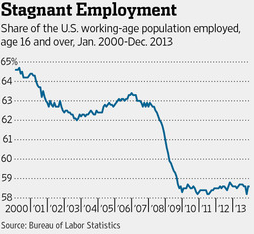
A look at the latest jobs report from the Labor Department should provide the focus which Congress needs to figure out how to increase economic opportunity.  Although the unemployment rate dropped substantially to 6.7% from 7.0% at the beginning of December, only 74,000 new jobs were created in December.  The explanation is that 347,000 left the labor force last month.  The labor force participation rate, the share of the U.S. working-age population employed, age 16 and over, has dropped from 64.5% in 2000, to just under 63% at the beginning of 2008 to near a post-recession low of 58.6% last month (see chart below).
CaptureIn other words, Congress should be totally focused on speeding up economic growth in order to create more jobs.  Since new businesses create the most new jobs, we should indeed relax as many regulations as possible which impede entrepreneurship.  We should lower the corporate tax rate from its very high current value of 35% to get American multinational companies to bring their trillions of overseas profits back home for reinvestment in the U.S.  Moving to a national consumption tax (see the Graetz Plan discussion in my January 7 post), could mean dropping the corporate tax rate to as low as 15%.
Isn’t is obvious that the best thing we can do to give low income people an opportunity to rise up the economic ladder is to just give them a job in the first place?  If they’re ambitious they’ll take any opportunity they can get and run with it!

Why a High Corporate Income Tax Is So Damaging to Our Economy


My previous post, “Fundamental Tax Reform Is the Key to Solving Our Economic and Fiscal Problems II.  The Graetz Plan”, describes a tax reform plan which establishes a 14% national consumption (VAT) tax, exempts families earning under $100,000 from paying any income tax and also reduces the Corporate Income Tax to 15%.  All of this is done in a revenue neutral manner while also preserving all of the progressivity of our current income tax system.
CaptureA recent Op Ed column in the New York Times, by the economist Lawrence Kotlikoff, “Abolish the Corporate Income Tax”, makes the case that such a proposal “might sound like a gift to the rich, but it would actually help workers. … Apple’s tax return says it all:  The company, according to one calculation, paid only 8% of its worldwide profits in United States corporate income taxes, thanks to piling up most of its profits and locating far too many of its operations overseas.”
Our corporate income tax rate, at 35%, is one of the highest in the world and this is what encourages American multinational companies to move their business to other countries.  Whether we abolish the corporate income tax entirely, or just reduce it to 15%, is less important than recognizing the need to overcome popular prejudice about big business and make fundamental changes in our tax structure.
Solving our country’s many problems, from rising inequality at home to projecting adequate strength around the world, requires that the U.S. have a strong economy.  An annual growth rate of 2% of GDP is not nearly good enough to end our current economic stagnation.  To accomplish this will require overcoming the strong headwinds of increasing global competition and the replacement of people with machines.  We will need innovative thinking and initiative to break out of the old ways of doing things which are holding us back.
Are the American people “exceptional” enough to accomplish this challenging task?

An Optimistic View of America’s Future!


In the latest issue of Barron’s, Frederick Rowe, the managing partner of Greenbrier Partners Capital Management, asks in “More Than a Sugar High?” , “Can you imagine a country that is managed in an economically rational manner, creating the wealth that’s necessary to take proper care of the citizens who get left behind? … What if our economic recovery is more than a sugar high?  What if there is more here than insanely stimulative monetary policy from the Federal Reserve?  What if the U.S. has already begun to steer an economic course to a period of unprecedented and genuine prosperity, achievement, and problem solving?”
Here are eight factors which Mr. Rowe gives to point us in the right direction:

  • North American Energy Independence (already on the horizon).
  • Sensible Immigration Reform: encouraging our most enterprising and hard-working people to become citizens rather than chasing them away.
  • Repatriation of Corporate Income: if a company domiciled in the U.S. makes money in Argentina and wants to invest it in the U.S. we double-tax the daylights out of it.  It would be hard to imagine a more counterproductive tax policy.
  • Changing Directors and Their Thinking: the once unthinkable mindset of corporate directors acting on behalf of long-term owners (rather than the CEOs with whom they play golf) is actually gaining traction.
  • Lowering Corporate Taxes: the tax-writing committees in Congress are working on this.
  • Increasing Technological Leadership: the most dynamic technology companies in the world are domiciled in the U.S. Technology, in the short run, displaces workers.  But eventually workers catch up because new technology creates new kinds of jobs that were never imagined before.
  • Americanization of the World: more than three billion people around the world will soon be able to afford to live much more like the 300 million Americans do.  So companies which make it big here have an automatic global opportunity.
  • Obamacare:  Even this bureaucratic catastrophe provides a large opportunity for economic opportunity.  Think of Jimmy Carter’s failures which led to Ronald Reagan’s successes.

“Let your imagination run and consider all the things that can be accomplished by an energy-independent, cash-generating, cash-repatriating country that is a hotbed of technological innovation.”
I can’t possibly say it any better than this!

Labor’s Share of National Income Is Falling

The latest issue of the Economist shows quite dramatically in the article “Labour Pains” that labor’s share of national income is dropping.  In the U.S. workers’ wages have historically been about 70% of GDP.  In the early 1980s this figure started falling and is now 64%.  Similar declines are occurring in many other countries.
This phenomenon is closely related to what others are observing as I have reported recently.  Tyler Cowen’s new book “Average is Over” discusses the threat of technology to the middle class.  Daniel Alpert in “The Age of Oversupply” talks about the increase of competition from various global forces.  Stephen King’s “When the Money Runs Out” makes the case that “a half-century of one-off developments in the industrialized world will not be repeated.”
Historically the stability of the wage to GDP ratio “provides the link between productivity and prosperity.  If workers always get the same slice of the economic pie, then an improvement in their average productivity – which boosts growth – should translate into higher average earnings. … A falling labour share implies that productivity gains no longer translate into broad rises in pay.  Instead, an ever larger share of the benefits of growth accrues to the owners of capital.”
A shrinking share of a GDP which itself is slowing down is a double whammy.  The only way to address the problem effectively is to deal with the root causes.
First of all, we need to boost overall economic growth by the proven methods of broad based tax reform, especially including much lower corporate tax rates, making regulations less onerous, carrying out immigration reform, and giving special attention to helping entrepreneurs create new businesses.
How can we, additionally, help low skilled and low waged workers move up the ladder?  Long term the most worthwhile action is to change K-12 education by putting more emphasis on career education to produce more highly skilled workers.  Short term, we should provide crash job training for the estimated three million current job openings in the U.S. which require skilled workers.
Economic inequality in the U.S. is becoming progressively worse all the time.  There are fiscally sound ways to address this alarming problem and it is important that they be clearly and forcefully advocated.

Where Are the Jobs? II. How to Create More of Them

My previous post, two days ago, introduced a new book by two economists, John Dearie and Courtney Geduldig, “Where the Jobs Are, Entrepreneurship and the Soul of the American Economy”.  They make a very strong case that net job creation comes primarily from businesses less than one year old, true “start-ups”.  But, unfortunately, there has been a huge drop off in the number of new businesses created each year since 2007 and, furthermore, the historical average of seven new jobs created by a firm in its first year has now fallen to less than five.
How do we reverse this alarming trend?  Here is what the authors have learned from the many entrepreneurs they have talked to:

  • “Not enough people with the skills we need”
  • “Our immigration policies are insane”
  • “Regulations are killing us”
  • “Tax payments can be the difference between survival and failure”
  • “There’s too much uncertainty and it’s Washington’s fault”

Although there are 24 million Americans either unemployed or underemployed, there are also 3 million advertised high skill job openings going begging and many more potential jobs available for qualified individuals.  A greater emphasis on STEM (Science, Technology, Engineering and Mathematics) education in the U.S. would help.  But also immigration reform is urgently needed.  The Senate has passed legislation to raise the annual cap on H1-B visas (for high skilled workers) from 65,000 currently to 110,000.  Hopefully the House will concur.
A Preferential Regulatory Framework for New Businesses could be devised to help fragile new businesses in their first five years.  A Regulatory Improvement Commission could be created to streamline the entire federal regulatory process.  Likewise a Preferential Tax Framework for New Business should be created and could, for example, recommend taxing income for the first five years at a much lower rate than normal.
Regarding policy uncertainty the authors refer to the U.S. Economic Policy Uncertainty Index which is at a very high level since the Great Recession.  Economic uncertainty obviously discourages business growth.
Conclusion:  A very good way to boost the economy and create more new jobs is to put greater emphasis on supporting entrepreneurs who are trying to start new businesses.  There are a number of concrete actions that the federal government can take to do this and doing so should be a very high priority for our national leaders.

Where Are The Jobs? I. The Basics

Two economists, John Dearie and Courtney Geduldig, have just published a very interesting new book, “Where the Jobs Are, Entrepreneurship and the Soul of the American Economy”.   In April 2011, Mr. Dearie and Ms. Geduldig launched an effort to understand the nature and scope of the damage to the U.S. labor markets caused by the Great Recession and, if possible, identify new ways to enhance the economy’s job-creating capacity.
They quickly “learned of research that demonstrates how virtually all net new job creation in the United States over the past 30 years has come from businesses less than a year old – true ‘start-ups.’  Investigating further, they also learned that America’s job creation machine is faltering, with the rate of start-up formation declining precipitously in recent years.  To find out why, they launched an ambitious summer road trip – conducting roundtables with entrepreneurs in 12 cities across the nation.”  Here is what they learned.
First of all, the U.S. labor market is tremendously dynamic, as existing businesses create new jobs and eliminate others.  “In 2011, for example, 47.5 million separations occurred while 49.6 million Americans took new jobs.”  But “existing firms, of any age or size, in aggregate, nearly always produce more separations than hires.  … Indeed, existing businesses shed on a net basis a combined average of about 1 million jobs each year as some businesses fail, others become more efficient, and as separations simply outpace new hires.  By stark contrast, new firms in their first year of existence, create an average of 3 million new jobs.”
Unfortunately, there has been a huge drop off in the number of new businesses created annually since 2007.  Furthermore, the historical average of seven new jobs created by a new firm in its first year, has now fallen to less than five new jobs.
The obvious question which this discussion raises is: what policy changes are needed to boost the creation of new businesses?  This will be the topic of my next post in a couple of days!

Why Growth Is Getting Harder

The Cato economist, Brink Lindsey, has just issued a new report, “Why Growth Is Getting Harder”.  See also Robert Samuelson’s Op Ed in yesterday’s Omaha World Herald, “Economic growth potion slowing to anemic trickle”.  Annual GDP growth has averaged over 3% since 1950.  But for the past four years, since the end of the Great Recession in June 2009, it has averaged barely 2% annually and, as Mr. Lindsey notes, this low growth rate is widely predicted to continue.
Historically the rate of GDP growth is attributed to four factors:

  • greater labor force participation, mainly by women
  • better educated workers, as reflected in high school and college graduation rates
  • more invested capital per worker
  • technological and organizational innovation

For example, women’s labor force participation went from 30.9% in 1950 to 59.9% in 2000.  Since then it has started to lag.  The national high school graduation rate is stuck at about 70% and realistically can’t go much higher.  Mr. Lindsey shows that both the national savings rate and domestic investment rate have been falling steadily since 1950.  Productivity growth was high from 1950 – 1979, high again from 1996 – 2004 and has fallen off again since.
Mr. Lindsey concludes “In the quest for new sources of growth to support the American economy’s flagging dynamism, policy reform now looms as the most promising “low-hanging fruit” available.”
What policy changes and improvements will counteract these negative trends?  Here are several more or less obvious suggestions:  Immigration reform can bring our 11,000,000 illegals into the main stream economy.  Education reform, especially including an early childhood emphasis, will improve the quality of education for low-income kids, and maybe even boost graduation rates.  Tax reform, with lower tax rates (offset by closing loopholes) has much potential for boosting investment and risk taking, as well as for boosting innovation and entrepreneurship.
Faster economic growth is so beneficial for so many reasons, that we should insist that our national leaders make it a top priority.  Ideological objections, such as providing “tax breaks for the rich” are not acceptable and must be constantly batted down!

A Pessimistic View of America’s Future


The George Mason University economist, Tyler Cowen, has written a provocative new book entitled “Average is Over”, which has just been reviewed by the Economist: “The American Dream, RIP?” .  His thesis is that the slow recovery of middle class jobs following the Great Recession of 2008-2009 portends a new economy more and more devoid of middle class jobs and broad prosperity.
Mr. Tyler says that “An elite 10-15% of Americans will have the brains and self-discipline to master tomorrow’s technology and extract profit from it.  They will enjoy great wealth and stimulating lives.  Others will endure stagnant or even falling wages as employers measure their output with ‘oppressive precision’.  Some will thrive as service providers to the rich….Young men will struggle in a labor market which rewards conscientiousness over muscle.”  Some highly motivated individuals, born poor, will be able to move into the elite group with cheap online education.  This creates overall a sense of “hyper-meritocracy” at the top which “will make it easier to ignore those left behind.”
What Mr. Cowen has done is to take the strong social and economic forces of globalization and technology, add to this mix emerging machine intelligence (Google is a prime example) and then to use his vivid imagination to conjure up an image of what life will be like in the not so distant future.  America will still likely be the dominant country in the world but the historically strong middle class will shrink as the rich become richer and the poor become poorer.
Is this pessimistic vision of America’s future inevitable?  Is there anything we can do to at least slow down if not to reverse these trends?
Speeding up economic growth is our only chance to turn things around and mitigate this grim future.  Better K-12 education (and therefore early child education as well) will help in the long run.  In the short run, broad based tax reform, healthcare cost control, relaxing overly burdensome regulations, and immigration reform are the four things which will help the most.  The same old basic stuff is what we need to do!  Tyler Cowen’s story just makes the need for such changes more compelling and more urgent!

The Link between Education and Prosperity


In Thursday’s Wall Street Journal, two education experts, Paul Peterson and Eric Hanushek, write about “The Vital Link of Education and Prosperity”.  They point out, for example, that only 32% of U.S. high school students are proficient in mathematics based on the National Assessment of Educational Progress test.  Comparable scores for other countries are 45% in Germany and 49% in Canada.
The authors demonstrate a close correlation between academic achievement and economic growth of many countries around the world.  The highest academic achievers, such as South Korea, Taiwan, Singapore and Hong Kong, also have the highest growth rates.
Over the past 50 years, from 1960 – 2009, the U.S. economy has grown 2/3 of a percent faster than would be predicted by our mediocre test scores.  But our relative economic advantages, such as open markets, secure property rights, universal K-12 education and favorable immigration policy, are now declining as other countries adopt these same successful social and economic practices.  In other words, we need to do better if we want to remain on top.
The authors make a good case that America’s GDP growth rate would be boosted by ¾ of a percent per year if we were able to match the educational attainment level of Canadian students (49% math proficiency vs 32%).
In their recent book, “Endangering Prosperity, a Global View of the American School,” the authors break down the overall math proficiency score by racial group:  the white proficiency rate is 41.8%, the African American rate is 11.0% and the Hispanic rate is 15.4%.  In other words, almost 2/3 of the American-Canadian math proficiency gap can be explained by the poor performance of American minority groups.
Conclusion: let’s definitely try to improve American K-12 education overall.  But in working on this difficult problem, we should concentrate on measures which will have the most impact on minority groups where the problem is greatest.  For example, providing early childhood education for all low income families will do more to raise academic achievement overall than adopting the Common Core curriculum (which will mostly benefit already high achieving students).