Do We Really Need a Wealth Tax?


Our dire fiscal and economic problems are crying out for a bold solution.  We need to simultaneously stimulate our economy to grow faster and create more jobs, raise sufficient tax revenue to pay for our growing spending commitments, and address a widening inequality gap which threatens to undermine the basic principles of a free and just society.  How are we going to accomplish all of these tasks at the same time?
It seems to me that the best way is to thoroughly reform our income tax system based on the following principles:

  • Lower tax rates on marginal income to encourage more investment and entrepreneurship.  Such changes can be made revenue neutral by eliminating deductions, loopholes and other tax preferences.  This would apply to corporations as well as individuals.
  • Establish a new low percentage (1% – 2%) wealth tax with a relatively high personal exemption ($5 million – $10 million).  This would bring in approximately $200 billion per year to be used for reducing the deficit.  Equally as important it would be a visible sign that the wealthy are making a significant contribution towards solving our fiscal problem.  This will make it more acceptable to lower marginal tax rates on income in order to boost economic growth.

Fiscal conservatives often oppose any increase in tax revenue because, they think, it is likely to be used for new spending rather than for lowering the deficit.  One way to overcome this concern is to pass a Balanced Budget Amendment to the Constitution. This would make it much harder to increase spending.  The problem is that it will be very hard for Congress to pass such an amendment and have it ratified by ¾ of the states.
But something has to be done.  The longer we wait and the more debt we build up, the more painful it will be to extract ourselves when the next crisis occurs as it surely will.

Considering a Wealth Tax for the U.S.


What should a country do when it has

  • Massive accumulated debt and annual deficits predicted to grow indefinitely.
  • A rapidly growing population of retirees heavily dependent on expensive entitlement programs such as Social Security and Medicare.
  • A national Congress which is unwilling to make significant spending cuts for fear of offending powerful constituent groups.
  • Growing income inequality and wealth inequality.
  • A stagnant economy and high unemployment which makes inequality worse.
  • An inefficient income tax system which does not take in enough tax revenue to pay the bills.

The best response by far is to implement broad-based, pro-growth, tax reform.  I have often discussed how to make major changes to our current income tax system.  I have also described an attractive way to introduce a consumption tax, the so-called Graetz Plan.
CaptureAnother way to reform taxes is to introduce a wealth tax.  The economist Ronald McKinnon has described a way to do this in a Wall Street Journal column, “The Conservative Case for a Wealth Tax”.  His plan is to implement a federal wealth tax in addition to the federal income tax.  It would consist of a flat tax of about 3% imposed on household wealth in excess of a $3 million exemption which would exclude 95% of the population.  In addition to bringing in a significant amount of new revenue each year, which is its principal objective, it would serve the purpose of making a flatter, pro-growth, income-tax system more palatable to people who are concerned about inequality, and therefore to a much wider audience.
The economics journalist, Daniel Altman, recently reported in the New York Times, “To Reduce Inequality, Tax Wealth, not Income” that American household wealth totaled more than $58 trillion in 2010.  The most recent issue of Forbes Magazine reports that there are now 492 billionaires in the U.S. with a total wealth of $2.3 trillion.  A 2% tax on the wealth of just these billionaires alone would raise $46 billion.  A 0.5% tax on the wealth of all Americans would raise $290 billion annually.  These examples show that a “moderate” wealth tax could bring in a significant amount of new tax revenue which would make a big dent in shrinking our annual deficit.
We have to do something and do it quickly.  The problem will occur when interest rates return to their normal level as they surely will before long.  When this happens, interest payments on our national debt will sky rocket.  It’s going to be painful regardless, but let’s try to head for the softest landing we can manage!

Where Have All the Raises Gone?


In yesterday’s New York Times an editorial asks the question “Where Have All the Raises Gone?”, pointing out that wages for college graduates have been stagnant since 2001 (see the chart below.)  A report referred to in the NYT editorial suggests that as the information technology revolution has matured, employer demand for cognitive skills has waned and so some college graduates have had to take lower paying jobs, displacing less educated lower skilled workers in the process.  This makes sense and, of course, new hiring has slowed down even more as a result of the recession.
CaptureThe question then becomes, what, if anything can government do to counteract and overcome this trend?   According to the NYT, “what’s needed to raise pay are policies like a higher minimum wage, trade pacts that foster high labor and regulatory standards, and more support for union organizing.”
Of course there is another point of view and it is expressed very well in yesterday’s Wall Street Journal by Mortimer Zuckerman, the Chairman and Editor-in-chief of U.S. News and World Report, “Fight Inequality With Better Paying Jobs”. Mr. Zuckerman declares that “income inequality isn’t so much the problem as income inadequacy.  A more robust economy, stoked by growth-oriented policies from Washington, would help produce the jobs and opportunities that millions of Americans need to climb the economic ladder.”  He suggests that what is needed is:

  • Lower corporate tax rates so that American multinational companies will bring their foreign earnings back home.
  • Get healthcare costs under control (Obama Care doesn’t do this).
  • Cut back on unnecessary regulations to encourage more business investment.
  • Train more skilled workers.  The National Federation of Independent Businesses reports that 38% of its members have job openings they can’t fill.
  • Restore H1-B visa levels to the higher levels of earlier years – 195,000 per year compared to only 65,000 today.  Skilled immigrants start many new businesses and this is the biggest source of new job creation.

In other words there are lots of things the federal government can do to boost the economy.  As Mr. Zuckerman says, “The political system is failing us.  Washington doesn’t seem to be listening as our political parties are focused more on ideological conflict than the good of the country.”

Poverty, Inequality and the Minimum Wage II. Cities Are Expensive!


Poverty and inequality are getting worse in the United States.  The question is what to do about it.  One proposal is to raise the minimum wage from its current value of $7.25 per hour to $10.10 per hour.  The Congressional Budget Office has studied the tradeoffs in doing this.  Approximately 16 million people, at the bottom end of the wage scale, would see their incomes go up.  But 500,000 people would see their incomes go down because they’d lose their jobs!  Does the positive outweigh the negative?  It’s not clear!
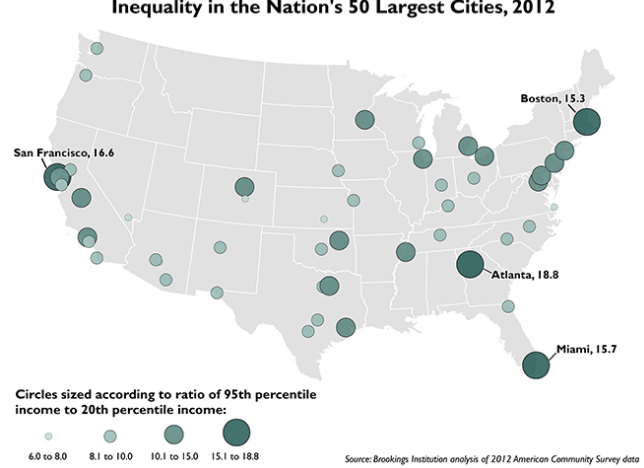
CaptureBut here is another aspect of the problem.  The Brookings Institution has just published a new study “All Cities Are Not Created Unequal”, pointing out that the 50 largest cities in the U.S. have higher rates of inequality than does the country as a whole.  Brookings looks at the so-called 95/20 ratio between the 95th percentile of wage earners compared to the 20th percentile.  The national average for this ratio is 9.1 with the 95th percentile earning (in 2012) $191,770 and the 20th percentile earning $20,968.  But many large cities such as San Francisco (16.6), Boston (15.3) and New York City (13.2) have much higher ratios.  The midsized city of Omaha has a ratio of 8.2 which is below the national average.
In other words the problems of poverty and inequality are much worse in some parts of the country than in others.  This suggests that at least part of the solution to addressing this problem should come at the state and local level.  It makes sense for California, Massachusetts and New York, for example, or at least San Francisco, Boston and New York City, to establish their own higher minimum wages.
This is not to say that a higher minimum wage at the national level is not also needed (more coming).  But the whole country cannot be expected to bail out a few major cities where the problem is much worse than elsewhere.

Poverty, Inequality and the Minimum Wage


Poverty and income inequality are getting increasingly worse in the United States and need to be seriously addressed by our political system.  In my last post on February 16, I presented data from the Heritage Foundation which shows that the War on Poverty has been quite successful in eliminating destitute poverty in the U.S.  What this means is that most low-income families have the basic necessities of enough food to eat (96%), a refrigerator (99%), a telephone (96%), air conditioning (81%), a car (74%), etc.  Of course, these “amenities” are provided at a great cost to society of about $1 trillion per year in social transfer payments.
CaptureCan we do a better job in helping the poor in the near term?  The conservative writer and political activist, Ron Unz, thinks we can.  He has just written a perceptive blog post “The Conservative Case for a Higher Minimum Wage”, proposing a national minimum wage of $12 per hour.  His reasoning is as follows.  Low wage jobs are primarily in the non-tradable service sector and so these jobs are hard to outsource and also hard to automate.  Therefore the unemployment effects of such a minimum wage increase would be minimal.  Mr. Unz estimates that, Walmart could accommodate a $12 per hour minimum wage with a one-time price hike of just 1.1%.  The grocery prices of home-grown agricultural products would rise by less than 2%.
A $12 per hour wage for a full time 40 hour per week worker would mean an annual salary of $25,000 per year or $50,000 per year for a couple.  At this income level, the family would be paying more in taxes and receiving fewer government benefits.  This would turn many net tax recipients into net taxpayers and thereby raise their stakes in the American way of life as well as lowering the deficit.
I emphasize that this is a program to alleviate poverty in the U.S.  It will not do anything to help the middle class worker whose wages have been stagnant ever since the recession started six years ago.  This is a much harder problem which will require politically charged changes in U.S. economic policy.
Stay tuned!

Inequality, Productivity and Compensation

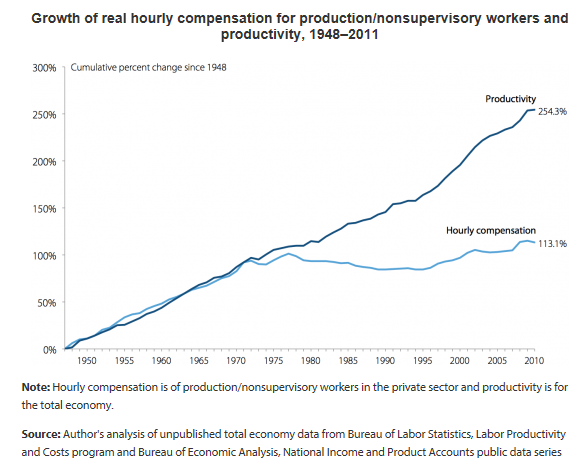
The Brookings Institution social economist, William Galston, has an interesting column in yesterday’s Wall Street Journal, “The U.S. Needs a New Social Contract”, deploring the fact that worker compensation (i.e. wages + benefits) has not kept up with gains in worker productivity since the 1970s.  Here is a chart published by the Economic Policy Institute showing the divergence between productivity and compensation for a “typical” ( i.e. in the middle) worker beginning in the 1970s:
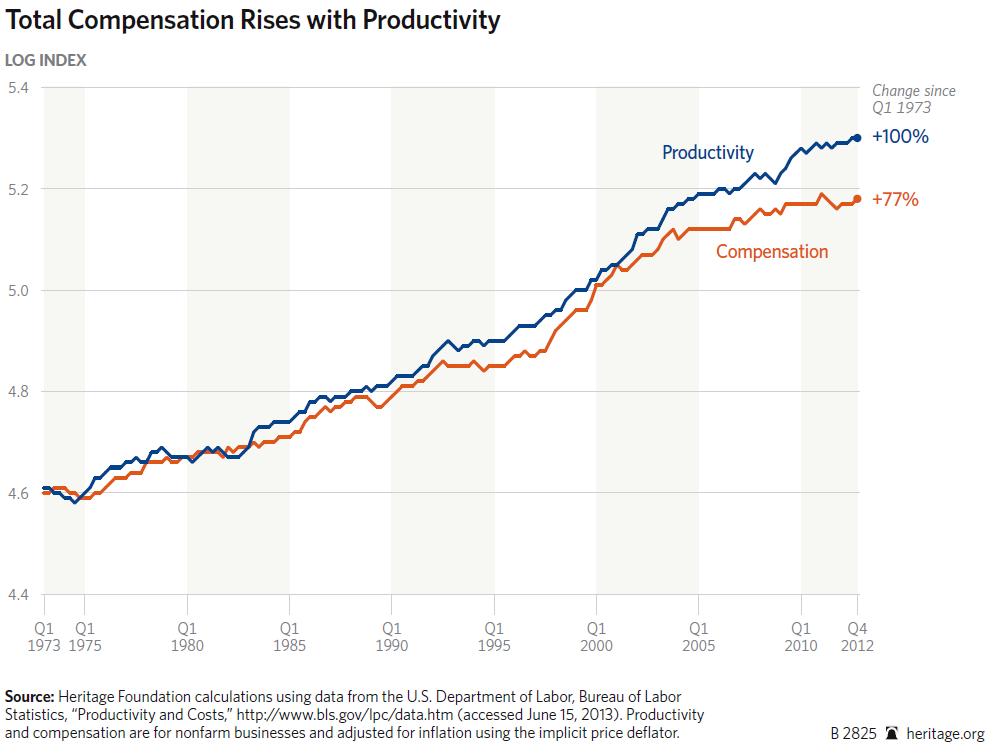
CaptureThe Heritage Foundation’s James Sherk has addressed this same question in a recent report “Productivity and Compensation: Growing Together” and shows that the “average” compensation of an American worker does track productivity very closely as shown in the chart below:
Capture1What is the explanation for this apparent discrepancy?  In fact, it is the difference between the average earnings of U.S. workers and the earnings of the median or middle worker.  The very high earnings of the top 10% and the even higher earnings of the top 1% raise average worker compensation way above the income level of the median worker.  In other words it is the result of the skewed and unequal distribution of incomes which is heavily weighted toward those at the top of the scale.  The typical or median worker is falling behind and is not benefitting from the steady rise in the overall productivity of the American economy.  This is what income inequality is all about.
The question is what to do about it.  Faster economic growth will create more opportunity by creating more jobs and better paying jobs.  Raising high school graduation rates as well as creating high quality technical training programs will also help.
Mr. Galston insists that this is not enough.  Too many workers will continue to lag farther and farther behind.  We could raise the Earned Income Tax Credit for low income workers but this would be very expensive in our currently tight fiscal situation which is likely to continue indefinitely.
Do we need a new social contract?  If so, what form will it take?  How will we pay for it?  These are indeed very difficult questions to answer!

Does Free Trade Increase Inequality?


Several days ago, David Bonior, a former Congressman from Michigan, wrote in the New York Times about “Obama’s Free-Trade Conundrum”. “The President cannot both open markets and close the wage gap.”  There is an “academic consensus that trade flows contribute to between 10 and 40 percent of inequality increases.”  This happens because “there is downward pressure on middle-class wages as manufacturing workers are forced to compete with imports made by poorly paid workers from abroad.”
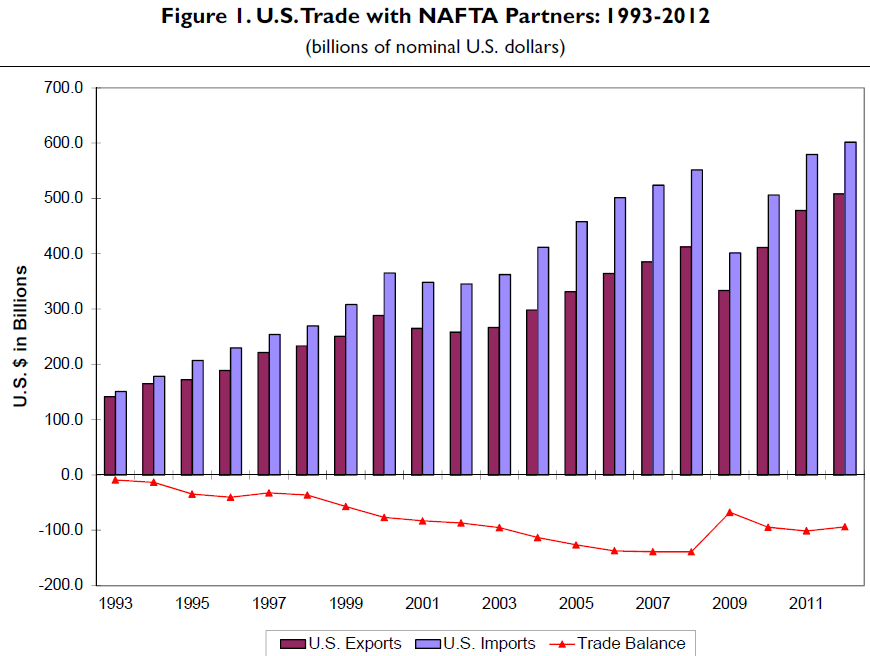
CaptureBut there is another point of view, provided, for example, by the report “NAFTA at 20: Overview and Trade Effects”, prepared by the Congressional Research Service about a year ago.  “U.S. trade with its NAFTA partners has more than tripled since the agreement took effect (in 1993).  (Canada and Mexico) accounted for 32% of U.S. exports in 2012.  40% of the content of U.S. imports from Mexico and 25% of U.S. exports from Canada are of U.S. origin.  In comparison, U.S. imports from China are said to have only 4% U.S. content.”  In other words, NAFTA at least has been a huge success.
Being able to trade with others is the foundation of private enterprise.  Foreign trade is simply an extension of domestic trade.  To limit trading opportunities with other countries would be a huge barrier to economic growth and therefore to future prosperity as well.
But at the same time we do want a more equal society as well as well as a more prosperous one.  The key to resolving this “conundrum”, as Mr. Bonior puts it, is to address “opportunity inequality” as well as “income inequality.”
It is estimated that each billion dollars in U.S. exports provides employment for about 5000 workers.  Nebraska, for example, exported $12.6 billion worth of goods and services in 2012 which translates into 63,000 jobs.
More jobs and better jobs are what create economic opportunity.  One way to create more jobs and better jobs is to promote foreign trade by removing as many trade barriers as possible.  Hopefully Congress and the President can work together to get this done!

A Global Perspective on Income Inequality II. Where Are the Jobs?


My last post on January 23 shows vividly what the challenges are in restoring the American middle class to the prosperity which existed up until the Great Recession hit in late 2007.  The problem, of course, is the gale strength force of globalization which is lifting up low wage workers all over the developing world and creating huge competition for the many low-skilled workers in the United States.
In today’s New York Times, the former Obama Administration car czar, Steven Rattner, writes about “The Myth of Industrial Rebound” in the United States, explaining why manufacturing jobs are coming back much more slowly than other jobs.  “Manufacturing would benefit from the same reforms that would help the broader economy: restructuring of our loophole-ridden corporate tax code, new policies to bring in skilled immigrants, added spending on infrastructure and, yes, more trade agreements to encourage foreign direct investment.”
CaptureThe above chart shows the huge decline in manufacturing jobs relative to other parts of the economy such as the education and health sector as well as the professional and business sector.  Of course, these more rapidly growing service sectors are the ones benefitting from the information technology revolution.  In manufacturing, on the other hand, the low skill jobs are going overseas while the high skill jobs, using technology such as robots, are much fewer in number.
Conclusion: in order to increase manufacturing jobs in the U.S., we better government policies, as outlined above by Mr. Rattner.  But we also need to recognize that there aren’t going to be as many high skilled manufacturing jobs in the future.  We are going to need much better K-12 and post-secondary educational outcomes to prepare the middle class for the high skilled service jobs which will predominate in the future.

A Global Perspective on Income Inequality


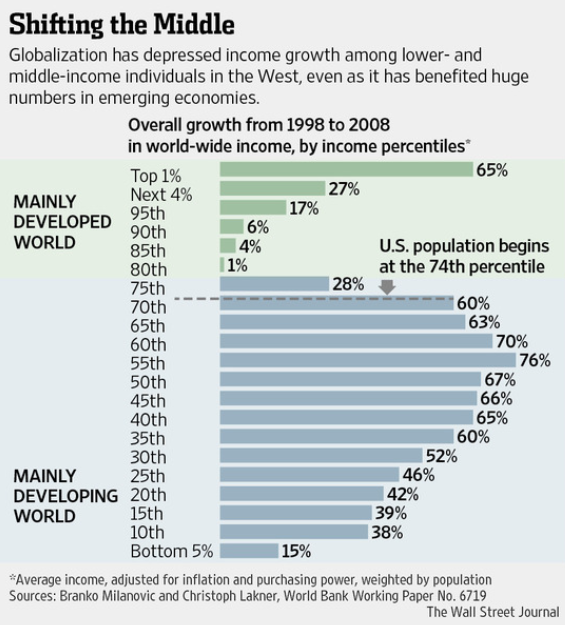
In connection with the annual World Economic Forum in Davos Switzerland, the World Bank has published a breakdown of income growth around the world, as reported yesterday by the Wall Street Journal in the article “Two-Track Future Imperils Global Growth”.  The key finding, as shown in the chart below, is that it is precisely the middle class in the developed nations which saw the slowest income growth in the years from 1998-2008.
CaptureIt is clear from this chart what is going on around the world.  The top 1% makes its money from capital investments and historically the return on capital exceeds economic growth.  The next 9% are both the skilled workers and the educated professionals who are benefitting from the growth of  knowledge industry.  The medium skilled middle class in the developed world, from the 75th percentile through the 90th percentiles, are the ones who are seeing the smallest income gains.  Their jobs are being eliminated by the force of globalization which is shifting lower skilled work to lower paid workers in the developing world.
The article points out, consistent with the above chart, that the income, including benefits, of the poorest 50% in the U.S. grew 23% in this same time period.  So it really is the middle class which is hurting the most in the U.S.  There are three basic ways of addressing this problem:

  • The federal government can help by taking much stronger measures to boost the economy thereby creating more jobs as well as higher paying jobs.  Tax reform, trade expansion, immigration reform and fiscal stability are what is needed to get this job done.
  • The states can help by improving our K-12 education system to make sure that everyone acquires the basic academic skills, such as reading and math, which they will need to achieve their highest potential in life.
  • All concerned and aware individuals (such as ourselves!) must constantly beat the drums to encourage young people to stay in school and take learning seriously.

America is “exceptional” because it is the strongest, freest, and wealthiest country the world has ever known.  But our future success is by no means guaranteed.  We have to constantly work for it and earn it!

Harnessing Market Forces versus Offsetting Market Forces


The economist Matthew Slaughter writes in today’s Wall Street Journal that ’High Trade’ Jobs Pay Higher Wages. He points out that the 22.9 million Americans who work for U.S. headquartered multinational companies made an average of $73,338 in 2011 compared with the overall average wage of about $55,000 that year.  “Workers in multinational firms earn more, as global engagement fosters innovation and productivity growth.”
“There is a growing concern about stagnant or falling incomes, yet most of the measures proposed to deal with the issue – raising the minimum wage and reinstating unemployment benefits – purport to help workers by offsetting market forces.  Less attention is given to harnessing market forces.”
CaptureThis can be done by “liberalizing U.S. trade, investment, immigration and tax policies.”  In other words, we need more trade agreements like NAFTA, which has been so successful in increasing trade in North America.  We need more high skilled workers, both domestic and foreign.  We need lower corporate tax rates to encourage multinational corporations to bring their trillions of dollars in overseas profits back home.
We should always strive for a more equal society with less income inequality.  But the best single way to do this is to create more opportunity by growing the economy, i.e. by harnessing market forces.