“We’ve Got to Do Something about Income Inequality”


This is what I hear over and over again from my liberal-minded friends.  Their solution is to raise taxes on the rich and give to the poor.  This might help a little but not nearly enough.
The best way to help middle- and lower-income people is to give them more opportunities for self-advancement by providing more upward mobility in society.  Right now the middle class is being “hollowed out” as shown in the chart just below.
CaptureThere are three major reasons for this:

  • Economic Globalization which provides low cost goods from around the world and thus puts pressure on low- and semi-skilled workers in the U.S.
  • Rapid technological advancement which puts a higher premium on educational attainment and advanced skill acquisition.
  • Slow economic growth averaging only 2.3% since the end of the Great Recession in June 2009.

Globalization and technological advancement are strong worldwide forces likely to continue indefinitely.  We will simply have to adapt to them with long term strategies such as improved educational outcomes at all levels (early childhood, K-12 and post-secondary).  But speeding up economic growth is under our direct control with tried and true methods which are not being fully utilized at the present time. Such as:

  • Tax Reform. We should lower tax rates for individuals across the board, paid for by shrinking deductions for the wealthy. This will give middle- and lower-income workers, as well as new entrepreneurs, more money to spend, thereby boosting both supply and demand in the economy.
  • Increasing the Earned Income Tax Credit paid for by using some of the increased revenues from shrinking deductions for the wealthy. This would encourage more people to take and hold onto entry level jobs, thus boosting the economy by increasing the size of the workforce.

In other words, much can be done to reduce income inequality.  Redistribution of tax revenue is fine as long as it is done in a way which increases economic growth, rather than just punishing the rich.

How Do We Boost Middle Class Jobs?


Income inequality is a serious political issue these days as it should be.  America’s future well-being depends on widely shared prosperity.  One of the very best ways to lessen inequality is to increase mobility into the middle class.
Capture  The political and economic analysis group, FiveThirtyEight, has just reported new data (see above) that “Mid-tier Jobs Are Seeing Less Growth.”  The middle class has already been hollowed out by the gale-wind forces of globalization and technological advancement.  Now the Great Recession, and the slow recovery from it, has made things that much worse.  It’s long past time to focus on middle class recovery.
The best way to do this is to make the economy grow faster as follows:

  • Tax Reform. Lowering individual rates should be the first priority, paid for by closing loopholes and shrinking deductions for the wealthy. This will give middle- and lower-income workers more money to spend and encourage startup small businesses. Lowering corporate tax rates, again offset by shrinking deductions, will incentivize multi-national corporations to bring their profits back home for distribution or reinvestment.
  • Increase the Earned Income Tax Credit, paid for with some of the increased revenues from shrinking deductions for the well-to-do. This will encourage more people to take and hold onto entry level low-wage jobs, thus increasing the size of the workforce.
  • Putting More Emphasis on Career Education in High School. Not everyone wants to or needs to go to college. There are lots of well-paying middle class jobs for high skilled workers and a shortage of workers for these jobs in many labor markets.
  • Miscellaneous. Immigration reform, trade expansion, and easing regulations on small business would also help grow the economy.


Economic growth since the end of the Great Recession in June 2009 has averaged a meager 2.3%. Speeding up growth is the best way to raise wages and lower unemployment at a much faster rate.  This is the best way to boost middle class jobs!

My Moral, Social and Political Values


About a month ago I wrote a post about a book by Dennis Prager, “Still the Best Hope: why the world needs American values to triumph.”  According to Mr. Prager, there are three ideologies competing for the allegiance of humankind.  They are: Islamism, Leftism and Americanism.  He defines American values as 1) Liberty, 2) In God We Trust and 3) E Pluribus Unum, the three expressions which appear on all American coins.  His trinity of ideologies and values helps me understand my own political framework.
CaptureI consider myself to be a cultural Christian meaning that I identify with Christian values such as practicing the Golden Rule and trying to be a Good Samaritan rather than believing in any particular theological doctrines.
My social values are based on my moral and religious values.  Americans have the good fortune to live in a very prosperous country with much personal liberty.  But along with our freedom and prosperity comes responsibility.  First of all, we are responsible for our own behavior.  If we make bad choices, we have to accept the consequences and try to learn from our mistakes.  We have greatly benefitted from the hard work of our forebears.  In return it is our responsibility to leave the world a better place than we found it.
Just as my social values are consistent with my moral values, so do my social values determine my political values.  I am a fiscal conservative and a social moderate.  I consider it highly irresponsible for my generation to leave a huge, and growing, national debt for future generations.  Either government should cut back on spending or it should raise taxes to pay for what it spends.
But I also consider it to be America’s responsibility, as well as in its own self-interest, to promote freedom and responsibility around the world.  This is demanding,  expensive and sometimes controversial but we need to be willing to do it.  Likewise, we need to provide an adequate safety net for those among us who are truly unable to cope for themselves.
This is my first public attempt to describe the underlying values around which I organize and conduct my life.  It’s a start but I’m pretty sure that I’ll be coming back to this theme again in the future!

Can We Solve All Our Fiscal and Economic Problems at the Same Time?


This website, It Does Not Add Up, is devoted to discussing our country’s most serious economic and fiscal problems.  They are:

  • Stagnant Economy. Since the end of the Great Recession in June 2009, the economy has been growing on average at the historically slow rate of about 2.3%. Slow growth means higher unemployment, stagnant wages and less tax revenue.
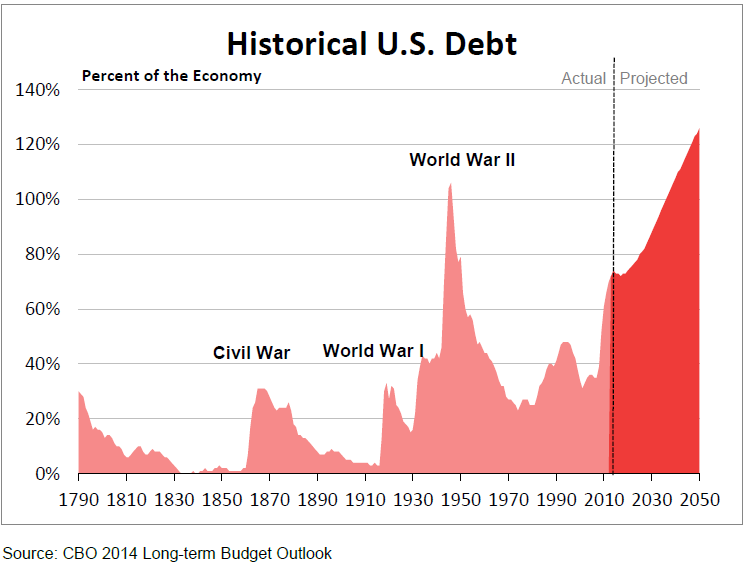
  • Massive Debt. U.S. public (on which we pay interest) debt is now 74% of GDP (highest since WW II) and projected by CBO to grow rapidly unless strong measures are taken to reduce it. This puts our country’s future wellbeing and prosperity at great risk.
  • Increasing Income Inequality. Incomes for the high-skilled and well-educated are increasing much faster than for the low-skilled and less-educated workers.

The new Republican majorities in Congress are stirring the waters by proposing a ten year plan to shrink the deficit down to zero, i.e. to balance the budget by 2025.  The opposition claims that this would “sharply cut the scale of domestic spending, which would mostly fall on the poor.”
Capture1But the American Enterprise Institute’s James Pethokoukis points out that social spending in the U.S., both public and private, is very generous and second only to France in the entire OECD. So here is how we could proceed to address our basic problems in a unified manner:

  • Balance the Budget by a combination of Republican spending cuts and cutting back on two major tax deductions: Employer-sponsored Health Insurance (cost: $250 billion per year) and Mortgage Interest (cost: $70 billion per year).
  • Boost Economic Growth by expanding the Earned Income Tax Credit to encourage more people to accept low paying, entry level jobs. Increase the Social Security eligibility age from 67 to 70, thereby keeping near retirees in the workforce for three additional years (this will also extend the solvency of the Social Security Trust Fund).
  • Decrease Income Inequality. Cutting back on tax deductions, in part to pay for expansion of the EITC, lessens income inequality as well as shrinking the deficit. A faster growing economy also lessens inequality by providing more opportunities for upward mobility.

In other words, addressing each of these fundamental problems in an intelligent manner contributes to solving the remaining problems as well.  This creates a virtuous circle for economic progress!

Too Much Income Inequality is Harmful to Society


It is well understood that income inequality is increasing in the U.S. and that there are lots of reasons for it.  Globalization provides low cost goods from around the world and thus puts pressure on low-wage workers in our own country.  Rapid technological advancement puts a high premium on educational attainment and skill acquisition and thus helps individuals who are highly motivated to succeed.  The Great Recession and our slow recovery from it have held back the growth of employment and wages increases for middle- and lower-income workers.
CaptureIncreasing income inequality is a pernicious social condition and has lots of unpleasant consequences.  A new study of U.S. counties has shown that there is a strong correlation between more inequality in a particular geographical area and shorter average live spans.  It is quite reasonable to expect that higher-income people will be more health conscious than lower- income people. Excessive inequality is bad for lots of reasons.
The question is what we can do about it.  Here are two good ways to address it:

  • Faster economic growth would help a lot. The American Enterprise Institute’s Michael Strain has recently proposed a fairly modest plan for increasing employment by cutting tax deductions for the wealthy, increasing the Earned Income Tax Credit for the poor and at the same time decreasing deficit spending. I have made a more substantial proposal along the same lines.
  • Boost educational performance across the board. College-ready middle class kids will take care of themselves so the emphasis should be on the 70% of young adults who will not go to a four year college. There are lots of good jobs available for the highly skilled and so we need more career education in high school. We also need more early childhood education to prepare kids from low-income families to get off to a good start in elementary school.

Increasing economic growth and expanding educational opportunities for the non-college bound will require little, if any, new federal spending.  Such policies as above are simply common sense ways to reduce income inequality and achieve a more inclusive society.

The Republican Budgets Focus on Entitlement Savings


Last week, both the House and the Senate passed ten year budget plans which would bring the federal budget into balance by 2025.  I have devoted several recent blog posts to discussing these budget proposals and how they address our very serious debt and deficit problems.
CaptureThere are several important points to make:

  • Under both of these Republican plans, overall spending will continue to increase by an average of 3.3% per year, from $3.8 trillion in 2016 to just over $5 trillion in 2015. The President’s budget would increase spending to $6.17 trillion by 2025 and would achieve no balance between spending and revenue.
  • Most of the savings in the Republican budgets, as indicated in the above chart, come from the mandatory (entitlement) programs of Social Security, Medicare and Medicaid. Medicare would be transformed into a subsidy program along the lines of the exchanges set up under the Affordable Care Act. Medicaid would be turned into a block grant program administered by the states. Social Security would be studied by a bipartisan commission to recommend operating efficiencies.
  • Other social welfare programs would be affected to a much smaller extent. For example, the Supplemental Nutrition Assistance Program (SNAP), or Food Stamps, has seen a growth of recipients of 69% between 2008 and 2013 while the poverty rate increased by just 16.5% during the same period. The Republican budgets would block grant Food Stamps to the states in order to achieve operating efficiencies.
  • It is true that both the House and Senate budgets would increase military spending by about 10%. But so would the President’s budget and we live in a very dangerous world. Military defense is one of the most very basic functions of our federal government.

Our country is in dire fiscal condition with large annual deficits projected indefinitely into the future, contributing to an exploding national debt.  It is heartening that our political system is responding to this threat to our future security and prosperity.  Let’s hope that House and Senate majorities continue to keep a sharp focus on the urgent task of fiscal restraint.

An Open Letter to Representative Brad Ashford


You’re off to a great start in Congress!  You’ve clearly established that you’re independent minded and that you vote your conscience.  I expected that you would act in this way and that is why I supported you during last year’s election campaign.  We need more people like you in Congress.
As you perhaps know, I am a non-ideological fiscal conservative and social moderate.  I am, like you, mainly interested in finding practical, workable solutions to difficult and complicated problems.  But I do have one guiding principle to which I strongly adhere.  I believe that, as a general rule, every level of government should refrain from spending more money than what it can pay for with tax revenue.
CaptureUnfortunately our federal government has gotten away from this principle in recent years.  This is clearly demonstrated in the above chart which shows an already very large national debt getting much, much worse in the coming years.
There is a movement in the new 114th Congress to address this perilous situation which we have gotten ourselves into.  I am referring to the bills drafted by the Budget Committees of both the House of Representatives and the Senate which would produce balanced budgets over the ten year period, 2015 – 2025.
It was reported in today’s Wall Street Journal that the full House voted yesterday to approve the budget bill by a 228-199 margin but without any Democratic votes.  This means that either you voted against the Budget Bill or you did not vote on it.
I don’t believe that any one vote is so important that it constitutes a decisive litmus test determining my support of a candidate in a future election.  However, as I mentioned above, I feel very strongly that we must greatly shrink our very large budget deficits and that now, not later, is the time to get started on this urgent task.
I hope to be able to support your re-election campaign in 2016 and beyond.  That is why I am writing to you at the present time.

Status Quo on the Budget Is Not Good Enough!


As I like to remind readers, I am a non-ideological fiscal conservative.  I am not hard core anything.  I just want to find practical, workable solutions for difficult and complicated problems.  There is basically only one exception to my generally moderate outlook.  I detest huge amounts of deficit spending except for unusual circumstances.  Most of the time we should be willing to either raise taxes and/or cut spending to do what needs to be done and to live within our means.
This is why the current efforts by the Budget Committees of both the House and the Senate to devise a plan to balance the budget, i.e. eliminate deficit spending, over a ten year period is so exciting to me.
An analysis in today’s New York Times suggests that Congress should be content to just extend the so-called Ryan-Murray Budget from 2014-2015.  “Ryan-Murray didn’t decisively move the needle one way or the other, which is why it was able to attract bipartisan support.  Rather it preserved the status quo.  In a world of divided government and polarized politics, keeping the government running without a lot of brinkmanship and high drama may be the best we can hope for.”
CaptureAs I pointed out in my last post, current policy will raise government spending by 5.1% annually over the next ten years.  The President wants to increase spending by an additional $1 trillion over this time period.  The Republican budgets, which lead to balance in ten years, still allow spending to increase by 3.3% annually.  The difference between the two plans is illustrated in the above chart from last Sunday’s Omaha World Herald.
Congress is finally in a position this year to start digging us out of the deep fiscal hole we have fallen into.  Let’s hope that too much “bipartisan” status quo thinking doesn’t get in the way of progress!

How the Obama and Republican Budgets Compare


The Budget Committees for both the House of Representatives and the Senate have now passed plans to achieve balanced budgets within a ten year period.  My last two posts have discussed the compelling need to get deficit spending under control and an overall rationale for how to approach this difficult task. Today I will take a look at the major differences between the Obama budget and the House and Senate budgets.  The two congressional budgets are quite similar and will surely be reconciled into a single budget.
CaptureHere are the major differences:

  • Revenue. The President wants to raise taxes by $3 trillion over 10 years to pay for more spending while the Republicans wants revenue-neutral tax reform in order to increase economic growth.
  • Spending. Under current policy the government will spend $48.6 trillion over the next ten years which represents a 5.1% annual rate of spending increase over the present. The President wants to spend an additional $1 trillion over this time period on new initiatives. The Republicans propose spending about $5.4 trillion less, or $43.2 trillion, which still works out to a 3.3% annual rate of increase over the present.
  • Deficits. Under current policy the deficit would start to increase, as a percentage of GDP, in 2018. The President proposes to stabilize the deficit at 2.5% of GDP. The Republicans would balance the budget within ten years by shrinking the deficit down to zero.
  • Public Debt. Under current policy the public debt (on which interest is paid) will increase to 79% of GDP by 2025. The President’s budget would stabilize the debt at the current level of 73% of GDP. The Republican’s balanced budget would shrink the debt to 57% of GDP by 2025.


There are stark differences between the President’s proposed budget and the Republican alternative.  Which is the better route to progress and prosperity?  Is it to raise taxes, increase government spending and only stabilize the debt or is it to streamline taxes, slow down the growth of spending and shrink the debt?  This is a fundamental question of government policy which will not be quickly resolved.  But at least the question is being raised in a dramatic way!

It’s Time to Bite the Bullet and Set up a Balanced Budget Plan

As a result of the 2014 elections, both the U.S. House of Representatives and the Senate are controlled by Republicans.  The House Budget Committee and the Senate Budget Committee are now gearing up to produce plans to balance our federal budget over the next ten years.  Accomplishing this goal will be a formidable challenge.
CaptureMaya MacGuineas, President of the Committee for a Responsible Federal Budget, has recently testified before Congress as to how hard it will be to get this job done.  The gist of her testimony:

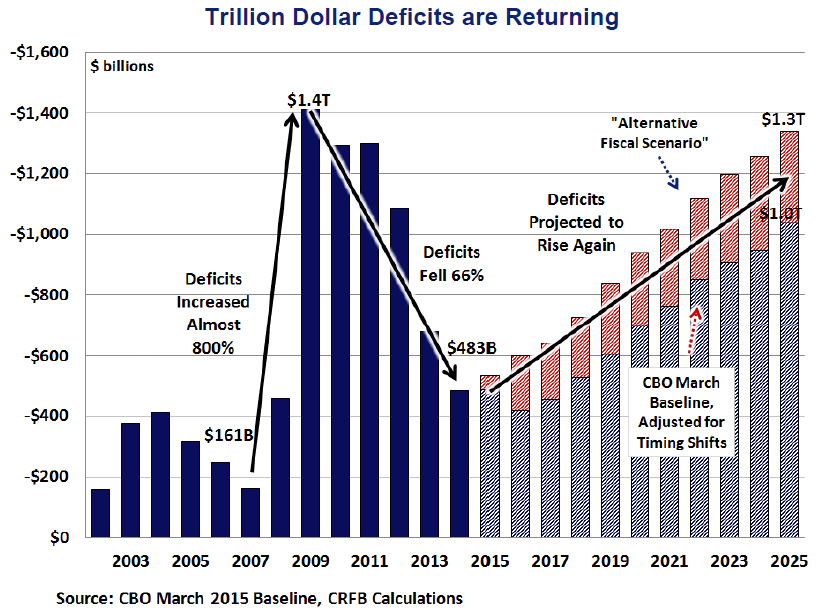
  • Even though the deficit has dropped by two-thirds since the 2009 peak, our deficit and debt problems are far from solved, as indicated in the above chart.
  • CBO estimates that under current law the deficit will rise from $485 billion in 2014 (2.7% of GDP) to more than $1 trillion (3.8% of GDP) by 2025.
  • If nothing is done to slow down these runaway deficits, annual interest payments on the debt will rise from $230 billion this year to $810 billion in 2025. Even with a balanced budget by 2025, interest payments will take up $630 billion in that year.

Capture1

  • As the chart above shows, it will require a ten year savings of $5.5 trillion to bring the budget into balance by 2025. Even to reduce the debt to 60% of GDP by 2025 (compared to 74% today), will take a ten year savings of $4.7 trillion.
  • As if this isn’t hard enough by itself, there will be additional “speed bumps” along the way, whose additional one-year costs alone are $210 billion. See chart below.

Capture2Clearly it will require much pain and shared sacrifice to find trillions of dollars in budget savings over a ten year period as well as avoiding additional costly speed bumps.  But the longer we wait to get started the harder it’s going to be to get the job done.  We need to stop delaying and get started on a budget recovery program this year!