Why Is the U.S. Economy Growing So Slowly?


The U.S. economy has only been growing at the rate of 2.1% since the end of the Great Recession in June 2009, almost seven years ago. Such a slow rate of growth means millions of unemployed and underemployed workers and only small salary raises for tens of millions of others.
Capture5The New York Times economic journalist, Eduardo Porter, observes that we have “A Growth Rate Weighted Down by Inaction.”  He points out that:

  • Our economy is adversely affected by the gradual shrinkage of the work force as a share of population as baby boomers retire and the one time surge of women into the workforce in the 20th century has ended.
  • A second factor is a persistent decline in productivity growth over the last dozen years.
  • A pessimistic forecast by the Economic Cycle Research Institute foresees growth of only 1% per year for the next five years. The Congressional Budget Office projects more optimistic productivity growth at 1.5% per year, which added to workforce growth of .5% per year, would amount to total growth of 2% per year for the next ten years.

Mr. Porter goes on to say that there are concrete reasons why productivity growth is so slow:

  • Hiring is growing faster than capital investment. This is because most job growth in the last decade has been in (low productivity) services instead of (high productivity) manufacturing.
  • Too many restrictions on educated immigrants. Relaxing these restrictions would increase entrepreneurship.
  • Too many onerous regulations.
  • Under training of skilled workers. We need more vocational and career education.

Many people, including myself, have pointed out ways to alleviate these problems and speed up economic growth, for example see here. It is most unfortunate that our dysfunctional national leadership cannot figure out how to work together to get this done.

Follow me on Twitter
Follow me on Facebook

Black Lives Matter


I describe myself as a fiscal conservative with a social conscience. Most of the time I discuss issues like slow economic growth and excessive national debt.  But occasionally, like today, I deal with related issues such as social inequality.
Capture11Last fall I had a post entitled, “Why Racism Exists in America” in which I made the case that it’s not just our different skin color which divides blacks and whites, but also the large degree of social inequality between the two races, such as disparities in family structure and education levels as well as for income levels.
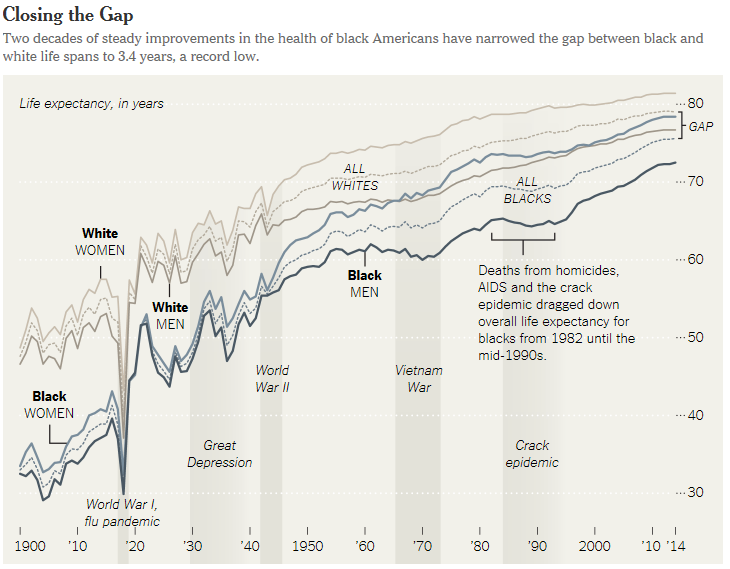
Capture10Today I am pleased to refer to an article in yesterday’s New York Times, “Black Americans See Gains in Life Expectancy.”  In fact, the black-white life expectancy gap has dropped from 7 years in 1990 to 3.4 years today.  This is for a multitude of reasons:

  • The suicide rate for black men has declined from 1999 to 2014, the only racial group to show such a drop.
  • Births to black teenage mothers, who tend to have higher infant mortality rates, have dropped by 64% since 1995, faster than for whites.
  • The rate of deaths by homicide for blacks decreased by 40% from 1995 to 2013, compared with a 28% drop for whites.
  • The death rate from cancer fell by 29% for blacks over the same period, compared with 20% for whites.
  • Smoking has declined faster for blacks than whites and, in fact, blacks now have lower smoking rates than whites.
  • The decline in black deaths from AIDS accounts for a fifth of the narrowing of the mortality gap with whites from 1995 to 2013.

One way that black lives matter is that blacks are living longer! This offers hope that blacks can and will make progress on other fronts as well.

Follow me on Twitter
Follow me on Facebook


Why Faster Economic Growth Is So Important III. Speeding Up Anemic Wage Growth


The U.S. economy is in a peculiar and potentially perilous situation:

  • On the one hand, overall economic growth has averaged only 2.1% since the end of the Great Recession in June 2009.
  • On the other hand, the unemployment rate has dropped from 8% in early 2012 to 5% today.
  • But wages and salaries have grown by only 2% in the past year and near that rate for the past four years.

What explains our relatively low, and steadily dropping, unemployment rate when overall economic growth, and wage growth in particular, are so slow?
Capture2It is low productivity growth as the New York Times’ Neil Irwin, has recently pointed out: here  and here.

  • GDP is up 1.9% in the past year. But the number of hours worked by Americans is also up 1.9% in the past year. This means no increase in labor productivity in the past year.
  • For the past five years labor productivity has only advanced by .4% annually, far below the 2.3% average annual growth since the 1950s.
  • Most job growth in the last decade has been in (low productivity) services rather than (high productivity) manufacturing.

We do not have to accept low productivity growth as immutable. As I have recently discussed here, and here, better government policies can boost labor productivity and therefore boost economic growth as well.  Here is a brief summary of what needs to be done:

  • Decrease regulation: the Dodd-Frank Act and Affordable Care Act, for example, are hampering growth by increasing the inefficiency of the financial and healthcare sectors of the economy.
  • Reform taxation: growth oriented taxation would have the lowest possible rates paid for by shrinking deductions.
  • Reform immigration: giving legal status to millions of illegal immigrants would turn them into far more productive citizens.

In other words, our severe slow growth predicament can be greatly ameliorated if we would adopt more sensible economic policies. It is a shame that this is so hard to do!

Follow me on Twitter
Follow me on Facebook

Why Faster Economic Growth Is So Important II. Replacing Factory Jobs


Populists such as Bernie Sanders and Donald Trump are doing so well in the 2016 presidential primaries because the middle class is suffering from the slow economic growth of the past 15 years.
Capture2My last post is based on the report of a typical victim.   Today’s post is based on an article by Eduardo Porter in yesterday’s New York Times discussing the loss of U.S. manufacturing jobs.  Says Mr. Porter:

  • Fifty years ago, 45,000 workers were employed in California to harvest 2.2 million tons of tomatoes. Now, with mechanization, it only requires 5000 workers to harvest 12 million tons.
  • In 1950, 24% of nonfarm jobs in the U.S. were in manufacturing. Today only 8.5% of nonfarm jobs are in manufacturing.
  • The same thing is true worldwide. Global employment in manufacturing is going down because productivity increases are exceeding increases in demand by significant amounts. The likelihood that we will get a manufacturing recovery is close to nil.
  • The U.S. has a trade surplus in manufacturing with the 20 countries with which it has trade agreements (which does not include China). We have an overall annual trade surplus in services of more than $200 billion.

In other words, an attempt to recover or save manufacturing jobs with smarter trade policies is simply impractical and will likely do more harm than good. What should be done instead is to:

  • Definitely do a better job of helping displaced manufacturing workers with Trade Adjustment Assistance and smarter job retraining programs.
  • Adopt policies to speed up overall economic growth from the anemic 2.1% annual growth rate since the end of the Great Recession in June 2009. Faster growth such as the 3.5% annual average from 1971 – 2001 will do wonders in creating more jobs and better paying jobs. For how to do this see an earlier post.

Our very serious economic problems can be solved if policy makers (and presidential candidates) would only get serious about it!

Follow me on Twitter
Follow me on Facebook

Trade Makes America Great


Two leading presidential candidates, Bernie Sanders and Donald Trump are running against trade expansion because they say it costs American jobs. I pointed out in my last post, that there is a strong correlation between international trade and global GDP growth.
Capture2Today I will focus on the direct benefits to the American economy of expanded international trade.  First of all, I refer to a recent article in the Wall Street Journal by Frederick Smith, the CEO of FedEx Corp.  Says Mr. Smith:

  • From less than $50 billion in total trade in 1966, the U.S. now imports and exports over $4 trillion annually in goods and services, out of a global trade market which exceeds $15 trillion annually.
  • NAFTA has clearly been an economic success. U.S. trade with Mexico and Canada has risen to $1.2 trillion in 2014 from $737 billion twenty years ago.
  • History shows that trade made easy, affordable and fast always begets more trade, more jobs and more prosperity.

The U.S. typically runs a trade deficit of about $500 billion per year. The New York Times journalist, Neil Irwin, explains what this means. Says Mr. Irwin:

  • The dollar is a global reserve currency, meaning that it is used around the world in transactions which have nothing to do with the U.S.
  • This creates upward pressure on the dollar for reasons unrelated to trade flows between the U.S. and its partners. That, in turn, makes the dollar stronger and American exporters less competitive.
  • In other words, trade deficits with other countries serve as their reserve dollars.
  • Maintaining this global reserve currency creates lots of advantages for the U.S., including lower interest rates and higher stock prices.
  • The centrality of the dollar to global finance gives the U.S. power on the global stage which no other country can match.

There certainly are workers who lose their jobs because of trade competition. We can and should do more to help these workers get back on their feet.  This will increase popular support for free trade and allow its growth to continue unimpeded.

Follow me on Twitter: https://twitter.com/jack_heidel
Follow me on Facebook: https://www.facebook.com/jack.heidel.3


Growing Employment, Shrinking Productivity: What Does It Mean?


I know that I occasionally repeat myself, but I can’t help it! In my opinion there are two major problems facing our country:

  • Slow economic growth which has averaged only an anemic 2.1% since the end of the Great Recession seven years ago.
  • Exploding national debt, now the highest it has been since the end of WWII. Unless we can quickly shrink our annual deficits down to zero, and therefore stop adding to the debt, interest payments on the debt will eventually rise to horrendous levels.


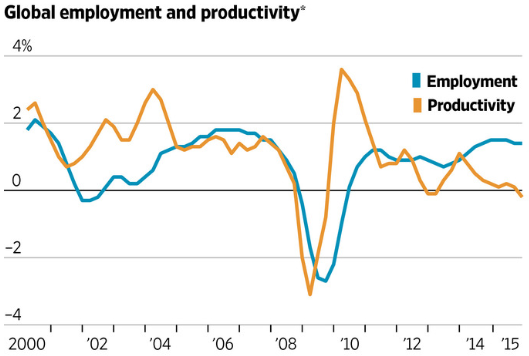
Two recent newspaper articles address the slow growth problem. Greg Ip, writing in the Wall Street Journal, points out that (worldwide) employment growth is up while productivity growth is down (see chart below).
Capture0Neil Irwin, writing in the New York Times, explains this dichotomy by pointing out that most job growth in the last decade has been in (low productivity) services rather than (high productivity) manufacturing. In other words, the U.S. economy is now producing lots of new temporary and contract jobs which do not add very much to the overall economic growth which produces higher wages and overall prosperity.
The economist John Cochrane has clearly described  why productivity growth, and therefore overall economic growth, has stagnated in recent years.  Here is a short summary:

  • Over-regulation. The Dodd-Frank Act and Affordable Care Act, for example, are hampering growth by strangling the financial and healthcare sectors of the economy.
  • Inefficient Taxation. Growth oriented taxation would have the lowest possible marginal rates paid for by shrinking deductions. Taxing consumption rather than income and savings would be even better.
  • Illegal Immigration. Solving our immigration problem would turn millions of illegals into productive citizens. An adequate Guest Worker program and e-Verify enforcement would solve this problem without the need for amnesty.

Conclusion: There are solutions to the severe economic problems facing our country. Does our political system have the flexibility to adopt these workable policies?

Follow me on Twitter: https://twitter.com/jack_heidel
Follow me on Facebook: https://www.facebook.com/jack.heidel.3


The Urgency of Defeating ISIS


After the terrorist attack in Paris I asked, “Does the U.S. Care about Europe?” Now, after the Brussels attack, it is time to repeat this warning. As the New York Time’s Roger Cohen points out:
Capture0

  • Over 1 million refugees entered Europe in 2015 alone. Another 136,000 have arrived so far in 2016. This creates a huge financial burden as well as a cultural challenge for a Europe which is already weakened by huge debt and slow economic growth.
  • It will bolster those campaigning to take Britain out of the European Union in the upcoming June referendum. A British departure from the EU will dramatically weaken it and might encourage other countries to leave as well.
  • Islamic State terror plays into the hands of populist demagogues such as presidential candidate Donald Trump and right wing French leader Marine Le Pen.
  • To allow ISIS to have its own territory, and capital city Raqqa in Syria, is a very high risk strategy. It allows the Islamic State to spread its evil not only around the immediate area but all over the world.
  • The question raised most urgently by the Brussels attacks, so soon after Paris, is whether and why Raqqa can be tolerated when Al Qaeda’s Tora Bora sanctuary in Afghanistan was not. Today, the West’s ponderous wait-them-out approach looks like capitulation.

The fundamental question is whether or not the U.S. can refrain from immersing itself in the crises of the Middle East and still maintain its status as the world’s indispensable super power. “George Bush will be remembered harshly for what he did in the Middle East. Barack Obama is gambling that he will be judged well for the things he didn’t do.”  The stakes are very high indeed for both the United States and our European allies.

Follow me on Twitter: https://twitter.com/jack_heidel
Follow me on Facebook: https://www.facebook.com/jack.heidel.3

Is A Carbon Tax Practical?


The evidence for global warming is overwhelming and largely beyond dispute.  On the other hand, our industrialized world is highly dependent on the fossil fuels which produce it. This is what makes global warming such a hot political potato.
Capture9Yesterday the New York Times columnist Eduardo Porter described a carbon tax which has been implemented in British Columbia and has gained wide political acceptance.  Its general features are:

  • It was introduced in 2008 by the Liberal Party which is actually quite conservative. It survived a challenge by the left-leaning New Democratic Party in 2009.
  • The economy in British Columbia grew faster than its neighbors even as its greenhouse gas emissions declined.
  • The tax rose from $10 (Canadian) per ton of carbon dioxide in 2008 to $30 (Canadian) in 2012. It raised the cost of a gallon of gasoline by 19 cents (U.S.)
  • Despite the price increases, voters warmed to the tax. In 2015 only 32% of British Columbians opposed it, down from 47% in 2009.
  • Every single carbon tax dollar is returned to families and businesses through a variety of tax breaks.

British Columbia’s experience shows that a carbon tax can work in practice. Here are a couple of reasons why such a tax should appeal to a broad political cross spectrum in the U.S.

  • A properly calibrated carbon price in the United States could effectively replace all the climate-related regulations businesses hate so much, including renewable fuel mandates and President Obama’s Clean Power Plan.
  • A carbon tax could become part of a broad fiscal overhaul, using the revenue, for example, to offset cuts in payroll taxes.

Conclusion. The rapidly changing climate and weather patterns caused by global warming are a threat to human civilization. Reasonable measures can be taken to mitigate the effects with minimal economic disruption.  As the world’s strongest economy and leading superpower, the U.S. should be providing more leadership towards addressing this very serious problem.

Follow me on Twitter: https://twitter.com/jack_heidel
Follow me on Facebook: https://www.facebook.com/jack.heidel.3

Why the U.S. Strategic Defense Initiative Is So Important


North Korea recently launched another long-range rocket as reported by the New York Times, the Wall Street Journal, and the Washington Post The editorial boards of all three newspapers deplore this development but differ in suggesting how the U.S. should respond.

  • The NYT says that sanctions should be imposed to limit North Korea’s ability to finance warheads and missiles. Such sanctions would most acutely be felt by the Chinese companies doing business with North Korea.
  • The WP supports economic sanctions as well as deploying an advanced missile defense system in South Korea as quickly as possible.
  • The WSJ is concerned about the “rogue state” ICBM threat in general. North Korean missiles can now reach Los Angeles, Denver and Chicago. Iran recently conducted two ballistic missile launches in violation of the recent nuclear deal.

Ronald Reagan’s launch of the SDI in the 1980s helped win the cold war. The Bush Administration is responsible for the missile defenses which exist today, including long-range missile interceptors in Alaska and California and Aegis systems aboard Navy warships.  The Obama Administration has cut its missile defense budget request from $9.8 billion in 2016 to $9.1 billion for 2017.
Capture6Admiral Bill Gortney, Commander of the North American Aerospace Defense Command, says that “We’re ready 24 hours a day if he’s (Kim Jong Un) dumb enough to throw something at us.”  But any miss would be catastrophic and a 100% interception rate won’t happen without engineering advances and presidential leadership.
SDI should be a very high priority within the overall military budget.  Our national security depends on it!

Follow me on Twitter: https://twitter.com/jack_heidel Follow me on Facebook: https://www.facebook.com/jack.heidel.3


The Close Connection between Fossil Fuels and Economic Growth


One of my favorite economics journalists, Eduardo Porter, has a column which appears each Wednesday in The New York Times.  His column this week, “Imagining a World Without Growth,” shows that economic growth took off consistently around the world only about 200 years ago and that two things powered it: innovation and lots of carbon-based energy from fossil fuels.
Capture0The United Nations climate conference, meeting this week in Paris, is asking all countries to greatly cut back on their use of fossil fuels.  Mr. Porter, in an earlier column, described what severe cutbacks in fossil-fuel energy could look like:

  • In order to meet the consensus goal of keeping the earth’s atmospheric temperature from rising more than 2 degrees C from preindustrial times (and we’re half way there already), CO2 emissions will have to fall to at most 1.6 tons per year for every person on earth by 2050. This is less than 1/10 of the present U.S. average and less than 1/3 of the present world average.
  • Within about 15 years every car sold in the U.S. will have to be electric. By midcentury more than half of the U.S. economy will run on electricity. Up to 60% of power will have to come from nuclear sources.
  • To meet these ambitious goals the U.S. will have to decarbonize its energy supply at an average pace of 4% per year for the next 40 years. This is 10 times faster than the Energy Information Administration’s current plan.
  • This is not achievable by going after low-hanging fruit such as replacing coal with natural gas in power plants. Rather, for example, carbon capture and storage will have to become widely available starting within about 10 years.

Meeting the goal of limiting the average world-wide temperature increase to 2 degrees C will thus require a severe regimen of regulatory actions which will have negative economic consequences.  In fact it is difficult to image how such a strict regimen could ever be put in place or enforced without much public dissatisfaction.
We thus have two options for dealing with global warming.  We can ignore it at our peril or we can introduce a market mechanism to change people’s fundamental behavior and attitude about energy use.  What market mechanism?  A (revenue neutral) carbon tax, of course!  How else?

Follow me on Twitter: https://twitter.com/jack_heidel
Follow me on Facebook: https://www.facebook.com/jack.heidel.3