The Importance of Keeping the Senate Filibuster

“The legislative filibuster is the most important distinction between the Senate and the House.  Without the 60 vote threshold for legislation, the Senate becomes a majoritarian institution, just like the House, much more subject to the winds of short-term electoral change.  No Senator would like to see that happen.”
Democratic Senator Chuck Schumer, April 2017

Now that the Democrats hold 50 seats in the 100 seat Senate, and the Democratic Vice-President can break ties, many Democrats want to change the Senate rules and eliminate the filibuster.  This is a terrible idea, which will lead to governmental chaos if enacted.

Consider:

  • Why is the U.S. such a strong and successful country? For many reasons, of course, including a powerful economy and favorable geography spanning a whole continent and sharing a common border with only two other countries, both of which are friendly democracies.  But also because of our amazingly stable constitutional form of government, which has now survived for 233 years (the constitution was ratified in 1788).  This has happened because we are able to work out our differences in a mostly peaceful (except for the Civil War!) way.
  • Ending the bipartisan comity resulting from a 60 vote threshold for most legislation in the Senate will mean, as Senator Schumer says, a Senate much more subject to the winds of short-term electoral change. Without the filibuster, Senator Mitch McConnell adds, “As soon as the Republicans wound up back in control, we wouldn’t stop at erasing every liberal change that hurt the country.  We’d strengthen America with all kinds of conservative policies with zero input from the other side.”  In other words, once the filibuster is eliminated, it is gone for good.
  • But there are lots of other ways the 50 Republicans in the Senate can fight back immediately. The filibuster is only one of 44 standing rules, most of which are designed to enhance the rights of individual senators at the expense of the powers of the majority.  Unanimous consent is required to open the Senate before noon, to dispense with the reading of the previous day’s journal, to move to business, to avoid reading out loud the text of every amendment and resolution, and to avoid roll call votes.  Without unanimous consent, every task requires a physical quorum of 51 senators on the floor, not counting the vice-president.  Would the 50 Democratic Senators plus the Vice-President eliminate all of these other procedural rules as well?
  • In 2013, the Democratic majority, under Senator Harry Reid, eliminated the filibuster for judicial appointments. We now have three new conservative justices on the Supreme Court.  Is this really the type of strictly majoritarian Senate the Democrats want from now on?

Conclusion.  By eliminating the Senate filibuster, the Democrats are playing with fire and can end up getting badly burned.  It will result in a “scorched-earth Senate,” which will be ugly to watch in action and will stir up even more partisan animosity along the way.  U.S. politics is already way too polarized.  Do we really want to make it even worse?  The U.S. a strong and stable democracy.  But the good will of the majority of citizens who just want sensible governmental policy should not be taken for granted.  It can dissipate very quickly in a crisis.   The Democrats should proceed with great caution.

Sign-up for my Email Newsletter
Follow me on Facebook
Follow me on Twitter
The Progressive Left’s Assault on Common Sense

The progressive Democratic steamroller sweeping through Congress is only the tip of the iceberg.  Take a look more widely to see what is happening all around the country:

  • The $1.9 trillion Covid Relief Stimulus Bill, now signed into law by President Biden, will overstimulate a rapidly recovering U.S. economy and risks tripping off a new round of inflation. This debt-financed spending blowout will speed up the onset of our next fiscal crisis. Do progressives really think that the effects of excessive debt can be postponed forever?
  • Save Democracy. Kill the Filibuster?   Don’t Democrats realize that once they end the Senate Filibuster (which requires a bipartisan 60 votes to pass most legislation), it’s gone forever.   Are Democrats willing to be completely shut out the next time that Republicans have a Senate majority?
  • More Children Cross Border Illegally.  The surge of unaccompanied minors now crossing the southern border has been caused by President Biden’s proposal to create a path to citizenship for all of the approximately 11 million illegal immigrants residing in the U.S., without an accompanying plan for strict border control.  Potential immigrants hear the message very clearly: get your families into the U.S. as soon as possible.
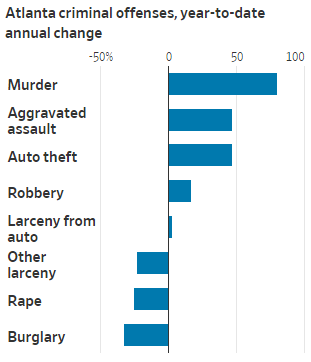
  • Rising Rate of Violent Crime Shakes Atlanta.   Murders and aggravated assaults are way up in Atlanta and other big cities over the past year.  It occurred while “we were dealing with increased hostility toward law enforcement and a decreased sense of trust towards police,” says an APD spokesman.  Defund the police?  Really?
  • Gender identity part of proposed Nebraska school curriculum.  Left-wing progressivism has even reached deep-red Nebraska, where I live.  Proposed health education standards would teach gender identity to first graders and sexual orientations such as “heterosexual, bisexual, lesbian, gay, queer, two-spirit, asexual and pansexual” to sixth-graders.  Such extreme curricular suggestions will, of course, be shot down by concerned citizens and parents, but how did they ever see the light of day in the first place?

Conclusion.  The progressive left, with President Biden as its mouthpiece, is vastly overplaying its narrow victory in the 2020 national election.  It’s headed for a big fall, most likely in the November 2022 elections.  The American public has too much common sense to overlook what is going on all around the country, as well as in Washington DC.

Sign-up for my Email Newsletter
Follow me on Facebook
Follow me on Twitter

Biden’s First Big Mistake: Risking Inflation for a $1.9 Trillion Covid Relief Stimulus Bill

As our economy continues its rapid recovery from the pandemic and we are likely to achieve herd immunity by April, the Democratic Congress is on the verge of passing a $1.9 trillion Covid Relief Stimulus Bill.

This is a terrible idea for many reasons:

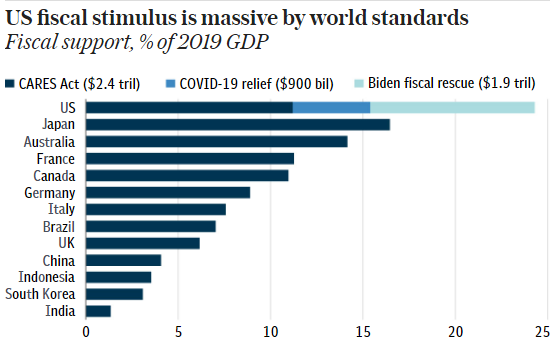
  • It isn’t needed. Congress has already provided a total of $3.3 trillion in Covid Relief, or 16% of annual GDP.  An extra $1.9 trillion would raise this to 24% of GDP, by far the highest in the world (see chart).

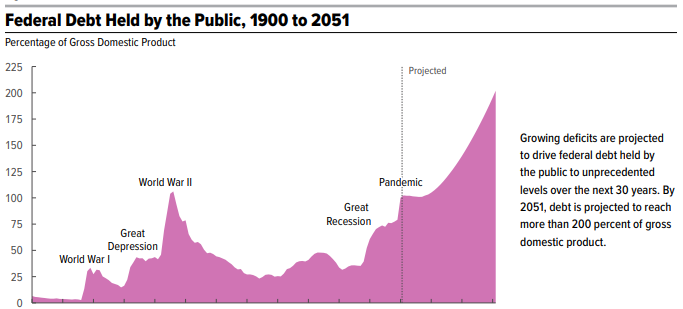
  • The exploding national debt is an extremely serious problem, already predicted by the Congressional Budget Office to reach 202% of GDP by 2051 (double the current level).  Carelessly throwing an additional $2 trillion more at the debt speeds up the time for when our next fiscal crisis hits, which will be a doozy.

  • Right now our debt is almost “free” money because interest rates are so low. But we can’t assume that this will continue indefinitely.  When interest rates do go up, then interest payments on the accumulated debt will increase dramatically, and this is when we’ll have our next fiscal crisis.
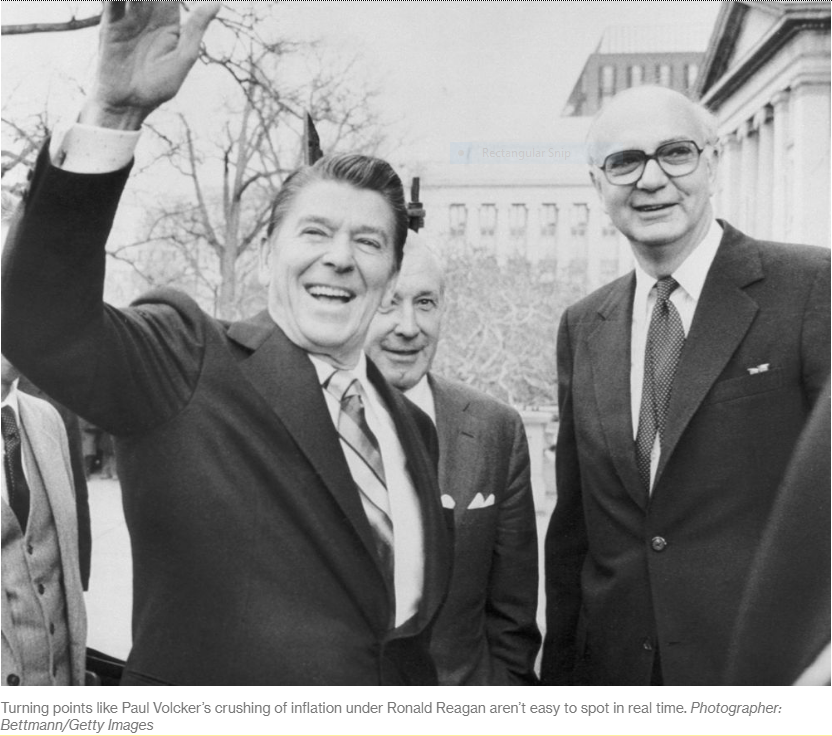
  • When will interest rates go up? This will happen when inflation takes off, forcing the Federal Reserve to raise interest rates in order to slow down the economy which is the only way to stop inflation.  This is exactly what happened in 1980 when inflation rose to 14% before dropping to 3.8% in 1982.

  • A big increase in inflation is already very likely, which will be greatly exacerbated by an additional $2 trillion stimulus. Even liberal economists such as Larry Summers and Steven Rattner consider inflation to be a big risk.  Some say that its signs are already present.

Conclusion. It is incredibly foolish for the Democrats, now in complete control of the White House and Congress, to act in such a fiscally irresponsible manner.  National debt started edging up under President Reagan and has continued to increase with every President since, except under President Clinton who actually achieved a balanced budget for several years in a row (see chart).  Since it will be rapid inflation that initiates the above-described damaging sequence of events, every President should be especially careful not to be the one kicking it off.

Sign-up for my Email Newsletter
Follow me on Facebook
Follow me on Twitter

A New Conservatism: Focusing on the Working Class

Regardless of Donald Trump’s own personal future in politics, his election as President in 2016 resulted from his support by the working class.   The working class is now up for grabs by both political parties, and future political success will depend on who can most successfully compete for its support.

An article from the current issue of Foreign Affairs, “A New Conservatism” by Oren Cass lays out a general framework for an effective political approach.  Consider the range of political ideologies from libertarianism to conservatism to progressivism:

  • Progressives and libertarians both exhibit an inclination to reason from abstract principles toward absolute commitments: progressives prioritize care for victims of oppression while libertarians are obsessed with economic liberty.
  • Conservatives tend to exhibit a broader range of moral concerns giving equal weight to care, liberty, fairness, loyalty, authority, and sanctity. “They believe that people need external structures or constraints in order to behave well, cooperate and thrive.”
  • Conservatism gives somewhat less weight to guaranteeing individual freedom and more weight to reinforcing obligations and constraints. The conservative affinity for free-markets is still important because markets limit the power of the central government.  Their quality is contingent on the norms and rules by which they function and the vitality of other institutions operating alongside them.

As a practical way to contribute to this conservative vision, Mr. Cass proposes a wage subsidy to take the place of, and improve, the popular Earned Income Tax Credit, see here and here.

His wage subsidy works like this.  If the target wage is $16 per hour and a worker earns $10, the subsidy is $3.00 per hour, provided by the employer, and deductible from the employer’s federal taxes.  This approach to welfare ties redistribution directly to productive employment.  It would be more inclusive and operate more smoothly than the current EITC.

Conclusion.  The need for less-skilled work is not going to go away.  How will society provide a living wage to the large numbers of low-skill workers who will always be needed?  The conservative viewpoint is uniquely qualified to answer this question and provide practical solutions as well as a governing philosophy to get this job done.

Sign-up for my Email Newsletter
Follow me on Facebook
Follow me on Twitter
A Closer Look at what Majority Minority America Will Likely Mean

There are now more white deaths every year than white births.  U.S. population is growing overall.  Therefore, non-whites will eventually outnumber whites in America.  The census bureau projects that this will happen by about 2043.

But the sociologist, Richard Alba, says not so fast, see here and here.  This narrative is misleading.  Here is a summary of his argument:

  • Many non-whites are assimilating into the American mainstream, just as white ethnic groups did before them. There is a surge in mixing across ethno-racial lines.
  • The mainstream can expand to accept a visible degree of racial diversity, as long as there are shared understandings between individuals with different ethno-racial backgrounds, which allow them to interact comfortably.
  • Such a shared understanding will be hardest to achieve between African Americans and whites because of the long history of racial discrimination in America.
  • More than 10% of U.S.-born babies have one parent who is nonwhite or Hispanic and one who is white and not Hispanic. This is a sign of growing integration into the mainstream by members of minority groups, especially those from recent immigrant groups such as Asians and Hispanics.
  • Not surprisingly, Americans of mixed Asian and white descent have more contact with white relatives than with Asian relatives (because they are geographically closer).
  • When they marry, 72% of Asian-white women and 64% of Asian-white men, take white spouses. The government nevertheless counts them and their progeny as nonwhite.
  • By the 2050s, Mr. Alba estimates that one-third of babies with white ancestry will also have Hispanic or nonwhite ancestry. The idea of who belongs to a racial majority or minority will become completely scrambled.
  • America needs a new narrative. The current one is about conflict and collision between groups.  A better one would allow minorities to become a part of the mainstream without abandoning their distinctiveness.

Conclusion.  It is misleading to classify all children born to racially mixed parents as nonwhite.  Many such children will easily assimilate into the mainstream of American society by personal preference.  To divide Americans into two categories, pure white and nonwhite, is not only divisive, it also ignores the large degree with which ethno-racial assimilation is occurring in American society.

Sign-up for my Email Newsletter
Follow me on Facebook
Follow me on Twitter
Is President Biden Serious about Reducing Unemployment?

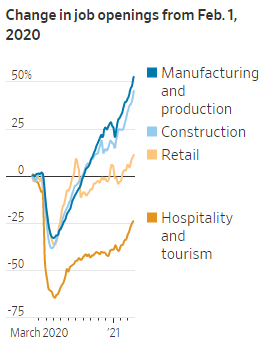
According to news reports, President Biden wants to reduce the unemployment rate back to where it was (3.5%) before the pandemic hit, see here and here. This is a highly worthwhile goal that will do more than anything else to raise wages for low-income workers.  But is he really serious?  Consider:

  • Killing the Keystone Pipeline and a likely federal leasing moratorium, see here  and here, will cost thousands of jobs and greatly affect revenues in western states such as New Mexico, Wyoming, and North Dakota. These measures will furthermore do nothing to reduce carbon emissions.
  • Red states, with their open economies, have lost far fewer jobs than blue states, with their massive lockdowns.  Avoiding a job-killing stimulus, with excessive unemployment benefits, will do much to get workers back on the job, especially in the blue states with the highest numbers of unemployed workers.
  • A $15 minimum wage, will lift 900,000 Americans out of poverty but also cost 1.4 million workers their jobs over the next four years.

Recall that the low 3.5% unemployment rate achieved for several months under President Trump, before the pandemic hit, was brought about by a combination of tax reform (lowering the corporate tax rate from 35% to 21%) and significant federal deregulation.  President Biden proposes to take a completely different approach (massive fiscal stimulus) to attempt to restore the same low unemployment rate, but this risks a new round of inflation.  Which approach will work best?  We might well know the answer before the midterm elections in 2022!

Conclusion.  Some commentators claim that Democratic Presidents are better for the economy than Republican Presidents.  We may have at least a partial and preliminary answer to this question real soon!

Sign-up for my Email Newsletter
Follow me on Facebook
Follow me on Twitter
Are Democratic Presidents Better for the Economy than Republican Presidents?

The New York Times published an article several days ago, “The Economy Does Much Better under Democratic Presidents.  Why?”  Their conclusion is based on the chart of GDP growth going back to FDR  (attached).  Based on this chart alone it certainly appears that they are correct.

But let’s look into this matter more carefully and completely.  Consider the following graph of GDP growth from 1930 to 2020.  It fluctuates greatly over the entire 90 year period.  This makes it hard to draw conclusions about which economic policies are better than others.

We also observe that the average GDP value is dropping from left to right, over the entire period from 1930 to 2020.  In other words, there is an overall decrease in GDP growth over time.  From the top chart, it is clear that there is a rough correlation with the chronological time period served by the particular president.  In other words, not only is Roosevelt at the top of the list and Trump last, but earlier presidents appear nearer the top of the list and more recent presidents near the bottom.

It turns out that there is a plausible reason why overall GDP growth is shrinking over time.  The economist, Dietrich Vollrath, says it is because our economy is “Fully Grown.”  What this means is as follows:

  • “Human capital” has been shrinking because the percentage of retirees is increasing relative to working-age adults. Furthermore, the average level of education has stopped rising because high school graduation rates, and women’s college graduation rates, have peaked and plateaued in recent years.
  • Furthermore, economic activity has shifted significantly from manufacturing to service industries where productivity gains are harder to achieve. This is an indication that people are getting wealthier, a sign of social and economic progress.

If GDP growth is declining for good reasons, as Mr. Vollrath claims, then we should pay more attention to the unemployment rate and less attention to GDP.  The unemployment rate was a very low 3.5% for several months before the pandemic hit in early 2020. This led to big wage gains for lower-income workers.  The Biden Administration hopes to restore the low unemployment rate to its pre-pandemic level.  But excessive fiscal stimulus could easily set off higher inflation.

Conclusion.  I conclude that it is very hard to say, probably impossible, that one party does a better job for the economy based on looking at only the rate of GDP growth.  In fact, if the overall rate of GDP growth continues to decline over time, it will become even more important to look at the unemployment rate as a measure of how the economy is doing.

Sign-up for my Email Newsletter
Follow me on Facebook
Follow me on Twitter

How President Biden Could Lose Popularity Fast

There is wide-spread relief in having Donald Trump out of office, so President Joe Biden’s honeymoon period may last longer than usual.  But there are several ways in which Mr. Biden could lose popularity quickly.

Last week I discussed the pitfalls of overstimulating a strong underlying economy, see here and here.  This risks setting off inflation which, in turn, would lead to higher interest rates and speed up a new fiscal crisis over debt.

Today I discuss several social issues that can flare up into major national controversies much more quickly.  Consider:

  • The year 2020 was one of the most violent in U.S. history.  Murder was up 37% in 57 large cities.  2000 more Americans, most of them African-American, were killed in 2020 than in 2019.  Police Officers are already facing a poisonous environment after last summer’s race riots.  And the Biden Justice Department will treat disparate stop or arrest rates as evidence of police bias and seek to place police departments under consent decrees.  The many law-abiding residents of troubled areas beg for vigorous law enforcement and probably will not now get it.
  • President Biden has proposed an eight-year pathway to citizenship for the estimated 11 million undocumented aliens living in the U.S. But, there is no provision in his plan for increased border control to cut down on illegal border crossings.  Voters want lawmakers to fix the border, not pretend that we don’t need one.  Amnesty for 11 million illegal immigrants without strict border control is a recipe for political upheaval.

  • Fracking and the price of gasoline. Thanks to fracking, the U.S. is now the largest oil producer in the world and has become energy independent.  The Biden Administration has already put a 60-day suspension on any new leases on federal land.  If this suspension becomes permanent, it will greatly restrict oil and natural gas production in several western states such as New Mexico, Colorado, Utah, and Wyoming.  Furthermore, career officials are now temporarily prohibited from signing off on environmental reviews, etc. for new fossil-fuel investment on private lands.  Such restrictions bode ill for the future of fracking in the U.S.  An oil shortage will lead to a rapid increase in the price of gasoline at the pump, which, in turn, means massive consumer discontent.

Conclusion.  These three issues: a dramatic increase in crime caused by interference with effective policing, giving amnesty to all undocumented aliens without establishing secure border control, and letting the cost of gasoline rise dramatically by putting major restrictions on fracking, have the potential to cause enormous social unrest which could easily destroy the Biden Presidency.

Sign-up for my Email Newsletter
Follow me on Facebook
Follow me on Twitter

Biden’s Biggest Challenge: Don’t Overheat a Strong Economy


As President Joe Biden takes office, the coronavirus daily infection rate is beginning to drop significantly and vaccines are rolling out.  Most Americans will soon be back to work and schools will reopen full time.

As I pointed out in my last post, fundamental inflationary forces, caused by world-wide demographic changes, are starting to reappear in the world economy.  This will have a serious negative consequence for our national debt by dramatically increasing interest rates and, therefore, interest payments on the debt.

Furthermore, even short term inflationary forces are rearing their heads:

  • Five-year inflationary expectations are growing rapidly.

  • S. fiscal stimulus (including Biden’s new $1.9 trillion proposals), is massive by world standards.

In evaluating the need for more stimulus, it is important to take into account the underlying strength of the economy:

  • Median U.S. household income has grown dramatically in recent years and was $68,703 at the end of 2019, right before the pandemic hit.

  • The unemployment rate, a very low 3.5% when the pandemic hit, has already dropped back down to 6.7% from a pandemic high of over 14%.

  • The federal debt held by the public, now $21.3 trillion, is a very high (and rapidly growing) 99.4% of GDP.

  • Only a relatively low 9.2% of U.S. citizens are without health insurance, the lowest number in many years.

The above overall data show the good shape of the American economy, as we are pulling out of the pandemic.  All of these factors indicate a need for restraint in providing additional fiscal stimulus.

Conclusion.  The combination of the underlying good health of the U.S. economy plus the building up of inflationary forces worldwide, suggest that any additional fiscal stimulus for the U.S. economy at the present time should be quite limited.

Sign-up for my Email Newsletter
Follow me on Facebook
Follow me on Twitter
The Return of Inflation

The main theme of this blog, It Does Not Add Up, is our country’s huge and out-of-control, national debt.  This rapidly growing debt will have very serious long-term consequences.

There is a simple connection between inflation and debt.  Higher inflation means higher interest rates because investors will insist on higher returns.  But higher interest rates mean higher interest payments on the debt.  In recent years, interest rates have been so low that our debt is virtually free money.  This has lulled national leaders into complacency.  As interest rates rise, interest payments on the accumulated debt will increase dramatically and, before long, will cause a new fiscal crisis.

The threat of inflation is rearing up, short-term and long-term.  Short-term because of the expected rapid recovery from the pandemic, see here and here, as vaccines become widely available.  This is not especially alarming in the short term.

It is the long-term, fundamental trend which should be of great concern.  This is well explained in a new book, “The Great Demographic Reversal: ageing societies, waning inequality and an inflation revival” by the economists Charles Goodhart and Manoj Pradhan.

Consider:

  • Between 1990 and 2017, the working-age population of China increased by 240 million and in the USA and Europe by 60 million. The employment of women also greatly increased.  This meant a dramatic decrease world-wide of the dependency ratio, the ratio of workers relative to non-workers.
  • The effective labor supply for the world’s advanced economic trading system more than doubled over the 27 years from 1991 to 2018. The inevitable result is a weakening in the bargaining power of the labor force.
  • This produced a strong deflationary force which has been so aggressive that it has caused inflation to remain at or below 2% since 1990.
  • Over the next few decades, the steady decline in birth rates to below the rate at which the population is self-sustaining will bring about a sharp reduction in the growth of the labor force in many countries.
  • This means that the deflationary bias of the past 30 years will change to an inflationary bias. The sharp worsening of the dependency ratio around the world means that non-workers who consume but do not produce will outnumber the workers who do produce.
  • The bargaining power of the decreasing number of workers will increase and so real wages, and the relative income share of labor, will start rising again. This produces inflation.
  • It also means that inequality between lower-income and higher-income workers will begin to fall.

Conclusion.  As the demographic trend reverses, and the current world-wide surplus of workers over non-workers begins to make a fundamental shift in the other direction, workers will be able to demand higher wages.  This will have a large inflationary effect.  It will also lessen inequality.  In other words, our current climate of low-interest rates, low inflation, and higher inequality will reverse to high inflation, high-interest rates and less inequality.  This demographic reversal has many implications for public policy.  Stay tuned!

Sign-up for my Email Newsletter
Follow me on Facebook
Follow me on Twitter