The Clinton Plan for “Equitable” Growth


I have tried to make it clear in my post that I have not endorsed either of the two main presidential candidates.  In fact I am waiting to see a credible plan for simultaneously spurring economic growth and getting our very large and growing national debt under much better control.
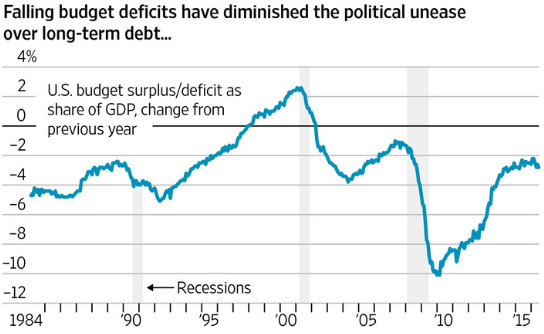
Capture12Capture13
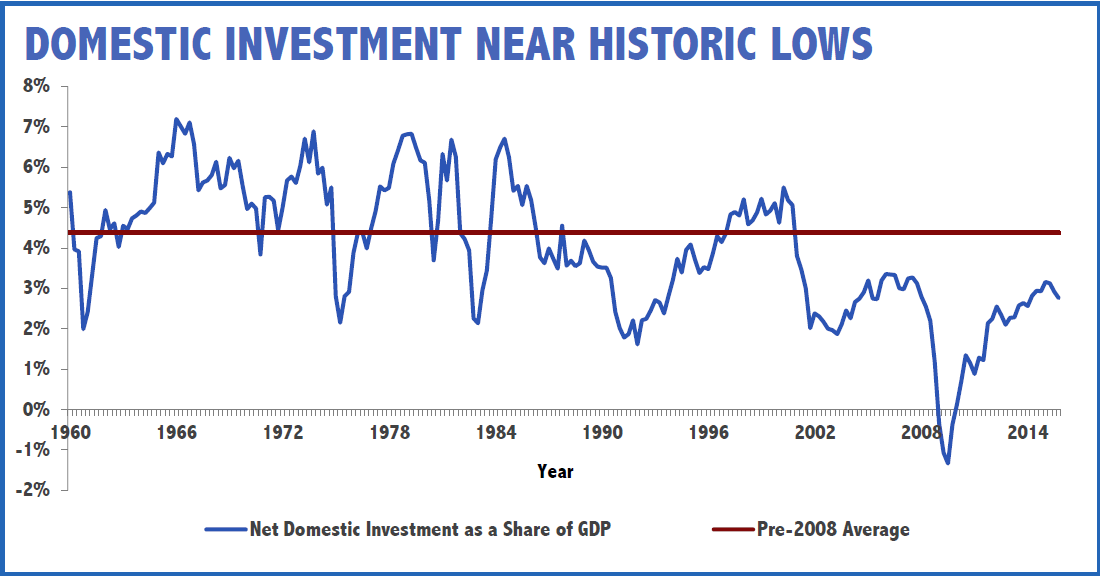
The debt problem is real and cannot be sloughed off as many try to do.  The two charts below show that while annual deficit levels have returned to what may be considered “normal” since 1984, they are still much too high and will lead to a rapidly increasing level of debt even if interest rates remain low which is by no means assured.
In other words, it is not good enough to just make the economy grow faster, it needs to be done in a fiscally responsible way.
I’ve already discussed how the Trump tax plan is unacceptable because it will substantially raise deficits and therefore make the debt much worse.

The same thing is true for the Clinton plan for “equitable” growth, but in a different way.  She wants

  • $250 billion in new spending for infrastructure.
  • Free public college tuition.
  • Universal Pre-K education.

Regardless of their individual attractiveness, it is irresponsible to propose new programs, with new spending, when deficits are already way too high and the debt is steadily climbing.

She also wants to:

  • Raise the national minimum wage to $15 per hour.
  • Mandate paid family leave.

The problem here is that both of these measures will increase unemployment and therefore slow down economic growth. Many states and cities are raising the minimum wage on their own and this way is preferable because it is locally determined.  Paid family leave should be left up to individual employers to use as an incentive to attract and retain good employees.

Conclusion. Hillary Clinton does want to make the economy grow faster which is highly desirable.  But she would do it with new federal spending and new mandates.  The new mandates will actually slow growth.  The new spending programs will add to the debt.  Both approaches are counterproductive.

Follow me on Twitter
Follow me on Facebook

Donald Trump’s Best Chance to Win in November


As I occasionally remind my readers, I am a non-ideological fiscal conservative and a registered independent. In November I will vote for the presidential candidate who has the most credible plan to address what I consider to be our country’s two more serious problems:

  • Slow Economic Growth, only 2.1% per year for the past seven years since the end of the Great Recession in June 2009. Faster growth will create more jobs and bigger wage gains for America’s workers.
  • Massive Debt. Our public debt (on which we pay interest) is now 75% of GDP, the highest it has been since the end of WWII, and likely to keep getting worse unless strong measures are taken to prevent this from happening.

According to current polls, Hillary Clinton is strongly predicted to be elected our next president. However her policy proposals will do little, if anything, to stimulate economic growth and are likely to make our debt much worse than it already is.
Capture8Donald Trump has a strong base of support among working class whites who are suffering in today’s economy and blame illegal immigration and unfair foreign trade for their woes.  However this base of support, while large enough for Mr. Trump to win the Republican nomination, is not nearly large enough to bring victory in November. The only way Mr. Trump can win is to greatly expand his base of support by appealing to moderate Republicans and Independents who are highly concerned about the direction our country is taking.
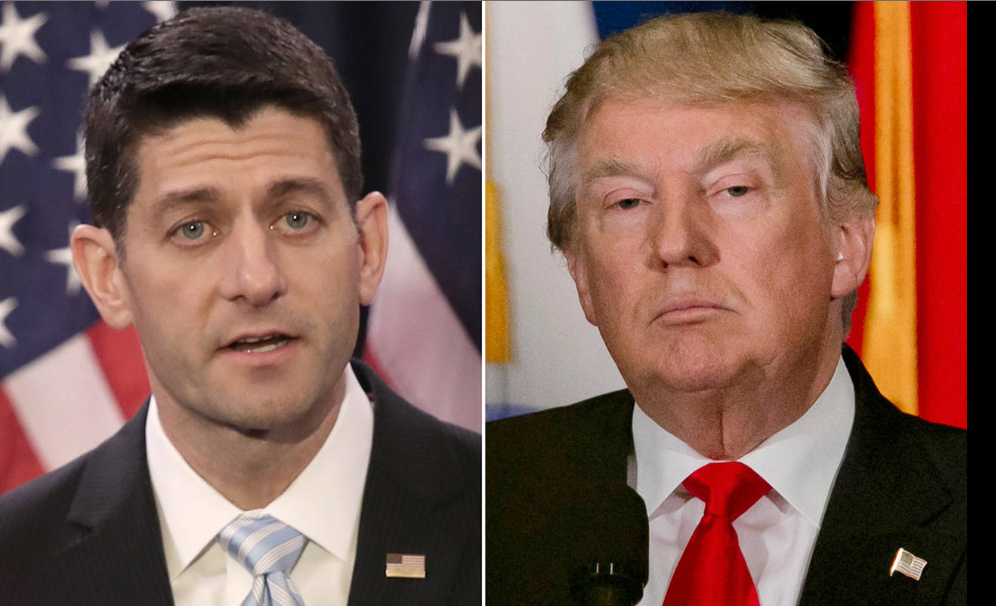
Capture9The best and most direct way for him to do this is to endorse the reform program, “A Better Way,” developed by the Republican House of Representatives, under Speaker Paul Ryan. This reform program has already unified the fractious Republicans in the House, and could easily serve as a vehicle for unifying the entire Republican party as well as many independents.
In my next post I will delineate how the Trump platform could easily mesh with “A Better Way.”

Follow me on Twitter 
Follow me on Facebook

Tax Reform for Faster Economic Growth


Several of my recent posts have been devoted to the topic of faster economic growth, see, for example, here. One way to do this is by making it easier to start and grow a small business.  Another way is with broad-based tax reform.
Capture11House Republicans have just released the outline of a plan for fundamental tax reform, “A Better Way: A Pro-Growth Tax Code for All Americans.”  It has the following main features:

  • The current seven tax brackets for individuals are condensed to just three: 12%, 25% and 33%.
  • The standard deduction of $12,600 (for joint returns) is raised to $24,000 and the $4,050 personal exemption is eliminated. This feature means that fewer filers will need to itemize deductions.
  • In fact, all itemized deductions for individuals are eliminated except for mortgage interest and charitable contributions.
  • To encourage business creation and expansion, the pass through tax rate for small business will be 25%. Full and immediate expensing for investments in new equipment and technology will be allowed.
  • The corporate tax rate will drop from 35% to 20%, paid for by eliminating dozens of tax carve-outs and deductions, including net interest expensing. A territorial system will be established whereby multinational firms will no longer be taxed both abroad and at home for the same dollar of income. This will encourage the multinationals to keep production facilities in the U.S. and to bring home foreign profits for reinvestment here.

The purpose of this plan, according to Kevin Brady, Chair of the House Ways and Means Committee, is “to rev up the economy, cut taxes on business, simplify the code and let American families file on a postcard.” The authors of the report claim that this tax proposal is revenue neutral, i.e. will not lower tax revenue, on a dynamic scoring basis, taking resulting economic growth into account.  If this assertion holds up under nonpartisan analysis, then this is an excellent proposal which deserves broad support.

Follow me on Twitter
Follow me on Facebook


The U.S. Middle Class Is Growing, Not Shrinking


One of the topics I discuss on this blog is income inequality (here, here, and here).  An interesting article in yesterday’s Wall Street Journal, “Upper Middle Class Sees Big Gains, Research Finds,” is highly pertinent to the inequality issue.
Capture1As can be seen in the above chart, the percentage of people in the middle class or above has greatly expanded between 1979 and 2014.  Furthermore, the basic research on this issue,by Stephen Rose at the Urban Institute, shows very clearly (in the chart below) what is happening: the higher is a family income, the faster it is increasing.
Capture3The best policy response to this phenomenon should be clear.  Rather than trying to decrease inequality with higher taxes on the wealthy, we should be trying to boost the less wealthy into higher income classes. The way to accomplish this is to:

  • Grow the economy faster with broad-based tax reform (lower tax rates paid for by shrinking deductions), immigration (guest worker) reform, (fair) trade expansion, and regulation reform (to help more small businesses get started). This will create more jobs and better paying jobs.
  • Improve education with early childhood education (to get minorities off to a better start in school), boosting high school graduation rates above the current 80% average (with better career and vocational education) and making college more affordable by putting more resources into community colleges and scholarships for low-income students.
  • Combat social inequality. The fraction of children with a single parent is the best predictor of upward economic mobility. The lower-income class marriage rate has dropped from 84% in 1960 to 48% in 2010. Policy should therefore focus on removing the marriage penalty in all government programs.

The basic forces of globalization and growing technology use are driving this societal change. The best way to respond is to enable more people to benefit from these basic trends.

Follow me on Twitter
Follow me on Facebook

Can the U.S. Economy Do Better?


In my last post I discussed the differing views of the U.S. economy held by Federal Reserve Chair Janet Yellen and her rival for the post, Larry Summers:

  • Janet Yellen thinks that the U.S. economy is steadily recovering from the Great Recession and that there is no hurry to raise interest rates back to normal levels.
  • Larry Summers thinks that the U.S. economy is suffering from secular stagnation and that there is a great need for more fiscal stimulus by the federal government.

There is another point-of-view, perhaps best expressed by the Hoover Institution’s John Cochrane in a recent Wall Street Journal Op Ed.  Let me try to summarize Mr. Cochrane’s argument:

Capture1

  • From 1950 – 2000 the U.S. economy grew at an average rate of 3.5% per year. Since 2000 it has grown at only half this rate, 1.76% annually. By 2008 the average American was more than three times better off than in 1952. Real average GDP per person grew from $16,000 to $49,000 during this period.
  • The U.S. economy is now overrun by an out-of-control and increasingly politicized regulatory state. America is now middle-aged and overweight. The solution is to eat better and exercise.
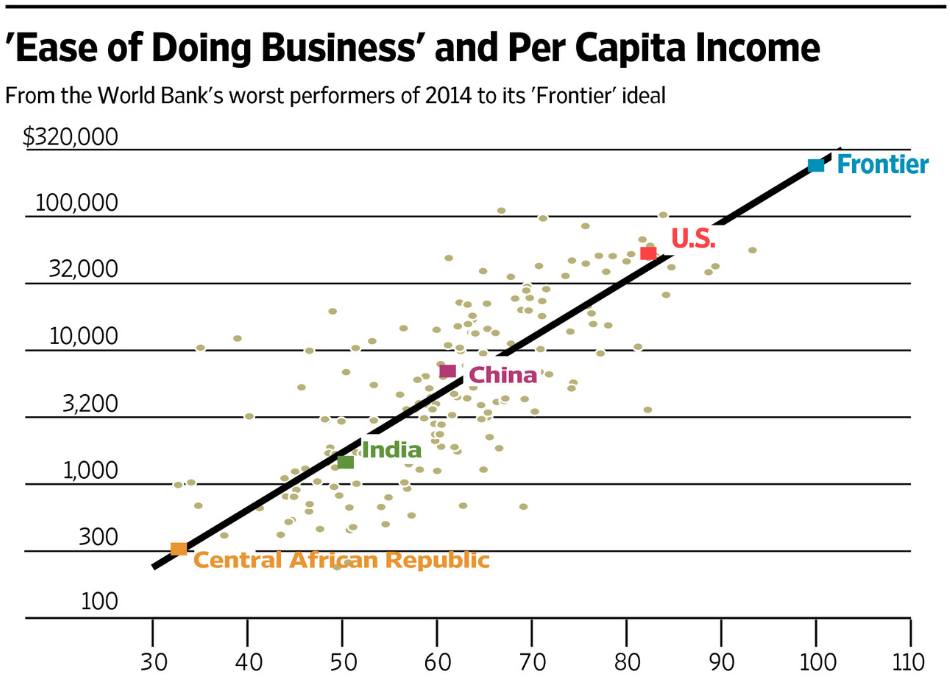
  • Consider the above chart, the World Bank’s “Distance to Frontier” ease-of-doing-business measure for 2014. The U.S. is near the top but there is plenty of room for improvement.
  • Here is what a growth agenda would involve: deep tax reform, cleaning out the insane complexity and cronyism; a thorough overhaul of social programs, getting rid of all the perverse incentives; better schools that come from increased choice and competition; a dramatic legal and regulatory simplification, restoring a transparent rule of law.
  • Growth-oriented policies will be resisted. Growth comes from productivity which comes from new disruptive technologies and businesses.

Can our political system deliver the changes that are needed? The rise of Donald Trump and Bernie Sanders show that the people want big changes and are willing to disrupt the status quo to achieve them.  This means change is possible but it won’t come easily.

Follow me on Twitter
Follow me on Facebook

A Guaranteed Income for All: Good Idea or Bad Idea?


The social scientist and American Enterprise Institute scholar, Charles Murray, has an interesting article in yesterday’s Wall Street Journal, “A Guaranteed Income for Every American,” Mr. Murray proposes a Universal Basic Income (UBI) with the following features:
Capture6

  • Every American citizen age 21 and older would get a $13,000 annual grant deposited electronically into a bank account in monthly installments. $3000 would be applied towards health insurance.
  • UBI is financed by eliminating all other welfare programs: Social Security, Medicare, Medicaid, food stamps, housing subsidies, aid for dependent children, etc. as well as agricultural subsidies and corporate welfare.
  • People can make up to $30,000 a year without losing any part of the grant. Above $30,000 in earned income, the grant decreases to $6500 when the income reaches $60,000. The $6500 retained by all compensates for losing Social Security and Medicare.
  • The overall cost of UBI will be $200 billion per year less than the current system. By 2020 UBI would be nearly $1 trillion per year cheaper.

On the other hand, there are at least two possible drawbacks to the Murray plan, as discussed recently by Eduardo Porter in the New York Times:

  • It would probably discourage work. Right now 80% of Americans in their prime working years, 25 – 54, are employed. Work is not just what people do for a living, it organizes people’s lives. Making work more optional would impair this basic social structure.
  • A UBI divorces assistance from need. For example, a housing voucher could lead a family to move to a better neighborhood. A basic monthly income would probably not.
  • More generally, a single parent with several children would be strapped to get by for $10,000 per year without any additional welfare assistance. We can’t let the kids starve.

Conclusion: UBI appears to be an attractive way to simplify our vast welfare system and would save a significant amount of money (always important). But the poor would not be well served.  There are better ways to reform our public assistance programs.

Follow me on Twitter
Follow me on Facebook

Black Lives Matter II. The Ferguson Effect


A recent post, “Black Lives Matter,” discusses the perhaps surprising fact, that the black-white life expectancy gap has been decreasing in recent years.  One aspect of this trend is that the death rate by homicide for blacks has been falling faster than it has been for whites. This may be about to change.
As recently reported by Heather MacDonald in the Wall Street Journal, “The Nationwide Crime Wave Is Building,” since Michael Brown was shot and killed by a policeman in Ferguson MO in August 2014, cops are disengaging from discretionary enforcement activity especially in big cities.
Capture4This “Ferguson Effect” is likely responsible for rising violence in urban areas.  For example:

  • Homicides increased 9% in the largest 63 cities in the first quarter of 2016.
  • These increases are on top of last year’s 17% rise in homicides in the 56 biggest U.S. cities, with heavily black cities showing murder spikes above 60%.
  • A study of gun violence in Baltimore showed an inverse correlation with proactive drug arrests. When Baltimore cops virtually stopped making drug arrests last year after the death of Freddie Gray while in police custody, shootings soared.
  • In Chicago, where pedestrian stops have fallen nearly 90%, homicides this year are up 60% compared with the same period last year.

As Ms. MacDonald notes, “If a powerful segment of society sends the message that proactive policing is bigoted, the cops will eventually do less of it. Ultimately, denial of the Ferguson effect is driven by a refusal to acknowledge the connection between proactive policing and public safety.”
Conclusion: If “Black Lives Matter” is going to be more than a slogan, it has to be tied in with sensible policies to reduce violent crime.  Demonizing law enforcement is exactly the wrong way to make things better.

Follow me on Twitter
Follow me on Facebook

Thank God for the Republican House of Representatives


It is now almost certain that Hillary Clinton will be the Democratic nominee for President and that Donald Trump will be the Republican nominee. The two biggest problems facing our country today are:

  • Slow economic growth, averaging just 2.1% since the end of the recession in June 2009, seven years ago. Even though unemployment is down to 5%, stagnant wages for the middle class have not nearly recovered from their pre-recession high.
  • Massive debt. The public debt (on which we pay interest) is now at 74% of GDP and rising. When interest rates go up, as they surely will eventually, debt payment will rise by hundreds of billions of dollars per year and be a huge drain on government revenues.

The likely Presidential nominees are not adequately addressing these problems:

  • Hillary Clinton wants to increase government spending by about $100 billion per year to be spent on various new programs and raise the top tax rate to 45% to pay for them. This will do nothing to either grow the economy faster or shrink our already sizable deficit.
  • Donald Trump has promised to keep entitlements as they are and spend more on infrastructure and defense. He also sees debt as useful. “I probably understand debt better than anybody” he has stated. His tax plan (which he says is negotiable) will create massive new debt.

If Clinton is elected, she may pull the Senate Democratic along with her. But either way the House of Representatives will likely remain Republican with Speaker Paul Ryan.
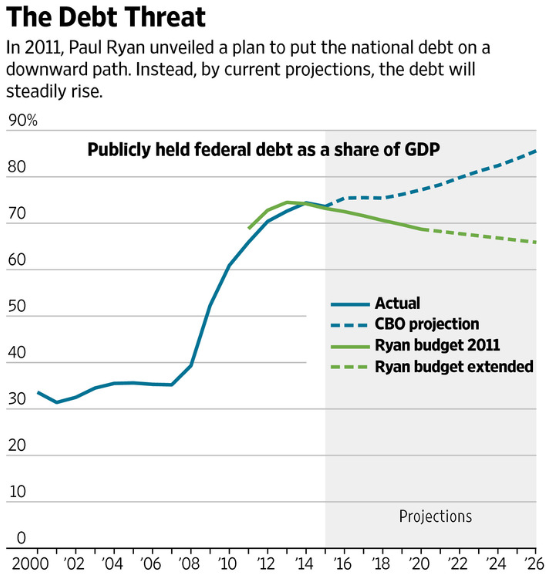
Capture3Since the Republicans took over the House in 2010, they have consistently proposed budgets each year to shrink the deficit and produced a balanced budget within ten years.  The new President, either Clinton or Trump, will have to negotiate their own ideas on spending and taxes with a fiscally conservative House.
The country is indeed very fortunate for this circumstance.

Follow me on Twitter
Follow me on Facebook


Ending America’s Slow Growth Tailspin II. What It Will Take.


One of the biggest problems facing the U.S. today is the slow growth of our economy, averaging just 2.1% per year since the end of the Great Recession seven years ago, well below the 3.5% average from 1950 – 2000.
Capture11My last post introduced an excellent Wall Street Journal Op Ed by the Hoover Institution economist John Cochrane.  He says that “the U.S. economy needs a dramatic legal and regulatory simplification.”  In particular:

  • Tax reform. Instead of arguing over tax rates, what’s really needed is deep tax reform, cleaning out the insane complexity and cronyism.
  • Social programs. Rather than arguing over whether to increase or cut spending, what’s needed is a thorough overhaul of the programs’ pernicious incentives. For example, Social Security disability (almost 9 million beneficiaries in March 2016) needs to remove its disincentives to work, move or change careers.
  • Education spending. Rather than arguing about the level of public spending, America needs the better schools that come from increased choice and competition.
  • Over-regulation. Most of all the country needs a dramatic legal and regulatory simplification. Middle-aged America is living in a hoarder’s house of a legal system, including state and local impediments such as excessive occupational licensing.
  • Growth-oriented policies will be resisted. Growth comes from productivity which comes from new technology and new companies. These displace the profits of old companies, and the hefty pay and settled lives of their managers and workers.
  • The presidential frontrunners are not championing economic growth. But the House of Representatives, under Speaker Paul Ryan, is doing exactly this. Perhaps economic policy leadership can be transferred from the Presidency to Congress.

After two disappointing presidencies our economy is lagging far behind where it could and should be. This is the reason for the rise of Bernie Sanders and Donald Trump.  Regardless of the outcome of the 2016 presidential election, there is hope for better days ahead!

Follow me on Twitter
Follow me on Facebook

How to End America’s Slow-Growth Tailspin


My last three posts, here, here, and here address America’s slow economic growth for the past 15 years and why it is such a serious problem.  Today I begin to discuss how we can turn this around.
In today’s Wall Street Journal, the economist John Cochrane has a very informative Op Ed, “Ending America’s Slow-Growth Tailspin” which describes a clear path to speed up economic growth.  Says Mr. Cochrane:

  • From 1950 – 2000 the U.S. economy grew at an average rate of 3.5% annually. Since 2000 it has grown at only half this rate, 1.76% annually. By 2008 the average American was more than three times better off than in 1952. Real GDP per person grew from $16,000 to $49,000 during this time period.
  • There are three main theories as to why growth is slowing down.
  1. We’ve run out of new ideas.  Get used to it and start fighting over the shrinking pie.
  2. The culprit is “secular stagnation” which the Federal Reserve is unsuccessfully trying to overcome with low interest rates and quantitative easing. The only other solution is vast new stimulus spending.
  3. The U.S. economy is overrun by an out-of-control and increasingly politicized regulatory state. America is middle-aged and overweight. The solution is to eat better and exercise.
    Capture3
  • The first two camps are doubtful that better policies will produce faster growth. But the examples of North Korea vs South Korea and East Germany vs West Germany show that government policy matters for economic growth. In fact Mr. Cochrane’s chart (above) shows how a country’s “ease of doing business” score, compiled by the World Bank, correlates with increased average income. Even though the U.S. is near the top by this measure, there is still plenty of room for improvement.

In my next post I will delineate specifically how to streamline our oversized regulatory state. In the meantime, take a look at Mr. Cochrane’s article in today’s WSJ.

Follow me on Twitter
Follow me on Facebook