Why We Need a Carbon Tax III. Natural Gas Is Not a Real Solution


Most people agree that global warming is for real and that it is caused by a buildup of greenhouse gases in the atmosphere, mostly from carbon dioxide.  We need to respond to this existential threat and the U.S. should lead the way.  The Environmental Protection Agency’s new regulations call for a 30% reduction in carbon emissions, from 2005 levels, by 2030.  Since fracking has led to a natural gas boom in the U.S. and the burning of natural gas only emits half as much carbon as the burning of coal, it is very likely that the new EPA rules will lead to a major replacement of coal by natural gas in U.S. energy production.
CaptureBut there is a downside to this approach as pointed out in yesterday’s New York Times, “The Potential Downside of Natural Gas,” as follows:

  • Natural gas is starting to replace nuclear power which has no carbon footprint. Last year five reactors announced that they would close because of the low cost of natural gas. This will increase CO2 in the atmosphere.
  • Fracking for oil produces natural gas as a side product which may not be easily marketable. This excess natural gas is either burned off or escapes unburned releasing methane which causes even more damage than CO2.
  • The low cost of natural gas is also slowing down the development of renewable energy sources such as wind and solar power.

A far more efficient system of reducing carbon dioxide in the atmosphere would be to tax its emission from any fuel source.  The most commonly mentioned amount is $20 per ton which would raise the price of gasoline by about 10 cents per gallon.   This way the use of all forms of fuel, including coal, oil and gas, would be taxed equally based on how much carbon they emit.  This would create a huge economic incentive for developing carbon capture in fuel combustion, which is the ultimate solution to eliminating CO2 emissions.
In other words, we have a huge problem on our hands which needs an effective solution.  Half measures will not get the job done and will just cause lots of confusion and political controversy in the meantime.  It’s time for some real leadership!
What Is the Best Way to Boost the Economy and Create More Jobs?


The publication of two new books is causing a reevaluation of the financial rescue and its aftermath, e.g. “The Case Against the Bernanke-Obama Financial Rescue”.  The two books are “Stress Test” by Timothy Geithner, former Treasury Secretary, and “House of Debt” by the economists Atif Mian and Amir Sufi.
CaptureMr. Mian and Mr. Sufi maintain that the government’s response to the financial crisis should have focused less on saving the banking system and more on the problem of excessive household debt.  They discovered in their research that, during the housing bubble, less affluent people were spending as much as 25 – 30 cents for every dollar of increase in housing equity.  When the bubble burst, and housing prices started to fall, these borrowers cut way back on spending which caused many businesses to lay off employees.  The authors propose setting up a government program to help borrowers decrease what they owe in underwater mortgages.
Five years after the end of the Great Recession it would still be very helpful to speed up our lagging economy.  Here are three different possible ways to do this:

  • The Keynesians say the best way to stimulate the economy is with more government (deficit) spending. For example, spending several hundred billion dollars a year on infra-structure would create hundreds of thousands, if not millions, of new construction jobs. I think this is a good idea, but only if it’s paid for with a new tax (e.g. a carbon tax or a wealth tax).
  • The Mian/Sufi plan, as described above, would alleviate mortgage debt problems for millions of middle class homeowners who are still under water, encouraging them to spend more money which would in turn boost the economy. The problem is that the M/S plan creates a moral hazard for mortgage holders unless it’s paid for by mortgage insurance which would raise costs for borrowers.
  • Broad-based tax reform, with lower tax rates for everyone, paid for by closing loopholes and limiting tax deductions for the wealthy, would automatically put more income in the hands of the two-thirds of tax payers who do not itemize deductions. These middle class wage earners would tend to spend this extra money thereby boosting the economy.

The point is that there very definitely are ways to boost the economy, some better than others, and it should be a top priority of Congress and the President to get this done.

Why We Need a Carbon Tax II. The Scientific Evidence Is Very Strong


A few days ago I made the argument that “we need a carbon tax” because global warming is real and our response to it should not be defaulted to regulatory action by the EPA and individual states acting on their own.  Just two days ago the U.S. Global Change Research Program released a voluminous new report, the “Third National Climate Assessment”, giving many examples of how dramatically global warming is already affecting life in the United States as well as all over the world.
CapturePerhaps the most direct effect in the U.S. is an increase in average temperatures of almost 2 degrees Fahrenheit since 1900.  This means that summers are longer and hotter and that winters are shorter and warmer, on average.  Hotter temperatures mean that there is more moisture in the atmosphere and rain comes in heavier downpours.
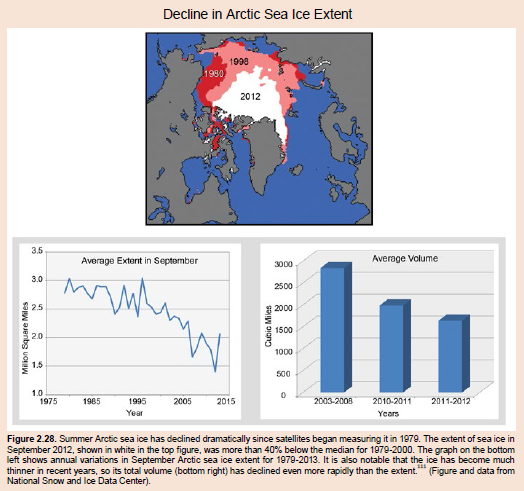
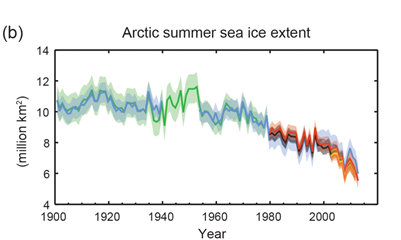
Capture1It is going to be harder and harder for doubters to deny the accumulating evidence.  Global average temperatures have also increased by almost 2 degrees F in the past century.  The most dramatic, and visible, evidence worldwide for climate change is the shrinking of the artic polar icecap measured each year in September.  Although the ice extent fluctuates from one year to another, the pattern of decline, as shown below, is clearly evident.
Capture2A worldwide response is urgently needed and the wealthiest country in the world should step up to the plate and lead the way.  A carbon tax does not mean an end to using to using fossil fuels but simply provides a strong incentive, without government picking winners and losers, to cut back on carbon emissions.  We can be confident that, with a strong economic incentive, American technology will figure out how to remove carbon from fossil fuels during combustion.
The sooner we begin a program along these lines, the better off we will all be in the very near future as the world continues to get warmer.

Global Warming Is For Real II. How Do We Move Forward?


The Intergovernmental Panel on Climate Change has just issued a new report, reported in yesterday’s New York Times, “Climate Efforts Falling Short, U.N. Panel Says”. The IPCC is saying that an intensive effort is needed in the next 15 years to prevent the global average temperature from rising more than 3.6 degrees Fahrenheit (2 degrees Celsius) above the preindustrial level. Since the U.S. and China are the biggest emitters of carbon, it is critical for the U.S. to show leadership on this issue.
CaptureOne dramatic piece of evidence that global warming is real is the rapidly shrinking size of the artic polar ice cap measured at the end of each summer. In a previous post last December 8, I took note that at least 29 U.S. companies “are incorporating a price on carbon into their long range plans.” I also noted a report from the Congressional Budget Office which estimates that a tax on energy companies of $20 to emit a ton of CO2 would raise $120 billion a year and raise the cost of gasoline by 10 to 15 cents per gallon.
The scene is clearly set. There is a serious threat to life on earth. We have a good estimate of what it will take to meet the threat and a specific time window for responding. We also know the approximate cost of a sensible plan for doing so. Can our democratic political system be moved to action?
A large energy tax like this will take a bite out of the economy. An attractive way of building support would be to make it part of broad based tax reform designed to stimulate the economy with lower individual and corporate rates offset by closing loopholes and eliminating deductions. In fact a carefully assembled package might be able to reduce carbon emissions, stimulate the economy (with lower tax rates) and raise revenue to pay down the deficit, all at the same time!
Is this too much to hope for?

Global Warming Is For Real. What Should We Do About It?

Although the threat of global warming is vastly overhyped, it is happening nonetheless.  Perhaps the best single indication of this is the shrinking of the north-pole ice cap.  The New York Times reported just a few days ago, “Large Companies Prepared to Pay Price on Carbon”, that at least 29 major companies “are incorporating a price on carbon into their long-range financial plans.”  This includes five big oil companies ExxonMobil, ConocoPhillips, Chevron, BP and Shell.  Specifically, these major companies have all come to accept the reality of global warming and are preparing for a carbon tax to be levied before long.
The Congressional Budget Office has recently released a report “Effects of a Carbon Tax on the Economy and the Environment”, which concludes that a tax of $20 to emit a ton of CO2 would raise a total of $1.2 trillion over a decade.  Such a tax would, for example, raise the price of gasoline by 10 to 15 cents per gallon.
Once we admit that global warming is for real, and that we need to address it in a serious way, a carbon tax is almost certainly the most efficient, and least economically harmful, way to do it.  A tax on carbon output would do many things.  It would give a big boost to renewable energy (solar and wind) with, or without, special subsidies for renewables.  It would speed up the transformation from the use of coal to natural gas, since natural gas only contains half as much carbon as coal does.  And it would create an economic incentive to speed up the development of carbon capture in order to make the burning of coal more cost competitive.
Of course, a new $120 billion per year carbon tax will affect the economy.  But it will do the least damage if the proceeds are used entirely for deficit reduction.  So we can address a serious environmental problem which effects life on earth and can do so in a way which also addresses a very serious fiscal problem.
I believe that the American people are up to making a sacrifice like this if the consequences of inaction are clearly explained to them.