How to Avoid a New, and Much Worse, Financial Crisis


Is it possible for the U.S. to effectively address its enormous debt problem in today’s contentious political environment? Two weeks ago I discussed in “America’s Fourth Revolution” why the political scientist James Piereson thinks this is impossible. He is very persuasive but I think he is too pessimistic.
CaptureSince then I have discussed several different things we should do to turn around this perilous situation:

  • If spending for just Medicare and Medicaid (two very expensive entitlement programs) alone fell by 25% over ten years, as a percentage of GDP, and then stayed in line with GDP after that, the U.S. would actually have a budget surplus in 2040.
  • Just recognizing the magnitude of our debt problem would do wonders in public awareness.
  • If the Tea Party were able to grow beyond a protest movement and unite the country behind a majoritarian agenda of work, mobility and opportunity, it would be much more effective in achieving its fiscally conservative goals.
  • Another significant way to save money, and get better results at the same time, is to turn over more and more programs to the states. A good way to do this is with block grants to the states for federal programs in such areas as welfare, education and Medicaid. This would give the states more flexibility to get the job done in an efficient and cost saving manner.

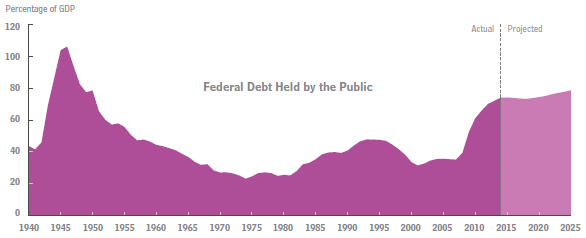
What we need to do to turn our debt situation around is to greatly shrink our annual deficits below their current level of about $450 billion per year. If the debt is growing slower than the economy, then it will shrink as a proportion of the economy. This is what happened after WWII (see above chart) and it needs to happen again now!

Perfecting Our Union: Ending the War Against the States


“The powers not delegated to the United States by the Constitution, nor prohibited by it to the States, are reserved to the States respectively, or to the people.”                                                 The Tenth Amendment to the U.S. Constitution

As the readers of this blog know, I am very concerned about our massive (public) debt, now at 74% of GDP, the highest since the end of WWII. One way to get federal spending under better control is to give more power back to the states (which are required to balance their budgets), as described by Adam Freedman in his new book “A Less Perfect Union: the Case for States Rights.”
CaptureHere are some of the many advantages of doing this, according to Mr. Freedman:

  • Better schools, roads and infrastructure, as states are freed from wasteful federal mandates. The Common Core, for example, should be considered as federal guidelines and not as an attempt to require a specific curriculum.
  • Lower taxes, as states engage in a virtuous competition for citizens and businesses.
  • Improved stewardship of natural resources, as decisions reflect local priorities on land use.
  • Less crowded prisons, by returning criminal jurisdiction to the states, where penal reform is light-years ahead of Washington.
  • An end to national gridlock, as the most divisive social issues devolve to state and local decision-makers. A good example here is the current interest by states and localities to enact their own minimum wage laws. This is far superior to raising the national minimum wage law in a one-size-fits-all manner.


The way to implement a program of giving responsibility back to the states is with block grants. A plan to do this for social welfare programs was formulated by the House Budget Committee just one year ago. It is often suggested to do something similar with federal education programs and with Medicaid as well.
Moving programs back to the states will improve their quality and help get costs under much better control. It makes much sense to move in this direction!

Prominent Myths about Our National Debt


As the 2016 presidential election contest begins to heat up, the Committee for a Responsible Federal Budget and its outreach arm, Fix the Debt, have issued a new “Fiscal FactChecker: 16 Budget Myths to Watch Out For in the 2016 Campaign.”  Here are four of the major myths:

  • We Can Continue Borrowing Without Consequences. “Low interest rates are a temporary consequence of the struggling global economy and near term Federal Reserve actions – not a permanent fixture.”

    Capture4

  • There is No Harm in Waiting to Solve Our Debt Problems. “The longer policy makers wait to control debt, the more difficult it will become. For example, reducing debt to around the historical average of about 40% of GDP by 2040 would require tax increases or spending cuts of about 2.6% of GDP per year, if enacted today, or starting at $1,450 per person per year. Waiting a decade to begin would require adjustments of over 4% of GDP.”
  • Deficit Reduction is Code for Austerity, Which Will Harm the Economy. “Most advocates of fiscal responsibility in the U.S. have called for gradual reductions in long-term deficits so that the debt grows slower than the economy. These changes tend to have minimal near-term effects as well as the potential to significantly grow the size of the economy over the long term.”
  • We Can Fix the Debt Solely by Taxing the Top 1%. “The top 1% of earners, households that make at least $450,000 annually, earn a substantial share of national income, about 13% on an after tax basis, and further tax increases on this group could help. But these increases would need to be combined with reductions in spending growth and/or broader tax increases to fully address the nation’s fiscal challenges.”

Just a few days ago, I described a persuasive argument, “America’s Fourth Revolution,” that our hyper-partisan and dysfunctional political system will be unable to rectify our debt problem until we have another and much more severe financial crisis. The above discussion of budget myths from CRFB actually suggests a way forward to solve our debt problem.
We have a choice. Which path will we take?

Fix It Now: the Political Philosophy of Chip Maxwell


I have just recently come across the book, “Fix It Now: Rediscover the Constitution and Get America Out of Its Fiscal Death Spiral” by Chip Maxwell, a candidate for Congress in Nebraska’s Second District May 2016 Republican Primary.
Chip lays out his political philosophy very clearly.  It is to:

  • Adopt a Balanced Budget Amendment to the U.S. Constitution, phased-in over ten years.
  • Phase out Social Security and Medicare for those under age 55.
  • Dismantle over the next decade the rest of the federal welfare/entitlement system.
  • Provide social services at the state or local level.
  • Launch a national effort to build a majority in Congress of crusaders for limited government.
    Capture1There are some attractive features to Chip’s program but overall I think it is too radical to have much chance at implementation.
    I am very much in favor of a balanced budget amendment and a ten year phase-in period is quite reasonable. Furthermore, providing social services at the state and local level would be much more efficient than what we are currently doing and, even with federal support, would be a big help in balancing the budget.
    Social Security and Medicare are lifelines for tens of millions of people. We can and should strengthen these programs in order to make them more financially viable for future retirees. They are now part of our national fabric and are here to stay.
    Chip’s last principle, promoting limited government, has much appeal but I think is not practical in this day and age. From my perspective, simply passing a Balanced Budget Amendment is sufficient to do what is needed. A BBA will force Congress to set spending priorities and eliminate inferior programs.
    Chip Maxwell is to be commended in running for Congress. If elected, he would move the needle in the right direction, even though some of his ideas wont work.

Predicting the Future


The postwar liberal consensus, beginning with President Roosevelt’s New Deal and extending through President Johnson’s Great Society, has broken down. The Reagan Revolution did not undo it and politics in the new 21st century have now become highly contentious with neither the Democrats nor the Republicans able to push their agendas very far.
Capture1The Manhattan Institute’s James Piereson has written a book, “Shattered Consensus: The Rise and Decline of America’s Postwar Political Order,” describing how we have arrived at our current impasse. Most interestingly, he predicts that “the Democratic blue model is unlikely to succeed at restoring growth and dynamism to the American economy” and that a new system will necessarily look more like the red model than the blue model, i.e. more sympathetic to business and private sector growth than to public employee groups and beneficiaries of public spending.
There will likely be at least three central elements to the new synthesis that must eventually replace the postwar order. They are:

  • A focus on growth, and the fiscal and regulatory policies required to promote it, as an alternative to the emphasis on redistribution, public spending and regulation.
  • An emphasis on federalism both to encourage experimentation and innovation in the American system and to remove issues from the national agenda which contribute to division, stalemate and endless controversy.
  • A campaign to depoliticize the public sector by eliminating or strictly regulating public employee unions.

Mr. Piereson promotes these three new principles of political organization on their intrinsic merits. For me there is the added attraction that each one would also improve our perilous fiscal condition by significantly reducing budget deficits. Growing the economy faster will increase tax revenue. Strengthening federalism means transferring spending programs from the national government (which is highly wasteful) to state governments which are far more efficient because they have to balance their budgets. Public employee unions are especially costly to state governments because of their strong negotiating power.
In short, the cost of government simply must be brought under much tighter control and Mr. Piereson has proposed three organizing principles which would accomplish this.

The Moral Case for Free Enterprise


Capitalism is under attack around the world as Greek socialists complain about their hard- hearted EU creditors, American liberals such as Bernie Sanders and Elizabeth Warren push the Democratic Party to the left, and Pope Francis compares the excesses of global capitalism to the “dung of the devil.”
CaptureOne of my favorite economic commentators is Arthur Brooks, President of the American Enterprise Institute.  One of his books is “The Road to Freedom: How to Win the Fight for Free Enterprise,” which examines the most important economic issues facing the United States from a moral point of view.  For example:

  • Getting the U.S. Economy Growing Again. Weak economic growth means the end of opportunity in America. Furthermore, weak growth disproportionately hurts those who most need new economic opportunities: the poor. One strategy says that the key to restarting economic growth is the state: more stimulus, more taxes, more borrowing. A second strategy says the source of economic growth is free enterprise: tax reform, less government regulation, policies that make it easier for entrepreneurs to succeed, and a smarter immigration policy.
  • Putting America Back to Work. Jobs are not just a source of money for Americans; they are a ticket to earned success. High unemployment is unfair because it robs people of their potential fulfillment. It is especially harmful to the poor and the young. The key to job creation is to get the economy growing faster.
  • Getting the United States Out of Debt. Unless the U.S. reduces deficits, it will have just three choices: steal from future generations, inflate the currency to lower the value of the debt or refuse to pay those to whom it owes the money. All of these options are immoral because they are unfair: they harm others who have done no harm to America. Three points here: 1) we have out-of-control entitlement spending, 2) debt crises are more successfully dealt with through spending reductions than with tax increases and 3) there are no quick fixes.

Considering basic economic and fiscal issues from a moral perspective adds an important new dimension to the discussion.  We might disagree on the details of how to proceed but it is imperative to take effective action of some kind!

The Root of Greece’s Problem (and Ours)


Will it be the Euro or Drachma for Greece?  It’s down to the wire as Greece and the European Union negotiate the necessary conditions for Greece to remain in the Eurozone.  I have devoted several recent posts to the Greek fiscal crisis, pointing out the parallels between the Greek situation and our own.
Greece needs a bailout because its public debt is nearly 180% of GDP.  Our own public debt is “only” 74% of GDP at the present time but is predicted by the CBO to reach 175% of GDP by 2040, just 25 years from now.  Furthermore, Greece is currently receiving very favorable lending conditions from the European Central Bank, much better than are likely to apply in the U.S. in the long term.  This means we’re likely to have another deep crisis on our hands much sooner than 25 years from now.
CaptureConsider the data in the above charts from today’s Wall Street Journal.  It shows that Greece is spending 14.4% of GDP on pensions, more than any other major European country.  Furthermore, the efficiency of its VAT revenue collection is the poorest in the EU.  In other words, Greece has a very high rate of entitlement spending and has a poor tax collection system to support it.
Capture1In a general sense the U.S. is in a similar situation.  Today we spend about 13% of GDP on mandatory, i.e. entitlement, programs, compared to a total tax revenue level of 18% of GDP.  Just entitlement spending alone is projected to rise to 18% of GDP by 2050, unless changes are made.
Just as Greece needs to tighten up on pension spending, improve revenue collection and get its economy growing faster, the U.S. needs to tighten up on entitlement spending and speed up its stagnant economic growth as well.
We’re not yet as bad off as Greece is today.  But we’re headed in that direction with no one to bail us out when we get there!

Letting Young People Drift and the Liberal Disconnect


The New York Times had an excellent lead editorial on Sunday, “The Cost of Letting Young People Drift,” describing how 5.5 million young Americans, ages 16 – 24, are neither working nor in school.  “At a time when the economy is requiring workers to have higher levels of skills, one in seven of America’s young adults can’t even get started.”
CaptureThe NYT editorial is based on new research, “Zeroing In on Place and Race: youth disconnection in America’s cities” performed by Measure of America.  The report points out that the problem has gotten much worse since the Great Recession in 2008, as shown in the chart below.
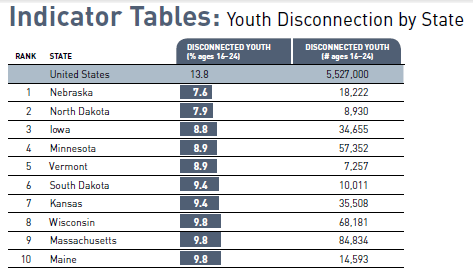
Capture1It also breaks down the youth disconnection rate by state.  For example, Nebraska (7.6%), North Dakota (7.9%) and Iowa (8.8%) have the lowest percentages, while Mississippi (18.5%), West Virginia (19.6%) and Louisiana (19.8%) have the highest percentages (as shown below).
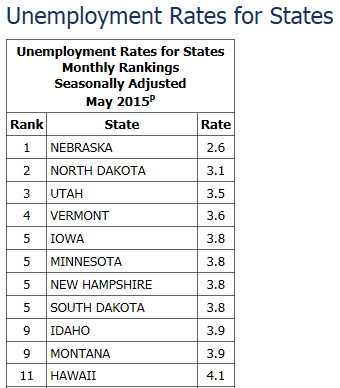
Capture2Capture3But also look at the latest “Unemployment Rates for States” published by the Bureau of Labor Statistics.  There is a very close connection between a state’s unemployment rate and its youth disconnection rate, as shown below. In other words, one of the best ways to keep young people connected is to give them a better chance of finding a job.
Capture4Capture6But it requires faster economic growth to provide more jobs.  Just yesterday the NYT had an editorial, “Obstacles to Economic Growth,” lamenting our very slow rate of economic growth of about 2.2% for the past six years.  According to the NYT, “What’s needed most is public and private investment in the economy sufficient to support strong growth and rising productivity.”  The editorial then goes on to berate Congress for being more interested in budget cuts than in new spending programs to stimulate the economy.  According to the NYT, “the pathway to prosperity is clear for leaders who will dare to take it.”
The NYT thus recognizes the need for more private investment to stimulate the economy but has no apparent interest in policy measures to encourage it.  How can a news organization as sophisticated as the NYT be so passionate about wanting to improve society and so clueless about the best way to do it?

The Fiscal Time Bomb Is Still Ticking!


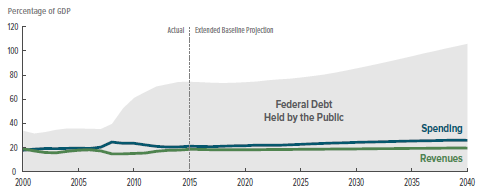
The Congressional Budget Office is by far the most objective source of detailed information about the federal budget, playing a valuable role in the super-charged political atmosphere of Washington D.C.  It has just released a new annual report, “The 2015 Long-Term Budget Outlook,” projecting our fiscal health for the 25 year window, 2015-2040, based on current policy. It is a scary scenario indeed.
CaptureAs shown in the above chart, our public debt (on which we pay interest) has increased from 38% of GDP at the beginning of the Great Recession in 2008 to 74% today.  Although it will remain steady at this high level for about five years, it will then resume a steady increase, reaching a level of about 100% of GDP by 2040.
As many observers, including myself, have pointed out, when interest rates eventually return to their normal historical level of around 5%, interest payments on this huge, and rapidly increasing, debt will double or triple from their current low level, causing a very painful budget shortfall.
Simple prudence suggests that the only responsible course of action is to put our debt on a downward path, as a percentage of GDP, in order to minimize this looming problem to the greatest possible extent.
Capture1CBO gives some useful guidelines for what is required to do this:

  • Just to keep the debt at its current value of 74% of GDP by 2040 would require an annual 6% increase in revenue or a 5½% decrease in spending. This would amount, for example, to a $210 billion spending cut for 2016.
  • To reduce the debt to 38% of GDP by 2040, its average over the past 50 years, would require an annual 14% increase in revenues or a 13% decrease in spending. The spending cut for 2016 would be $480 billion.

These examples show the enormity of the fiscal mess we have gotten ourselves into.  Under current policy it will require a big effort just to stay even with where we are right now, without showing any debt reduction over the next 25 years!
Our only hope is to change current policy.  But how?

Fixing the Debt: Creating a Greater Sense of Urgency II. An Example


My last post, ”Fixing the Debt: Creating a Greater Sense of Urgency,” expresses my dismay that our huge debt problem does not receive enough serious attention from the American people.  Yes, most Americans deplore the national debt and the deficit spending that leads to it, but it only too seldom affects how they vote for candidates for federal office, thus giving a pass to the big spenders in Congress.
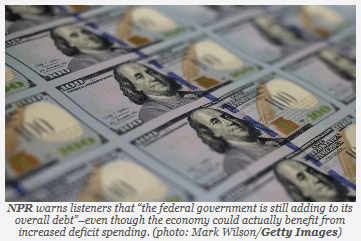
CaptureHere is a good example of this refusal to take the debt seriously.  The advocacy group FAIR (Fairness and Accuracy in Reporting) ridicules NPR for addressing this problem, “Look a Deficit: How NPR Distracts You From Issues That Will Actually Affect Your Life.”  Here is what FAIR is saying:

  • Interest on the national debt is projected to be only 2% of GDP in 2016 and 3% of GDP in 2024, which is tiny. (But this is because the interest rate for the debt is now abnormally low, approximately 1.7%).
  • If the Fed keeps interest rates low, then interest on the debt will continue to stay low indefinitely and so the debt will continue to be a trivial problem. And the President appoints 7 of the 12 voting members of the Fed Open Market Committee which sets interest rates.
  • The reason the Fed raises interest rates is to slow the economy and keep people from getting jobs.  (Actually the real reason is not to keep people from getting jobs but to keep inflation under control. Once inflation takes off, it is very difficult to bring it back down as we painfully discovered in the late 70s and early 80s).
  • Anyhow, if the Fed raises interest rates to keep the labor market from tightening, as it did in the late 1990s, this would effectively be depriving workers of the 1.0 – 1.5 percentage points in real wage growth they could expect if they were getting their share of productivity growth. (A rise in interest rates need not choke off economic growth which is primarily affected by supply and demand. Fiscal policy (tax rates and spending), established by Congress, has a far greater effect on the rate of economic growth than does monetary policy).


If our debt is not soon placed on a sustainable downward path, we will soon have another financial crisis, much worse than the Great Recession of 2008.  This will affect everyone’s life in a substantial and very unpleasant way.