Thank God for the Republican House of Representatives


It is now almost certain that Hillary Clinton will be the Democratic nominee for President and that Donald Trump will be the Republican nominee. The two biggest problems facing our country today are:

  • Slow economic growth, averaging just 2.1% since the end of the recession in June 2009, seven years ago. Even though unemployment is down to 5%, stagnant wages for the middle class have not nearly recovered from their pre-recession high.
  • Massive debt. The public debt (on which we pay interest) is now at 74% of GDP and rising. When interest rates go up, as they surely will eventually, debt payment will rise by hundreds of billions of dollars per year and be a huge drain on government revenues.

The likely Presidential nominees are not adequately addressing these problems:

  • Hillary Clinton wants to increase government spending by about $100 billion per year to be spent on various new programs and raise the top tax rate to 45% to pay for them. This will do nothing to either grow the economy faster or shrink our already sizable deficit.
  • Donald Trump has promised to keep entitlements as they are and spend more on infrastructure and defense. He also sees debt as useful. “I probably understand debt better than anybody” he has stated. His tax plan (which he says is negotiable) will create massive new debt.

If Clinton is elected, she may pull the Senate Democratic along with her. But either way the House of Representatives will likely remain Republican with Speaker Paul Ryan.
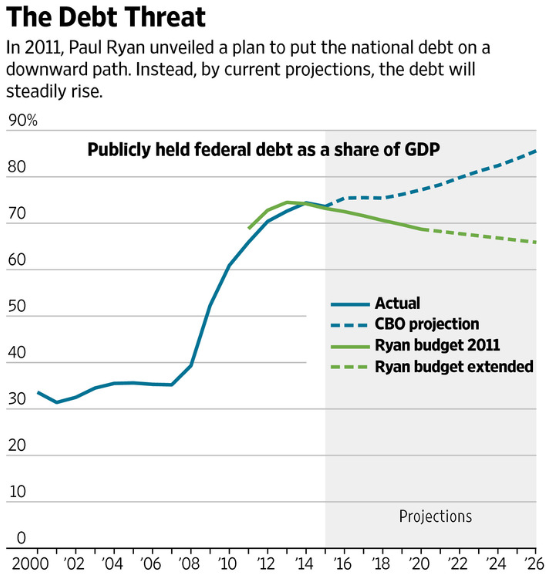
Capture3Since the Republicans took over the House in 2010, they have consistently proposed budgets each year to shrink the deficit and produced a balanced budget within ten years.  The new President, either Clinton or Trump, will have to negotiate their own ideas on spending and taxes with a fiscally conservative House.
The country is indeed very fortunate for this circumstance.

Follow me on Twitter
Follow me on Facebook


Why Faster Economic Growth Is So Important


The main topic of this blog is addressing America’s two biggest problems which are:

  • Slow economic growth, averaging 2.1% since the end of the Great Recession in June 2009, and
  • Massive public (on which we pay interest) debt, now 74% of GDP and growing, the highest it has been since right after WWII.

In a recent post, “Is America’s Middle Class Really Shrinking?” I showed that middle-income households did very well from 1971 – 2001, while our economy was growing on average at a rate of 3.5% per year.  Middle-income households then stood still from 2001 – 2008, and have lost ground since.
Capture2A vivid example of what has happened in the last 15 years is provided in the article, “My Secret Shame” in the current issue of the Atlantic magazine.  The author describes his own financial hardships supplemented with pertinent data from several sources:

  • In 2013, 47% of Americans responded to a survey that they would have great difficulty coming up with $400 to handle an emergency.
  • The inflation-adjusted net worth of a typical (median level) household in 2003 was $87,992. By 2013 it had declined to $54,500, a 38% drop.
  • A family headed by someone of prime working age, between 24 and 55 years old, and with an income of $50,000, could continue to self-fund its current consumption, if the family were to lose its current income, presuming the liquidation of all financial assets except home equity, for only six days!

As this data clearly shows, many Americans are in a precarious financial situation! The solution to this very serious problem is to speed up the growth of the American economy.  I have discussed how to do this over and over again in previous posts, i.e. here and here.
It is both surprising and disturbing that the presidential candidates are either ignoring this problem or making unserious proposals for how to solve it.

Follow me on Twitter: https://twitter.com/jack_heidel
Follow me on Facebook: https://www.facebook.com/jack.heidel.3

Five Ways to Destroy the U.S. Economy


For seven years following the end of the Great Recession in June 2009 our economy has been plodding along at an average growth rate of 2.1% per year, much more slowly than after a typical recession. Instead of talking about how to fix the mess we are in, most of the presidential candidates are proposing measures which will make things even worse.
Capture0The economists Glenn Hubbard and Tim Kane, writing in the Weekly Standard, take a novel approach.  Rather than suggesting ways of speeding up economic growth, which may no longer be of interest to voters in primary elections, they list their “Top Five Ways to Destroy the U.S. Economy” which are to:

  • Restrict Trade. Free exchange is the cornerstone of a growing economy. Raising tariffs will restrict imports, cause inflation and harm American consumers. Killing the Trans Pacific Partnership, stopping the Keystone Pipeline, and curtailing legal immigration would just be a start.
  • Make Work Illegal. Raising the minimum wage to $15 per hour will do lasting harm to underprivileged teenagers who are denied a first job. In the U.S. today over 30% of jobs require a government license compared to only 5% in the 1950s. This creeping need for permission keeps untold millions out of the labor force.
  • Tax People More Unequally. Why should the tax code be riddled with exemptions, deductions and credits which primarily benefit the wealthy? Why do we insist on taxing corporations at 35% when all other advanced economies are competing to lower their corporate taxes? This simply drives jobs overseas.
  • Stop Innovation. Why does Washington continue to favor big banks and bail out old established industries? A generation ago 1 in 6 companies were startups: today 1 in 12 are.
  • Increase the Debt. Debt has more than doubled in the past decade, yet interest payments in 2015 were the same as in 2006, because rates are artificially low. How long can this last? A sure path to a slow growth future is this kind of fiscal profligacy. Just call it investment and hope that most people will ignore the problem.

As Mr. Hubbard and Mr. Kane conclude, “The good news about this policy agenda is that it requires no sacrifices. If Washington just stays on course we will reap the whirlwind.”

Follow me on Twitter: https://twitter.com/jack_heidel
Follow me on Facebook: https://www.facebook.com/jack.heidel.3

The Fundamental Driver of Our Debt Problem: the Cost of Healthcare


How to grow the economy faster. How to get our rapidly growing national debt under control.  These are the two main problems facing our country which I address over and over again on this blog.  Finding satisfactory solutions to these two problems will determine our future strength and prosperity as a nation.  Today’s discussion is about the major cause of our debt and deficit problem.
CaptureI recently came across the above chart showing the steady rise of overall American healthcare spending (public and private).  In 1960 it was less than 6% of GDP.  Now it is approximately 18%, a tripling, compared to the overall size of the economy, in just 55 years. Of course it is the cost of public healthcare programs such as Medicare, Medicaid and the Affordable Care Act which directly contribute to our growing deficits and to the accumulated debt.
However we will never be able to limit the cost increases of these public programs until we get the fundamental drivers of private healthcare costs under control. As pointed out (in the chart below) by several scholars from the American Enterprise Institute, the basic reason for the high cost of private American health care is that “we don’t have enough skin in the game” as shown by the chart just below.  We are paying less and less of total healthcare costs out of our own pockets because more costs are paid directly by third party insurers.  This means we have less incentive to control our own healthcare costs.
Capture2The AEI has suggested several reform measures to improve this situation such as:

  • Placing an upper limit on the tax exemption for employer-paid insurance premiums.
  • Expanding the use of Health Savings Accounts to be used in conjunction with high deductible plans.

We have a stark choice in front of us. Either we move in this direction in the near future or we will face another, much worse, financial crisis.  In the latter case we will end up with an inferior healthcare system, much less responsive to our wants and desires.

Follow me on Twitter: https://twitter.com/jack_heidel
Follow me on Facebook: https://www.facebook.com/jack.heidel.3

Growing Employment, Shrinking Productivity: What Does It Mean?


I know that I occasionally repeat myself, but I can’t help it! In my opinion there are two major problems facing our country:

  • Slow economic growth which has averaged only an anemic 2.1% since the end of the Great Recession seven years ago.
  • Exploding national debt, now the highest it has been since the end of WWII. Unless we can quickly shrink our annual deficits down to zero, and therefore stop adding to the debt, interest payments on the debt will eventually rise to horrendous levels.


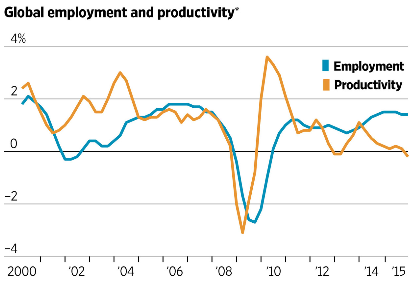
Two recent newspaper articles address the slow growth problem. Greg Ip, writing in the Wall Street Journal, points out that (worldwide) employment growth is up while productivity growth is down (see chart below).
Capture0Neil Irwin, writing in the New York Times, explains this dichotomy by pointing out that most job growth in the last decade has been in (low productivity) services rather than (high productivity) manufacturing. In other words, the U.S. economy is now producing lots of new temporary and contract jobs which do not add very much to the overall economic growth which produces higher wages and overall prosperity.
The economist John Cochrane has clearly described  why productivity growth, and therefore overall economic growth, has stagnated in recent years.  Here is a short summary:

  • Over-regulation. The Dodd-Frank Act and Affordable Care Act, for example, are hampering growth by strangling the financial and healthcare sectors of the economy.
  • Inefficient Taxation. Growth oriented taxation would have the lowest possible marginal rates paid for by shrinking deductions. Taxing consumption rather than income and savings would be even better.
  • Illegal Immigration. Solving our immigration problem would turn millions of illegals into productive citizens. An adequate Guest Worker program and e-Verify enforcement would solve this problem without the need for amnesty.

Conclusion: There are solutions to the severe economic problems facing our country. Does our political system have the flexibility to adopt these workable policies?

Follow me on Twitter: https://twitter.com/jack_heidel
Follow me on Facebook: https://www.facebook.com/jack.heidel.3


The House Budget vs the President’s Budget: Another Reason for a Balanced Budget Amendment


In January I had several posts advocating in favor of a Balanced Budget Amendment to the U.S. Constitution.  Briefly, the argument runs as follows:

  • Our public debt (on which we pay interest) is now at 74% of GDP, the highest it has been since the end of WWII.
  • Democrats want to raise taxes and increase spending; Republicans want to cut taxes and decrease spending. The only way to satisfy both parties simultaneously is to run huge annual deficits which is exactly what has happened ever since the end of the Great Recession in 2009.

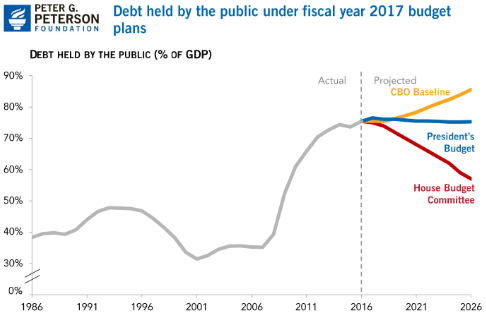
Current planning for the next budget year beginning October 1, 2016 has now begun. Both the House Budget Committee and the President have budget proposals for next year. As reported by the Peterson Foundation, these two budgets differ substantially:
Capture0

  • The President’s budget would hold the public debt at about 75% of GDP over the next ten years by both raising taxes and increasing spending on a variety of programs.
  • The House Budget Committee plan keeps revenues steady at 18.2% of GDP over the next ten years and achieves a balanced budget after ten years. By 2026 the debt held by the public would fall to 57% of GDP from its current 74% level.

Here are two significantly different ten year budget plans. What is likely to happen is a complete standoff without any bipartisan agreement.  This means that no appropriations bills for individual government agencies will be enacted by October 1.  Finally, as usual, an omnibus spending bill will be put together by Congressional leaders and forced through at the last minute to avoid a government shutdown.
A BBA would make both sides compromise and come up with an overall plan.  It would likely contain both spending restraint and new sources of revenue.  Then the various Congressional committees would hammer out the spending details for individual agencies and department.  It would be a far more sensible and transparent process than the way things are done now.
Congress and the President have to be forced to act in such a reasonable manner.  A Balance Budget Amendment is perhaps the only way to make this happen.

Follow me on Twitter: https://twitter.com/jack_heidel
Follow me on Facebook: https://www.facebook.com/jack.heidel.3

Why I Lean Republican


In the midst of a tumultuous presidential campaign season, it iscommon for partisans of the left and the right to question the integrity, motives and values of those on the other side of the political divide. For example, the rise of Donald Trump in the Republican primaries has led some observers to declare that the Republican Party has lost its way and no longer has any sort of basic, coherent and broadly acceptable political philosophy.
On the contrary, I think that Republicans do by and large share the following two general attitudes towards government which are favorite topics of discussion on this blog:

  • Economic growth in recent years has been much too slow and it should be a major goal of government to substantially speed it up.
  • Our national debt is much too high and Congress and the President should be making serious efforts to balance the budget on an annual basis.

The House Budget Committee has just made a big contribution towards the second goal with, “A Balanced Budget for a Stronger America. Fiscal Year 2017 Budget Resolution.”
Capture0Here are its basic components:

  • The federal budget will be brought into balance over a ten year period.
  • Devolving power back to the states.
  • Prioritizing the responsibilities of the federal government and concentrating on the most important.
  • Strengthening government functions that are critical to the health, retirement and economic security of millions of Americans.

Such a budget plan as this could make an excellent first step towards an eventual bipartisan agreement that would address some of our country’s biggest problems. Instead it is likely to be ridiculed or dismissed by the Democratic Party as mere political posturing by the Republican majority in Congress. What could be a beginning to real progress on urgent issues will probably just be washed down the drain.

Follow me on Twitter: https://twitter.com/jack_heidel
Follow me on Facebook: https://www.facebook.com/jack.heidel.3

The Strengths and Weaknesses of the U.S. Economy


If the U.S. is going to be able to solve its serious economic and fiscal problems, there needs to be a realistic understanding of what they are. My last post, “Is the U.S. Economy Really in Good Shape?” discusses a recent Op Ed in the Wall Street Journal by Martin Feldstein.  Mr. Feldstein makes the case that it is in pretty good shape right now even though there are big problems on the horizon. Unfortunately, such an assessment is likely to lead to complacency and inaction towards our long term problems.
Capture0Let’s look at the overall situation.

Our Economic Strengths:

  • The world’s largest economy, twice as large as our nearest competitor, China. The 2.2% GDP growth since the Great Recession ended in June 2009 is not especially robust but it’s among the best in the developed world.
  • World leadership. The U.S. dominates international finance, technology, higher education and popular culture. Everybody else wants to emulate us and to have what we have.
  • The U.S. Dollar dominates world currency because of its strength and stability. This protects the value of the dollar relative to other currencies.

Our Economic Weaknesses:

  • Massive Debt. The public debt (on which we pay interest) now stands at 74% of GDP, the largest since right after the end of WWII. As our currently low interest rates inevitably continue to rise, interest payments on the debt will skyrocket creating a huge burden on future generations.
  • Demographic Challenges. Payouts for Social Security, Medicare and Medicaid are continuing to grow rapidly, thereby putting upward pressure on annual deficits as well as accumulated debt.
  • Slow Growth Environment. The economist Robert Gordon makes a persuasive case that the explosive economic growth which the U.S. enjoyed from 1870 – 1970 will be very difficult, perhaps even impossible, to duplicate in the future.


The big picture is that we are going to have to work hard to achieve the degree of economic growth which will be needed to propel American society forward in the future as it has in the past.

Follow me on Twitter: https://twitter.com/jack_heidel
Follow me on Facebook: https://www.facebook.com/jack.heidel.3


Is the U.S. Economy Really in Good Shape?


The noted Harvard economist, Martin Feldstein, says in yesterday’s Wall Street Journal, that “The U.S. Economy Is in Good Shape.”
Capture0The reasons are that:

  • We are essentially at full employment with an overall unemployment rate of 4.9% and 2.5% among college graduates.
  • Real income (after government transfers and federal taxes) is up 49% between 1979 and 2010 for households in the lowest income quintile. Real income is up 40% between 1979 and 2010 for households in the middle three income quintiles.
  • The 70% decline in the price of oil since early 2015 will eventually have a positive impact on U.S. economic growth. The fall in gasoline prices alone has increased annual household spending power by more than $1000 per household. When consumers start spending this money, it will have a large impact.
  • The Fed’s quantitative easing program has led to artificially high stock prices which now are coming down as the Fed begins to raise short-term interest rates. The U.S. economy is strong enough to withstand this shock. It would be a mistake for the Fed to abandon its December forecast of four rate increases in 2016.

I would refer to Mr.Feldstein’s analysis as a somewhat rosy scenario. It ignores our low labor participation rate, our high (U-6) underemployment rate of 9.8% and the historically slow 2.2% growth of our economy since the end of the recession almost seven years ago.
Mr. Feldstein goes on to say that “the American economy does face long term problems.  High on the list is the large and growing national debt, rising from less than 40% of GDP before the recession to 75% now and heading to more than 80% in ten years.  But the big uncertainties which now hang over our economy are political, with presidential candidates threatening to raise taxes, increase fiscal deficits and pursue antibusiness policies.”
Conclusion. What Mr. Feldstein is really saying is that our economy is in satisfactory shape right now but that we must attend to its long term threats to make sure that things do not turn sour.  What the presidential candidates are saying in this respect is not encouraging.

Follow me on Twitter: https://twitter.com/jack_heidel
Follow me on Facebook: https://www.facebook.com/jack.heidel.3

The Quality of American Health Care


One of the most common themes on this website is the high cost of American healthcare. What I am saying is that our annual deficits are way too high and that our accumulated debt is increasing too fast.  Furthermore, the only way to get the cost of healthcare entitlements, Medicare and Medicaid, under control, is to get the overall cost of private healthcare under control as well.  And, of course, I support specific policies to do just this.
CaptureIt so happens that I have just had a major interaction with the American healthcare system in Omaha NE where I live.  I go jogging first thing in the morning, five days a week, all year around.  I have done this all my life and have never had a problem – until last Monday morning when I slipped on some ice, fell down and fractured my wrist.  What I did then was:

  • Call off my 8:00 A.M. Calculus class
  • My wife, Sharon, took me to a Minor Medical facility at 8:00 A.M. just as it opened.
  • The facility x-rayed my wrist and determined that I had broken several bones.
  • They then located an orthopedic surgeon who could see me the same day at 2:50 P.M.
  • The surgeon scheduled me for surgery the very next morning.
  • The surgery was successful and I am now recovering.
  • In other words, 30 hours after my accident occurred, I had had an intense inter-action with American medicine and came through with flying colors.
  • To say the least, I am very impressed with the quality of the facilities and healthcare professionals with whom I interacted.

It may cost an arm and a leg for this superb medical treatment but then I have excellent health insurance which I have seldom had to make use of.
Conclusion: Although we must make significant changes in healthcare delivery in the U.S., to make the system more cost efficient, we should try hard to do this without affecting the high degree of quality inherent in the system.

Follow me on Twitter: https://twitter.com/jack_heidel
Follow me on Facebook: https://www.facebook.com/jack.heidel.3