Why Inequality Is Harmful and What to Do About It


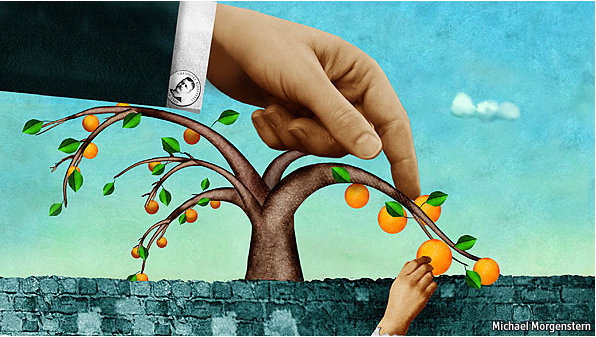
I describe this blog as addressing our fiscal and economic problems, meaning deficits and debt on the one hand and slow economic growth on the other.  But these topics, while being of critical importance to our national welfare, are also somewhat on the dry side.  The subject of economic inequality stirs up lots more interest and response. In the Fall of 2012 The Economist declared that “a new form of radical centrist politics is needed to tackle inequality without hurting economic growth.”
CaptureSays The Economist:

  • There’s too much cronyism in the rich world. Banks which are “too big to fail” have an implicit subsidy. From doctors to lawyers, many high paying professions are full of unnecessarily restrictive practices. Social spending often helps the rich more than the poor. For example housing subsidies for the top 20% (mortgage-interest deductions) are four times the amount spent on public housing for the poorest 20%.
  • If income gaps become too wide, they can lead to less equality of opportunity, especially in education. The gap in test scores between rich and poor American children is 30 – 40% wider than it was 25 years ago.
  • If those on the top of the heap resist equalizing changes, it could lead to political pressure which serves nobody’s best interests.

Here are The Economist’s proposals for a True Progressive Agenda to attack inequality:

  • Compete.   A Rooseveltian attack on monopolies and vested interests is needed. School reform is crucial: no Wall Street financier has done as much damage to social mobility as the teacher’s unions have.
  • Target. Government spending need to be focused on the poor and the young. Governments can’t hope to spend less on the elderly but they can reduce the pace of increase.
  • Reform. Eliminate tax deductions which primarily benefit the wealthy such as for mortgage-interest; narrow the gap between tax rates on wages and capital income.

“The right is still not convinced that inequality matters.  The left’s default position is to raise income tax rates for the wealthy and to increase spending still further – unwise when sluggish economies need to attract entrepreneurs and when governments are overburdened with promises of future spending.”
Surely there is a better way!

Baltimore Is About Economics, Not Racism


The death of another black man at the hands of the police, this time Freddie Gray of Baltimore, has again set off a national debate about poverty, inequality and racial injustice.
CaptureThe Washington Post journalist Marc Thiessen wrote about this several days ago in, “The Baltimore Democrats Built,” saying that:

  • Although 63% of Baltimore residents are black, so are 40% of police officers.
  • City officials injected $130 million into the Sandtown-Winchester community (where the riots took place) in a failed effort to transform it.
  • The poverty rate in Baltimore is 24% compared with 14.5% nationally.
  • The unemployment rate for black men in Baltimore between the ages of 20 – 24 is 37%.
  • Among the nation’s 100 largest counties, the one where children face the worst odds of escaping poverty is the city of Baltimore.
  • In 2014, Baltimore public schools ranked third in the country in per-pupil spending, yet 55% of Baltimore fourth graders scored below basic in reading.
  • In the Sandtown-Winchester community, nearly half of all high school students missed at least 20 days of school in 2011.
  • This community’s murder rate is double the average for Baltimore, which in turn had the fifth highest murder rate last year among major U.S. cities.

In other words, Baltimore’s problems cannot be blamed on racial prejudice or on a lack of resources to combat poverty and low educational performance.  Clearly needed are better schools and more employment opportunities.  Better state and local leadership would help in this respect. But what is most needed is faster economic growth for the whole country.  There are many things which could be done to accomplish this.  It’s a shame that our current political system is too fractured to allow this to happen.

Will Wage Stagnation Continue Indefinitely?


It is widely deplored that wages for both middle- and lower-income workers are stagnant and have not even recovered from where they were before the beginning of the Great Recession.  The latest issue of The Economist explores this problem, “When what comes down doesn’t go up.”
CaptureThe Economist sees several factors at work:

  • As the unemployment rate continues to drop, many new jobs are paying less than the old jobs that were lost.
  • In Germany “mini jobs,” paying under $440 per month, are skyrocketing. In Britain “zero hours” contracts, with no commitment to a fixed number of hours, are becoming more common.
  • In 2013 Kelly Services, which provides temporary workers, was the second largest employer in the U.S. with a staff of 750,000. 2.9 million temps account for 2% of all jobs in the U.S.

As The Economist points out, if low pay does in fact lock in, inflation will stay low even as the unemployment rate continues to fall.  The Federal Reserve will then be likely to keep interest rates low indefinitely as well.  But this means there will be far less incentive for Congress and the President to cut back on huge deficit spending because debt is almost “free money” when interest rates are low.  Long term, massive debt, is a huge threat to our security and prosperity.
Breaking out of this pernicious low wage trap will require a bold effort by Congress and the President to boost economic growth.  By far the best way to do this is with broad-based tax reform at both the individual and corporate levels.  As I have discussed in previous posts, what is needed is lower tax rates paid for by closing loopholes and deductions.  Hopefully, the new Congress is headed in this direction!

Globalization Is a Messy Process


Globalization is having a dramatic effect on income distribution around the world as I discussed in a previous post. Middle incomes in the developed world are stagnating while at the same time they are growing rapidly throughout much of the rest of the world.
At the same time as western world economies are stagnating, turmoil and instability are breaking out elsewhere, especially in eastern Europe, the Middle East and northern Africa.  Fortunately the U.S. and its allies are stepping in with military force to help maintain local order in many parts of the world where it is breaking down.
In short, at the same time, whether connected or not, the postwar geopolitical system is breaking down and the economic stability of the Great Moderation has given way to the Great Recession and its aftermath of macroeconomic volatility.
An interesting article by Chrystia Freeland in the latest issue of The Atlantic, “Globalization Bites Back” addresses both of these issues together.  She says “I believe that capitalist democracy has proved itself to be the only compelling, universalist vision of how to live the good life.  But the stable world order many of us assumed this thesis foretold has not come to pass.”
CaptureAs the above chart shows, one very positive result of this messy process is likely to occur.  The middle class worldwide is predicted to grow from 1.8 billion in 2009 to 4.9 billion in 2030.  All of this enormous growth in the size of the middle class will occur outside of North America and Europe.
The implications for the continued prosperity and world leadership of the U.S. are clear.  We need to get our own economy back on track, growing at a faster rate.  We also need to get our fiscal house in order so that the dollar will continue to be the international currency of choice.
Our dominant role in world affairs is beneficial to all but it is by no means assured without much effort on our part.

Are We Doing Enough to Help the Poor?


Income inequality in the U.S. is getting worse and one reason is that the middle class is being “hollowed out” by a lack of sufficient job opportunities.
CaptureThe result is more people at the bottom end of the income scale.  Not surprisingly, it turns out that many of these low-wage workers are receiving public assistance, as documented by the UC Berkeley Labor Center, and the New York Times.
Capture1The authors point out that if these workers received higher wages, they would not require as much public support which, in turn, would save money for the taxpayers.  This is a true but not a practical means for helping the poor.  Employees are paid what they’re worth based on the law of supply and demand.  Companies will pay as much as they have to in order to find and retain well qualified workers.  Furthermore, a minimum wage which is too high will simply lead to a higher rate of unemployment.
There is really only one good way to raise the overall wage level, especially at the bottom end of the scale.  It is to speed up economic growth, thereby lowering the unemployment rate and creating more demand for workers.
This is exactly what has happened in Omaha NE where I live.  The official unemployment rate is 3.2% and there is a labor shortage.  A new minimum wage ($8/hour now, $9/hour next January) was approved by the voters last November.  But low-skill entry level jobs are paying $10/hour or more because of the scarcity of workers.
There are plenty of opportunities to succeed in Omaha.  Support yourself with a low-wage job and go to Metropolitan Community College to learn a high-skill, high-wage trade.  Most people are capable of following this route to a better life!

“We’ve Got to Do Something about Income Inequality”


This is what I hear over and over again from my liberal-minded friends.  Their solution is to raise taxes on the rich and give to the poor.  This might help a little but not nearly enough.
The best way to help middle- and lower-income people is to give them more opportunities for self-advancement by providing more upward mobility in society.  Right now the middle class is being “hollowed out” as shown in the chart just below.
CaptureThere are three major reasons for this:

  • Economic Globalization which provides low cost goods from around the world and thus puts pressure on low- and semi-skilled workers in the U.S.
  • Rapid technological advancement which puts a higher premium on educational attainment and advanced skill acquisition.
  • Slow economic growth averaging only 2.3% since the end of the Great Recession in June 2009.

Globalization and technological advancement are strong worldwide forces likely to continue indefinitely.  We will simply have to adapt to them with long term strategies such as improved educational outcomes at all levels (early childhood, K-12 and post-secondary).  But speeding up economic growth is under our direct control with tried and true methods which are not being fully utilized at the present time. Such as:

  • Tax Reform. We should lower tax rates for individuals across the board, paid for by shrinking deductions for the wealthy. This will give middle- and lower-income workers, as well as new entrepreneurs, more money to spend, thereby boosting both supply and demand in the economy.
  • Increasing the Earned Income Tax Credit paid for by using some of the increased revenues from shrinking deductions for the wealthy. This would encourage more people to take and hold onto entry level jobs, thus boosting the economy by increasing the size of the workforce.

In other words, much can be done to reduce income inequality.  Redistribution of tax revenue is fine as long as it is done in a way which increases economic growth, rather than just punishing the rich.

How Do We Boost Middle Class Jobs?


Income inequality is a serious political issue these days as it should be.  America’s future well-being depends on widely shared prosperity.  One of the very best ways to lessen inequality is to increase mobility into the middle class.
Capture  The political and economic analysis group, FiveThirtyEight, has just reported new data (see above) that “Mid-tier Jobs Are Seeing Less Growth.”  The middle class has already been hollowed out by the gale-wind forces of globalization and technological advancement.  Now the Great Recession, and the slow recovery from it, has made things that much worse.  It’s long past time to focus on middle class recovery.
The best way to do this is to make the economy grow faster as follows:

  • Tax Reform. Lowering individual rates should be the first priority, paid for by closing loopholes and shrinking deductions for the wealthy. This will give middle- and lower-income workers more money to spend and encourage startup small businesses. Lowering corporate tax rates, again offset by shrinking deductions, will incentivize multi-national corporations to bring their profits back home for distribution or reinvestment.
  • Increase the Earned Income Tax Credit, paid for with some of the increased revenues from shrinking deductions for the well-to-do. This will encourage more people to take and hold onto entry level low-wage jobs, thus increasing the size of the workforce.
  • Putting More Emphasis on Career Education in High School. Not everyone wants to or needs to go to college. There are lots of well-paying middle class jobs for high skilled workers and a shortage of workers for these jobs in many labor markets.
  • Miscellaneous. Immigration reform, trade expansion, and easing regulations on small business would also help grow the economy.


Economic growth since the end of the Great Recession in June 2009 has averaged a meager 2.3%. Speeding up growth is the best way to raise wages and lower unemployment at a much faster rate.  This is the best way to boost middle class jobs!

Can We Solve All Our Fiscal and Economic Problems at the Same Time?


This website, It Does Not Add Up, is devoted to discussing our country’s most serious economic and fiscal problems.  They are:

  • Stagnant Economy. Since the end of the Great Recession in June 2009, the economy has been growing on average at the historically slow rate of about 2.3%. Slow growth means higher unemployment, stagnant wages and less tax revenue.
  • Massive Debt. U.S. public (on which we pay interest) debt is now 74% of GDP (highest since WW II) and projected by CBO to grow rapidly unless strong measures are taken to reduce it. This puts our country’s future wellbeing and prosperity at great risk.
  • Increasing Income Inequality. Incomes for the high-skilled and well-educated are increasing much faster than for the low-skilled and less-educated workers.

The new Republican majorities in Congress are stirring the waters by proposing a ten year plan to shrink the deficit down to zero, i.e. to balance the budget by 2025.  The opposition claims that this would “sharply cut the scale of domestic spending, which would mostly fall on the poor.”
Capture1But the American Enterprise Institute’s James Pethokoukis points out that social spending in the U.S., both public and private, is very generous and second only to France in the entire OECD. So here is how we could proceed to address our basic problems in a unified manner:

  • Balance the Budget by a combination of Republican spending cuts and cutting back on two major tax deductions: Employer-sponsored Health Insurance (cost: $250 billion per year) and Mortgage Interest (cost: $70 billion per year).
  • Boost Economic Growth by expanding the Earned Income Tax Credit to encourage more people to accept low paying, entry level jobs. Increase the Social Security eligibility age from 67 to 70, thereby keeping near retirees in the workforce for three additional years (this will also extend the solvency of the Social Security Trust Fund).
  • Decrease Income Inequality. Cutting back on tax deductions, in part to pay for expansion of the EITC, lessens income inequality as well as shrinking the deficit. A faster growing economy also lessens inequality by providing more opportunities for upward mobility.

In other words, addressing each of these fundamental problems in an intelligent manner contributes to solving the remaining problems as well.  This creates a virtuous circle for economic progress!

How the Obama and Republican Budgets Compare


The Budget Committees for both the House of Representatives and the Senate have now passed plans to achieve balanced budgets within a ten year period.  My last two posts have discussed the compelling need to get deficit spending under control and an overall rationale for how to approach this difficult task. Today I will take a look at the major differences between the Obama budget and the House and Senate budgets.  The two congressional budgets are quite similar and will surely be reconciled into a single budget.
CaptureHere are the major differences:

  • Revenue. The President wants to raise taxes by $3 trillion over 10 years to pay for more spending while the Republicans wants revenue-neutral tax reform in order to increase economic growth.
  • Spending. Under current policy the government will spend $48.6 trillion over the next ten years which represents a 5.1% annual rate of spending increase over the present. The President wants to spend an additional $1 trillion over this time period on new initiatives. The Republicans propose spending about $5.4 trillion less, or $43.2 trillion, which still works out to a 3.3% annual rate of increase over the present.
  • Deficits. Under current policy the deficit would start to increase, as a percentage of GDP, in 2018. The President proposes to stabilize the deficit at 2.5% of GDP. The Republicans would balance the budget within ten years by shrinking the deficit down to zero.
  • Public Debt. Under current policy the public debt (on which interest is paid) will increase to 79% of GDP by 2025. The President’s budget would stabilize the debt at the current level of 73% of GDP. The Republican’s balanced budget would shrink the debt to 57% of GDP by 2025.


There are stark differences between the President’s proposed budget and the Republican alternative.  Which is the better route to progress and prosperity?  Is it to raise taxes, increase government spending and only stabilize the debt or is it to streamline taxes, slow down the growth of spending and shrink the debt?  This is a fundamental question of government policy which will not be quickly resolved.  But at least the question is being raised in a dramatic way!

How to Restore Manufacturing in America

The former CEO of Nucor Steel Company, Dan DiMicco, has written a book, “American Made: why making things will return us to greatness” describing why and how U.S. manufacturing dominance has shrunk in the past 50 years and how it can be restored.  Nucor is the largest American steel company and has never laid off an employee in its 42 years in existence, even during the recent recession.
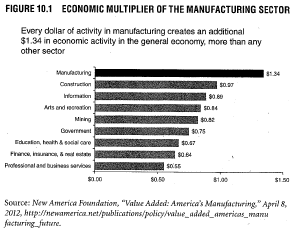
CaptureHere is Mr. DiMicco’s prescription for a return to industrial greatness:

  • Build public-private partnerships to restore the manufacturing base. For example, only $60 billion out of the $765 billion stimulus bill in 2009 was devoted to infrastructure spending.  As another example, the corporate income tax rate should be significantly lowered.
  • Level the playing field in international trade. When Germany and Japan built up huge trade surpluses in the 1970s and 1980s, the Reagan Administration responded with the Plaza Accord in 1985 outlawing foreign currency manipulation. Since then China especially has adopted a strongly mercantilist trading policy, subsidizing key industries, exporting as much as possible and importing as little as possible. No president since Reagan has insisted on equitable rule-based trade agreements where the rules are enforced.  This would help immensely.
  • Rebuild the nation’s infrastructure. Mr. DiMicco would be willing to increase deficit spending for such needs as highways, bridges, fiber-optic lines, mobile networks, and urban wastewater systems.
  • Develop our energy resources. Go all out on natural gas production by fracking. This will lower our carbon footprint and has the potential to make us completely energy independent, thereby greatly reducing our trade deficit.
  • The skills gap myth. It would help if the U.S. had better career education for high school students unlikely to go to college. But Nucor sponsors cooperative training programs at all of its locations and has no trouble finding workers.

A strong revival of U.S. manufacturing has the potential to create 30 million new jobs and thereby revitalize the American middle class.  Mr. DiMicco’s prescription makes a lot of sense.