What, if Anything, Will Restrain Donald Trump?


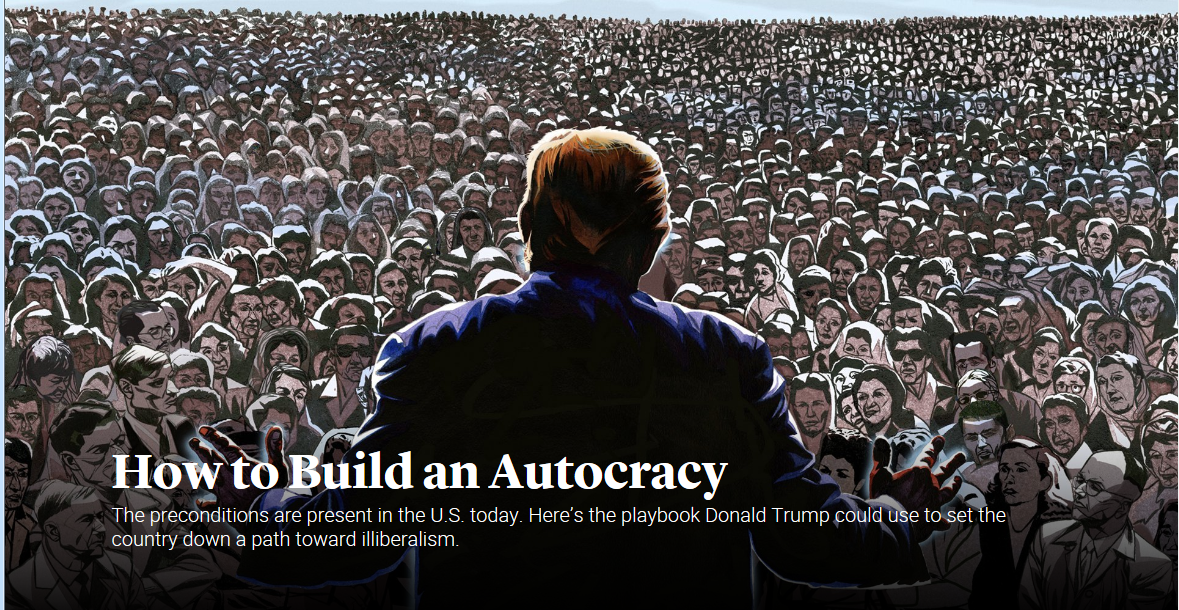
The Atlantic magazine has just released a remarkable essay written by the political commentator, David Frum, entitled, “How to Build an Autocracy.”  Says Mr. Frum, “Donald Trump will not set out to build an authoritarian state.  His immediate priority seems likely to be to use the presidency to enrich himself.  But as he does so, he will need to protect himself from legal risk.  Being Trump, he will also inevitably wish to inflict payback on his critics.  Construction of an apparatus of impunity and revenge will begin haphazardly and opportunistically.  But it will accelerate.  It will have to.”
capture99
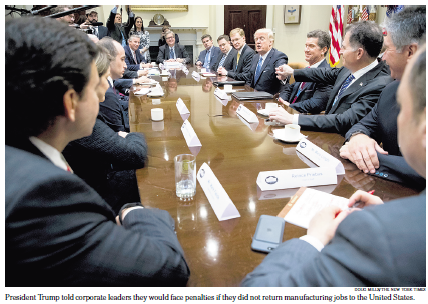
Let’s assume that Mr. Frum is correct that Trump’s top priority is to enrich himself.  What will stop him from doing this?  A recent column in the New York Times points out that:

  •  54% of registered voters in congressional districts represented by Republicans view Mr. Trump favorably compared with only 42% who view him unfavorably.
    In these same districts, 87% of registered Republicans view Mr. Trump favorably.
  • In other words, the Republican dominated Congress is unlikely to strongly oppose his sleazy and self-enriching behavior.

But there are other constraints on what he does in office:

  • As I said in a recent post in order for Mr. Trump to be reelected in 2020, he will need to substantially speed up economic growth in order to increase the wages of his key blue-collar supporters. He clearly wants to accomplish this.
  • On the other hand, the conservative Republican base, including its representatives in the House such as the Freedom Caucus, will simply not support huge increases in deficit spending for anything (except an emergency) including infrastructure, the military or unfunded tax cuts.
  • In fact, Rep Mick Mulvaney (R, SC), a deficit hawk, has been nominated to become the Trump Administration’s Budget Director. In March the debt ceiling will have to be raised. I expect the many fiscal conservatives in Congress to insist on significant fiscal restraint (e.g. a ten year plan to balance the budget) as a tradeoff for raising the debt ceiling.

Conclusion. Just because Republicans are tolerant of Mr. Trump’s personal behavior does not mean he can successfully ignore the strong Republican desire for fiscal restraint.

Follow me on Twitter
Follow me on Facebook


Can We Trust Donald Trump to Do What’s Best for America?


From a reader of my blog:

You are an eternal optimist. Have you factored in these possibilities:

1. Paul Ryan and others will support the Wall and what it costs.
2.
Immigration control will limit much needed manpower.
3.
Trade wars with Mexico and other countries might severely reduce the output of
the USA.
4.
Tax reform will favor the ultra-wealthy, thus not do much to stimulate the
economy, causing a dramatic increase in the debt.
5.
Defense spending will be massive, thus up with the debt.
6.
Charter schools will lack sufficient oversight, thus poor results will follow.

You seem to convey that Trump will execute a strategy much as you think it should be done. I doubt it.

The above outcomes are unlikely for the following reasons:

  • Trump obviously likes being President, will continue to do so, and will hope to be re-elected in 2020. His re-election prospects will depend almost entirely on his boosting economic growth in order to increase the wages of his key blue-collar supporters.capture97
  • The quickest way to speed up growth is through corporate and business tax reform and deregulation. Trump’s entire team of advisors and cabinet secretaries, as well as congressional majorities, agree on this strategy. These things are likely to get done, sooner rather than later.
  • A trade war with Mexico or any other major trading partner (China, Canada, etc.) will badly hurt the economy. Trump knows this as well as anyone and won’t let it happen. A 20% tariff on Mexican imports to pay for a wall will just transfer the cost to American consumers and will be very unpopular. Trump’s people can figure this out.
  • Having 11½ million illegal immigrants in the U.S. is a significant problem and Trump has a mandate to fix it. His plan is to 1) build a wall, 2) deport the 800,000 or so lawbreakers amongst these illegals, and then 3) figure out what to do with the rest. This sounds to me like a reasonable plan and has a good chance of being successfully implemented.Conclusion. I admit to being an optimist. It keeps me going! I’ll respond to the other specifics (debt, charter schools, etc.) in the near future.

    Follow me on Twitter
    Follow me on Facebook
On Evaluating President Trump: Put Substance over Style


In Sunday’s New York Times, the Ethics and Public Policy Center’s Peter Wehner wrote: “Donald Trump is a transgressive personality.  He thrives on creating disorder, in violating rules, in provoking outrage.  He is a shock jock.  . . . For Mr. Trump, nothing is sacred.  The truth is malleable, instrumental, subjective.  It is all about him.  It is always about him.”

capture97
I understand that he is a narcissist but I am paying as much attention to what he does as to what he says.  For example:

  • Economic Policy. A major focus of his campaign was to get the economy growing faster. His appointments so far will help in this regard. Mnuchin at Treasury is for tax reform and financial deregulation. Price at HHS is for healthcare deregulation. Pruitt at EPA is for loosening environmental rules. He may try to negotiate modifications to NAFTA but he is too smart to start a trade war which would be devastating to the overall economy. His best hope for being re-elected in 2020 is to create more jobs and better paying jobs for his fervent blue-collar supporters.
  • Education Policy. K-12 public education for minorities in many big inner cities is a disaster. Betsy DeVos is an education reform activist in Michigan. Shaking up the education establishment is a good idea.
  • Fiscal Policy. Our public debt is much too large and must be reduced, sooner rather than later, before we have a new fiscal crisis. This will be very difficult to do because it means modifying entitlements such as Social Security and Medicare which Mr. Trump has said he won’t do. The Republican House is adamant about shrinking the debt and it is hard to imagine Mr. Trump standing in the way. It will be fascinating to see how he finesses this critical issue.

Conclusion. Far from being a detriment to performing his presidential duties, Mr. Trump’s rhetorical skills could come in very handy in moving our nation forward.

Follow me on Twitter
Follow me on Facebook
Trump as the Anti-Obama


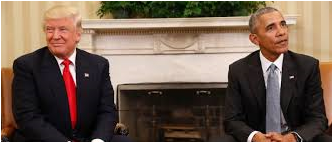
Donald Trump assumes office with perhaps the lowest favorability ratings of any modern president. According to the New York Times,

  • Mr. Trump’s approval rating is only 40% among all adults and just 46% among likely voters.
  • But a recent CNN poll reports that 48% of adults think he’ll do a good job as president and 61% think he’ll bring back well-paying jobs to economically depressed areas.capture97

Contrast this with Barack Obama’s latest poll ratings:

  • According to Gallup Mr. Obama leaves office with an approval rating of 57%.
  • But Rasmussen reports that only 35% of likely voters think the country is heading in the right direction (with 55% saying that we’re headed in the wrong direction).

I interpret this to mean that the country is largely turned off by Mr. Trump’s crude speech and sleazy behavior, while still liking his economic program.  On the other hand, voters like Mr. Obama personally while disapproving of many of his policies and accomplishments.

All of this leaves Mr. Trump in an amazingly good political position:

  • With unemployment currently at a relatively low 4.7% and the economy fully recovered from the Great Recession, even modest reform in tax policy coupled with energy, healthcare and financial deregulation could provide a significant boost to long stalled economic growth.
  • He is criticized for having no clear cut political philosophy but this means he is free to do whatever makes good sense regardless of ideology. This will be a huge advantage in working with both parties to get things done.
  • He has nowhere to go but up in the polls. Such an increase in personal popularity will create the semblance of forward momentum.

Conclusion. The prospects are indeed propitious for Donald Trump to become a transformational president.

Follow me on Twitter
Follow me on Facebook


The Divided States of America: Who’s at Fault?


Frontline’s two part series, “The Divided States of America” makes the case that the divisive and hyper-partisan political atmosphere of the past eight years was caused primarily by the racially tinged reaction of the extremist Tea Party to the progressive policies of a forward looking, if inexperienced, black president.

capture97
I think that Frontline has missed the most fundamental reasons for our current malaise, namely that:

  • Slow economic growth since the end of the Great Recession in June 2009 has caused great angst and resentment amongst middle-income, and especially blue-collar, workers who have stagnant incomes when they observe all around them the elite professional, managerial and financial classes who are doing so well.
  • Self-righteous attitude of progressives who refuse to accept that conservatives have legitimate, and maybe even superior, points of view on various issues.

For example:

  • National Debt. The public debt (on which we pay interest) is now 76% of GDP, the highest since the end of WWII, and is projected by the Congressional Budget Office to keep steadily getting worse without a change in policy. Right now, with ultra-low interest rates, our $14 trillion debt is essentially “free” money. But what is going to happen when interest rates go back up to more normal levels? It could easily be a new fiscal crisis, much worse than the financial crisis of 2008.
  • Inequality. Inequality has risen somewhat in recent years but slow growth is the real problem. What is especially lacking is new business investment to increase labor productivity. The best way to fix this is with tax reform (lower tax rates paid for by shrinking deductions) and a reduction in government regulation. But this would mean more “trickle down” economics. Horrors!
  • Improving Obamacare. The Affordable Care Act has increased access to healthcare but has done nothing to control costs. Most developed countries control the cost of healthcare with a “single payer,” government run monopoly. But this is anathema to many Americans who neither want to give up personal choice nor want to forgo the innovation which a free-market consumer-driven healthcare system provides.

Conclusion. The driver of our currently divisive political climate is a deep chasm between the fundamental beliefs of the two different sides. How can this deep division be overcome short of a new crisis which pulls both sides together?  A very difficult question.

Follow me on Twitter
Follow me on Facebook


What Will Trump Do?


I did not vote for Donald Trump because of his often crude remarks and sleazy behavior. But I am now cautiously optimistic about the prospects for his presidency based on the quality of his nominees for important government posts.  Like many of his voters, I “take him seriously but not literally.”

capture97
Here is what I think he will do:

  • Economic Policy. He will try to speed up economic growth, well above the average 2.1% annual GDP growth of the past 7½ years. This can be accomplished with tax reform (lowering tax rates paid for by shrinking deductions), regulatory reform (including paring back Dodd-Frank and the ACA), immigration reform and tougher trade policies. Faster growth benefits the whole country and especially the blue-collar workers who voted for him.
  • Improving life in the inner cities. K-12 education is a disaster in many inner cities and Betsy DeVos will be a reformer in the Education Department. Ben Carson grew up in public housing and is an excellent choice for HUD.
  • Foreign Policy. Mr. Trump wants changes from China on currency and trade practices. He also wants more cooperation from Russia in fighting terrorism. He wants our NATO partners to bear a bigger share of their own defense. His Secretary of State designee, Rex Tillerson, supports arming Ukraine against Russia and also supports the TPP trade agreement with Asia. This all sounds good to me.
  • Fiscal Policy. My biggest concern at this point is our national debt, now 76% of GDP (for the public part on which we pay interest) which is historically high and steadily getting worse. The House Republicans are serious about shrinking deficit spending and hopefully Mr. Trump will support their efforts.

Conclusion. Donald Trump has a highly unconventional (but very effective) style of communication. If it leads to progress in addressing our biggest problems as above, then he’ll have a very successful presidency.

Follow me on Twitter
Follow me on Facebook

What Is Slowing Down Today’s Economy? II. Three Culprits


My last post, “What Is Slowing Down the U.S. Economy,” reports on an interesting analysis by the Gallup economist, Jonathan Rothwell, making an excellent case that three of the biggest drags on the U.S. economy are the costs of:

capture93

  • Healthcare. By far the biggest drag, healthcare costs have increased from 9% of GDP in 1980 to 18% in 2015. Mr. Rothwell notes that the average U.S. physician spends $83,000 per year to process claims and interact with insurance companies compared to $22,000 in Canada which has a single payer system. The solution, in my opinion, is to change the tax treatment of employer provided health insurance (to cover catastrophic coverage only) in order to give individuals more “skin in the game.”
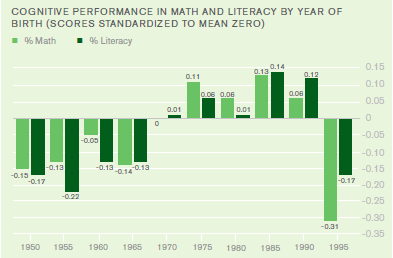
  • Education. Although education costs have risen only from 6% to 7% of GDP over the past 35 years, education overall is 8.9% more expensive in 2015 than in 1980 and higher education is 11.1 times more expensive. Considering the ever increasing need for highly trained workers in today’s high-tech and globally competitive economy, such rapidly increasing cost presents a huge impediment to progress. Foundational K-12 education is also failing to close the achievement gap between low-income minority students and middle-class students. Such disparity in educational outcomes bodes ill for future social harmony. Even overall cognitive performance in math and literacy is now declining (see chart). These are tough problems to solve.

    capture95

  • Housing. Again, only a 1% increase (from 11% to 12%) in GDP from 1980 to 2015 but this translates into a rental cost increase of 19% of GDP in 1980 to 28% of GDP in 2015. Also mortgage payment costs increased from 12% of GDP in 1980 to 16% of GDP today. Mr. Rothwell attributes these increases to a tightening of local zoning restrictions. There does not appear to be any general policy solution to such a problem.

Conclusion. The costs of healthcare, education and housing are eating up greater and greater amounts of family income and therefore are retarding economic growth and social progress. What can be done about these problems?  Stay tuned!

Follow me on Twitter
Follow me on Facebook
What Is Slowing Down Today’s Economy?


We will soon have a new President and, even though his election was somewhat of a fluke, he will obviously want to help the blue-collar workers who elected him.  The best way to do this is to make the economy grow faster.
The Gallup economist, Jonathan Rothwell, has just issued an excellent analysis of some of the major reasons for our current slow economy, “No Recovery: an analysis of long-term U.S. productivity decline.”

capture91
Says Mr. Rothwell:

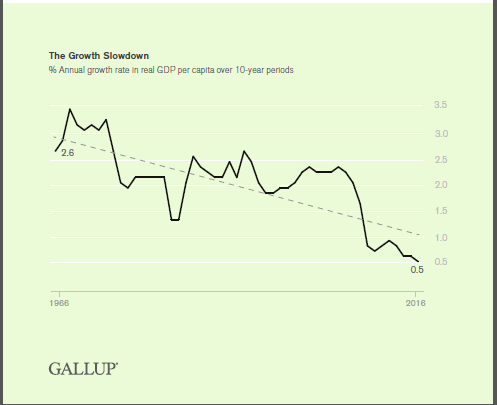
  • The problem is severe. U.S. GDP growth per capita has declined from 2.6% in 1966 to .5% today. Small differences expand into vast gaps in potential living standards. 1% growth for the next 35 years would expand household income from $56,000 in 2015 to $79,000 in 2050 (inflation adjusted), whereas 1.7% growth would raise household income to $101,000 in 2050.
  • Changes in living standards are fundamentally linked to changes of how the quantity of goods and services relate to their cost. Deterioration in the quality-to-cost ratio for healthcare, housing and education is dragging down economic growth. These three sectors alone have increased from 25% of GDP in 1980 to 36% of GDP in 2015.capture92
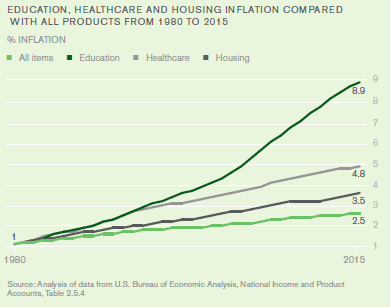
  • The cost of healthcare is 4.8 times as high today as in 1980, the cost of education is 8.9 times as high today as in 1980 and the cost of housing is 3.5 times as high today as in 1980. These compare to an overall cost increase of all items of 2.5 times today compared to 1980.
  • These three sectors have all gotten more expensive (without getting more productive), thereby absorbing more of families’ incomes, making it harder to satisfy other wants.

Conclusion.  We all want schools that work, adequate housing, and quality healthcare.  The problem is how to achieve these ends in a much more affordable manner.  Stay tuned!

Follow me on Twitter
Follow me on Facebook
Trump’s Economic Challenge


As I like to remind my readers from time to time, I am a non-ideological fiscal conservative. I simply want to solve our two most fundamental fiscal and economic problems:

  • Slow economic growth, averaging just 2.1% since the end of the Great Recession in June 2009,
  • Massive debt, now at 76% of GDP (for the public part on which we pay interest), the highest since the end of WWII,

by whatever means it takes.
Donald Trump won the presidential election contest because he convinced blue-collar white voters that he would do something about their declining economic prospects.  But can he actually deliver for them?
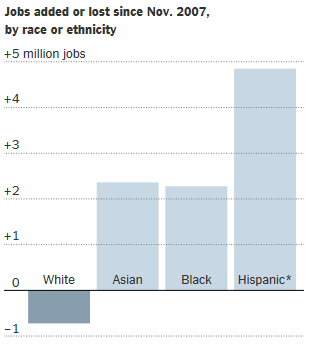
capture87Yesterday’s New York Times has an excellent analysis of this problem by the economic journalist, Eduardo Porter, “Where were Trump’s votes?  Where the jobs weren’t.”  Mr. Porter points out that, in fact, Hispanic, Black and Asian workers have all done much better than white workers since November 2007 (see above chart).
capture88He also points out that all three of these minority groups live primarily in metropolitan areas where jobs have been growing much faster than in nonmetropolitan areas (see above chart).
He further points out that while the number of manufacturing jobs has been flat since 1978, the number of service jobs has been increasing rapidly and that most of these new service jobs are in the cities where minorities are clustered (see below).
capture89The question then is what Mr. Trump (or anyone else!) can do to help his largely rural blue-collar constituency?  Mr. Porter recognizes that faster economic growth will have to come from investments in technology and human capital.  But he thinks that this will happen mostly in the cities and thus help minorities proportionally more than whites. Conclusion. Helping blue-collar whites is Mr. Trump’s fundamental economic problem.  Faster overall economic growth will help to some extent.  Trade restrictions will not help.  Immigration restrictions might help but could also hurt the overall economy if employers can’t hire enough workers. Better education and vocational training will help in the long run but not immediately.  This is a very tough problem to solve!

Follow me on Twitter
Follow me on Facebook
Trump’s Cabinet Choices Bode Well for the Economy


President-elect Donald Trump made faster economic growth one of his major campaign themes and the direction of Trumponomics is already beginning to take shape.  His major cabinet choices so far auger well for the fundamental changes which are needed to speed up economic growth:
capture64

  • Steven Mnuchin for Treasury. Mr. Mnuchin says that “the number one problem with Dodd-Frank is that it is way too complicated and cuts back lending.” Making loans is “the engine of growth to small- and medium-sized businesses.”  He also believes that 3% – 4% GDP growth is possible with tax and regulatory reform.
  • Tom Price for Health and Human Services. Mr. Price has some excellent ideas for getting American healthcare straightened out, in order to make it more consumer-oriented as well as less costly for individuals, businesses and the government (i.e. the taxpayers).
  • Scott Pruitt for the Environmental Protection Agency. Mr. Pruitt is a lawyer who has fought EPA overreach as the Attorney General of Oklahoma. Mr. Pruitt will end up improving the environment because “he will make sure that the rules issued by the EPA are rooted in law and thus won’t be overturned in court.”
  • Betsy DeVos for Education. Ms. DeVos, a school reformer from Michigan, is a strong supporter of vouchers and charter schools. K-12 school reform is absolutely essential to better prepare low-income and minority students for the high tech and global economy which awaits them after graduation.
  • General James Mattis for Defense and Senator Jeff Sessions for Attorney General are also excellent choices for strengthening America’s national security and moral fabric.

Conclusion. I have been advocating fundamental changes in fiscal and economic policy for years now and, thanks to the election of Donald Trump, things are moving rapidly in this direction. It is a good time to be optimistic about the future of our country.

Follow me on Twitter
Follow me on Facebook