A Path for Climate Change beyond Paris


The United Nations climate conference has just opened in Paris.  The pledges that countries are making fall way short of what many say is needed to solve the problem of climate change.  The Deep Decarbonization Pathways Project based in Paris and New York describes what will be needed to get the job done:
Capture

  • The 2 degree C temperature increase benchmark is used even though it is an arbitrary threshold. “Hell is not going to break loose at two degrees – it will take hundreds of years to unfold.” The world has so far warmed .9 degree C since 1880, halfway to the threshold.
  • The technologies available today, such as solar power and wind turbines, while good enough to get a running start on the transition, are not good enough to finish it.
  • Many countries will need to keep burning coal or natural gas to generate power while capturing the carbon dioxide emerging from smoke stacks, compressing it and injecting it deep underground. In fact most fossil fuel energy producers do not appear to be putting much effort into this approach.
  • Governments could easily flub the energy transition by failing to plan far enough ahead. Most countries are setting 10 and 15 year targets that can be met with incremental changes.
  • To achieve emissions goals, entire economies, including transportation, needs to be electrified as much as possible. Spending a lot of effort, as the U.S. is doing, trying to make gasoline cars more efficient, may be going down a blind alley.
  • Another potential dead end would be an overreliance on natural gas, which emits only half as much carbon as coal. This helps in the short run but gas has to go away within a few decades. Thus heavy investment in natural gas pipelines and power plants now could undermine long term goals.

The point is that the DDPP, designed to hold a global temperature increase to just 2 degrees C from preindustrial times, is extremely demanding.  It will require massive governmental interference in the energy economies of both developed and developing countries all over the world.    A far, far better approach is for leading world economies such as the U.S., Western Europe, China and Japan to provide leadership by implementing a tax on carbon emissions and thereby create an economic incentive for the fossil fuel industry to decarbonize itself.

Follow me on Twitter: https://twitter.com/jack_heidel
Follow me on Facebook: https://www.facebook.com/jack.heidel.3

 

Creating a Carbon-Free World


Tomorrow the United Nations climate conference opens in Paris.  According to Peter Thiel, the venture capitalist, “We can talk about a carbon-free world, or we can create one.” Continues Mr. Thiel, “The single most important action we can take is thawing a nuclear energy policy that keeps our technology frozen in time.”
CaptureConsider:

  • Wind and solar together provide less than 2% of the world’s energy and they aren’t growing anywhere near fast enough to replace fossil fuels.
  • China’s coal consumption is growing at 2.6% per year and India’s at 5%. In India there are 300 million people without access to electricity. The Paris plan wants India to be satisfied with a .6 metric ton of oil equivalent per person, when a minimum of at least four tons per person is needed for the development of an advanced nation.
  • Safety fears about nuclear power are overblown. The 1979 accident at Three Mile Island caused no significant amount of radiation to be released. The 1986 Chernobyl disaster was caused by a faulty design and operator incompetence. Fewer than 50 people were killed by released radiation compared with 13,000 killed every year by smoke from coal-fired power plants. The 2011 Fukushima disaster resulted in no deaths from radiation.
  • A new generation of American nuclear scientists has produced designs for better reactors which have the potential to overcome the biggest obstacle to the success of nuclear power: high cost.

I hear many people say that the U.S. needs to provide leadership in getting the world to stop using fossil fuels.  A carbon tax would provide an economic incentive to either move away from fossil fuels or clean them up.  But even a revenue neutral carbon tax would face strong political resistance. Climate change activists should consider supporting nuclear energy development as perhaps the most viable alternative to fossil fuels.

Follow me on Twitter: https://twitter.com/jack_heidel
Follow me on Facebook: https://www.facebook.com/jack.heidel.3

The Evidence for Rapid Climate Change


My last post, “Why We Badly Need a Revenue Neutral Carbon Tax” makes the case for combatting global warming with a sensible free market mechanism such as a carbon tax rather than a hodge-podge of arbitrary national and state regulatory actions. Since many of the Facebook responders to this post deny the reality of global warming in the first place, I have decided to present the overwhelming evidence for its existence.
When ninety-seven percent of climate scientists worldwide agree that climate change is real and they have assembled a massive amount of measurement data to back up this claim, I think we have to take them seriously. For example:

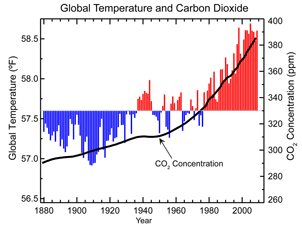
  • The Global Surface Temperature is Rising. Global average temperature has risen 1.4 F since the early 20th century as shown in the chart just below which also shows the close correlation with carbon-dioxide concentration.
    Capture2
  • The Sea Level is Rising. It has risen at an average rate of 1.7 mm/year over the last 100 years and at the rate of 3.5 mm/year since 1993 which is equivalent to one inch every seven years.
  • Global Upper Ocean Heat Content is Rising. The top 700 meters have warmed by .3F since 1969. Thermal expansion of the ocean water as it warms contributes to the sea level rise.
  • Glacier Volume is Shrinking Worldwide. Just Greenland and Antartica alone have lost at 150 cubic kilometers of ice annually in recent years.
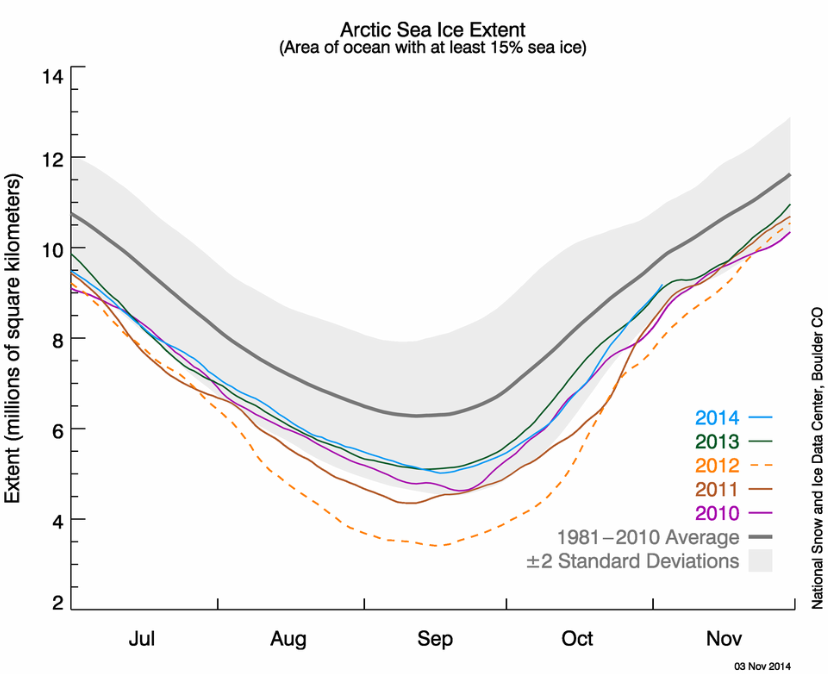
  • Declining Artic Sea Ice. Both the extent and thickness of artic sea ice has declined rapidly over the last several decades (see chart below).
    Capture1I accept the reality of the scientific evidence for global warming but I am certainly no “alarmist” in terms of what our response should be towards addressing it. It will be many, many years before renewable energy sources like wind and solar are able to make a substantial dent in worldwide energy needs.
    The best thing to do in the meantime is to attempt to decrease carbon dioxide emissions from fossil fuels through carbon capture and storage. A carbon tax would create a huge economic incentive for the coal and oil industry to solve this problem. If and when they figure it out, it is likely that the technology involved would rapidly spread around the world.
    This would represent a real solution to a very serious problem.

Why We Badly Need a Revenue Neutral Carbon Tax


A large and steadily growing majority of Americans believe that global warming, caused by the burning of fossil fuels, is a serious problem which must be addressed. What remains is to figure out how to do this with the least possible amount of economic damage to ourselves and others.
Capture1Consider that:

  • Energy consumption will increase 56% worldwide by 2040, overwhelmingly with the use of fossil fuels. Biofuels are a very inefficient source of energy and wind energy isn’t much better. Solar energy is dropping in price but is still much more expensive than natural gas.
  • The Environmental Protection Agency has just issued its Final Rule for a Clean Power Plan to reduce carbon emission levels in 2030 by 32% below 2005 levels.
  • California is now considering drastic legislation requiring a 50% reduction in petroleum use by 2030 which is likely to do much damage to the California economy.
  • In 2008 the Canadian province British Columbia introduced a revenue neutral carbon tax which has succeeded in reducing carbon emissions without damaging the BC economy.
  • The advocacy group, Washington Carbon, is trying to put a carbon tax on the Washington State 2016 ballot. Initiative Measure 732 would institute a tax on fossil fuels of $25 per ton of carbon dioxide. According to the Seattle Times many environmentalists are opposed to this initiative because it would be revenue neutral!

Conclusion: humanity is faced with the very serious problem of global warming and the response so far is chaotic and totally inadequate. The developing world is rapidly increasing its use of fossil fuels while the EPA is trying to put the brakes on our own use. Meanwhile states (and Canadian provinces) are establishing their own individual energy policies.
Isn’t it clear that what is needed is a conceptually simple unified approach to create incentives for all of us to cut back on carbon dioxide emissions? Isn’t it also clear that the best way to do this is with a national carbon tax?
It is up to the U.S. and other developed countries to take the lead in doing this. Once we are clearly doing what is needed, then and only then can we begin to lean on less developed countries to follow our example.


Climate Change Requires N2N


I have been reporting for several days on a fascinating new book, “Smaller Faster Lighter Denser Cheaper” by Robert Bryce and, in particular, what it means for climate change.
CaptureHere are some key points:

As Mr. Bryce says, “It’s time to focus our inquiry on the key question: if we agree that too much carbon dioxide is bad for the Earth’s atmosphere – what are we going to do? What’s the best “no regrets” climate policy as we move forward?” Here’s how to proceed:

  • We will need much more energy in the decades ahead in order to raise the living standards of the more than two billion people who are still living in energy poverty.
  • Hydrocarbons now provide 87% of the world’s total energy needs. There are still no affordable, scalable substitutes for the vast quantity of hydrocarbons that we use today.
  • People in the industrialized countries cannot and should not hinder the efforts of the world’s poor to gain access to cheap, reliable sources of energy.
  • We must give a very high priority to adapting and hardening our cities, networks and structures so they can better survive severe weather events.
  • N2N (natural gas to nuclear) provides the best no-regrets energy policy because those fuels can provide significant environmental benefits with relatively low economic costs.
  • The combination of natural gas and nuclear energy has reduced America’s carbon footprint by 54 billion tons over the last six decades. By comparison, wind, solar and geothermal sources reduced emissions by just 1.5 billion tons over the same period.

In other words, we need to be practical about the new sources of energy which will be needed to meet growing world demand. Renewable energy sources cannot nearly provide what is needed. Exploiting the current abundance of natural gas while further developing nuclear energy is the best way to proceed.

Biofuels are “A Crime Against Humanity”


Such has been called the burning of food crops to produce biofuels.
CaptureA recent research report by Capt. T.A. Kiefer, “Twenty-First Century Snake Oil: Why the United States Should Reject Biofuels as Part of a Rational National Security Energy Strategy” states that:

“Imagine if the US military developed a weapon that could threaten millions around the world with hunger, accelerate global warming, incite widespread instability and revolution, provide our competitors and enemies with cheaper energy, and reduce America’s economy to a permanent state of recession. What would be the sense and morality of employing such a weapon? We are already building that weapon – it is our biofuels program.”

Here are a few of the reasons for such a severe indictment of biofuels:

  • Liquid hydrocarbons are unmatched as transportation fuel. Using hydrocarbons to process biomass into transportation fuel is detrimental to civilization’s energy balance and must be avoided.
  • Not even today’s best liquid biofuels have any prospect of simultaneously attaining the 6:1 EROI (Energy Return on Investment) necessary to support a healthy modern civilization while also achieving the massive yields per acre necessary to supplant any significant fraction of the national energy supply.
  • Petroleum and natural gas are true primary energy sources and fuel modern agriculture. The use of petroleum to accelerate energy crop growth is ludicrous on its face, as the result is less overall efficiency of energy and greater net consumption of petroleum.
  • The best use of agricultural land and water is to produce sufficient food for the United States and a surplus for the rest of the world.
  • The only sensible use of biomass as fuel is to harvest unfertilized biomass from unmanaged land and consume it as is (e.g. firewood) without wasteful attempts to transform it into liquid fuel.
  • Mandating the use of higher-EROI fossil fuels to make lower-EROI biofuels requires the overall consumption of more energy to deliver the same power output. Current U.S. biofuels policy is accelerating rather than decreasing the use of fossil fuels.

“We must understand that a national energy strategy is nothing less than a national survival strategy.” Is it not obvious that all subsidies and mandates for biofuels, including ethanol, should be ended as quickly and expeditiously as possible?

The Problem of Soaring World Population


As I remind readers from time to time, this blog is focused on the fiscal and economic problems of the U.S. Our biggest fiscal problem is not having enough tax revenue to pay our bills.  Our biggest economic problem is a stagnant economy which leaves too many people unemployed or underemployed.
My last three post have been on the subject of climate change. This is a worldwide problem which has a huge effect on the U.S.  There’s going to be a cost in cutting way back on carbon emissions.  But there will soon be a much greater cost if we don’t cut back and therefore suffer the growing adverse environmental effects.
Now there is another looming problem.  The journal Science has just published the article “World population stabilization unlikely this century,” reporting that world population, now 7.2 billion, is likely to reach 9.6 billion by 2050 and 10.9 billion by 2100.  Much of the increase will take place in Africa due to higher fertility rates because of a recent slowdown in the pace of fertility decline.
CaptureThe implications of a growing world population are huge:

  • First of all, it will add even more stress to an environment which is already being increasingly stressed by global warming.
  • Secondly, it will aggravate a slowdown in middle-income wage growth throughout the developed world. This is very evident in the above chart. What is happening is that the force of globalization is shifting lower skilled work to lower paid workers in the developing world. A larger population in the developing world will simply exacerbate this trend.

The noted economist, Tyler Cowen, has a different perspective on this problem, “A Strategy for Rich Countries: Absorb More Immigrants,” in today’s New York Times.  But Mr. Cowen’s approach is untenable for the long run.  The idea that you can offset an increase in the elderly population with an even bigger increase in the younger population will lead to an ever-growing overall population.
What then is the answer to over-population?  It is either more birth control or less sex.  Take your pick!

What Is the Best Way to Cope with Climate Change?


The Intergovernmental Panel on Climate Change has just issued it’s latest and most definitive assessment about the extent of global warming.  The earth’s average temperature has increased by .85 degrees centigrade since 1880 and is on track to increase to 2 degrees centigrade in a relatively short time span.  Such a major climate change will have severe repercussions for human life.
CaptureThere is much evidence for the IPCC’s gloomy prognosis.  Most convincing for me is that the extent of the summer artic ice cap is steadily shrinking, as demonstrated in the above chart.
The Environmental Protection Agency is attempting to decrease carbon emissions by regulation but there is a limit to what can be accomplished in this way:

  • The EPA’s goal is a 30% reduction in carbon emissions from 2005 levels by 2030. But the only way that this can possibly be achieved is by substituting the use of natural gas for coal, which reduces carbon emissions by 50%
  • The current low cost of natural gas is making nuclear power less economically viable even though nuclear power has no carbon footprint at all.
  • In addition to creating such constraints, this approach also has led the EPA to set complicated and arbitrary goals on carbon emissions for each state individually.

In other words, by employing onerous regulations the EPA will only, at best, be able to achieve a 30% reduction in carbon emissions by 2030. Of course, this is better than nothing but it is not nearly enough to significantly slow down global warming.  Even if European countries succeed in meeting similar targets as the ones set for the U.S., this leaves out the largest carbon emitter of all, namely China, as well as the rest of the developing world. Since it is impractical to eliminate the use of fossil fuels altogether, or even come close to doing so, the emphasis should be on limiting carbon emissions.  In other words, we should create incentives for carbon “sequestration,” i.e. the capture and storage of carbon when burning fossil fuels.   The way to do this is with a tax on the release of carbon into the atmosphere.  Such a carbon tax would provide a huge incentive for energy and power companies to develop the best possible sequestration techniques. With an economic incentive to do so, U.S. technological ingenuity will quickly develop effective methods for carbon sequestration.  Once discovered and perfected, their use would rapidly spread around the world. Climate change is real and we need an effective way to address it.  A carbon tax is the best way to get the job done.

What the EPA Is Doing about Climate Change


My last post, “The Latest Scientific Report on Climate Change,” summarizes a new report from the Intergovernmental Panel on Climate Change. It makes a very strong case that global warming is real and that it will badly disrupt human civilization before the end of the twenty-first century if not substantially mitigated.
What are we doing about it? The Environmental Protection Agency reports on its many actions as follows: “What EPA is doing about Climate Change

  • Inventorying of U.S. Greenhouse Gas Emissions and Sinks has been tracking all GHG emissions since 1990.
  • Developing “Common Sense” Regulatory Initiatives. For example, EPA’s vehicle greenhouse gas rules will eliminate 6 billion metric tons of GHG pollution by 2025. EPA is developing carbon pollution standards for the power sector which will cut carbon emissions 30% below 2005 levels.
  • Partnering with the Private Sector. EPAs partners reduced over 345 million metric tons of GHG in 2010 alone.
  • Advancing the Science. EPA works with the IPCC to understand the environmental and health impacts of climate change.


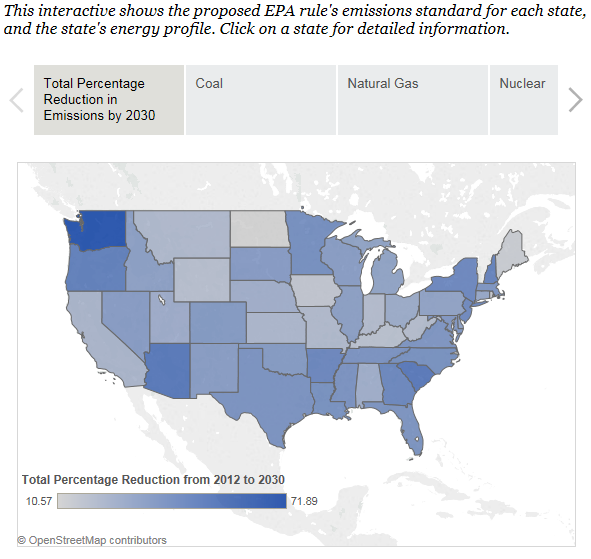
Here is how the Washington Post describes another EPA activity, the recently announced Clean Power Plan. “The rule provides every state with a target carbon-emissions intensity for its power plants, with preliminary standards kicking in by 2020 and full goals to be achieved by 2030.  As the map (below) shows, the rule generally asks the least from the states with the worst carbon-intensity at present – those that are very dependent on coal generation, such as West Virginia, Kentucky and North Dakota.  While cross-state variations in the intensity of pollution controls are a standard feature of regulation under the Clean Air Act, they usually have a compelling justification: the negative effects of emissions are local, and so areas suffering from pollution problems must be more stringent.  But greenhouse gas concentrations are uniform globally, making it somewhat awkward to subject identical emitters to divergent standards simply because their home states’ power mix is more or less carbon-intensive.”
CaptureThe purpose of this whole discussion is to illustrate how complicated it already is and will continue to be to achieve a significant reduction in GHG carbon emissions by regulation alone, even the relatively modest 30% reduction which the EPA is trying to accomplish.
Fortunately there is a better way of achieving an even bigger reduction in carbon emissions.  Stay tuned for my next post!

The Latest Scientific Report on Climate Change


The Intergovernmental Panel on Climate Change has just issued its Fifth Assessment Report summarizing the best scientific information about global warming that is available in 2014.
Capture1CaptureKey findings are:

  • It is extremely likely that humans are the dominant cause of warming since the mid-20th century.
  • Each of the past three decades has been successively warmer than the preceding decades since 1850.
  • Oceans absorb more than 90% of the heat.
  • Land temperatures remain at historic highs while ocean temperatures continue to climb.
  • Oceans will continue to warm during the 21st century.
  • Global mean sea level will continue to rise during the 21st century.
  • It is very likely that the Artic sea ice cover will continue to shrink and thin as global mean surface temperature rises.
  • Some of the changes in extreme weather and climate events observed since about 1950 have been linked to human influence.
  • The globally averaged temperature shows a warming of .85 degrees centigrade over the period 1880 – 2012. And 65% of the carbon budget compatible with limiting future temperature to an overall 2 degrees C increase has already been used.
  • Energy production remains the primary driver of greenhouse gas emissions.
  • Measures exist to achieve the substantial emissions reductions required to limit likely warming to 2 degrees C.
  • Delaying mitigation will substantially increase the challenges associated with limiting warming to 2 degrees C.

I consider the above information from the IPCC report to be noncontroversial and providing overwhelmingly strong evidence that global warming is taking place. Next question:  What do we do about it?  This will be the subject of my next post!