Poverty, Inequality and the Minimum Wage


Poverty and income inequality are getting increasingly worse in the United States and need to be seriously addressed by our political system.  In my last post on February 16, I presented data from the Heritage Foundation which shows that the War on Poverty has been quite successful in eliminating destitute poverty in the U.S.  What this means is that most low-income families have the basic necessities of enough food to eat (96%), a refrigerator (99%), a telephone (96%), air conditioning (81%), a car (74%), etc.  Of course, these “amenities” are provided at a great cost to society of about $1 trillion per year in social transfer payments.
CaptureCan we do a better job in helping the poor in the near term?  The conservative writer and political activist, Ron Unz, thinks we can.  He has just written a perceptive blog post “The Conservative Case for a Higher Minimum Wage”, proposing a national minimum wage of $12 per hour.  His reasoning is as follows.  Low wage jobs are primarily in the non-tradable service sector and so these jobs are hard to outsource and also hard to automate.  Therefore the unemployment effects of such a minimum wage increase would be minimal.  Mr. Unz estimates that, Walmart could accommodate a $12 per hour minimum wage with a one-time price hike of just 1.1%.  The grocery prices of home-grown agricultural products would rise by less than 2%.
A $12 per hour wage for a full time 40 hour per week worker would mean an annual salary of $25,000 per year or $50,000 per year for a couple.  At this income level, the family would be paying more in taxes and receiving fewer government benefits.  This would turn many net tax recipients into net taxpayers and thereby raise their stakes in the American way of life as well as lowering the deficit.
I emphasize that this is a program to alleviate poverty in the U.S.  It will not do anything to help the middle class worker whose wages have been stagnant ever since the recession started six years ago.  This is a much harder problem which will require politically charged changes in U.S. economic policy.
Stay tuned!

Poverty, Inequality and Mobility in a Free Society: Can We Do Better?

There has been a lot of public attention given to these topics recently.  Our stagnant economy since the end of the recession almost five years ago has meant high levels of unemployment and underemployment which naturally causes widespread discontent.  The 50th anniversary of President Johnson declaring War on Poverty provides an opportunity to look back and evaluate its success.
A very good summary of where we stand on poverty was given two years ago by Robert Rector and Rachel Sheffield of the Heritage Foundation: “Understanding Poverty in the United States: Surprising Facts about America’s Poor”.  The authors used 2010 census data for their study.  Poverty was defined to be a cash income of $22,314 or less for a family of four in 2010 (which increased to $23,550 in 2013).  They pointed out, for example, that “96% of poor parents stated that their children were never hungry at any time during the year because they could not afford food.”  The chart below shows that poor households, in general, have many of the common amenities.
CaptureIn other words, the close to $1 trillion spent per year ($871 billion in 2010) by federal and state governments on means tested assistance for the poor has largely eliminated destitute poverty in the U.S.  Further progress will require successfully addressing both the collapse of marriage and the lack of parental work in low-income communities.  These very difficult problems can only be addressed with a long term educational effort to turn poor children into productive citizens.
Conclusion:  the War on Poverty has had reasonable success at huge cost and further gains will be more expensive and more drawn out over time.  We’ve already started on this second phase by emphasizing early childhood education and so the focus now should be to implement this new direction.
Next step: it’s now time to direct our serious attention to the issues of inequality and mobility.  That will be the subject of my next post!

More on Inequality: How Bad Is It and Why?


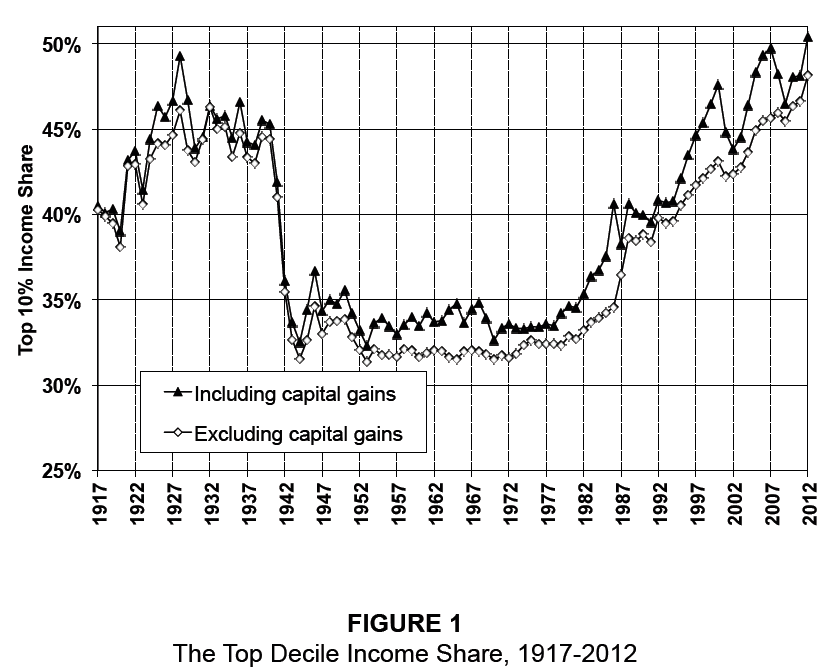
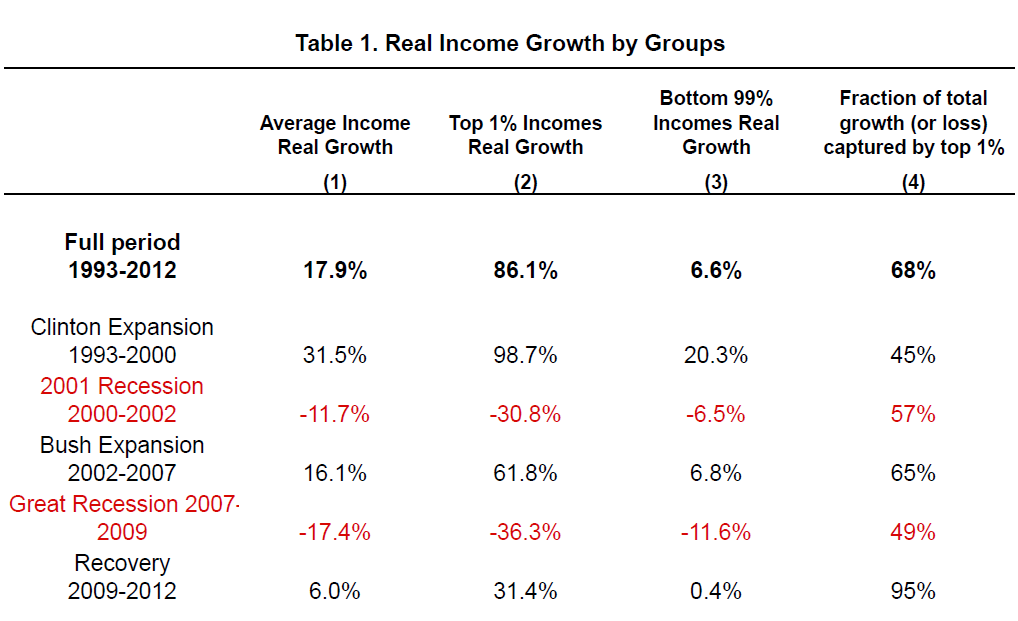
A recent article in Bloomberg View by Cass Sunstein, “How Did the 1 Percent Get Ahead So Fast?“, discusses the significance of new research by the economist Emmanuel Saez, ”Striking it Richer: The Evolution of Top Incomes in the United States”.  Referring to Saez’s table and chart below, the conclusion is that income inequality has been getting steadily worse since the early 1980s and has been especially pronounced since June 2009 when the Great Recession ended.
Capture1Capture2In particular, 95% of all income gain in the last four years has gone to the top 1%.  This is a much greater disparity than during the so-called Clinton Expansion, from 1993 – 2000 (45% to the top 1%) or during the Bush Expansion, from 2002 – 2007 (65% to the top 1%).  According to Mr. Sunstein, “one point is clear: through 2012 the gains from the current recovery were concentrated among the top 1 percent, and that pattern, extreme though it is, fits with a general surge in economic inequality over the last 40 years.”
CaptureBut there is more to the story!  Looking at the final chart, just above, it is clear that the economy grew much faster during the Clinton Expansion than during the Bush Expansion, and, in turn, much more slowly during the Obama Recovery.  In other words, the way to reduce inequality is to speed up economic growth.  There are tried and true ways to speed up growth (e.g. tax reform with lower rates, emphasis on deregulation, boosting entrepreneurship, etc.).  It is unfortunate that too many in Congress, as well as the President have ideological blinders which prevent them from moving in this direction!

Income Inequality and What to Do About It


In yesterday’s New York Times Timothy Noah has a column in The Great Divide series “The 1 Percent Are Only Half the Problem” in which he makes the case that there are two different types of inequality which society needs to address.  First, the income gap between the top 1% and the bottom 99% is getting wider and wider.  But there is also a skills gap between the (college) educated class and those whose education ended in high school.
What can and should be done about these two different aspects of inequality in America?  Controlling the excesses on Wall Street in order to avoid future bailouts will help control the wages of the top 1%.  This is already being done with the Dodd-Frank financial reforms and current efforts to require the biggest banks to hold more capital reserves.
But much more could be done.  Unfortunately, the main effect of the Federal Reserve’s low interest rate policy is to drive up the stock market which favors the more affluent.  Broad based tax reform which would lower tax rates by eliminating unjustified tax breaks for the rich would do much more to stimulate faster economic growth and give a big boost to middle class incomes.
The huge and rapidly growing cost of employer provided health care (now averaging about $5000 annually for individual coverage and about $14,000 for family coverage) is having a huge negative impact on middle class wage growth.  The U.S. spends twice as much of GDP, about 18%, on healthcare as any other developed nation.  Reforming employer provided health insurance by removing the tax exemption (and replacing it with lower tax rates) would get each of us personally involved with controlling healthcare costs.
The skills gap is driven by globalization and the advance of technology and is not going to disappear.  The only way to address it is by improving educational outcomes.  Putting more emphasis on early childhood education (ages 0-5) will help as well as making college more accessible and affordable.  Online education and especially Massive, Open, Online Courses (MOOCs) will help in both respects.  Hopefully more and more students and families will come to realize that there are many attractive alternatives to very expensive and elite residential colleges and universities.  It is not necessary to be wealthy or to borrow lots of money to attend college!
Conclusion:  inequality in American society is a large and growing problem.  But there are effective ways for both policy makers and individuals to respond.