Trash Talk from the New York Times


The Budget Committee of the House of Representatives has just issued a report “The War on Poverty: 50 Years Later”, providing an excellent summary of federal antipoverty programs and their cost at the present time (budget year 2012).  Highlights are:

  • The federal government spent $799 billion on 92 different programs to combat poverty
  • Over $100 billion was spent for 15 different food aid programs
  • Over $200 billion was spent on cash aid
  • Over $90 billion spent on education and job training (over 20 programs)
  • Nearly $300 billion spent on healthcare
  • Almost $50 billion spent on housing assistance

The report also points out that many low-income households face very high effective marginal tax rates, approaching 100%, if any members are employed, because making more money means losing welfare benefits.  This discourages low-income individuals from working at a time when the labor-force participation rate has fallen to a 36-year low of 62.8%.
CaptureHere’s the situation: we have a rapidly growing federal budget with huge deficit spending (see above chart), a stalled economy with low labor-force participation, and an inefficient welfare system which encourages people not to work. Surely our goal should be to motivate welfare recipients to become productive citizens by returning to the workforce.  So doesn’t it make sense to revamp our welfare system to be more efficient as well as to create more incentives for recipients to get and hold a job?
Apparently this does not make sense to the New York Times.  Two days ago they ran an editorial “Mr. Ryan’s Small Ideas on Poverty”, castigating Paul Ryan for “providing polished intellectual cover for his party to mow down as many antipoverty programs as it can see.”  The editorial goes on to say that “it’s easy to find flaws or waste in any government program, but the proper response is to fix those flaws, not throw entire programs away as Mr. Ryan and his Party have repeatedly proposed. . . . For all their glossy reports, Republicans have shown no interest in making these or any other social programs work better.”
Putting it as charitably as possible, the NYT is being unhelpful.  It is a beacon of progressive thought for millions of Americans.  But it is apparently unwilling to give any credence to a sincere effort by fiscal conservatives to reform a major government program to make it operate more efficiently and effectively.
Truth and Myth about Inequality


Two of my favorite columnists are the Brooking Institution’s William Galston, a social economist who has a weekly column in the Wall Street Journal and the economics journalist Robert Samuelson who writes for the Washington Post.  
Most people agree that income inequality in the U.S. is steadily getting worse.  Mr. Galston make a good case (see my last post) that it is primarily caused by the large gap between the rising productivity of American workers and the stagnant level of their pay which has developed since 1973.  He thinks that we need a fundamentally new social contract which links worker compensation to productivity.  This, of course, is a tall order and it is not at all clear how such a new order would be achieved.
CaptureMr. Samuelson has a different perspective: “Myth-making about Economic Inequality”.  For example:

  • The poor are not poor because the rich are rich
  • Most of the poor will not benefit from an increase in the minimum wage because only 6% of the 46 million poor people have full time jobs
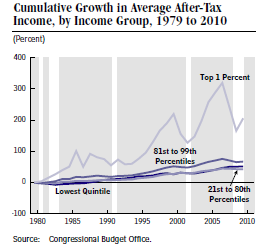
  • All income groups have gained in the past three decades, even though the top 1% has gained the most (see the above chart from the CBO, December 2013)
  • Widening economic inequality did not cause the Great Recession

These two perspectives on inequality are quite different but not contradictory.  Basically what Mr. Samuelson is saying is that we have to be careful in how we address this problem or we’ll just make it worse.  Raising taxes on the rich is unlikely to help and might hurt if it slows down the economy.  Raising the minimum wage will only raise a fairly small number of people out of poverty and may cause a lot of unemployment along the way.
My solution: focus on boosting the economy to create more jobs in the short run (tax reform, immigration reform, trade expansion) and improved educational outcomes for the long run (early childhood education, increasing high school graduation rates, better career education).
But I agree with Mr. Galston that it is imperative to lessen income inequality, one way or another.  Otherwise as a society we’ll have big trouble on our hands.

Poverty, Inequality and the Minimum Wage II. Cities Are Expensive!


Poverty and inequality are getting worse in the United States.  The question is what to do about it.  One proposal is to raise the minimum wage from its current value of $7.25 per hour to $10.10 per hour.  The Congressional Budget Office has studied the tradeoffs in doing this.  Approximately 16 million people, at the bottom end of the wage scale, would see their incomes go up.  But 500,000 people would see their incomes go down because they’d lose their jobs!  Does the positive outweigh the negative?  It’s not clear!
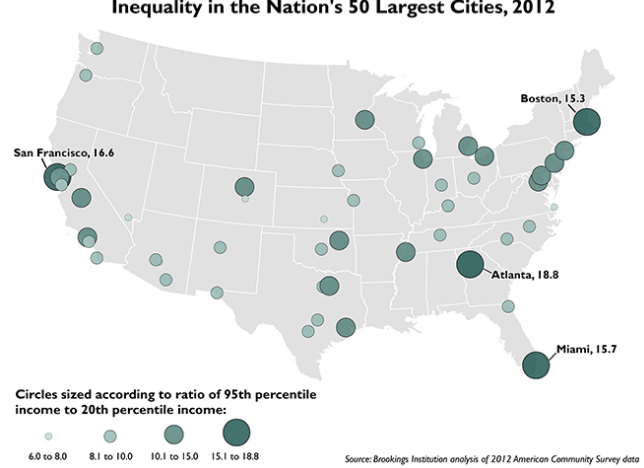
CaptureBut here is another aspect of the problem.  The Brookings Institution has just published a new study “All Cities Are Not Created Unequal”, pointing out that the 50 largest cities in the U.S. have higher rates of inequality than does the country as a whole.  Brookings looks at the so-called 95/20 ratio between the 95th percentile of wage earners compared to the 20th percentile.  The national average for this ratio is 9.1 with the 95th percentile earning (in 2012) $191,770 and the 20th percentile earning $20,968.  But many large cities such as San Francisco (16.6), Boston (15.3) and New York City (13.2) have much higher ratios.  The midsized city of Omaha has a ratio of 8.2 which is below the national average.
In other words the problems of poverty and inequality are much worse in some parts of the country than in others.  This suggests that at least part of the solution to addressing this problem should come at the state and local level.  It makes sense for California, Massachusetts and New York, for example, or at least San Francisco, Boston and New York City, to establish their own higher minimum wages.
This is not to say that a higher minimum wage at the national level is not also needed (more coming).  But the whole country cannot be expected to bail out a few major cities where the problem is much worse than elsewhere.

Poverty, Inequality and the Minimum Wage


Poverty and income inequality are getting increasingly worse in the United States and need to be seriously addressed by our political system.  In my last post on February 16, I presented data from the Heritage Foundation which shows that the War on Poverty has been quite successful in eliminating destitute poverty in the U.S.  What this means is that most low-income families have the basic necessities of enough food to eat (96%), a refrigerator (99%), a telephone (96%), air conditioning (81%), a car (74%), etc.  Of course, these “amenities” are provided at a great cost to society of about $1 trillion per year in social transfer payments.
CaptureCan we do a better job in helping the poor in the near term?  The conservative writer and political activist, Ron Unz, thinks we can.  He has just written a perceptive blog post “The Conservative Case for a Higher Minimum Wage”, proposing a national minimum wage of $12 per hour.  His reasoning is as follows.  Low wage jobs are primarily in the non-tradable service sector and so these jobs are hard to outsource and also hard to automate.  Therefore the unemployment effects of such a minimum wage increase would be minimal.  Mr. Unz estimates that, Walmart could accommodate a $12 per hour minimum wage with a one-time price hike of just 1.1%.  The grocery prices of home-grown agricultural products would rise by less than 2%.
A $12 per hour wage for a full time 40 hour per week worker would mean an annual salary of $25,000 per year or $50,000 per year for a couple.  At this income level, the family would be paying more in taxes and receiving fewer government benefits.  This would turn many net tax recipients into net taxpayers and thereby raise their stakes in the American way of life as well as lowering the deficit.
I emphasize that this is a program to alleviate poverty in the U.S.  It will not do anything to help the middle class worker whose wages have been stagnant ever since the recession started six years ago.  This is a much harder problem which will require politically charged changes in U.S. economic policy.
Stay tuned!

Poverty, Inequality and Mobility in a Free Society: Can We Do Better?

There has been a lot of public attention given to these topics recently.  Our stagnant economy since the end of the recession almost five years ago has meant high levels of unemployment and underemployment which naturally causes widespread discontent.  The 50th anniversary of President Johnson declaring War on Poverty provides an opportunity to look back and evaluate its success.
A very good summary of where we stand on poverty was given two years ago by Robert Rector and Rachel Sheffield of the Heritage Foundation: “Understanding Poverty in the United States: Surprising Facts about America’s Poor”.  The authors used 2010 census data for their study.  Poverty was defined to be a cash income of $22,314 or less for a family of four in 2010 (which increased to $23,550 in 2013).  They pointed out, for example, that “96% of poor parents stated that their children were never hungry at any time during the year because they could not afford food.”  The chart below shows that poor households, in general, have many of the common amenities.
CaptureIn other words, the close to $1 trillion spent per year ($871 billion in 2010) by federal and state governments on means tested assistance for the poor has largely eliminated destitute poverty in the U.S.  Further progress will require successfully addressing both the collapse of marriage and the lack of parental work in low-income communities.  These very difficult problems can only be addressed with a long term educational effort to turn poor children into productive citizens.
Conclusion:  the War on Poverty has had reasonable success at huge cost and further gains will be more expensive and more drawn out over time.  We’ve already started on this second phase by emphasizing early childhood education and so the focus now should be to implement this new direction.
Next step: it’s now time to direct our serious attention to the issues of inequality and mobility.  That will be the subject of my next post!