Trump Needs a Wall of Fiscal Discipline


So says the Concord Coalition’s Robert Bixby. President Trump said in a recent interview on Fox News that he would like to have a balanced budget “eventually,” but not at the expense of higher spending for the military. The problem is, as Mr. Bixby points out, if we delay fiscal discipline in order to increase military spending, what else will we delay it for?  Will we delay it for infrastructure spending or border security or tax cuts?  Will we delay it to protect Social Security and Medicare?

capture98
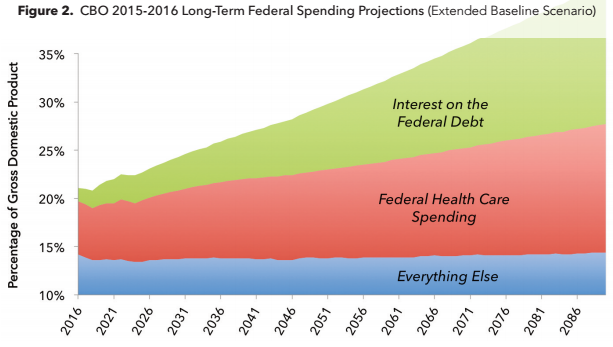
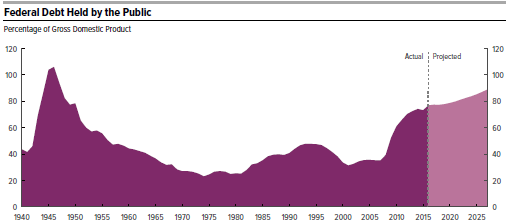
The Congressional Budget Office predicts (see chart) that, under current law, the public debt (on which we pay interest) will grow from 77% of GDP in 2017 to 89% of GDP in 2027.  Furthermore, mandatory programs (Social Security, Medicare and Medicaid) will grow from 13% of GDP this year to 15.4% in 2027 while discretionary programs (everything else except interest payments) will fall from 6.3% of GDP today to 5.3% of GDP in 2027.  Interest payments on the debt will grow from 1.4% of GDP ($270 billion) today to 2.7% of GDP ($768 billion) in 2027.

capture97
It turns out that it is possible to avoid this calamitous scenario in the following fiscally responsible way (see the attached table):

  • Note that spending (outlays) is projected to increase from $3963 billion in 2017 to $6548 in 2027, which represents a 5% annual increase in spending every year.
  • But also revenues (tax income) are projected to increase from $3404 billion in 2017 to $5140 billion in 2027.
  • If spending growth could slow down from $3963 billion in 2017 to $5140 billion in 2027 (the projected amount of revenue in that year), the budget would then be balanced in 2027!
  • It turns out that no budget cuts are required to accomplish this. In fact a calculation shows that simply limiting spending increases to 2.6% per year (rather than CBO’s projected increases of 5% per year) is sufficient to achieve this goal.

Conclusion. Above is outlined a plan to balance the budget over a ten year period without making any spending cuts! All that is needed is a modest amount of spending restraint!

Follow me on Twitter
Follow me on Facebook
Can We Trust Donald Trump to Do What’s Best for America?


From a reader of my blog:

You are an eternal optimist. Have you factored in these possibilities:

1. Paul Ryan and others will support the Wall and what it costs.
2.
Immigration control will limit much needed manpower.
3.
Trade wars with Mexico and other countries might severely reduce the output of
the USA.
4.
Tax reform will favor the ultra-wealthy, thus not do much to stimulate the
economy, causing a dramatic increase in the debt.
5.
Defense spending will be massive, thus up with the debt.
6.
Charter schools will lack sufficient oversight, thus poor results will follow.

You seem to convey that Trump will execute a strategy much as you think it should be done. I doubt it.

The above outcomes are unlikely for the following reasons:

  • Trump obviously likes being President, will continue to do so, and will hope to be re-elected in 2020. His re-election prospects will depend almost entirely on his boosting economic growth in order to increase the wages of his key blue-collar supporters.capture97
  • The quickest way to speed up growth is through corporate and business tax reform and deregulation. Trump’s entire team of advisors and cabinet secretaries, as well as congressional majorities, agree on this strategy. These things are likely to get done, sooner rather than later.
  • A trade war with Mexico or any other major trading partner (China, Canada, etc.) will badly hurt the economy. Trump knows this as well as anyone and won’t let it happen. A 20% tariff on Mexican imports to pay for a wall will just transfer the cost to American consumers and will be very unpopular. Trump’s people can figure this out.
  • Having 11½ million illegal immigrants in the U.S. is a significant problem and Trump has a mandate to fix it. His plan is to 1) build a wall, 2) deport the 800,000 or so lawbreakers amongst these illegals, and then 3) figure out what to do with the rest. This sounds to me like a reasonable plan and has a good chance of being successfully implemented.Conclusion. I admit to being an optimist. It keeps me going! I’ll respond to the other specifics (debt, charter schools, etc.) in the near future.

    Follow me on Twitter
    Follow me on Facebook

Fixing Obamacare: Keep it Simple and Low Cost


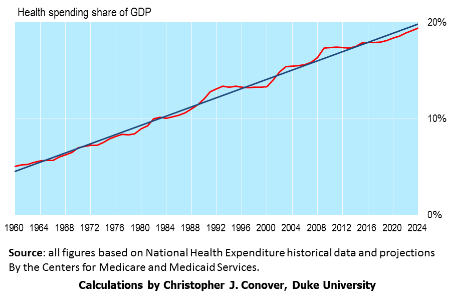
Straightening out healthcare insurance is a high priority for the new Trump Administration and Congress as it should be. The U.S. spends 18% of GDP on healthcare, public and private, twice as much as any other developed country and this percentage is likely to keep on increasing without major changes.

capture
Republican thought is converging, see here and here, on a plan with these broad features:

  • Repeal of both the individual and employer mandates so that health insurance can be individually tailored and purchased at a much lower cost than under the ACA.
  • A Universal (and refundable) tax credit sufficient to pay for catastrophic insurance coverage.
  • Health Savings Accounts to pay for routine healthcare expenses up to the deductible for catastrophic insurance. Such HSAs could be funded, at least initially, with (refundable) tax credits.
  • High risk pools and coverage for pre-existing conditions. It is estimated that 500,000 people with pre-existing conditions would need protection if the ACA is repealed. This would cost about $16 billion annually, much less than the full cost of the ACA.

Conclusion. Such a plan will insure coverage for all Americans who want it. The high deductibility feature, coupled with HSAs, will strongly encourage healthcare consumers to shop around for the best price on routine care.  Such price consciousness by consumers is the only way (short of a single payer system with severe rationing) to get our national healthcare costs under control.
A modification of such a plan, proposed by Senator Bill Cassidy (R, LA) and Senator Susan Collins (R, ME) would give each state the choice of either keeping the ACA or replacing it with a version of the above plan.  This is a poor idea because the ACA has no cost control and this is what is sorely needed.  In other words, the above plan should be made universal, identical for all states.  Let the states provide and pay for supplemental coverage if they wish.

Follow me on Twitter
Follow me on Facebook


On Evaluating President Trump: Put Substance over Style


In Sunday’s New York Times, the Ethics and Public Policy Center’s Peter Wehner wrote: “Donald Trump is a transgressive personality.  He thrives on creating disorder, in violating rules, in provoking outrage.  He is a shock jock.  . . . For Mr. Trump, nothing is sacred.  The truth is malleable, instrumental, subjective.  It is all about him.  It is always about him.”

capture97
I understand that he is a narcissist but I am paying as much attention to what he does as to what he says.  For example:

  • Economic Policy. A major focus of his campaign was to get the economy growing faster. His appointments so far will help in this regard. Mnuchin at Treasury is for tax reform and financial deregulation. Price at HHS is for healthcare deregulation. Pruitt at EPA is for loosening environmental rules. He may try to negotiate modifications to NAFTA but he is too smart to start a trade war which would be devastating to the overall economy. His best hope for being re-elected in 2020 is to create more jobs and better paying jobs for his fervent blue-collar supporters.
  • Education Policy. K-12 public education for minorities in many big inner cities is a disaster. Betsy DeVos is an education reform activist in Michigan. Shaking up the education establishment is a good idea.
  • Fiscal Policy. Our public debt is much too large and must be reduced, sooner rather than later, before we have a new fiscal crisis. This will be very difficult to do because it means modifying entitlements such as Social Security and Medicare which Mr. Trump has said he won’t do. The Republican House is adamant about shrinking the debt and it is hard to imagine Mr. Trump standing in the way. It will be fascinating to see how he finesses this critical issue.

Conclusion. Far from being a detriment to performing his presidential duties, Mr. Trump’s rhetorical skills could come in very handy in moving our nation forward.

Follow me on Twitter
Follow me on Facebook
Trump as the Anti-Obama


Donald Trump assumes office with perhaps the lowest favorability ratings of any modern president. According to the New York Times,

  • Mr. Trump’s approval rating is only 40% among all adults and just 46% among likely voters.
  • But a recent CNN poll reports that 48% of adults think he’ll do a good job as president and 61% think he’ll bring back well-paying jobs to economically depressed areas.capture97

Contrast this with Barack Obama’s latest poll ratings:

  • According to Gallup Mr. Obama leaves office with an approval rating of 57%.
  • But Rasmussen reports that only 35% of likely voters think the country is heading in the right direction (with 55% saying that we’re headed in the wrong direction).

I interpret this to mean that the country is largely turned off by Mr. Trump’s crude speech and sleazy behavior, while still liking his economic program.  On the other hand, voters like Mr. Obama personally while disapproving of many of his policies and accomplishments.

All of this leaves Mr. Trump in an amazingly good political position:

  • With unemployment currently at a relatively low 4.7% and the economy fully recovered from the Great Recession, even modest reform in tax policy coupled with energy, healthcare and financial deregulation could provide a significant boost to long stalled economic growth.
  • He is criticized for having no clear cut political philosophy but this means he is free to do whatever makes good sense regardless of ideology. This will be a huge advantage in working with both parties to get things done.
  • He has nowhere to go but up in the polls. Such an increase in personal popularity will create the semblance of forward momentum.

Conclusion. The prospects are indeed propitious for Donald Trump to become a transformational president.

Follow me on Twitter
Follow me on Facebook
 

The Divided States of America: Who’s at Fault?


Frontline’s two part series, “The Divided States of America” makes the case that the divisive and hyper-partisan political atmosphere of the past eight years was caused primarily by the racially tinged reaction of the extremist Tea Party to the progressive policies of a forward looking, if inexperienced, black president.

capture97
I think that Frontline has missed the most fundamental reasons for our current malaise, namely that:

  • Slow economic growth since the end of the Great Recession in June 2009 has caused great angst and resentment amongst middle-income, and especially blue-collar, workers who have stagnant incomes when they observe all around them the elite professional, managerial and financial classes who are doing so well.
  • Self-righteous attitude of progressives who refuse to accept that conservatives have legitimate, and maybe even superior, points of view on various issues.

For example:

  • National Debt. The public debt (on which we pay interest) is now 76% of GDP, the highest since the end of WWII, and is projected by the Congressional Budget Office to keep steadily getting worse without a change in policy. Right now, with ultra-low interest rates, our $14 trillion debt is essentially “free” money. But what is going to happen when interest rates go back up to more normal levels? It could easily be a new fiscal crisis, much worse than the financial crisis of 2008.
  • Inequality. Inequality has risen somewhat in recent years but slow growth is the real problem. What is especially lacking is new business investment to increase labor productivity. The best way to fix this is with tax reform (lower tax rates paid for by shrinking deductions) and a reduction in government regulation. But this would mean more “trickle down” economics. Horrors!
  • Improving Obamacare. The Affordable Care Act has increased access to healthcare but has done nothing to control costs. Most developed countries control the cost of healthcare with a “single payer,” government run monopoly. But this is anathema to many Americans who neither want to give up personal choice nor want to forgo the innovation which a free-market consumer-driven healthcare system provides.

Conclusion. The driver of our currently divisive political climate is a deep chasm between the fundamental beliefs of the two different sides. How can this deep division be overcome short of a new crisis which pulls both sides together?  A very difficult question.

Follow me on Twitter
Follow me on Facebook
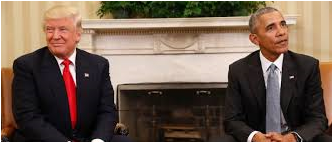
 

What Will Trump Do?


I did not vote for Donald Trump because of his often crude remarks and sleazy behavior. But I am now cautiously optimistic about the prospects for his presidency based on the quality of his nominees for important government posts.  Like many of his voters, I “take him seriously but not literally.”

capture97
Here is what I think he will do:

  • Economic Policy. He will try to speed up economic growth, well above the average 2.1% annual GDP growth of the past 7½ years. This can be accomplished with tax reform (lowering tax rates paid for by shrinking deductions), regulatory reform (including paring back Dodd-Frank and the ACA), immigration reform and tougher trade policies. Faster growth benefits the whole country and especially the blue-collar workers who voted for him.
  • Improving life in the inner cities. K-12 education is a disaster in many inner cities and Betsy DeVos will be a reformer in the Education Department. Ben Carson grew up in public housing and is an excellent choice for HUD.
  • Foreign Policy. Mr. Trump wants changes from China on currency and trade practices. He also wants more cooperation from Russia in fighting terrorism. He wants our NATO partners to bear a bigger share of their own defense. His Secretary of State designee, Rex Tillerson, supports arming Ukraine against Russia and also supports the TPP trade agreement with Asia. This all sounds good to me.
  • Fiscal Policy. My biggest concern at this point is our national debt, now 76% of GDP (for the public part on which we pay interest) which is historically high and steadily getting worse. The House Republicans are serious about shrinking deficit spending and hopefully Mr. Trump will support their efforts.

Conclusion. Donald Trump has a highly unconventional (but very effective) style of communication. If it leads to progress in addressing our biggest problems as above, then he’ll have a very successful presidency.

Follow me on Twitter
Follow me on Facebook

Trump Could Become a Transformational President


According to the historian John Steele Gordon, “Trump May Herald a New Political Order,” there have been just four transformational presidencies so far in U.S. history:

  • Andrew Jackson in 1828 moved the locus of political power sharply down the socioeconomic scale.

    capture97

  • Abraham Lincoln in 1860 preserved the Union, freed the slaves and turned the South into essentially a third world country for the next 100 years.
  • William McKinley in 1896 ushered in an era of almost unbroken Republican dominance which lasted until the 1930s.
  • Franklin Roosevelt in 1932 who overcame the Great Depression and greatly expanded the reach and power of the federal government.

Ronald Reagan in 1980, constrained by a solidly Democratic House, was less transformational than the four presidents above, even though he ushered in the era of Great Moderation which lasted until the Great Recession hit in 2007-2008.
Barack Obama in 2008 took office with strong Democratic majorities.  However the last eight years have proved a disaster for the Democratic Party.  They lost the House in 2010, the Senate in 2014, and Republicans now control most governorships and state legislatures as well.
Now consider Donald Trump’s strong political position as he takes office:

  • The Republicans hold a big majority in the House and a small majority in the Senate. And ten Democratic Senators in states carried by Mr. Trump are up for re-election in 2018.
  • He was elected to change the self-serving ways of Washington and owes little to the political establishment.
  • His cabinet picks, many with excellent qualifications, signal profound changes in government policy, especially lower tax rates and a regulatory environment more friendly to business.

Conclusion. Mr. Trump has excellent prospects for achieving faster economic growth and therefore rising incomes for the blue-collar workers who provided his victory margin. If he can also improve life in the inner cities, as he has promised to do, he and the Republican Party will be unbeatable for many years to come.

Follow me on Twitter
Follow me on Facebook

Repealing and Replacing Obamacare


The U.S. spends 18% of GDP (and rising) on healthcare, public and private, almost twice as much as any other developed country. The Affordable Care Act, passed by Congress and signed by President Obama in 2010, increases access to healthcare in the U.S. but does nothing to control its cost.

capture96
President-elect Donald Trump and the Republican Congress want to repeal the ACA and replace it with a more effective and less expensive alternative. An excellent plan for doing this, “Transcending Obamacare” has been proposed by Avik Roy, the President of the Foundation for Research and Opportunity.  Mr. Roy’s Universal (and refundable) Tax Credit Plan will:

  • expand health insurance coverage well beyond ACA levels without an individual mandate
  • improve the quality of coverage and care for low-income Americans
  • achieve permanent solvency of U.S. healthcare entitlements
  • reduce the federal deficit without raising taxes
  • reduce the cost of health insurance for individuals and businesses

Here are the main elements of the Universal Tax Credit Plan:

  • Premium assistance. The Plan repeals the ACA’s individual mandate and expands access to health savings accounts. By lowering the cost of insurance for younger and healthier individuals, the Plan would expand coverage beyond ACA levels.
  • Employer-sponsored insurance reform. The Plan repeals the ACA’s employer mandate, thereby offering employers a wider range of options for subsidizing workers’ coverage.
  • Medicaid reform. The Plan migrates the Medicaid acute-care population onto the reformed private individual insurance market, with 100% federal funding. The Plan returns to the states full financial responsibility for the Medicaid long-term care population.
  • Medicare reform. The Plan gradually raises the Medicare eligibility age by four months each year (forever), allowing younger retirees to remain on their existing plans.
  • Veterans’ health reform. The Plan gives veterans the option of private coverage via premium assistance.
  • Medical innovation is encouraged by the Plan.

Conclusion. The Universal Tax Credit Plan is a big improvement over the ACA because it expands access, improves quality and dramatically lowers costs for both individuals and the country as a whole. Check it out!

Follow me on Twitter
Follow me on Facebook


The Obama Legacy: Personal Popularity Coupled with Poor Judgement


As President Obama prepares to leave office many observers are weighing in on his accomplishments, as I have already done myself, see here and here.

capture97

Today let’s evaluate his major achievements:

  • Reviving the economy after the Great Recession. This was done but the recovery has been unnecessarily slow with annual growth averaging just 2% of GDP ever since June 2009. In fact, stagnant middle-class and especially blue-collar incomes are the reason Donald Trump eked out a victory over Hillary Clinton.
  • A giant step towards national healthcare. Even if the Affordable Care Act is repealed, its replacement will be much more universal than before. Unfortunately, however, the ACA increases access but does nothing to control the cost of healthcare (now 18% of GDP) which continues its steady rise. This is what has to change.
  • A global pact to combat climate change. Global warming is real but our response should be more circumspect. China has only pledged to reduce carbon emissions after 2030. India has 300 million people off the electric grid. It also has an abundant supply of coal. Heroic efforts by the developed world alone will have little effect on worldwide C02 levels.
  • A rash of new financial and environmental regulations. Both Dodd-Frank and new EPA regulations have contributed significantly to the economic slowdown which is why they are likely to be modified by the Trump Administration and Congress.
  • The Iran nuclear deal. The problem here is what will happen when the 10 – 15 year deal expires. Iran then will have a green light to develop nuclear weapons unless China and Russia agree to new sanctions which is unlikely.
  • American retreat from superpower status. Obama deposed a dictator in Libya but walked away from the aftermath. His premature decision to leave Iraq allowed ISIS to spring up. He let the civil war in Syria run out of control. A “reset” with Russia did nothing to prevent Putin from invading Ukraine and annexing Crimea.

Conclusion. As the first African-American President, Barack Obama is certainly a historical figure. But “a presidency of great promise is now ending in rancor and disappointment.”

Follow me on Twitter
Follow me on Facebook