Why We Cannot Wait to Fix the Debt


A Letter from Birmingham Jail   Why we cannot wait  Martin Luther King, Jr., April 16, 1963

Yesterday was Martin Luther King Day and every year at this time we are reminded of his eloquent letter from the Birmingham Jail, “Why we cannot wait,” written to some of his hesitant supporters in the Spring of 1963.
African-Americans were tired of waiting so long for equal rights in their own country.  On my own personal scale, I am so frustrated by the inability of our political system to address our massive debt problem, that I am getting organized to enter the 2018 Nebraska Republican Senate Primary against the incumbent Deb Fischer who has just voted (with the new tax law) to increase our debt by $1 trillion over the next decade.
Basically I am saying that our debt is so large and growing so fast that it will soon be out of control if we don’t take action to start reducing it very soon.


Consider:

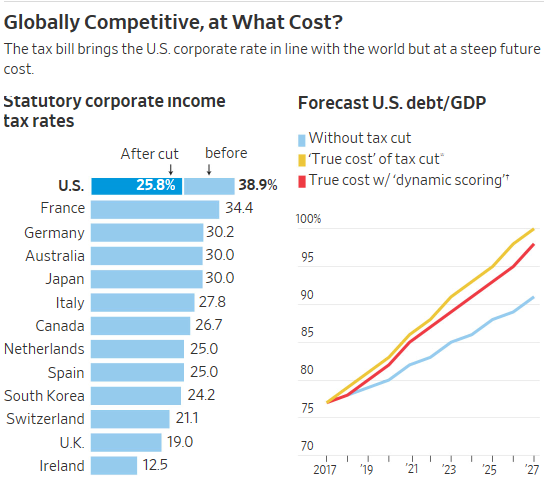
  • The public debt (on which we pay interest) is now 77% of GDP, the highest since WWII, and projected by the Congressional Budget Office to keep getting steadily worse. It will grow by $11.5 trillion in just 10 years to almost 100% of GDP and will reach 150% of GDP, double the current level, by 2047, without major changes in current policy.
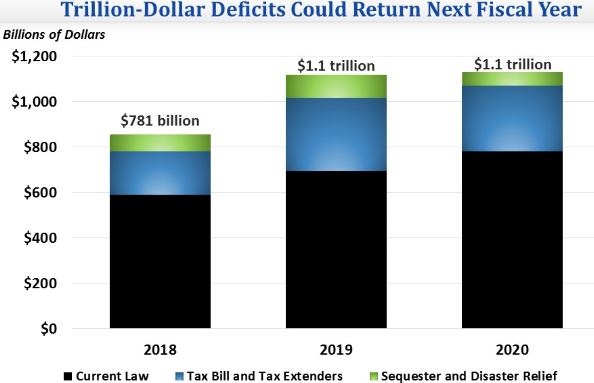
  • A fiscal crisis, much worse than the Financial Crisis of 2008, will occur long before 2047 if nothing is done to greatly shrink our annual deficits which are again rapidly approaching the trillion dollar per year level.
  • The new tax law increases deficits by an average of $100 billion per year, and therefore makes it that much harder to shrink them down substantially. It is imperative for the two parties, Democrats and Republicans, to work together to figure out how to do this.

Conclusion. Our national debt is so large and growing so fast that it is virtually out of control. We need prompt and fairly strong action to turn the situation around.  I have often discussed one major way to do this.

Follow me on Twitter 
Follow me on Facebook 

It Is Awfully Easy to Get Discouraged about Our Debt Problem


Six years ago I was a candidate for the Republican nomination for Nebraska’s Second District Congressional seat. I lost in the May 2012 Primary.  After the November 2012 national election I began writing this blog It Does Not Add Up focused on fiscal and economic issues, mainly our large and rapidly growing national debt. I have now been blogging on this issue for over five years and the debt problem is just getting worse and worse.  Here is where we are right now:

  • All 52 Republican Senators voted for the new tax law which, in spite of its beneficial tax reforms, adds $1 trillion to our debt over the next decade (after growth is taken into account).
  • The Congressional Budget Office projects our debt to grow by $11.5 over the next ten years. In FY2019, just one year from now, CBO projects the deficit will exceed  will exceed $1 trillion and equal 4.7% of GDP.  By 2047 federal debt will reach 150% of GDP, almost double the current 77%.

  • In our polarized Congress, Republicans insist on increasing defense spending, Democrats insist on increasing domestic spending and trying to put any limits on entitlement spending is very difficult. Republicans are willing to cut taxes but there is little enthusiasm for raising them.
  • The present stalemate will eventually lead to a new fiscal crisis, much worse than the Financial Crisis of 2008, without major changes in current policy. The thought of having to drastically cut many different spending programs in the middle of a huge fiscal crisis is horrifying.
  • Are there any alternatives? Calling a Constitutional Convention for balancing the budget, establishing term limits and/or limiting Congressional power (Convention of States), have created much interest but are long shots which may never happen.

Conclusion. Somehow or other we need to light a fire under enough members of Congress to persuade them to take our rapidly accumulating debt very seriously. Let me know (jackheidel@yahoo.com) if you are willing to work with me to do something along these lines!

Follow me on Twitter 
Follow me on Facebook 

Why Am I So Fixated on Our Debt Problem?


In a few days I expect to announce my candidacy for the Republican nomination for the U.S. Senate seat now held by Deb Fischer. She is running for reelection and apparently is quite popular in Nebraska.  But she has one huge liability as far as I’m concerned.  First of all, she is a big spender.  But now as well she has just voted for the new tax law which will increase our debt by $1 trillion over the next decade. In other words she is flagrantly guilty of ignoring our very serious debt problem even as it continues to get worse.


People sometimes ask me why I am so fixated on the debt.  After all, there are plenty of other important issues that we should be concerned about. The answer is that uncontrolled debt affects almost everything else government does because as interest rates increase, eventually interest payments on the debt will skyrocket.

  • Defense spending, so critical to our role as the world’s major superpower, which maintains peace and stability in the world, will be threatened.
  • Run-away inflation is likely to result from the buildup of the debt bubble and this will erode the economic security which is so important to our way of life.
  • The international standing of the dollar, so critical to our leadership role in the financial world, will be weakened.
  • Spending for programs such as education, research and infrastructure, so important to our quality of life, will be threatened.
  • By focusing so strongly on the debt issue, hopefully I will be able to persuade large numbers of people that I am really serious about taking strong action to address it effectively.

Conclusion. There are lots of issues which will come up on the campaign trail in a Senate race. But my campaign will be focused on our gigantic debt problem.  If we can’t get our debt under control, then our entire way of life is threatened.  It is that simple.

Follow me on Twitter 
Follow me on Facebook 

Why It Is Such a Bad Idea to Increase the Debt


As the readers of this blog know very well, I am so upset about our rapidly increasing national debt that I am preparing (in just a few days) to enter the 2018 Nebraska Republican Primary for U.S. Senate against the incumbent Deb Fischer because she just voted (with the new tax law) to increase our debt by $1 trillion over the next decade.  Of course, so did all of the other 52 Republican Senators as well but she is up for reelection this year and I live in her state.
The analyst Desmond Lachman from the American Enterprise Institute has a cogent summary of why increasing our debt at this time is such a bad idea:

  • With the public debt (on which we pay interest) at 77% the highest it has been since WWII, the U.S. already has a compromised debt position.
  • Basic principles of public finance suggest that when the economy is humming along (like now at 3% annual growth) and when unemployment is low (like now at 4.1%), one should try to reduce the public debt.
  • By having used up our fiscal space in good times, we run the risk of not having room to increase budget deficits in bad times.
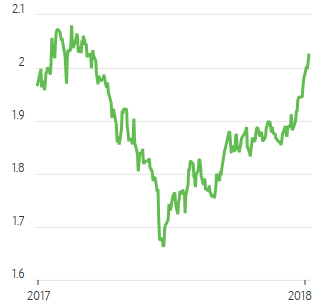
  • The very low interest rates today (an artificial product of the Federal Reserve’s extraordinarily easy monetary policy over the past 8 years) are unlikely to last much longer and, in fact, the Fed has already started the process of raising interest rates, as inflation begins to heat up (see chart below).

  • Increased budget deficits make us increasingly reliant on foreign financing.
  • By our own sowing in joy with unfunded tax cuts, our children are likely to reap in sorrow the fruits of lower long-run economic growth.

Conclusion. By raising our debt by $1 trillion, the new Republican tax law is appallingly short-sited policy. I hope to make Senator Fischer pay a political price by her bad judgment in voting for it.

Follow me on Twitter 
Follow me on Facebook 

The Oracle of Omaha Speaks on American Progress


“In the years of growth that certainly lie ahead, I have no doubt that America can both deliver riches to many and a decent life for all. We must not settle for less.”            Warren Buffett, Time Magazine, January 15, 2018

As the readers of this blog know well, the two main topics I discuss are: 1) our massive debt, now 77% of GDP (for the public part on which we pay interest), the highest it has been since WWII, and predicted by CBO to get much worse without major changes in current policy, and 2) slow economic growth, averaging just 2% of GDP annually ever since the end of the Great Recession in June 2009.  Naturally I am always interested to relate the views of others to my own.


In the current issue of Time,  Mr. Buffett makes the simple argument that, with .8% growth in population each year (births minus deaths plus immigration), 2% GDP growth overall leads to 1.2% annual growth of GDP per capita.  This means that in just 25 years, or one generation, our current $59,000 GDP per capita will increase to $79,000 GDP per capita. This is very impressive.  The problem, of course, is that the average GDP per capita is not evenly distributed.
Here are the two most common political reactions:

  • Democratic. 2% growth is creating plenty of GDP per capita. It just needs to be distributed more evenly by raising taxes on the wealthy and spending it on more generous welfare programs for the less fortunate.
  • Republican. We can do better than 2% annual growth. If growth could be increased to 3% per year or maybe even just 2.5%, then the labor market will stay tight and produce more jobs and better paying jobs. Everyone will prosper, not just the well-off.

Conclusion. I greatly admire Warren Buffett. He is right about many things.  But I think we can do better than 2% annual growth.

Follow me on Twitter 
Follow me on Facebook 

After the New Tax Law: Debt Is an Even Bigger Problem


The Republicans in Washington are exuberant because passing the new tax law means that they finally have gotten something done. And the new law will have at least one highly beneficial effect:

  • The new 21% corporate tax rate will increase profits for domestic corporations and encourage multinational corporations to bring their foreign profits back home. Even if these profits are used to buy back company stock or are paid out in larger dividends, the new money will be put to use in the U.S. economy one way or another. This will give the economy a boost and create new and better paying jobs. This is how private enterprise works and it is the best economic system ever invented.

But at the same time the new law has two huge deficiencies which make it a net minus on the whole:

  • It adds $1 trillion to our debt over the next ten years, as scored by the joint Committee for Taxation, the official scorekeeper. And this is after the positive economic effect is taken into account.  Our debt is already 77% of GDP (for the public part on which we pay interest), the highest it has been since right after WWII, and will continue to get worse without major changes in public policy. As interest rates rise and return to normal historical levels, interest payments on the debt will increase quickly, creating a huge drain on the federal budget.

  • The trillion dollar artificial stimulus created by the new tax law, i.e. the trillion dollars in new debt, is likely to overheat the economy, which is now already growing at a 3% annual clip.  This means that inflation is likely to gain increased momentum, thereby causing the Federal Reserve to raise interest rates faster than it otherwise would. This means that interest payments on the debt will be pushed up even faster than otherwise. Without fiscal retrenchment, a new fiscal crisis is virtually inevitable in the relatively near future.

Conclusion. Fiscal restraint in Congress is now more urgently needed than ever, and it is going to be even harder to accomplish than before the new tax law was passed. I am an eternal optimist but it sure would be easy to get discouraged!

Follow me on Twitter 
Follow me on Facebook 

Fixing Our Broken Healthcare System


As I get organized to enter the 2018 Nebraska Republican Primary for U.S. Senate, I want to make it clear why I would challenge the apparently popular incumbent Senator Deb Fischer who is running for reelection. The reason is very simple and clear cut.  The new tax law which she voted for will raise our national debt by $1 trillion over the next ten years and likely overheat our already vigorously growing economy in the process.  In other words:

  • Our national debt, already sitting at 77% of GDP (for the public part on which we pay interest), is the highest it has been since right after WWII and already slated to get worse, even before the new tax law supported by Senator Fischer. When interest rates inevitably rise in the near future, interest payments on the debt will become a huge burden on our economy.

  • Controlling the cost of healthcare, which already eats up 18% of our GDP (and is growing much faster than GDP), is the key to shrinking our annual deficits and therefore being able to shrink our debt as well.

But is it possible to control healthcare costs within the framework of a free market? I think it is and here is one way to do it:

  • For private healthcare, repeal the employer mandate and replace the ACA income based tax credits with age based tax credits (which then apply to everyone). This will allow healthy employees to migrate away from employer provided health insurance towards individually underwritten health insurance (including Health Savings Accounts) at much lower cost. This saves money for employers and rewards healthy life styles. High risk pools for unhealthy people would receive federal and state subsidies.
  • Medicaid recipients would also be able to migrate into this new private system.
  • Medicare Advantage (Medicare Part C) would be required to offer Medical Savings Accounts which were authorized in 1997 but have not been widely utilized. This will make Medicare Advantage highly attractive to healthy people and encourage migration from regular Medicare (Part B) to Medicare Advantage.

Conclusion. The point here is not to try to insist on one particular way of controlling the cost of healthcare but to demonstrate that it can be done within a relatively free market framework.

Follow me on Twitter 
Follow me on Facebook 

There Is Really Only One Way to Reduce Our Debt


In 2012 I was a candidate in the Republican Primary for U.S. Congress, Nebraska District 2. My platform at that time was to “Eliminate the Deficit.” Today I am about to enter the 2018 Nebraska Republican Primary for the U.S. Senate.  My platform will be to “Fix the Debt.” (http://www.fixthedebt.org/)
Our current debt ($15 trillion for the public part on which we pay interest) is now 77% of GDP, the highest since right after WWII, and steadily getting worse.  At the present time it is essentially “free” money because interest rates are so low. But that is already starting to change.  Every 1% increase in interest rates will increase interest payments by $150 billion per year.  A huge upsurge in inflation (which can happen at any time), followed by a corresponding rise in interest rates, will become a huge drain on the federal budget and likely lead to a new crisis much worse than the Financial Crisis of 2008.


With healthcare spending, both public and private, now almost 18% of GDP, and growing rapidly, there is really only one practical way of getting our national debt under control: stabilize the cost of healthcare in the U.S.
Consider the following data:

  • Our national health expenditure grew 4.3% (much faster than inflation) to $3.3 trillion in 2016, $10,348 per person, and accounted for $17.9% of GDP.
  • National health spending is projected to grow at an average rate of 5.6% for 2016 – 2015, and reach 19.9% of GDP by 2025.

  • Federal Medicare Outlays were $588 billion in 2016 or 15% of federal outlays.
  • Federal Medicaid outlays were about $390 billion in 2016 or 10% of federal outlays.
  • The federal tax exclusion for employer provided health insurance was $250 billion in 2016.
  • Summary: the federal government spent almost $1.23 trillion on healthcare in 2016, over 30% of all federal spending of $3.9 trillion.

Conclusion. The only practical way to get our nation’s debt under control is to limit the growth of healthcare spending. Right now federal spending on healthcare is defined benefit (i.e. open ended).  We simply must move to a defined contribution system where all of us as healthcare consumers assume responsibility for our own healthcare spending.  Detailed proposal forthcoming!

Follow me on Twitter 
Follow me on Facebook 

Shall I Enter the Nebraska Republican Primary for U.S. Senate?


The tax bill was signed by President Trump on Friday and is now law. In spite of many good individual features, including the reduction of the corporate tax rate from 35% to 21%, it has the overall negative effect of adding $1 trillion to the national debt over the next decade, and this is after allowing for new growth.
Every Republican Senator voted for this new law.  That means every single one of them is responsible for increasing our debt by $1 trillion.  This includes Nebraska Senator Deb Fischer, who is up for reelection in 2018.  She needs to be chastised for voting for this atrocious law.
I am seriously thinking of entering the Republican Primary against her, if there is sufficient support for my candidacy.  Here is a summary of my views on the most important issues.  Roughly in order of importance:

  • Debt. Now worse than ever with the new tax law, we will soon be back to trillion dollar annual deficits.  The only real solution is to curtail the growth (no actual cuts needed!) of entitlement spending.  Otherwise a new fiscal crisis will soon occur.

  • Global Warming. The evidence for man-made global warming is overwhelming,  including warmer and more acidic oceans, shrinking artic sea ice, and rising sea levels. The best solution is to impose a (refundable!) carbon tax to replace all sorts of ad hoc and arbitrary regulations.
  • Economic growth. The U.S. is the most prosperous large country in the world and prosperity equates to economic growth. But our economy is now growing at a 3% annual clip and the new tax law is likely to overheat it and cause inflation to take off.  This will force interest rates up prematurely.
  • Trade Policy. Withdrawing from NAFTA would be a disaster for the whole country and especially Nebraska with its export based ag economy. It is China’s mercantilist policies, restricting imports from other countries, which need to be opposed.
  • Immigration Reform. With a national unemployment rate of 4.1% (2.7% in Nebraska), a severe labor shortage is developing. The solution is to establish an adequate guest worker visa program so that employers can be assured of having the employees they need.

Conclusion.  Senator Deb Fischer is simply unwilling to make the tough decisions necessary to shrink annual deficits and thereby control our burgeoning debt.  I would be a sensible replacement for her.  Will you support me if I run?  Let me know at jackheidel@yahoo.com.

Follow me on Twitter 
Follow me on Facebook 

The Republican Party Is Putting its Reputation for Fiscal Responsibility at Great Risk


The final Republican tax bill has now been passed by both the House and the Senate and awaits the President’s signature which is expected soon. It dramatically lowers the federal corporate tax rate from 35% to 21%.  This is highly beneficial as it will provide a big incentive for U.S. multinational companies to bring their foreign profits back home for spending and reinvestment.


The huge problem, of course, is that the tax rate cuts are not paid for by other offsets and will add $1 trillion over ten years to our already exploding national debt. In fact, we are likely to see trillion dollar deficits again as soon as FY 2019.


Here is a cogent analysis of the bill’s weaknesses by the Wall Street Journal’s Greg Ip:

  • Distortionary business tax breaks still remain such as for oil and gas drilling, electric cars and renewable energy. Also the “carried interest” loophole largely remains intact.
  • New breaks are created, most importantly a 20% deduction for businesses which pay taxes as individuals (pass throughs). This introduces “grave complexity” and creates huge incentives for tax avoidance.
  • The challenge of constraining entitlement growth has become much more difficult. The soaring cost of Social Security, Medicare and Medicaid is the main driver of our debt problem. The Democrats, having been excluded from developing the tax plan, will be far less likely to cooperate on entitlement reform.

Conclusion. Corporate tax rate reform, as desirable as it is, as been badly handled by the Republicans. The new tax law not only makes the debt much worse by itself but poisons the atmosphere for actually figuring out a way to effectively address entitlement reform, the key to getting debt under control.

Follow me on Twitter 
Follow me on Facebook