The Only Way America Can Be Great Is To Provide Leadership


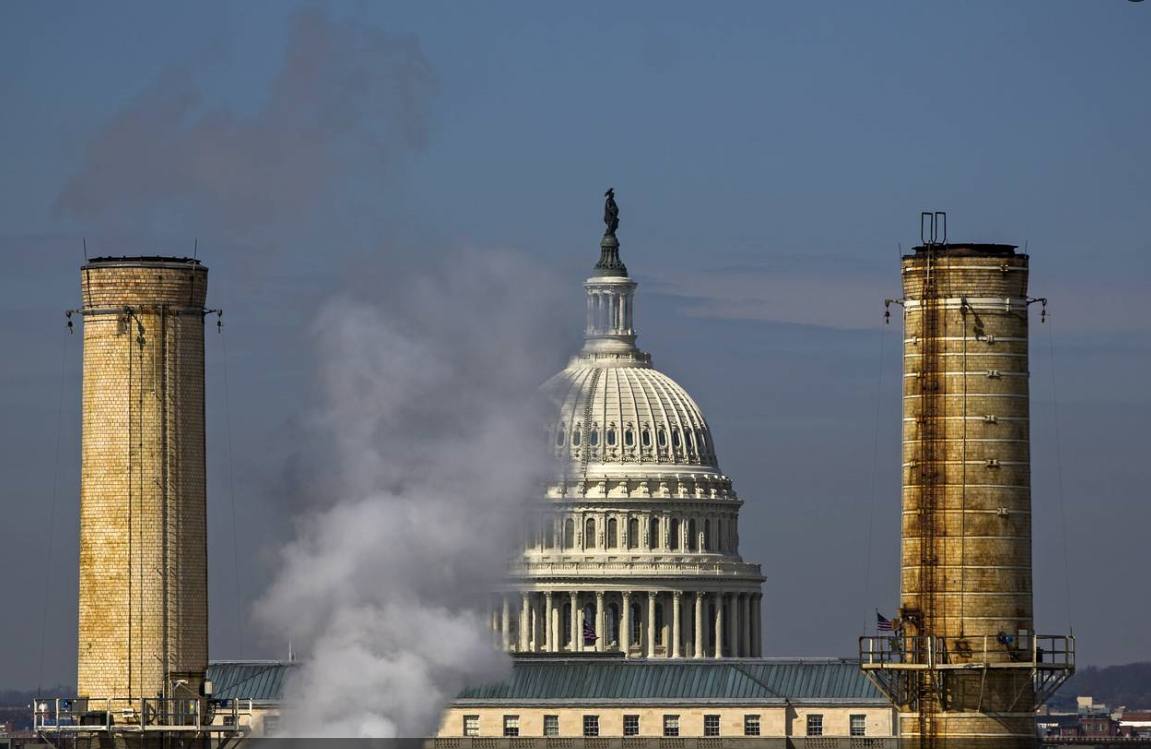
Like many other people I am upset that President Trump has decided to withdraw from the Paris Climate Accord.  It’s not that Paris solves the global warming problem but it is a major step in the right direction.  We’re the biggest contributor of carbon emissions  so it is our responsibility to lead in reducing them.


Here are some other major issues that need leadership:

  • Trade. The Trans-Pacific Partnership would have been a big win for the U.S.  But it is with China, responsible for two-thirds of our trade deficit, that we need a major rebalance.
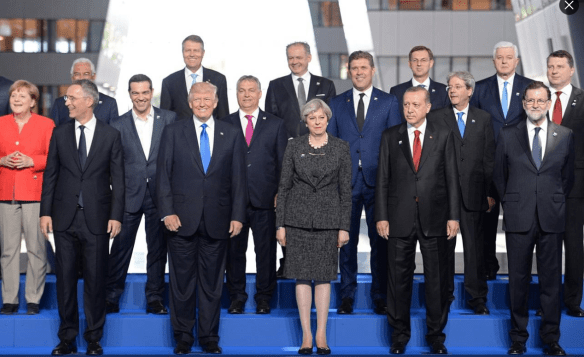
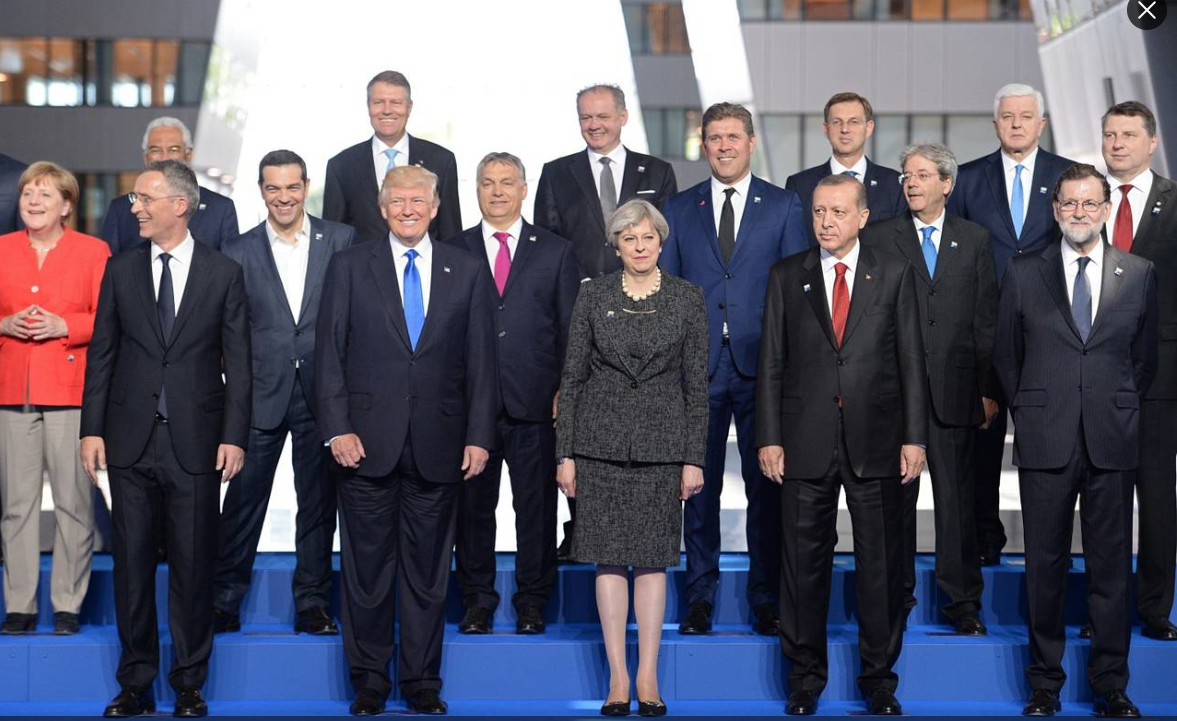
  • NATO. Mr. Trump has withdrawn his campaign statement that NATO is “obsolete.” His criticism of NATO could turn out to be useful if it leads to an increase in NATO defense spending.
  • Faster Economic Growth. Economic strength is the backbone of our influence in world affairs. Lower corporate tax rates will encourage our multinational companies to bring their profits back home for reinvestment in the U.S. Administration efforts already under way to deregulate various aspects of the U.S. economy should soon lead to faster growth.
  • U.S. Budget. Mr. Trump has proposed to balance the U.S. budget within ten years which is hugely important. Unfortunately many of his specific proposals on spending and growth are not realistic.
  • Infrastructure Spending. This is an excellent idea if it is paid for directly and does not add to the federal deficit. Apparently Mr. Trump will soon announce a plan for private industry, cities and states to take the lead in new infrastructure spending with possible contributions from the federal government.
Conclusion. Although Paris is a disappointment, Mr. Trump will have many opportunities to redeem himself.
Follow me on Twitter 
Follow me on Facebook 

PLEASE, Mr. President, Don’t Withdraw from the Paris Climate Accord


When Barack Obama was President I described our country’s two biggest long range problems as:

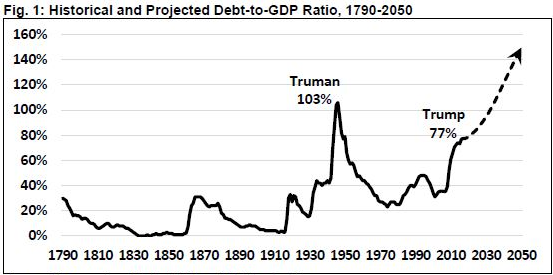
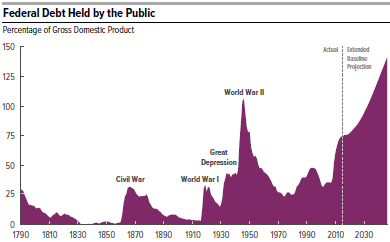
  • Massive Debt, now 77% of GDP (for the public part on which we pay interest) and predicted by the CBO to keep steadily getting worse.
  • Slow economic growth, averaging just 2% since the end of the Great Recession in June 2009. This means fewer new jobs are created and lower raises for existing jobs.

Now, under President Trump, I have modified this list to read:

  • Massive Debt, etc.
  • Global Warming, for which the evidence is overwhelming.

All three of these issues are large and urgent problems but President Obama was insufficiently concerned about both debt and economic growth while President Trump is insufficiently concerned about both debt and global warming.
Today’s Wall Street Journal, “Paris Climate Discord” has perhaps the best possible argument for withdrawing from the Paris Accord but it is ultimately unpersuasive.  Even if full implementation of the Paris standards would have only a tiny effect on global temperatures by 2100, and even if other countries aren’t contributing their fair share, Paris represents a big step in the right direction.
Global warming is real and if the U.S. is the world leader which it needs to be, and often purports to be, then it needs to be part of the Paris Accord.  Adjustments to our own domestic energy policies (such as adopting a revenue neutral carbon tax) will enable us to decrease carbon emissions much more efficiently than we are currently doing.

Conclusion. Global warming presents an opportunity for President Trump to show real leadership. I hope he is up to it.

Follow me on Twitter 
Follow me on Facebook 

The Cost of Higher Education Is Not What Is Holding Us Back

It is well known that the cost of higher education is increasing much faster than inflation and even faster than the cost of healthcare. In turn, student debt is also rising rapidly and creating a financial burden for lots of young people.


The New York Times writer, David Leonhardt, has an article in Sunday’s paper showing that most states have reduced their funding of higher education since 2009, some quite dramatically.  This is not surprising since higher ed has to compete with K-12 education, Medicaid, prison operations, public employee pensions, etc. and states have to balance their budgets.  But it means that the cost of tuition will continue to rise even faster than usual.
However, except for a few specific fields such as computer programming, high school STEM teaching and nursing, there is no overall shortage of college graduates to keep our economy going.  In fact there is a surplus of college graduates in many non-technical areas.


But there is a growing labor shortage more generally, first of all for construction and agriculture workers which can be filled by unskilled immigrants.  Furthermore, there are now millions of job openings for middle skill workers which are going unfilled for lack of qualified applicants.  Training for such jobs as emergency medical technician, robot-heavy factory worker, and wind turbine technician is where states and localities should invest more public resources.
The huge demand for middle- and high-skill blue collar workers provides an opportunity to put laid-off middle-aged (Trump voting!) factory workers back to work in high paying middle class jobs.  A little ingenuity at the local and state level should be able to figure out how to do this.
Conclusion. A college education is not the only path to a productive and satisfying middle class life.  In fact U.S. economic growth is being held back by a lack of qualified middle- and high-skill workers.

Follow me on Twitter
Follow me on Facebook

How to Achieve a Balanced U.S. Budget


President Trump’s proposed 2018 Budget lays out a plan to achieve a balanced budget over a ten year period. I strongly endorse this goal whether or not the Trump budget is a realistic way to get this done.
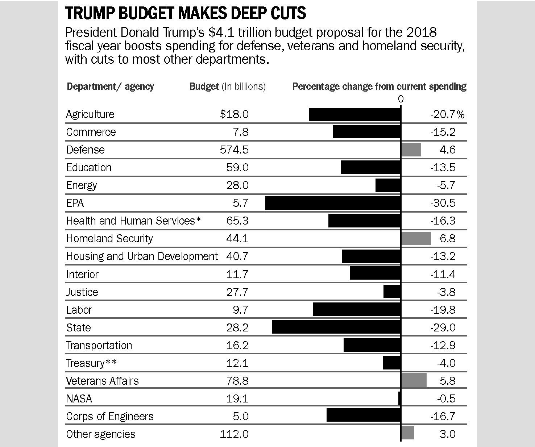
The virtue of the Trump budget is to tackle waste and inefficiency across many different domestic programs (see chart below).


Its main defect is that neither healthcare reform nor tax reform has yet been implemented and the cost and/or savings of these two major initiatives are not yet known.
In the meantime the only way to think about balancing the budget is conceptually in terms of how it might be done.  Barron’s economic analyst Gene Epstein has done this recently.


Mr. Epstein proposes:

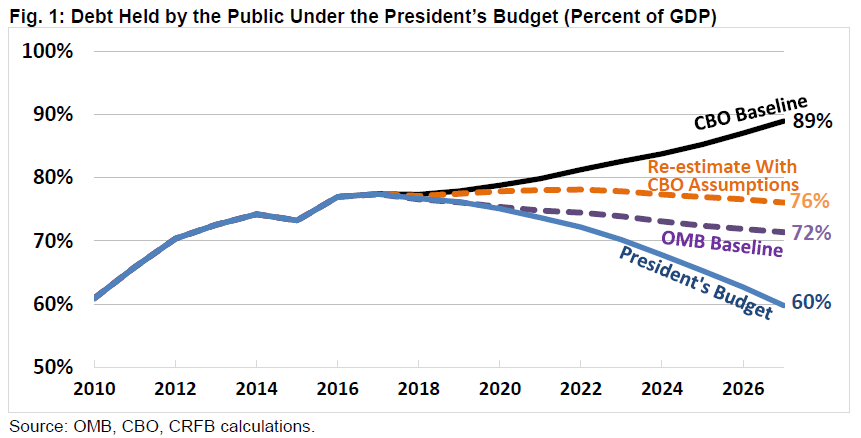
  • $8.6 trillion worth of spending cuts over ten years, of which 40% would come from programs other than Social Security and healthcare. By achieving a balanced budget in ten years it would lower our public debt (on which we pay interest) from 77% today to 58% in 2027.
  • By raising the age limit for full SS benefits to 67 (already enacted) at a faster pace, and indexing initial benefits to price inflation rather than wage inflation, $200 billion can be saved over ten years. Another $300 billion can be saved by phasing in a 25% reduction in SSDI benefits.
  • Cutting the estimated improper payment rate for Medicare of 12.1% in half would save $400 billion over ten years. Raising the premiums for Medicare Part B and Part D to 35% of costs from the current 25% of costs would save $400 billion.
  • Another $600 billion would be saved by turning Medicaid into a block grant program to the states and giving the states much more flexibility in how it is spent.
  • $950 billion could be cut from the military budget by cutting back on overly expensive new weapon systems as well as closing unnecessary military bases, both foreign and domestic.
  • Many cuts in government subsidies to individuals and businesses would save $1 trillion. Grants in aid to sates could be cut by $500 billion.

Conclusion. There are many different ways to curtail federal spending. It has to be done and the sooner we get started the less painful it will be for all concerned.

Follow me on Twitter
Follow me on Facebook


Objections to the Trump Budget


President Trump’s budget for 2018 presents a plan to achieve a balanced federal budget in ten years, by 2027.  This is a highly desirable goal but there is much skepticism about whether or not his budget is realistic, see here and here.


My thoughts on this important matter are:

  • Fiscal restraint is a common sense necessity, and is not austerity. Our public debt (on which we pay interest) now stands at 77% of GDP, the highest since WWII, and will continue to increase without major changes in public policy. Right now the debt is almost “free” money because interest rates are so low. As interest rates inevitably go up in the near future, interest payments on the debt will skyrocket and become a huge drain on our federal budget and make annual deficits even worse than they already are.
  • 3% annual GDP growth, as assumed in the Trump budget, is almost certainly too optimistic. However the Trump Administration is on track to achieve significant deregulation  and averaging 2.5% growth over the next ten years is doable.
  • Insufficient entitlement reform is a big drawback for the budget. It will be very difficult, essentially impossible, to achieve and sustain a balanced budget without modifying Social Security and Medicare to make them self-financing. Turning Medicaid into a block grant program to the states would finally put Medicaid on a sensible budget.
  • Requiring able-bodied welfare recipients to work is a good idea and is the basis for cutbacks in social welfare programs.
  • The Departments of State, Interior, Education and Justice should be able to absorb cutbacks and operate more efficiently.

Conclusion. There are many good initiatives built into the Trump budget. Unfortunately there are also some invalid assumptions and glaring omissions.  It does not represent a bona fide plan to balance the budget in ten years but at least it recognizes the importance of doing so.

Follow me on Twitter
Follow me on Facebook

Is Trump Serious about Shrinking the Debt?

The newly released Trump budget for Fiscal Year 2018 claims that it will lead to a balanced budget in ten years.  This is a highly desirable goal.  However the projected $4.5 trillion in spending cutbacks for many popular programs, as well as the projected 3% GDP growth for the next ten years, are both unrealistically optimistic.  Nevertheless, at least the Trump Administration is moving in the right direction.


Here is a good summary by Donald Marron in National Affairs of why it is so important to keep deficits and debt under control:

  • Prolonged deficits and mounting debt will undermine economic growth by interfering with investment in the private sector.
  • Prolonged deficits risk fueling inflation as the government lowers the value of the dollar by printing more of them.
  • High levels of debt held by foreign lenders put us at the mercy of foreign countries.
  • The growing debt exposes America to greater “rollover” risk with the increasing reliance on short term debt which frequently has to be rolled over.
  • Rising debt limits flexibility for increased spending in times of recession or other emergency. For example, when the Financial Crisis occurred in 2008, the debt level was just half of its current level. This meant the government could risk higher deficit spending in order to stimulate the economy.
  • Deficits have an unfortunate tendency to feed on themselves. Our current deficit level of approximately $500 billion per year is so large that it can only be significantly reduced with great pain. The only possible way to make deficit reduction politically feasible is to spread this pain widely amongst the public as shared sacrifice. This will be very hard to do.
  • Deficits and debt are grossly unfair to future generations who are stuck with servicing the debt and/or struggling to pay it down.

Conclusion. The Trump Administration recognizes the strong need to get deficits and debt under control. Unfortunately its current budget just submitted is not a realistic plan to get this done.

Follow me on Twitter
Follow me on Facebook

How Fast Can the Economy Realistically Be Expected to Grow?


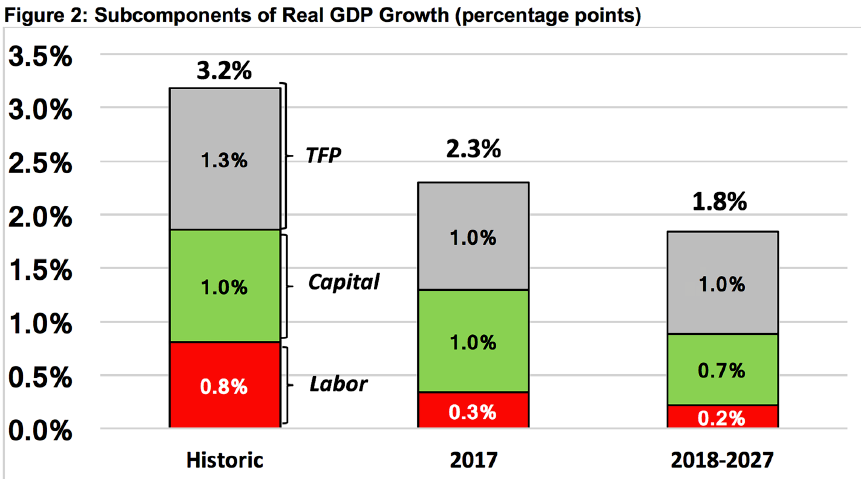
Both President Trump and the Republican Congress want the economy to grow faster than the slow 2% growth which we have experienced since the Great Recession ended in June 2009. The Congressional Budget Office predicts (see chart below) that growth will average just 1.8% over the next ten years under current policy.


The Committee for a Responsible Federal Budget, using CBO data, believes that several policy changes can help boost growth on an annual basis as follows:

  • Immigration reform, .3%, by increasing the number of workers.
  • Tax reform, .18%, if well designed. However, deficit-financed tax reform would ultimately harm growth.
  • Increase the Social Security retirement age by two years, .15%, by keeping people in the workforce longer.
  • Reduce deficits by $4 trillion over ten years, .1%. This is enough deficit reduction to put our debt on a sustainable, downward path.
  • Continue expanding energy production at the shale boom level, .09%.
  • Repeal of the Affordable Care Act, .08%, will keep more people in the workforce.
  • Ratifying the Trans Pacific Partnership, .01%, by increasing foreign trade.
  • Increasing public investment in infrastructure, education and research by $40 billion per year, .1%.

Note that all of these changes would increase growth by an estimated .83% of GDP per year. Added to the 1.8% base this yields a growth rate of 2.63%. Unfortunately, many of these reforms are unlikely to occur.  On the other hand, various deregulatory actions being taken by the Trump administration are likely to increase growth by an unknown amount.

Conclusion. It is reasonable to anticipate that growth can and will be speeded up to about 2.5% of GDP per year under the Trump administration.  Along with the tight labor market now developing (current unemployment rate of 4.4%), blue-collar and other middle class workers should continue to receive decent pay increases for the foreseeable future.

Follow me on Twitter
Follow me on Facebook

How Donald Trump Could Redeem Himself


From a reader of my blog:
I think he is too flawed, self-centered and sociopathic to accomplish much. I believe that tax reform will become tax cuts for the wealthy (no inheritance tax, etc.) and dealing with budget deficits will not happen. I know you think Trump will be contained by the conservative members of Congress. The Republicans seem unwilling to confront him or speak out as long as his base continues to be very loyal. I think he is so wounded now that it will be hard to accomplish much.


Granted that Donald Trump is hopelessly ensnared in controversy and incapable of changing his ways, he still has many opportunities to do something positive. For example regarding our extremely serious debt problem, he could focus on:

  • Coming up with a budget that reduces the debt path. No one expects the budget to be balanced in one year. Last year’s Republican plan would have taken ten years to get the job done. The important thing is to clearly move in this direction.
  • Focusing healthcare reform on cost control. Give the Democrats credit for expanding healthcare access with the Affordable Care Act. But now focus on reining in the cost of healthcare in America.

  • Enacting fiscally responsible tax reform. Most people agree that the tax code is a complicated mess and, especially, that the corporate tax rate is too high. There are many ways to achieve lower tax rates and simplification in a revenue neutral way.
  • Stop digging the debt hole deeper by just adding new initiatives. There will always be attractive new programs which are worth pursuing. But in adding them to the federal budget, other programs which are no longer effective need to be phased out.
  • Reforming entitlements such as Social Security, Medicare and Medicaid. These are the big drivers of national debt. Without entitlement reform, all other efforts to restrain federal spending will be insufficient.

Conclusion. There is nothing easy about pursuing the above agenda. Implementing it will be highly controversial with lots of vociferous opposition.  It will take strong leadership to push it through.  But it represents a huge opportunity for a controversial president to do something worthwhile.

Follow me on Twitter
Follow me on Facebook

What Will Happen if We Have a New Fiscal Crisis?


As I often remind the readers of this blog, the two main topics are what I consider to be America’s two biggest economic and fiscal problems:

  • Slow economic growth, averaging just 2% since the end of the Great Recession in June 2009. This means fewer new jobs and smaller raises.
  • Massive debt, now 77% of GDP for the public part on which we pay interest, the largest since the end of WWII and predicted by the CBO to keep getting worse. As interest rates rise from their currently unusually low levels, interest payments on the debt will skyrocket.


The first problem, slow growth, is being addressed by the Trump Administration with various deregulatory actions as well as likely tax reform action by Congress.  Furthermore, the current low 4.4% unemployment rate means that the labor market is tightening on its own.


The second problem, massive debt, is much more worrisome for the future.  Right now interest rates are so low that our entire debt is essentially “free” money.  But every 1% increase will add nearly $150 billion per year in interest payments.  And this continues indefinitely (and keeps getting worse with more debt) because debt is rarely if ever paid back, it is only rolled over!  What are the likely outcomes of such an upward spiral in interest payments?  There are two possibilities:

  • First, the unthinkable. We default on our debt. This would immediately end the role of the U.S. dollar as the international currency and end our superpower status. The fallout would be disastrous for world peace and stability.
  • Second, a huge tax increase. The only alternative to default will be a large tax increase just to keep afloat on interest payments. A likely new tax for this purpose is a consumption tax in the form of a value added tax.

Conclusion. It is extremely shortsighted to keep on delaying a necessary solution to our rapidly worsening debt problem. It’s going to be unpleasant to either cut back on spending or to raise taxes but the longer we delay action the more painful it will become in the end.  Isn’t it obvious that we should get started immediately?

Follow me on Twitter
Follow me on Facebook

Quo Vadis America?


In many respects things are going quite well in the U.S. at the present time:

  • The economy is chugging along at 2% annual growth, not spectacular but better than in most other developed countries. In fact a rather severe labor shortage is developing in some industries such as construction and agriculture.   More specialized guest worker visas would help relieve these shortages. Better career and vocational education in high school as well as targeted job retraining programs for the underemployed would help prepare workers for the millions of high-skill manufacturing jobs going unfilled.
  • Pesky foreign policy problems are under control. ISIS is being squeezed in the Middle East. China appears willing to help contain the North Korean nuclear threat. Iran is mostly abiding by the 2015 nuclear agreement.
  • Congress is inching its way towards resolution of the healthcare stalemate, by repairing Obamacare rather than repealing it. It’s not clear how much tax reform will be implemented this session but there is at least a consensus on lowering the corporate tax rate to encourage multinational companies to bring their profits back home.
  • Deregulation efforts by the Trump Administration will give the economy at least a small beneficial boost.

    But there is one huge problem which is constantly being swept under the rug or being kicked down the road by both parties in Congress and by Democratic as well as Republican presidential administrations alike. I am referring, of course, to our massive national debt, now sitting at 77% of GDP (and growing) for the public part on which we pay interest.  Right now this debt is essentially “free” money because interest rates are so low.  But it’s really a ticking time bomb because sooner or later interest rates will return to more normal levels and then interest payments will skyrocket causing a huge fiscal crisis.

Conclusion. It is imperative for Congress to reform entitlement programs to make them less costly to the federal budget and to otherwise restrain discretionary federal spending across the board. The future of our country depends on our national leaders exercising much greater fiscal restraint.  They need to get much better at doing this!

Follow me on Twitter
Follow me on Facebook