Learning By Doing II. The negative influence of lobbyists


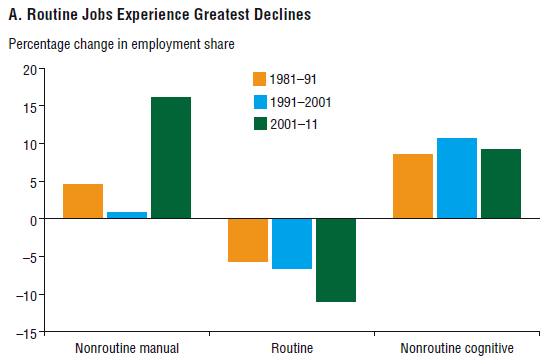
My last post reported on a new book by James Bessen, “Learning by Doing: the real connection between innovation, wages and wealth.”  It makes several recommendations for how the U.S. can better meet the challenges posed by the hollowing out of the middle class, as illustrated in the chart just below from the Dallas Federal Reserve.
Capture Mr. Bessen blames one primary culprit for this problem: the growing role of money in politics.  For example:

  • The dramatic growth in occupational licensure from 70 occupations covering 5% of the workforce in the 1950s to over 800 occupations covering over 29% of the workforce in 2008. Such a major change can only be understood as the outcome of massive lobbying.
  • Defense procurement. For example, in 2012 the defense industry spent $132 million on over 900 lobbyists. It is hardly surprising that defense procurement rules have favored established defense contractors at the expense of start-up technology firms.
  • The best patent law money can buy. Patent trolls have continued to file more lawsuits, despite the America Invents Act of 2011. A new legislative effort for patent reform in 2013 passed the House by a margin by a margin of 325 to 91 but then was killed by the Senate in May 2014.
  • Changes in trade secret law. The problem is that more uniform trade law, which sounds desirable, also broadens its scope which then limits employee mobility and the creation of spin-offs.
  • Strong enforcement of non-compete agreements in Massachusetts protects established firms but hurts startups. This has given Silicon Valley companies a big advantage over the companies on Route 128 outside of Boston.

Mr. Bessen makes a very strong case for the harmful effects of lobbyists and their money in retarding economic growth.  But how can we possibly curtail the influence of lobbyists without limiting their freedom of speech?  Stay tuned for the next post!

Learning By Doing


The two biggest problems facing our country today are a stagnant economy and an exploding national debt.  Faster economic growth would help pay our bills by bringing in more tax revenue.  It would also create more jobs and give a boost to stagnant wages.  One of the causes of this stagnation is that our economy has become less entrepreneurial over time as shown by this often cited chart from the Brookings Institution.
CaptureA very interesting new book by James Bessen, “Learning by Doing: the real connection between innovation, wages and wealth.” looks at both our economic history and our current economy to understand how society can best meet the challenges posed by new technology.  Mr. Bessen  identifies the basic problems as follows:

  • Funds have been shifted away from vocational education and community colleges at a time when large numbers of workers could acquire valuable skills at these institutions.
  • The rapid growth of occupational licensing restricts training and jobs open to mid-skill workers and, in many cases, limits their use of technology.
  • Military procurement favors large defense contractors over start-up firms, while heightened secrecy requirements limit the development of open standards and the broad sharing of knowledge.
  • Job mobility has declined, limiting knowledge sharing and weakening labor markets.
  • Abusive patent litigation has exploded, making it harder for startups and small firms to develop new technology.

Mr. Bessen concludes:“The practical skills of ordinary people have been a wellspring of widely shared wealth for 200 years, and the economic power of mighty nations rests on the technical knowledge of the humble.  Provide the means for ordinary workers to acquire the skills and knowledge to implement new technology today and the economic bounty will not only grow, it will be widely shared.”
What are the roadblocks to implementing Mr. Bessen’s recommendations?  I will return to this question later.

Is the Democratic Party Giving Up On Growth?


Prospects for future economic growth are decidedly grim.  The Congressional Budget Office has just reported that after a brief improvement for a couple of years, annual GDP growth will likely hover around 2.2% for the remainder of the ten year window 2015 – 2025.  This means, in turn, that the unemployment rate will also not likely fall much below its current level of 5.7% for the same ten year period.
CaptureA new report from the McKinsey Global Institute makes the even gloomier prediction that average U.S. GDP growth rate for the next 50 years will be only 1.9% per year, given current trends and policies.  A summary of this report is provided by the Brookings Institution social economist, William Galston.
On the other hand, according to New York Times columnist, Nate Cohn, the Democratic Party may be adopting a new policy direction, “The Parent Agenda, The Democrats’ New Focus.”  By this new focus he means:

  • Paid family leave
  • Universal preschool
  • An expanded earned-income tax credit and child tax credit
  • Free community college
  • Free four year college in time

Mr. Cohn points out that both President Obama as well as Hillary Clinton have endorsed such ideas.  Initiatives such as these are unlikely to go far in the current Republican Congress but they may still sound very attractive to the many hard-pressed middle class families with stagnant incomes.
The problem is that to emphasize a “family” political agenda like this is in effect to accept the conventional wisdom that faster economic growth is unattainable.  This is a defeatist attitude which is very harmful to the 20 million Americans who are either unemployed or under-employed. Here, briefly, is what could be done to boost economic growth in the short term:

  • Implement broad-based tax reform with lower tax rates for all, paid for by closing loopholes and limiting deductions.
  • Reduce regulatory burdens on business by, for example, streamlining (not repealing!) the Affordable Care Act and the Dodd-Frank Financial Reform Act.
  • Expand legal immigration with additional high-skill visas as well as an adequate guest worker program.
  • Expand international trade with new trade agreements.

These are all political footballs, of course, but also policies with much potential to speed up economic growth.  Either we take initiatives such as these or we consign our country to a future of relative economic stagnation with slow wage growth, high unemployment and increasing income inequality.

“Manana Is Not a Credible Fiscal Plan”


Thus spoke George Osborne, Great Britain’s Chancellor of the Exchequer, in a recent speech to the Economic Club of New York.  “By applying a consistent and long-term economic plan, we can ensure that our best days lie ahead.  If we reduce our high debt so we can weather new shocks, and take the difficult decisions to make our economies more productive, we can provide rising living standards for our citizens.”
CaptureAccording to Mr. Osborne, any long term economic plan needs to include three elements:

  • An activist monetary policy to do whatever it takes to sustain sufficient demand in the economy.
  • A credible commitment to sustainable fiscal policy. Some have argued that fiscal consolidation is incompatible with economic recovery. But recent experience, e.g. sequestration in the U.S. and a balanced budget in the U.K., has shown the reverse.
  • An ambitious program of supply-side reform. The U.S. has a booming technology sector and the fracking revolution. The U.K. has cut its corporate tax rate to 20%, welcomes disruptive innovation and is pushing ahead on shale gas.

In the U.S. things are moving in the right direction and so the focus needs to be on keeping the momentum going.  Monetary stimulus has accomplished much but now a sound exit policy is needed.  Sequestration has slowed down the growth of government debt but has not ended it.  Further progress will require entitlement reform, especially for Medicare and Medicaid.  But first, the Affordable Care Act needs to be improved to do a better job of controlling the overall cost of healthcare.  Infrastructure improvement, tax reform and expanding trade are the supply side keys to increasing productivity and shared prosperity.
Activist monetary policy, credible fiscal policy, and ambitious supply side reform: these are the policies which will lead to future progress!

Let’s Keep the Economic Momentum Going


There has been lots of good economic news lately:

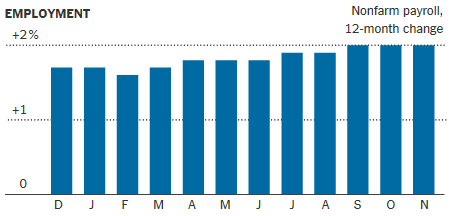
  • The economy added 321,000 jobs in November, the most in one month since January 2012.
  • The unemployment rate of 5.8% remains steady and is down from 7% in November 2013.
  • The average hourly earnings for workers is up by 2.1% from a year earlier.
  • Economic growth for the third quarter is up 3.9% from the previous quarter.
  • The deficit for the 2014-2015 fiscal year was “only” 2.8% of GDP and is predicted by the Congressional Budget Office to drop to 2.6% for the current year.
  • The price of a gallon of gasoline has dropped to $2.71 on average, its lowest level since 2010 and is still dropping.

CaptureThe New York Times predicts that the “Brighter Economy Raises Odds of Action in Congress.”  Jason Furman, Chairman of the White House Council of Economic Advisors, is quoted as saying that “At least there will be less of a philosophical debate on infrastructure, tax reforms and expanding exports.  You can have that agenda because the economy is not in free fall.” These three items would make a great agenda for the 114th Congress in the following way:

  • Infrastructure. The continuing drop in the price of gasoline offers the opportunity to replenish the inadequately funded Highway Trust Fund in a fiscally responsible manner. Congress should raise the federal gasoline tax above its current 18 cents per gallon to a level which is sufficient to fund the entire federal share of highway construction and repair.
  • Tax reform. Individual and corporate tax reform will give the economy a huge boost. The idea here is to lower tax rates in a revenue neutral way by closing loopholes and deductions.
  • Expanding Exports. What’s needed here is to give the President fast track negotiating authority so that Congress has to vote any trade agreement up or down without modification. This is the only way to get other countries to make concessions.


Of course there are many other issues which need to be seriously addressed by the new Congress.  But relatively quick action on just these three less controversial items would be a great start!