A Major Difficulty of True Healthcare Reform


As my regular readers know I am focused primarily on two major national problems:

  • Speeding up economic growth to create more jobs and better paying jobs, and
  • Getting our national debt under control by reducing our annual budget deficits so that our debt will shrink over time as a percentage of GDP.

The evidence continues to persuade me that entitlement spending in general and the cost of healthcare in particular will play the biggest role in solving these two problems. My last post points out that healthcare, higher education and housing are all drags on family expenses but that the cost of healthcare has by far the largest negative effect on our economy.
The United States spends 18% of GDP (and climbing) on healthcare, both public and private, twice as much as any other developed country.  This enormous expense must be reduced but how will it happen?  The Affordable Care Act has increased access to healthcare but has not bent the cost curve.
Now the Republicans (President-elect Trump and Congress) want to repeal the ACA and replace it with something less restrictive and less expensive.   A popular alternative is health insurance which has:

  • High deductibles typical of catastrophic coverage in order to hold down the cost of insurance.
  • Tax credits to defray the cost of insurance.
  • Tax preferred health savings accounts to pay for routine expenses below the deductible.

    capture96

Unfortunately it’s not this simple. Today’s New York Times has a credible Op Ed by Drew Altman, CEO of the Henry Kaiser Family Foundation, “The Health Care Plan Trump Voters Really Want,” which reports on a series of focus groups set up by Kaiser after the election to quiz Trump voters about healthcare. What Kaiser learned about Trump voters is that:

  • In the pre-ACA market, they liked their ability to buy lower-cost plans which met their needs.
  • They want lower drug costs and improved access to cheaper drugs.
  • The very last thing they want in healthcare reform is higher out-of-pocket costs.

Conclusion. What Trump voters are looking for in healthcare reform is quality healthcare at a low cost. This is also the Republican ideal.  But the high deductible plus health savings account combination is going to be a hard sell to many Trump voters.

Follow me on Twitter
Follow me on Facebook


Getting American Health Care Straightened Out II. Medicare


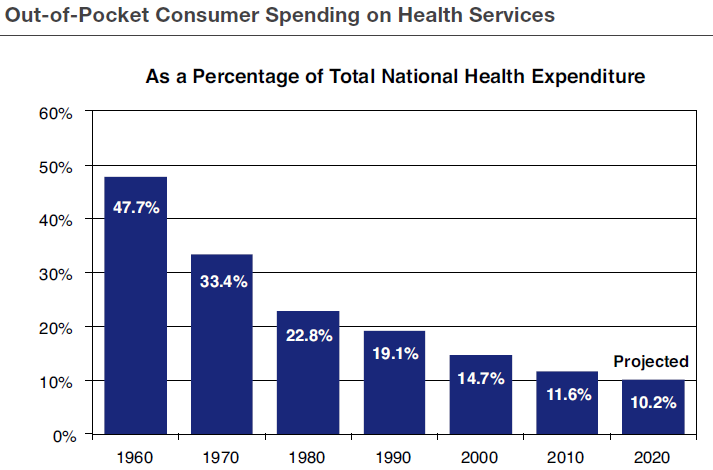
One of the major problems facing the United States today is the high cost of healthcare. We spend almost 18% of GDP on healthcare, both public and private, almost twice as much as any other developed country.  A big reason for the high cost is the low out-of-pocket consumer spending on health services in the U.S. 
My last post discusses a general plan, involving catastrophic health insurance and health savings accounts, for getting the overall cost of healthcare under control.

capture82Once we have a handle on the overall problem, we then need to focus on the cost of the Medicare entitlement program for retirees.  The problem here is easy to understand.  In just 15 years enrollment in Medicare will increase to over 80 million beneficiaries from 57 million today.  Likewise there are 3.1 workers per beneficiary today and there will be only 2.4 in 2030 (see above chart).

capture4
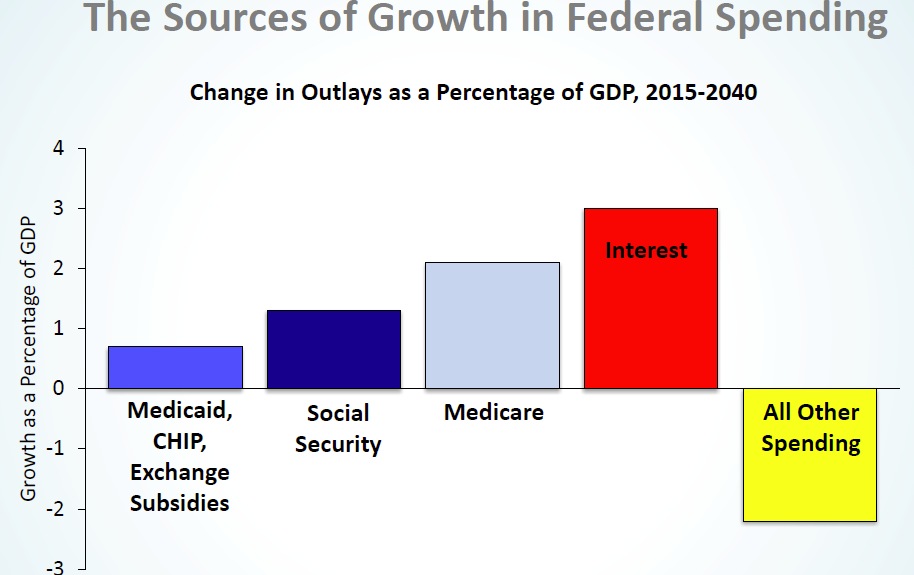
The second chart demonstrates that Medicare will be the major component of increases in federal spending in the coming years (with the other entitlements of Social Security and Medicaid following right behind).
So the question is: how do we control Medicare spending within the context of overall health-care reform?  Here is a proposal from James Capretta of the American Enterprise Institute:

  • Medicare recipients would receive fixed payments toward the coverage option of their choice, based on their age, income and health status. The traditional Medicare program would be one of the choices. Enrollees choosing less costly coverage options would see a reduction in their premiums.
  • Premium payments would be comparable to subsidies and tax credits received from the reformed Affordable Care Act.
  • Privately run managed care plans provide benefits at far less cost than traditional Medicare. Beneficiaries would share in the savings.

Conclusion. It needs to be emphasized as strongly as possible that the point of Medicare reform is to lower costs to both individuals and the government, sa that Medicare can be preserved indefinitely into the future.

Follow me on Twitter
Follow me on Facebook
Getting American Health Care Straightened Out


Donald Trump was elected to be our next president because of the huge desire for change amongst the American electorate. Many things need changing, but among the most important is our healthcare system.  The problem is that we are spending 18% of our GDP on healthcare, twice as much as any other developed country.  The Affordable Care Act has increased access to healthcare but does very little to hold down costs.  This is one reason why it is so unpopular and needs to be substantially modified.
capture10President-elect Trump has nominated Representative Tom Price (R, Ga) to head up Health and Human Services in his cabinet.  Rep. Price is an expert on healthcare and is a leading advocate for replacing the ACA with something more workable.  He will soon be in position to lead the charge for healthcare reform.
The two American Enterprise Institute scholars, James Capretta and Scott Gottlieb,  have some good ideas for what needs to be done.

  • Provide a path to catastrophic health insurance for all Americans. The idea is that all Americans who do not get health insurance through employers, or Medicare or Medicaid, should be eligible for a refundable tax credit sufficient to pay for a basic level of catastrophic (i.e. with a high deductible) insurance coverage.
  • Accommodating people with pre-existing health conditions. Everyone who maintains continuous (catastrophic, as above) coverage would be allowed to move from employer coverage to the individual market without facing exclusions or higher premiums based on health status.
  • Allow broad access to health-savings accounts. There would be a one-time federal tax credit to encourage all Americans to open an HSA to pay routine medical bills. Families typically spend up to 22% less on healthcare after switching to an HSA.
  • Deregulate the market for medical services. Providers need freedom from regulation to provide packages of services better tailored to people’s needs. Such provider flexibility will further reduce costs through additional marketplace competition.

Conclusion. The major reason why our healthcare is so expensive is because we, as individuals, don’t have enough “skin in the game,” in the sense of paying for routine medical expenses directly out of our own pockets. The reforms outlines above would correct this very problem.

Follow me on Twitter
Follow me on Facebook

How to Improve Obamacare and Lower It’s Costs


I have been making the case for some time now that the rapidly increasing costs of U.S. health care, especially for the entitlement programs of Medicare and Medicaid, is the fundamental cause of our exploding national debt, and therefore these costs must be curtailed.  The only way to fix this problem is for Americans to have more “skin in the game” regarding these costs.
Capture10My last post, “The Inherent Instability of Obamacare,” discusses the separate but related problem that the Affordable Care Act is actuarially unsound because it misprices the basic risks involved in health insurance.  This is why costs on the exchanges are going up so fast which, in turn, leads to fewer enrollees.
A good way to address this double whammy of problems is to use a plan developed (mostly) by the American Enterprise Institute in December, 2015.  The main features are:

  • ACA Mandates, for both individuals and employers, would be abolished.
  • Retain tax preferences for employer-paid premiums, with an upper limit comparable to the cost of catastrophic health insurance.
  • Provide refundable tax credits to households without access to employer coverage, gradually replacing subsidies provided by ACA exchanges.
  • Persons with pre-existing conditions would have continuous coverage protection.
  • Medicare would migrate to a defined contribution, refundable tax credit model as above, with eligibility gradually rising to age 67.
  • Medicaid would be financed with block grants to the states and would supplement the refundable tax credit model.
  • Health Savings Accounts, to accompany high deductible plans, would be encouraged with a one-time federal tax credit matching enrollee contributions.
  • Health Care for Veterans would be integrated into mainstream care.

Summary. Abolishing the mandates means that coverage levels and price would be actuarially determined in the market place. Equal tax credits for insurance and help in setting up health savings accounts ensure fairness and widespread accessibility.  The overall free market model will guarantee both low cost and the greatest possible degree of flexibility, innovation and quality of care.

Follow me on Twitter
Follow me on Facebook
 

Reforming U.S. Health Care to Control Costs


My last two posts, here and here, have made the case that:

  • Our national debt is now 74% of GDP (for the public part on which we pay interest), the highest since WWII, and steadily getting worse. This will create a huge problem in the not so distant future, as soon as interest rates return to normal (higher) levels.
  • Entitlement spending is the main driver of our increasing debt. The best way to control Medicare and Medicaid spending is to control the cost of health care spending in general.
  • The overall cost of health care, public and private, in the U.S. is now 17.4% of GDP, much higher than for any other developed country, and is steadily increasing.
  • The main reason our health care costs are rising so rapidly is that Americans do not have enough “skin in the game.” Health insurance pays for close to 90% of our health care costs so that we pay for very little directly out of our own pockets. This means we have little incentive to pay close attention to these costs.

Christus Health in Dallas and Privia Medical Group in Washington, DC  are causing disruption by shifting health care delivery from hospitals to outpatient settings.  They are putting in place a number of lower-cost and more consumer friendly options which reward collaboration, performance and a focus on cost and quality on the part of both management and front-line providers.
Capture18As I have pointed out in previous posts, here and here, several policy changes would help speed up this process of needed change:

  • The tax exemption for employer provided health insurance should be limited to the cost of high deductible catastrophic insurance with an equal (refundable) tax credit for those without employer coverage. Health Savings Accounts would be encouraged for routine health care expenses.
  • Affordable Care Act exchanges would continue to operate as at present but without any mandates.
  • Medicare would provide a fixed level of assistance with which seniors would purchase a private health plan of their own choosing, rather than being open ended as at present.
    Medicaid. The federal government would give states fixed, per-person payments. Low-income individuals could combine Medicaid and the (refundable) tax credit to enroll in private insurance.

Conclusion. The whole idea is to make everyone, rich and poor, young and old alike, responsible for their own health care expenses.  Only with such a consumer-oriented, free-market system will we be able to preserve the high quality of American health care and rein in excessive costs at the same time.

Follow me on Twitter
Follow me on Facebook

The Challenges of American Health Care


America is facing great challenges in healthcare. Our national health expenditure is $3.1 trillion per year, 17.4% of GDP, and is projected to reach 19.6% of GDP by 2024.   Some 34% of Americans are obese (BMI>30), far more than in any other country. Their medical expenses will soar in the years ahead.  Medicaid now covers over 70 million low-income people at a cost of $500 billion per year.  Medicare spends $615 billion per year on the 42 million Americans over age 65.
CaptureThe Hoover Institution’s Scott Atlas has just published “Restoring Quality Health Care: a six-point plan for comprehensive reform at lower cost.”  He claims that his plan will save $2.75 trillion over a decade for private healthcare and an additional $1.5 trillion per decade for federal healthcare programs such as Medicare, Medicaid and the Affordable Care Act.
The elements of his plan are to:

  • Expand Affordable Private Insurance by allowing all insurers to offer high deductible, limited-mandate catastrophic coverage (LMCC) to all citizens, which would be owned by individuals and portable.
  • Establish and Liberalize Universal Health Savings Accounts (HSA) for all citizens, individually owned and portable.
  • Instill Appropriate Incentives with Rational Tax Treatment of Health Spending equal for all, whether individual, self-employed or employer-based, requiring LMCCs for all.
  • Modernize Medicare for the 21st Century by establishing a private insurance option with defined-benefit premium support based on regional benchmarks featuring cash rebates to individual HSAs if premium is less than benchmark, otherwise additional cost paid by enrollee.
  • Overhaul Medicaid and Eliminate the Two-Tiered System for Poor Americans by permitting all insurers to offer LMCC plans to entire state population as well as setting up government seeded HSAs for all Medicaid enrollees.
  • Strategically Enhance the Supply of Medical Care While Ensuring Innovation by stimulating private retail clinics and loosening practice restraints on nurse practitioners and physician assistants.


A plan along these lines would go a long way towards both improving the quality and lowering the costs of American healthcare.

Follow me on Twitter
Follow me on Facebook

The Fundamental Driver of Our Debt Problem: the Cost of Healthcare


How to grow the economy faster. How to get our rapidly growing national debt under control.  These are the two main problems facing our country which I address over and over again on this blog.  Finding satisfactory solutions to these two problems will determine our future strength and prosperity as a nation.  Today’s discussion is about the major cause of our debt and deficit problem.
CaptureI recently came across the above chart showing the steady rise of overall American healthcare spending (public and private).  In 1960 it was less than 6% of GDP.  Now it is approximately 18%, a tripling, compared to the overall size of the economy, in just 55 years. Of course it is the cost of public healthcare programs such as Medicare, Medicaid and the Affordable Care Act which directly contribute to our growing deficits and to the accumulated debt.
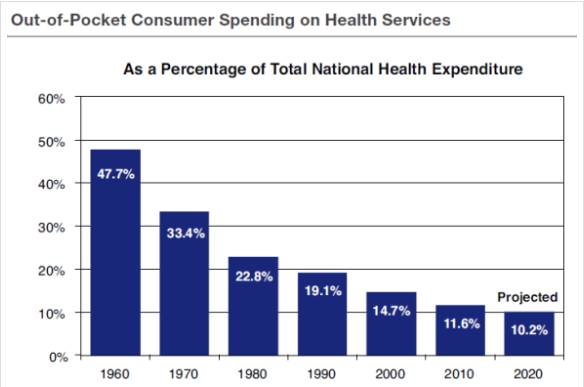
However we will never be able to limit the cost increases of these public programs until we get the fundamental drivers of private healthcare costs under control. As pointed out (in the chart below) by several scholars from the American Enterprise Institute, the basic reason for the high cost of private American health care is that “we don’t have enough skin in the game” as shown by the chart just below.  We are paying less and less of total healthcare costs out of our own pockets because more costs are paid directly by third party insurers.  This means we have less incentive to control our own healthcare costs.
Capture2The AEI has suggested several reform measures to improve this situation such as:

  • Placing an upper limit on the tax exemption for employer-paid insurance premiums.
  • Expanding the use of Health Savings Accounts to be used in conjunction with high deductible plans.

We have a stark choice in front of us. Either we move in this direction in the near future or we will face another, much worse, financial crisis.  In the latter case we will end up with an inferior healthcare system, much less responsive to our wants and desires.

Follow me on Twitter: https://twitter.com/jack_heidel
Follow me on Facebook: https://www.facebook.com/jack.heidel.3

Health Care Spending is Driving Budget Deficits


In my last post, “Annual Deficits are Starting to go Back Up,” I refer to a new report from the Congressional Budget Office to show that it is the large annual increases in federal healthcare spending (Medicare, Medicaid, CHIP and Obamacare) which is the main driver of our annual deficit spending which is going to start increasing again unless we do something serious about it.
CaptureThe basic problem is, as shown by the above chart, that Americans, in general, don’t have enough skin in the healthcare game, i.e. we don’t pay enough of our health care expenses out of our own pockets, and therefore we don’t directly feel the pain of high and rapidly increasing health care costs.
A group of policy experts from the American Enterprise Institute have come up with a practical plan to address this problem.  Its elements are:

  • Retain employer provided coverage. This is how half of Americans get health insurance. The only change would be an upper limit on the tax preference for employer-paid premiums so that only the most expensive plans would exceed it.
  • Tax Credits. Individuals without employer coverage would get a tax credit with no strings attached to pick any state-approved plan that meets their needs.
  • Continuous coverage protection. As long as people stay insured, they cannot be denied enrollment based on health status.
  • Medicaid reform. The federal government would give states fixed, per-person payments based on historical spending patterns. Able bodied adult and their children could combine Medicaid and the (refundable) federal tax credit to enroll in a private insurance option.
  • Medicare reform. Medicare would provide a fixed level of assistance which seniors would use to purchase a health plan of their own choosing.
  • Expanded Health Savings Accounts. These are intended to be used with catastrophic insurance with a high deductible. HSAs could be established with a one-time $1000 tax credit and unused funds rolled over from one year to the next.

Such a system does not repeal, but rather improves the Affordable Care Act. It keeps the ACA exchanges and introduces cost controls in a flexible manner, i.e. without mandates.  It is the type of system the U.S. needs to get health care costs, and therefore overall deficit spending, under control.

Follow me on Twitter: https://twitter.com/jack_heidel
Follow me on Facebook: https://www.facebook.com/jack.heidel.3