Do We Want More of the Same?


Most of the time on this blog I address what I consider to be our country’s two biggest fiscal and economic problems: 1) economic growth which, at 2% per year for the past seven years, is too slow to create enough new jobs and higher wages for middle- and lower-income workers and 2) massive and rapidly growing debt, now at 75% of GDP, the highest since the end of WWII.
But from time to time I take a broader look such as:

  • James Piereson’s contention that the New Deal liberal consensus has broken down and we are headed for America’s Fourth Revolution.
  • Yuval Levin’s argument that both progressives and conservatives are stuck with a mid-twentieth century nostalgia to which it is impossible to return.
  • Senator Mike Lee’s (R, Utah) belief that Congress is itself responsible for its shrinking powers vis-à-vis the President and the Supreme Court.

Along this line, Yuval Levin and Ramesh Ponnuru have a powerful essay in the latest issue of the National Review saying that “Mainstream liberals now advance a vision of American government that is increasingly contemptuous of our system’s democratic character and seeks to break through the restraints of the constitutional system in pursuit of their policy ends.”

capture64This vision is advanced in three key ways:

  • Executive unilateralism, for example, by President Obama with respect to status of illegal immigrants, various suspensions and waivers in the implementation of the Affordable Care Act, and net neutrality regulations.
  • The administrative state referring to the tangle of regulatory agencies that populate the executive branch. These agencies issue thousands of regulations per year which, given the vagueness of major legislation, means that the agencies legislate through their rules. Examples are the immense power of the Environmental Protection Agency and the implementation of the Dodd-Frank financial-regulatory reforms.
  • Liberal judicial philosophy understands the courts to be in the business of advancing what is properly understood as a legislative agenda. For example, two Supreme Court cases, a health-care related case (King vs Burwell) and a same-sex-marriage case (Obergefell vs Hodges) turned out this way.

Conclude Messrs. Levin and Ponnuru: “That the constitution makes the work of progressive ideologues frustrating is not an excuse for ignoring and subverting it. Arguments for doing so amount to unprincipled excuses for lawlessness.”

Follow me on Twitter
Follow me on Facebook
 

Donald Trump Needs a More Positive Message


As regular readers of my blog posts know, I am not enthusiastic about either of our two main presidential candidates because neither of them has a good grasp of our two biggest economic problems which are:

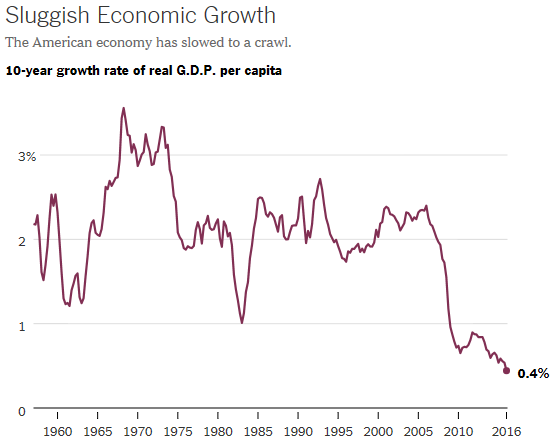
  • Slow economic growth, averaging just 2% per year since the end of the Great Recession in June 2009. Faster growth would solve or alleviate many other problems, especially by creating more new jobs as well as delivering faster wage growth for all middle- and lower-income workers.
  • Massive debt now at 75% of GDP, the highest it has been since right after WWII, and projected by the Congressional Budget Office to get steadily worse unless big changes are made in spending and tax policies. Such major changes are difficult to make without presidential leadership.

Hillary Clinton promises “equitable” growth but her policy proposals will lead to a big increase in spending (bad idea) on projects of dubious value in speeding up economic growth. Donald Trump would hurt the economy with immigration controls and trade restrictions.  His proposal for lower tax rates (good idea) needs much improvement to avoid increasing annual deficits.
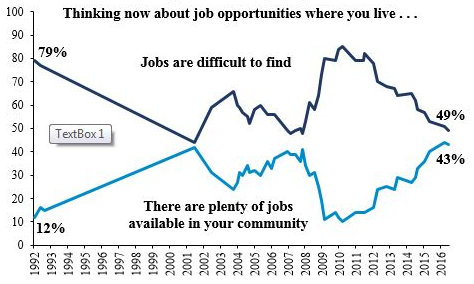
capture40Mr. Trump’s biggest problem, however, is his negative message about life in America today. Yes, we need stronger border security but we don’t need a Fortress America.  As the American Enterprise Institute has just reported, worker satisfaction is greatly improved since 2009 and workers are now much less anxious about job security than just a few years ago.
There is a really good way for Mr. Trump to sound a more positive note.  He could very easily take up the major themes of the Republican House Plan, “A Better Way” for solving America’s major economic problems.
Conclusion. There is an overwhelming desire for change in America, for new leadership which breaks out of the corruption, cronyism and elitism so rampant in Washington DC today.  But Americans are natural optimists and want a leader who can look forward to a bright future for our country.

Follow me on Twitter
Follow me on Facebook

The Democrats Are Half Right (and Half Wrong!) on the Economy


In my opinion both of the two main presidential candidates have overall poor economic plans.  But at least several major Democratic figures such as Hillary Clinton, the NYT columnist Thomas Friedman, and the economist Larry Summers do understand the importance of economic growth.
In particular, says Mr. Summers, “What is unfortunate is that many (progressives), in their eagerness to focus on fairness, neglect the single most important determinant of almost every aspect of economic performance – the rate of growth of total income, as reflected in the gross domestic product.”
Furthermore,

  • More growth means more employment. For each 1 point increase in adult male employment, the employment of young black men rises by 7%.
  • More growth reduces the need for desperation monetary policies that risk future financial stability.
  • If U.S. growth continues to have a 2% ceiling, it is doubtful if we will achieve any of our major national objectives. If we can boost growth to 3%, interest rates will normalize, middle-class wages will rise faster than inflation, debt burdens will continue to melt away and the power of the American example will be greatly enhanced.
  • The question is not whether business success is desirable. The question is how it can be achieved.

All of the above is very positive on the part of Mr. Summers. But then he adds, “What is needed is more demand for the product of business.  This is the core of the case for policy approaches to raising public investment and increasing workers’ purchasing power.”  In other words Mr. Summers is ignoring that:

  • Our national debt is huge and growing way too fast.
  • Wages are now increasing fairly rapidly which increases demand by itself.

    Capture27

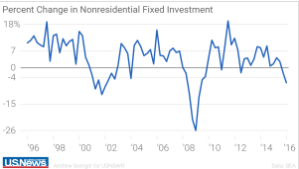
  • Investment in new business structures, equipment and intellectual property has now fallen for three quarters in a row.

    Capture28

Conclusion. The way to achieve the faster rate of growth which Mr. Summers (and almost everyone else) wants is not more public investment but rather more private investment. The House Republicans have a plan to accomplish exactly this.

Follow me on Twitter
Follow me on Facebook
Amazing! Some Progressives May Actually Understand Economics


I have to constantly remind my readers that I am a non-ideological fiscal conservative. I simply want our national leaders to address our two most serious fiscal and economic problems which are:

  • Massive Debt. Our (public, on which we pay interest) debt is now 75% of GDP, the largest since WWII and steadily getting worse. When interest rates go up, as they surely will before long, interest payments on the debt will increase by hundreds of billions of dollars per year and become a huge drain on the federal budget, eventually leading to a new financial crisis, much worse than the last one.
  • Slow Economic Growth. The economy has grown at the average rate of only 2.1% since the end of the Great Recession in June 2009. Such slow growth means fewer new jobs for the unemployed and underemployed and smaller raises for all workers.

My last several posts, here and here have pointed out that neither of our two main presidential candidates is adequately addressing these issues.  Both of them claim that they want faster growth but their policy proposals will just make our humongous debt even worse.
Capture31So I was quite surprised by a column in yesterday’s New York Times by Thomas Friedman, “How Clinton could knock Trump out,” trying to “push Clinton to inject some capitalism into her economic plan.”  Says Mr. Friedman:

  • Clinton could be reaching out to center-right (and anti-Trump) Republicans with a real pro-growth, start-up, deregulation, entrepreneurship agenda.
  • If Clinton wins, she will need to get stuff done, not just give stuff away.
  • The concerns of the Sanders supporters with fairness and inequality can only be addressed with economic growth; the rising anti-immigration sentiments can be defused only with economic growth; the general anxiety feeding Trumpism can be eased only with economic growth.

Conclusion. I am pleased to hear such sensible thoughts from one of the leading columnists of the NYT. If Clinton wins the election (as I expect) and if the Republicans continue to hold the House of Representatives (as I fervently hope), there could be much common ground for constructing an intelligent agenda going forward.

Follow me on Twitter 
Follow me on Facebook
The Presidential Candidates Are Clueless on the Economy


My last several posts, here and here, have discussed the economic plans of both Hillary Clinton and Donald Trump.  In short,

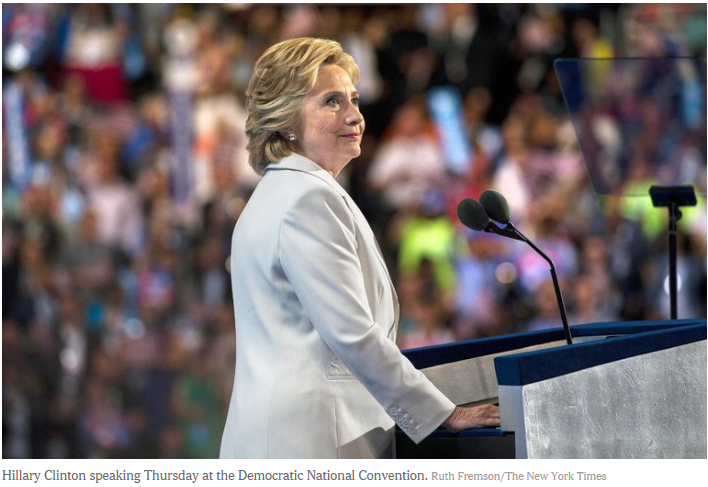
  • Ms. Clinton wants “equitable” growth meaning huge new public spending on such things as infrastructure, free public college tuition universal pre-K education as well as increasing the minimum wage to $15 per hour nationally and mandating paid family leave. More public spending and new mandates will provide only minimal economic growth.
  • Mr. Trump wants to restrict the labor force with immigration controls and raise the price of imports with new tariffs. He would also cut tax rates across the board (good idea) but in such a way that would increase the national debt by $10 trillion over the next ten years (very bad idea).

They both need to take our actual current economic situation into account as follows:

  • The U.S. is in its weakest recovery since post WWII. The average growth rate of 2.2% for 2012 – 2015 has now stalled in the past year to just barely 1%.

    Capture25

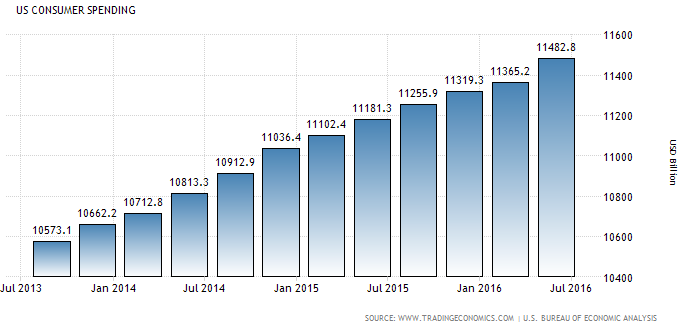
  • Consumer spending has been increasing steadily and rose 4.2% in the second quarter of 2016. In other words, consumer demand is at a high level.

    Capture26

  • The problem is that business investment, i.e. supply, has decreased.

    Capture24

The House Republicans have “a better way.” Their tax reform plan, among many other good features, would

  • Lower the top corporate tax rate from 35% to 20% and establish a territorial system, to encourage multinational corporations to produce in the U.S. as well as bringing their foreign earnings back home for reinvestment.
  • Provide a tax-free return on new investment by allowing, for the first time ever, for full and immediate write-offs.

Conclusion. The House Republicans have a sensible plan for getting our country back on a much faster economic growth track. Regardless of who is elected president, the House is likely to stay under Republican control.  I am waiting to see if either of the presidential candidates will figure this out and adjust their campaign messages accordingly.

Follow me on Twitter
Follow me on Facebook


The Clinton Plan for “Equitable” Growth


I have tried to make it clear in my post that I have not endorsed either of the two main presidential candidates.  In fact I am waiting to see a credible plan for simultaneously spurring economic growth and getting our very large and growing national debt under much better control.
Capture12Capture13
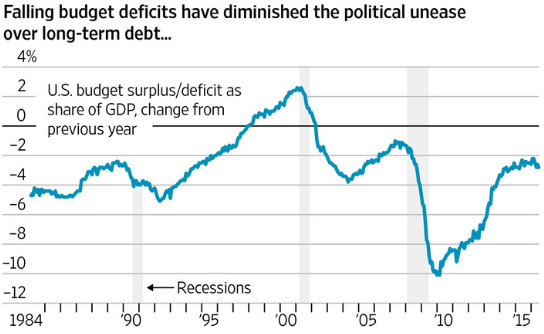
The debt problem is real and cannot be sloughed off as many try to do.  The two charts below show that while annual deficit levels have returned to what may be considered “normal” since 1984, they are still much too high and will lead to a rapidly increasing level of debt even if interest rates remain low which is by no means assured.
In other words, it is not good enough to just make the economy grow faster, it needs to be done in a fiscally responsible way.
I’ve already discussed how the Trump tax plan is unacceptable because it will substantially raise deficits and therefore make the debt much worse.

The same thing is true for the Clinton plan for “equitable” growth, but in a different way.  She wants

  • $250 billion in new spending for infrastructure.
  • Free public college tuition.
  • Universal Pre-K education.

Regardless of their individual attractiveness, it is irresponsible to propose new programs, with new spending, when deficits are already way too high and the debt is steadily climbing.

She also wants to:

  • Raise the national minimum wage to $15 per hour.
  • Mandate paid family leave.

The problem here is that both of these measures will increase unemployment and therefore slow down economic growth. Many states and cities are raising the minimum wage on their own and this way is preferable because it is locally determined.  Paid family leave should be left up to individual employers to use as an incentive to attract and retain good employees.

Conclusion. Hillary Clinton does want to make the economy grow faster which is highly desirable.  But she would do it with new federal spending and new mandates.  The new mandates will actually slow growth.  The new spending programs will add to the debt.  Both approaches are counterproductive.

Follow me on Twitter
Follow me on Facebook
Can the U.S. Economy Do Better VI. Does the President Matter?


My last five posts have discussed several different aspects of the question, “Can the U.S. Economy Do Better?”  Our economy has been doing especially poorly since the end of the Great Recession seven years ago (see the chart below).  Many people claim that the President doesn’t really have all that much control over the economy.
Capture6 Here is what the2016 presidential candidates are saying on economic policy so far:

  • Hillary Clinton. She wants national paid family leave, a national minimum wage increase and more government spending on infrastructure projects. She would raise taxes by about $100 billion per year to pay for these initiatives. She is opposed to the Trans Pacific Partnership to expand trade with 11 other Pacific Rim countries.
  • Donald Trump. His top priorities are trade and immigration policy. Would he be able to successfully address China’s currency manipulation without starting a trade war? How would he be able to round up and deport millions of illegal immigrants without destroying millions of jobs and thereby crippling many businesses? His plan to slash tax rates would boost the economy but also add trillions of dollars to the debt.

As I have discussed over and over again on this blog, see, for example, here and here,  there are several fundamental policy changes needed to make our economy grow faster and create more and better paying jobs.  We need to:

  • Make it easier to start a small business by simplifying regulations at all levels.
  • Lower tax rates and simplify the tax code, paid for by shrinking deductions and closing loopholes.
  • Respond to globalization and new technology by helping its victims rather than blocking progress.

Our two presidential candidates are appealing to the fears of the voters rather than to their hopes and aspirations. Neither of them is espousing policies which will help the economy really grow in a healthy way.

Follow me on Twitter
Follow me on Facebook

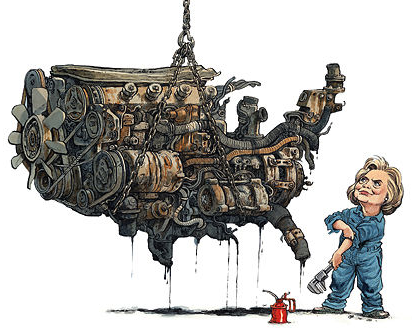
Can She Fix It?


As I have recently pointed out, Hillary Clinton is now likely to be our next president.  In my last post I provided vivid evidence that middle class income grew dramatically between 1971 and 2001 and has been either stagnant or declining since then.  The fact is that the years from 1971 – 2001 were a time of rapid economic growth, about 3.5% per year.
Capture2So it is obvious what needs to be done to fix America’s economic woes: grow the economy faster!  In its latest issue, the Economist asks, “Can she fix it?” The tentative answer suggested by the Economist is no, based on Mrs. Clinton’s tepid policy proposals to date:

  • She wants to make college more affordable, grant paid leave to parents, raise the national minimum wage to $12 per hour, and increase infrastructure spending. These are nice sounding proposals but will have only minor effects on growth or add greatly to the national debt (infrastructure spending).
  • She proposes a tax-credit for companies to encourage profit-sharing schemes. This would just make the tax code more complicated.
  • She wants an extra tax on the debt of big banks but simply increasing capital requirements on big banks would be more effective.
  • She wants to raise the top tax individual tax rate to 45% but shrinking deductions and closing loopholes would be a more efficient way to make the tax code more progressive.
  • She wants to abandon the Trans Pacific Trade Partnership rather than figuring out how to help those workers who lose from expanded trade with such measures as wage insurance or better job retraining.

As the Economist concludes, “A bigger plan to help American workers would start by boosting competition, both by slashing unnecessary regulations for small businesses, and by ensuring that big firms no longer operate in protected markets.”
If we are going to end up with another Clinton presidency, we certainly don’t want four more years of Obama-type economic stagnation!

Follow me on Twitter: https://twitter.com/jack_heidel
Follow me on Facebook: https://www.facebook.com/jack.heidel.3

After Donald Trump


It looks more and more likely that Hillary Clinton will be our next President. She is almost certain to be the Democratic nominee and unlikely to be indicted for mishandling classified information.  If Donald Trump is the Republican nominee, she will trounce him because his negatives are much worse than hers.  If Mr. Trump is denied the Republican nomination, he is likely to run as an independent candidate and take votes away from the Republican nominee, thereby also electing Mrs. Clinton.
Capture0What happens then?  The Republicans will regroup by broadening their base to better appeal to Mr. Trump’s constituency of disaffected white working class voters.  Yuval Levin, editor of National Affairs, has visualized what policies a reconstituted conservative party might want to embrace to replace the no longer affordable progressive model:

  • Healthcare: a new approach would liberate insurers and providers to offer many different models of coverage and care and empower consumers to choose between them.
  • K-12 Education: a new approach would allow parents to make choices for their children and reshape the educational system around their preferences.
  • Welfare: a new system would empower local problem solvers to mix resources, advice, experience and moral leadership in a process of bottom-up experimentation.
  • Higher Education: a new model would no longer reinforce a cycle of rising tuition and declining value with inflationary federal loans. Rather it would open up accreditation to allow for more options and offer aid to the needy which rewards high value rather than high prices.
  • Cultural Issues: moral traditionalists should emphasize building cohesive and attractive subcultures, offering alternatives to the chaos of the mainstream permissive society.
  • Diminished Opportunity for the Working Class: Improvements to Trade Adjustment Assistance and Job Retraining programs (wage insurance?) will have to be embraced.

Conclusion. The disruption caused by Donald Trump could lead to a new and more broadly based Republican Party better equipped to address the emerging problems of the 21st century.

Follow me on Twitter: https://twitter.com/jack_heidel
Follow me on Facebook: https://www.facebook.com/jack.heidel.3

Is the Democratic Party Giving Up On Growth?


Prospects for future economic growth are decidedly grim.  The Congressional Budget Office has just reported that after a brief improvement for a couple of years, annual GDP growth will likely hover around 2.2% for the remainder of the ten year window 2015 – 2025.  This means, in turn, that the unemployment rate will also not likely fall much below its current level of 5.7% for the same ten year period.
CaptureA new report from the McKinsey Global Institute makes the even gloomier prediction that average U.S. GDP growth rate for the next 50 years will be only 1.9% per year, given current trends and policies.  A summary of this report is provided by the Brookings Institution social economist, William Galston.
On the other hand, according to New York Times columnist, Nate Cohn, the Democratic Party may be adopting a new policy direction, “The Parent Agenda, The Democrats’ New Focus.”  By this new focus he means:

  • Paid family leave
  • Universal preschool
  • An expanded earned-income tax credit and child tax credit
  • Free community college
  • Free four year college in time

Mr. Cohn points out that both President Obama as well as Hillary Clinton have endorsed such ideas.  Initiatives such as these are unlikely to go far in the current Republican Congress but they may still sound very attractive to the many hard-pressed middle class families with stagnant incomes.
The problem is that to emphasize a “family” political agenda like this is in effect to accept the conventional wisdom that faster economic growth is unattainable.  This is a defeatist attitude which is very harmful to the 20 million Americans who are either unemployed or under-employed. Here, briefly, is what could be done to boost economic growth in the short term:

  • Implement broad-based tax reform with lower tax rates for all, paid for by closing loopholes and limiting deductions.
  • Reduce regulatory burdens on business by, for example, streamlining (not repealing!) the Affordable Care Act and the Dodd-Frank Financial Reform Act.
  • Expand legal immigration with additional high-skill visas as well as an adequate guest worker program.
  • Expand international trade with new trade agreements.

These are all political footballs, of course, but also policies with much potential to speed up economic growth.  Either we take initiatives such as these or we consign our country to a future of relative economic stagnation with slow wage growth, high unemployment and increasing income inequality.