The Republican Party beyond Donald Trump


My last several posts have discussed the strengths and weaknesses of the U.S. economy and where the presidential candidates stand on the main issues.  As Donald Trump now slides further and further behind in the polls due to his juvenile tit-for-tat personality, his personal views matter less and less.
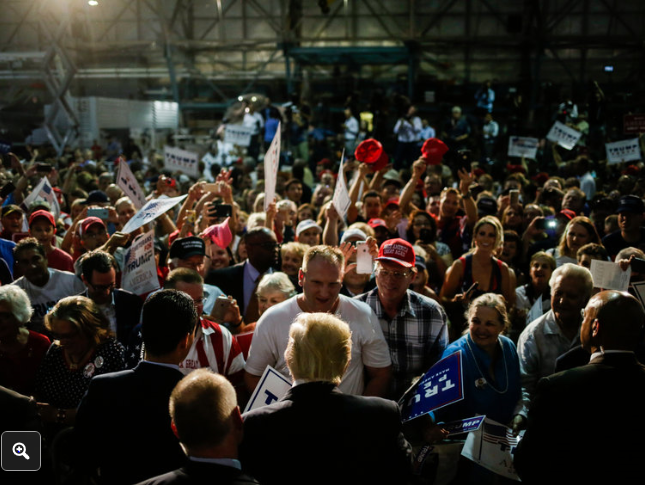
Capture31What does matter now is how the Republican Party will use the Trump disruption to broaden its appeal in the future. Here is a restatement of several of my ideas, influenced by two recent articles in the New York Times, here and here:

  • Reject tax cuts for the wealthy. But rather support tax rate cuts across the board, paid for by shrinking deductions which primarily benefit the wealthy. Such tax reform will give a sorely needed big boost to the economy.
  • Help workers displaced by foreign trade with expanded retraining programs and wage insurance. Increased globalization will also boost economic growth but it will stall without greater public support.
  • Acknowledge that universal health care is here to stay but push for market-oriented changes such as eliminating the mandates required by the ACA.
  • Disavow mass deportations but set up a firm border security program along with an adequate guest worker program to provide businesses the workers whom they are unable to hire locally. Again, legitimate immigration reform will boost the economy.
  • Admit that Invading Iraq was a mistake but nevertheless insist on a muscular foreign policy. U.S. economic and military strength provide peace and stability for the whole world including us.
  • Loosen up on social policy. Insist on restrictions on abortion (e.g. a 20 week cutoff) rather than abolition and work requirements for social welfare recipients rather than cutbacks in aid. In general turn over more social policy regulation to the individual states.

Conclusion. The U.S. badly needs more fiscally conservative national leaders. But conservatives will not prevail in the political process without using more common sense.
Follow me on Twitter
Follow me on Facebook

Amazing! Some Progressives May Actually Understand Economics


I have to constantly remind my readers that I am a non-ideological fiscal conservative. I simply want our national leaders to address our two most serious fiscal and economic problems which are:

  • Massive Debt. Our (public, on which we pay interest) debt is now 75% of GDP, the largest since WWII and steadily getting worse. When interest rates go up, as they surely will before long, interest payments on the debt will increase by hundreds of billions of dollars per year and become a huge drain on the federal budget, eventually leading to a new financial crisis, much worse than the last one.
  • Slow Economic Growth. The economy has grown at the average rate of only 2.1% since the end of the Great Recession in June 2009. Such slow growth means fewer new jobs for the unemployed and underemployed and smaller raises for all workers.

My last several posts, here and here have pointed out that neither of our two main presidential candidates is adequately addressing these issues.  Both of them claim that they want faster growth but their policy proposals will just make our humongous debt even worse.
Capture31So I was quite surprised by a column in yesterday’s New York Times by Thomas Friedman, “How Clinton could knock Trump out,” trying to “push Clinton to inject some capitalism into her economic plan.”  Says Mr. Friedman:

  • Clinton could be reaching out to center-right (and anti-Trump) Republicans with a real pro-growth, start-up, deregulation, entrepreneurship agenda.
  • If Clinton wins, she will need to get stuff done, not just give stuff away.
  • The concerns of the Sanders supporters with fairness and inequality can only be addressed with economic growth; the rising anti-immigration sentiments can be defused only with economic growth; the general anxiety feeding Trumpism can be eased only with economic growth.

Conclusion. I am pleased to hear such sensible thoughts from one of the leading columnists of the NYT. If Clinton wins the election (as I expect) and if the Republicans continue to hold the House of Representatives (as I fervently hope), there could be much common ground for constructing an intelligent agenda going forward.

Follow me on Twitter 
Follow me on Facebook

What Is Right and Wrong With the U.S. Economy


My last several posts have discussed the poor economic proposals of both major presidential candidates. Today’s New York Times has an excellent article by Neil Irwin, “Here’s What’s Going Right and Wrong in the U.S. Economy.”  According to Mr. Irwin and the NYT:

  • GDP Growth Disappointing. GDP growth was only 1.2% in the second quarter of 2016 and in fact has now averaged only 1.2% for the past year, much lower than the 2.1% average growth since the end of the Great Recession in June 2009.Capture30
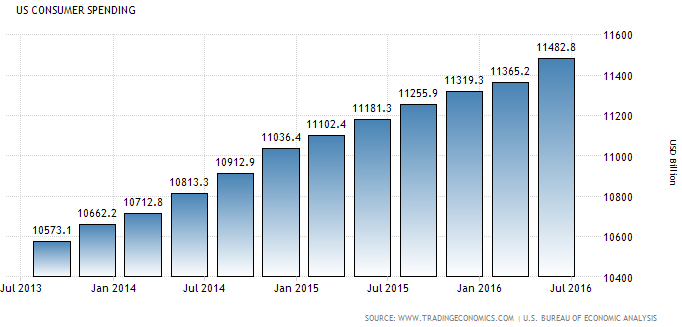
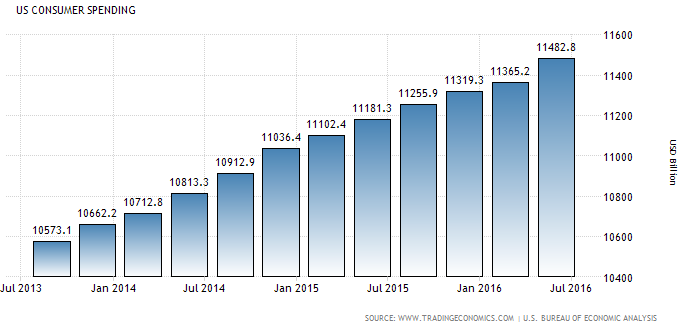
  • Consumers Spending Money. Consumer spending was up 4.2% in the second quarter continuing a long term trend. This means that there is plenty of demand for new products in the economy.Capture26
  • Wages Rising More Quickly. Total compensation is not only rising but the wage and salary component, not counting benefits, is up 2.5% over one year ago. This means that consumers have more money to spend.Capture27
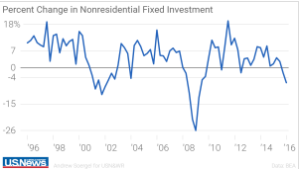
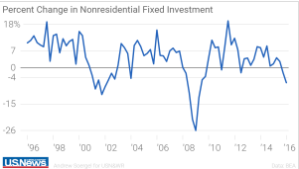
  • Investment Shrinking. Investment in new business structures, equipment and intellectual property has now fallen for the third consecutive quarter.  Eventually, if not turned around, this decrease in new investment will lead to fewer jobs and less consumer spending.Capture28
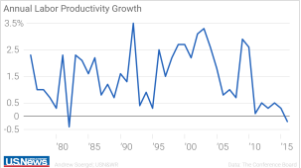
  • Poor Productivity Growth. Labor productivity fell .6% in the first quarter of 2016, a continuing slide. Weak productivity growth is a grave threat to long term prosperity in the U.S.Capture29

Conclusion. Wages are going up and consumers have money to spend. But worker productivity can only increase when business makes new investment.  This is not happening nearly fast enough. The House Republicans have an excellent plan to encourage business investment.
Is either presidential candidate paying attention to this opportunity to speed up economic growth?
I, for one, am waiting to find out!

Follow me on Twitter
Follow me on Facebook


The Presidential Candidates Are Clueless on the Economy


My last several posts, here and here, have discussed the economic plans of both Hillary Clinton and Donald Trump.  In short,

  • Ms. Clinton wants “equitable” growth meaning huge new public spending on such things as infrastructure, free public college tuition universal pre-K education as well as increasing the minimum wage to $15 per hour nationally and mandating paid family leave. More public spending and new mandates will provide only minimal economic growth.
  • Mr. Trump wants to restrict the labor force with immigration controls and raise the price of imports with new tariffs. He would also cut tax rates across the board (good idea) but in such a way that would increase the national debt by $10 trillion over the next ten years (very bad idea).

They both need to take our actual current economic situation into account as follows:

  • The U.S. is in its weakest recovery since post WWII. The average growth rate of 2.2% for 2012 – 2015 has now stalled in the past year to just barely 1%.

    Capture25

  • Consumer spending has been increasing steadily and rose 4.2% in the second quarter of 2016. In other words, consumer demand is at a high level.

    Capture26

  • The problem is that business investment, i.e. supply, has decreased.

    Capture24

The House Republicans have “a better way.” Their tax reform plan, among many other good features, would

  • Lower the top corporate tax rate from 35% to 20% and establish a territorial system, to encourage multinational corporations to produce in the U.S. as well as bringing their foreign earnings back home for reinvestment.
  • Provide a tax-free return on new investment by allowing, for the first time ever, for full and immediate write-offs.

Conclusion. The House Republicans have a sensible plan for getting our country back on a much faster economic growth track. Regardless of who is elected president, the House is likely to stay under Republican control.  I am waiting to see if either of the presidential candidates will figure this out and adjust their campaign messages accordingly.

Follow me on Twitter
Follow me on Facebook


The Clinton Plan for “Equitable” Growth


I have tried to make it clear in my post that I have not endorsed either of the two main presidential candidates.  In fact I am waiting to see a credible plan for simultaneously spurring economic growth and getting our very large and growing national debt under much better control.
Capture12Capture13
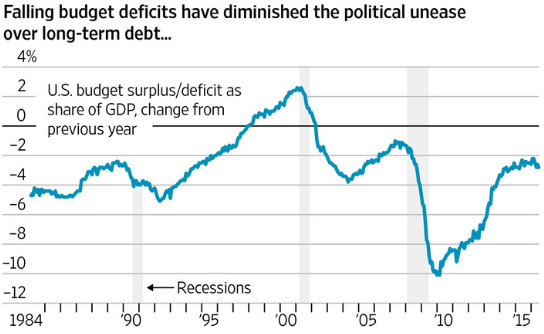
The debt problem is real and cannot be sloughed off as many try to do.  The two charts below show that while annual deficit levels have returned to what may be considered “normal” since 1984, they are still much too high and will lead to a rapidly increasing level of debt even if interest rates remain low which is by no means assured.
In other words, it is not good enough to just make the economy grow faster, it needs to be done in a fiscally responsible way.
I’ve already discussed how the Trump tax plan is unacceptable because it will substantially raise deficits and therefore make the debt much worse.

The same thing is true for the Clinton plan for “equitable” growth, but in a different way.  She wants

  • $250 billion in new spending for infrastructure.
  • Free public college tuition.
  • Universal Pre-K education.

Regardless of their individual attractiveness, it is irresponsible to propose new programs, with new spending, when deficits are already way too high and the debt is steadily climbing.

She also wants to:

  • Raise the national minimum wage to $15 per hour.
  • Mandate paid family leave.

The problem here is that both of these measures will increase unemployment and therefore slow down economic growth. Many states and cities are raising the minimum wage on their own and this way is preferable because it is locally determined.  Paid family leave should be left up to individual employers to use as an incentive to attract and retain good employees.

Conclusion. Hillary Clinton does want to make the economy grow faster which is highly desirable.  But she would do it with new federal spending and new mandates.  The new mandates will actually slow growth.  The new spending programs will add to the debt.  Both approaches are counterproductive.

Follow me on Twitter
Follow me on Facebook

“A Better Way” for Donald Trump to Make His Case


In my last post, “Donald Trump’s Best Chance to Win in November,” I said that the best way for Mr. Trump to broaden his appeal beyond working-class whites and to have any chance of winning the presidential election is for him to endorse the reform plan, “A Better Way,”  recently developed by the Republican House of Representatives.
Capture9Here is a brief and positive summary of the Trump platform so far:


  • His tax plan is highly pro-growth and will not cost nearly as much as the previously advertised $10 trillion over a decade.
  • He supports legal immigration and simply wants to solve the illegal immigration problem, one way or another.
  • He is not opposed to foreign trade per se but wants to negotiate, from a position of strength, with countries that manipulate their currencies, steal intellectual property or compel companies to disclose trade secrets as a condition of entering their markets.

His policy proposals so described are completely compatible with the House’s “A Better Way” reform plan whose planks are:


  • Poverty. Reward work. Tailor benefits to people’s needs. Improve skills and schools. Demand results.
  • National Security. Defeat the terrorists. Protect the homeland. Defend freedom.
  • The economy. Regulate smarter. End bailouts and cronyism. Put students and workers first.
  • The constitution. Make government more accountable and more representative. Restore constitutional checks on spending.
  • Health Care. More choices and lower costs. Real protections and peace of mind. Cutting edge cures and treatments. A stronger Medicare.
  • Tax reform. Simplicity and fairness. Jobs and growth.


These guiding principles are being fleshed out into complete policy documents. They do indeed represent a better way forward for our national government.  Donald Trump could do far worse than to endorse this comprehensive reform plan developed by the House Republicans.  It would show that he is serious about “Making America Great Again.”

Follow me on Twitter
Follow me on Facebook


Donald Trump’s Best Chance to Win in November


As I occasionally remind my readers, I am a non-ideological fiscal conservative and a registered independent. In November I will vote for the presidential candidate who has the most credible plan to address what I consider to be our country’s two more serious problems:

  • Slow Economic Growth, only 2.1% per year for the past seven years since the end of the Great Recession in June 2009. Faster growth will create more jobs and bigger wage gains for America’s workers.
  • Massive Debt. Our public debt (on which we pay interest) is now 75% of GDP, the highest it has been since the end of WWII, and likely to keep getting worse unless strong measures are taken to prevent this from happening.

According to current polls, Hillary Clinton is strongly predicted to be elected our next president. However her policy proposals will do little, if anything, to stimulate economic growth and are likely to make our debt much worse than it already is.
Capture8Donald Trump has a strong base of support among working class whites who are suffering in today’s economy and blame illegal immigration and unfair foreign trade for their woes.  However this base of support, while large enough for Mr. Trump to win the Republican nomination, is not nearly large enough to bring victory in November. The only way Mr. Trump can win is to greatly expand his base of support by appealing to moderate Republicans and Independents who are highly concerned about the direction our country is taking.
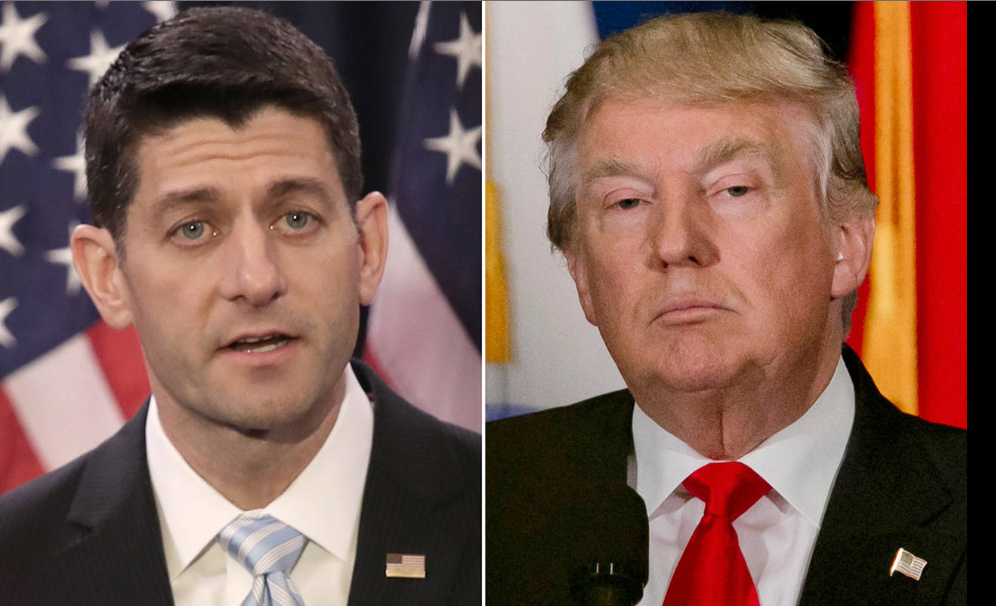
Capture9The best and most direct way for him to do this is to endorse the reform program, “A Better Way,” developed by the Republican House of Representatives, under Speaker Paul Ryan. This reform program has already unified the fractious Republicans in the House, and could easily serve as a vehicle for unifying the entire Republican party as well as many independents.
In my next post I will delineate how the Trump platform could easily mesh with “A Better Way.”

Follow me on Twitter 
Follow me on Facebook

Poor Education Is a Large Barrier to Black Progress


My last post, “Racism and Black Progress,” pointed out that, despite all of the racial tension in our society, especially bad at the present time, blacks have made much social and economic progress over the past half century.  All Americans of good will want this progress to continue.
I live in Omaha NE and am personally involved in a very promising public initiative to improve educational outcomes in inner city schools.  It is called the Learning Community and is an Omaha metro-wide effort to close the academic achievement gap between children from low-income families and those from the middle class.
Capture6The above chart shows clearly what the problem is.  Already in third grade FRL (free and reduced priced lunch) kids are behind on the NeSA (Nebraska State Assessment) reading test.  The gap persists into middle school and then gets much worse in high school.
Capture23A recent article in the Omaha World Herald reports that while black students make up 25% of Omaha Public Schools enrollment, they are responsible for 55% of disciplinary incidents.  Obviously, disruptive students are not learning what they need to know to succeed in school and in life.
A promising solution to this very difficult problem of improving educational outcomes for inner city students is early childhood education to prepare these kids to succeed in Kindergarten and then stay in school until graduation.  This is in fact the approach being taken by Omaha’s Learning Community.  But it is clearly a long range program which will take many years to show success.
Conclusion. A solid basic education is essential for success in today’s highly complex society.  Blacks will never reach full social and economic equality with whites until they achieve better educational outcomes.  Early childhood education has much promise in closing the academic achievement gap but will take many years to show significant progress.

Follow me on Twitter
Follow me on Facebook

Racism and Black Progress


At this time of heightened racial tensions in the U.S. it is worthwhile to step back and take a broader view of the economic and social status of blacks in America. The Washington Post’s Robert Samuelson has done just this in a recent column. As pointed out by Mr. Samuelson blacks have made much progress since the 1960s:

  • Poverty. Black poverty has dropped from 39.3% in 1967 to 26.2% in 2014, which was still double the white rate of 12.7%
  • Education. In 1950 only 13.7% of adult blacks had completed high school. By 2014 this had jumped to 86.7%. Over the same period the percentage of black adults with a four year college degree jumped from 2.2% to 22.8%. The corresponding percentage for whites in 2014 is 36%.
  • Upward Mobility. The black upper middle class (with incomes of $100,000 or more, inflation adjusted) has grown form 2.8% of households in 1967 to 13% in 2014. For the U.S. population as a whole it is now 31%.
  • Politics. In 1965, when the voting rights act was passed, there were five blacks in Congress, now there 46. Over the same time period, the number of black state legislators grew from 200 to 700.
    Capture22
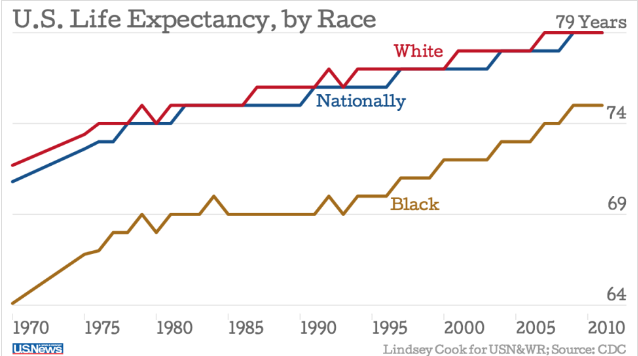
  • Life Expectancy. The life expectancy gap between blacks and whites shrank from 8 years in 1970 to 5 years in 2010.

Conclusion. Most people understand that life for blacks in America is more difficult than it is for whites. On the whole American society is trying to help blacks lift themselves up to be able to enjoy a more prosperous and satisfying life.  Much progress has been made in this respect in the last half-century but there is clearly still a long way to go in achieving full equality with white America. In my next post I will discuss one of the biggest barriers which remain in achieving equality between races.

Follow me on Twitter
Follow me on Facebook

Reforming U.S. Health Care to Control Costs


My last two posts, here and here, have made the case that:

  • Our national debt is now 74% of GDP (for the public part on which we pay interest), the highest since WWII, and steadily getting worse. This will create a huge problem in the not so distant future, as soon as interest rates return to normal (higher) levels.
  • Entitlement spending is the main driver of our increasing debt. The best way to control Medicare and Medicaid spending is to control the cost of health care spending in general.
  • The overall cost of health care, public and private, in the U.S. is now 17.4% of GDP, much higher than for any other developed country, and is steadily increasing.
  • The main reason our health care costs are rising so rapidly is that Americans do not have enough “skin in the game.” Health insurance pays for close to 90% of our health care costs so that we pay for very little directly out of our own pockets. This means we have little incentive to pay close attention to these costs.

Christus Health in Dallas and Privia Medical Group in Washington, DC  are causing disruption by shifting health care delivery from hospitals to outpatient settings.  They are putting in place a number of lower-cost and more consumer friendly options which reward collaboration, performance and a focus on cost and quality on the part of both management and front-line providers.
Capture18As I have pointed out in previous posts, here and here, several policy changes would help speed up this process of needed change:

  • The tax exemption for employer provided health insurance should be limited to the cost of high deductible catastrophic insurance with an equal (refundable) tax credit for those without employer coverage. Health Savings Accounts would be encouraged for routine health care expenses.
  • Affordable Care Act exchanges would continue to operate as at present but without any mandates.
  • Medicare would provide a fixed level of assistance with which seniors would purchase a private health plan of their own choosing, rather than being open ended as at present.
    Medicaid. The federal government would give states fixed, per-person payments. Low-income individuals could combine Medicaid and the (refundable) tax credit to enroll in private insurance.

Conclusion. The whole idea is to make everyone, rich and poor, young and old alike, responsible for their own health care expenses.  Only with such a consumer-oriented, free-market system will we be able to preserve the high quality of American health care and rein in excessive costs at the same time.

Follow me on Twitter
Follow me on Facebook