What Will It Take to ‘Fix the Debt’?


I have recently become a volunteer for the national bipartisan organization, Fix the Debt. It is the outreach arm for the Washington think tank, Committee for a Responsible Federal Budget, which is an offshoot of the Simpson-Bowles Commission from several years ago.
As such, I give presentations to local civic organizations about our national debt and what needs to be done to get it under control. Typically the audience will readily appreciate the seriousness of our debt problem.  What they want to talk about are practical ways to address it.  They have their own ideas and want to know what I think as well.  My first message is that we don’t have to pay off the debt or even balance the budget going forward.  Realistically we need to shrink our annual deficits in order to put the debt on a downward course as a percent of our growing economy,  as shown in the chart just below.
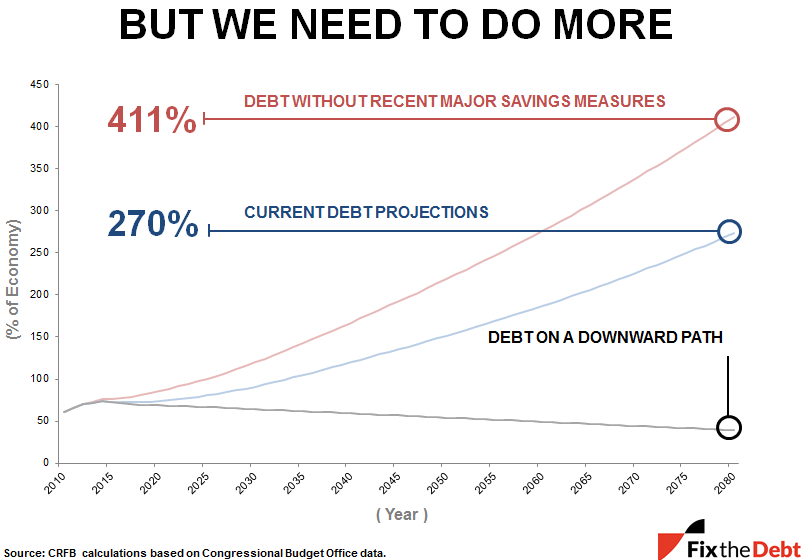
Capture It will be a huge challenge to accomplish even this!  Here are my ideas, in very general outline, on how to get this done:

  • Entitlements (Social Security, Medicare and Medicaid) are the biggest single problem because our population is aging so fast. Furthermore, in order to control the growth of Medicare and Medicaid, we have to do a much better job of controlling the overall cost of healthcare in the U.S. For example, even though healthcare costs slowed down to an increase of only 4.1% in 2014, this is still more than twice the rate of inflation!
  • The second thing we need to do is to make our economy grow faster than the roughly 2.3% growth we have achieved since the end of the Great Recession. The main way to get this done is through broad-based (and revenue neutral) tax reform at both the individual and corporate levels, by reducing tax rates, paid for by closing loopholes and limiting deductions.
  • Finally, there is enormous waste and inefficiency in the federal budget, with huge redundancy and overlap of programs between different federal departments. Responsibility for such programs as education, community development, transportation and social welfare, for example, should be returned to the states with block-grant funding to replace rigid federal control.

I have discussed each of these major reform ideas in much detail in previous blog posts and will continue to do so.  As large as our fiscal problems are, I remain optimistic that they can and will be successfully addressed.

Honoring Martin Luther King’s Legacy


Every year at this time, our nation is reminded of the progress our country has made in race relations as well as the work which remains to be done.  Here are three different approaches to concrete actions which can be taken to help black Americans improve their lot.
Not too long ago I quoted the black scholar, John McWhorter, as follows “Today’s struggle should focus on three priorities.  First, the war on drugs, a policy that unnecessarily tears apart black families and neighborhoods.  Second, community colleges and vocational education, which are invaluable for helping black Americans get ahead.  And third, the AIDS and obesity epidemics, which are ravaging black communities.”
An extensive report by the Hamilton Project (associated with the Brookings Institute), “Policies to Address Poverty in America,” focuses on four discrete areas where progress can be achieved:

  • Promoting Early Childhood Development
  • Supporting Disadvantaged Youth
  • Building Skills
  • Improving the Safety Net and Work Support

Capture Finally, the Budget Committee of the House of Representatives has recently released a new plan, “Expanding Opportunity in America,” proposing to redesign the American welfare system to help more people move off the bottom rung.  The idea is to let selected states experiment in consolidating separate means-tested programs such as SNAP, TANF, childcare and housing assistance programs, into a new holistic Opportunity Grant Program.  Here’s how it would work:

  • Each participating state will approve a list of certified providers who are held accountable for achieving results such as moving people to work, out of poverty and off of assistance.
  • Needy individuals will select a provider who will conduct a comprehensive assessment of that person’s needs, abilities and circumstances.
  • The provider and the recipient will develop a customized plan and contract both for immediate financial needs and also for long term goals towards self-sufficiency.
  • Successful completion of a contract will include able-bodied individuals obtaining a job and earning enough to live above the poverty line.

Here are three very distinct sources addressing the issue of black poverty in America. All three approaches are looking for practical solutions to a very difficult problem and they have a lot in common. This suggests that it should be possible for national leaders to come together and take effective action!

Why America Needs the Common Core


It is well understood that American educational standards are falling behind those of many other developed nations.  I have recently discussed this issue from the point of view of giving more public support to community colleges, as recently proposed by President Obama.
Capture1But the problem is much broader than this. American college students in general score very poorly in basic critical thinking and communication skills.  As the above chart shows, even college seniors are only 60% proficient in these skills and college freshmen do much more poorly.
A new book, “The Smart Society: Strengthening America’s Greatest Resource, its People,” by the political scientist, Peter Salins, provides a good description of the basic problem.  It starts long before college!  America actually has two different K-12 academic achievement gaps.  One, the “Megagap” is the huge test score disparity between middle class students and low-income students, who are largely minorities.  This achievement gap is best addressed with expanded early childhood education, as we are beginning to do in Omaha NE where I live.
But as Mr. Salins points out there is also a Mainstream Achievement Gap between what most non-disadvantaged American youth are capable of learning and what is actually expected of them in the typical U.S. public school.  It is this learning gap which is primarily responsible for America’s mediocre standing on international achievement tests.
CaptureMr. Salins argues that the Mainstream gap is closable because there is such an enormous variation in achievement scores among the 50 states, as shown in the above chart.  In particular, in Massachusetts, a top state, the Education Reform Act of 1995 included the following reforms:

  • The requirement for all state school districts to adhere to rigorous curriculum specifications.
  • A new statewide diagnostic testing protocol.
  • More rigorous testing of new teacher candidates.
  • A statewide uniform high school graduation standard.

Reforms such as these are what make up the Common Core State Standards Initiative.  Such high standards are working well in the top performing states.  Other states need to seriously implement these same standards.  America’s competitive edge depends on it!


Preventing the Next Housing Crisis: Shared Responsibility Mortgages


It is now commonly agreed that the Financial Crisis of 2008 was caused by the collapse of the housing bubble beginning in 2007. There were three main aspects to the huge collapse of wealth caused by the Financial Crisis:
Capture

  • It Destroyed Mainly Middle Class Wealth. During the Great Recession housing values collapsed by $5.5 trillion, a large fraction of the total $14 trillion economy. As shown in the above chart, most of this loss of wealth came at the expense of middle- and lower-income families.
  • Foreclosures on Underwater Mortgages Lowered Housing Values across the Board. When foreclosed houses are sold at steeply discounted prices, the appraised value of all other houses in the area are lowered as well.
  • The Loss of Wealth of Indebted Households Forced Them to Cut Back on Their Overall Spending. The decline in aggregate demand due to wealth loss of the indebted then becomes a problem for everyone in the economy.

In a new book, the economists Atif Mian and Amir Sufi have proposed a new way to set up mortgages, called Shared Responsibility Mortgages (SRM), to protect holders of underwater mortgages during a housing crisis.
Consider a house bought for $100,000 with a 20% down payment and a 30 year mortgage of $80,000 at 5% interest.  The annual mortgage payment is $5,204 per year.  Suppose the value of the house drops 30% to $70,000.  With an SRM the owner’s equity drops to 20% of $70,000 or $14,000.  The annual mortgage payment would also drop 30% to $3,643.  It would continue to be adjusted each year until the house returns to 100% of original value at which point the payment would revert to and remain at the original amount unless the value again drops below 100% of original value.
In return for sharing in the loss caused by a drop in value, the mortgage holder would receive 5% of any capital gain realized whenever the house was sold or refinanced in the future.
Suppose that all mortgages in 2007 had been SRMs.  All three of the problems outlined above would have been avoided.  The financial crisis would have been much less severe!

Is Universally Free Community College a Good Idea?


President Obama has just proposed that two years of community college be free for all Americans “willing to work for it.”  Forty percent, or about nine million, of today’s college students are enrolled at one of America’s more than 1100 community colleges which have an average annual tuition of $3800.  First estimates are that such a program would cost about $6 billion per year when fully implemented. The advantages of such a program are:
Capture

  • The biggest advantage is to greatly increase college enrollments especially for the low-income, minority and first generation college students who typically attend community colleges.
  • It will make a contribution toward solving the college affordability issue. With tuition averaging $9,139 at public four-year colleges and universities and $31,231 at private institutions, students unsure of their future plans can start out with much lower expenses before deciding if they really want a four year degree. Equally important, it will put pressure on four-year institutions to do a better job of controlling their costs and focusing more strongly on what they do best.
  • Finally, such a plan will put great pressure on expensive for-profit educational institutions, whose primary source of income is from federal student loans, to demonstrate much more clearly their true educational value. Community colleges are likely to expand their course offerings under a big influx of new students and expand into specialized practical subjects where the for-profit institutions now have a virtual monopoly.

There is, of course, one nitty-gritty little thing to be concerned about with such an ambitious new education program.  How is it going to be paid for in our current era of high federal deficits and exploding debt?
I think there are two ways to approach this question.  First of all, the federal education budget is quite large, $141 billion for FY 2014.  We should be able to trim other education programs in order to pay for this new initiative.  This kind of budget discipline, which is absolutely necessary, might require cutting back the President’s proposal in order to reduce its cost.  This is quite appropriate.
There will always be good ideas for new programs which could prove to be quite valuable.  But they will need to be implemented very efficiently!

Is Europe’s Decline an Indication of America’s Future?


One of my favorite writer’s on current affairs is Arthur Brooks from the American Enterprise Institute.  His article in yesterday’s New York Times, “An Aging Europe in Decline” gives a good explanation for the current malaise in Europe.  “The optimists see the region’s economy growing by just 1% in 2015: many fear that a triple-dip recession is in the offing. … Predictions of decade-long deflation, low productivity and high unemployment are becoming conventional wisdom.” But Mr. Brooks makes a strong case that Europe’s core problems are as much demographic as economic:

  • In 2014, the average number of children per woman in the European Union was 1.6, well below the replacement rate of 2.1.
  • The labor participation rate in the EU in 2013 was just 57.5%, much lower than the 62.7% in the U.S..
  • In 2012 the median age of the national population in the EU was 41.9 while the average age of foreigners living in the EU was 34.7. But “anti-immigration sentiment is surging across the continent.”

In other words, Europe is “rejecting the culture of family, turning its back on work and closing itself off to strivers from the outside.”  This is a powerful indictment of contemporary European culture.
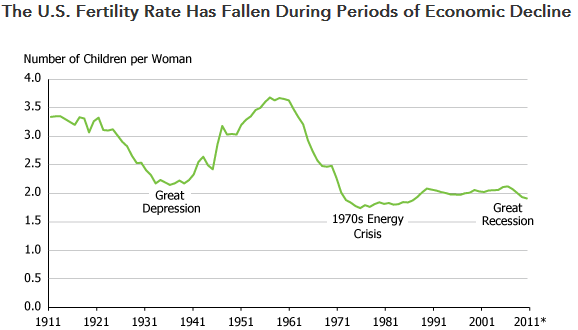
Capture1To a certain extent these same trends are evident in the U.S. although to a somewhat lesser degree:

  • Our own fertility rate (see the above chart) is down to 1.9 children per woman in 2012, and is dropping among all racial groups.
  • Our labor participation rate is better than Europe’s but is our own lowest in 36 years.
  • We admit over a million legal immigrants per year who lower the average age of our population. However we fail to accept many highly educated and skilled workers who would be able to give our economy a huge boost.

Demographics are a problem for the U.S. just as they are for Europe.  The only way to counteract strong demographic trends is with smarter economic policies.

Where Should the New 114th Congress Focus Its Attention?


The two main themes of this website are how to boost economic growth and how to get our national debt under control.  Faster economic growth will put more people back to work by creating more jobs.  Faster growth will also bring in more tax revenue and therefore potentially reduce deficit spending.
The latest monthly unemployment rate, 5.8% for November 2014, is much higher than it should be almost six years after the end of the Great Recession in June 2009.  The best thing that Congress could do to boost economic growth is to adopt broad-based tax reform, lowering tax rates in a revenue neutral way by closing loopholes and limiting deductions.  I’m still in favor of doing this but I no longer consider it to be the top priority for the following reason.
The huge drop in the price of gasoline is already providing a big economic stimulus.  At the current price of $2 per gallon, the average American family will save about $750 per year in driving expenses.  This is even more relief than a tax cut would provide.  The economy has already picked up steam in 2014 and is predicted to grow at the rate of 3% in 2015.  This will keep the unemployment rate decreasing steadily throughout 2015 and beyond, which represents much progress.
Capture1It’s now time for Congress to focus more strongly on putting the debt on a downward path.  This can only be done by shrinking our annual budget deficits well below the $483 billion deficit for the last (2014) budget year.  As the above chart from Fix the Debt shows, our current fiscal path leads inexorably to a growing debt which is completely unsustainable in the long run.  Annual deficits will have to be at least cut in half to be able to turn the debt trajectory downwards.
Getting this done will require much dedication and hard work by Congress.  Many programs will have to be eliminated.  Surviving programs will need to operate more efficiently.  The entitlement programs of Social Security, Medicare and Medicaid will have to be greatly tightened up.
Is Congress up to this task?  The future of our country depends on it!

The Legacy of Senator Tom Coburn


Oklahoma’s Senator Tom Coburn has just retired from Congress after serving six years in the House of Representatives and ten years in the Senate.  He will be sorely missed because his achievements were legion.
By ridiculing the “Bridge to Nowhere” in Alaska in 2006, he eventually prevailed upon Congress to totally eliminate earmark spending by 2011.
Beginning in 2010 his staff compiled an annual “Wastebook” each year listing numerous examples of wasteful spending by the federal government.  The “2014 Wastebook” gives 100 such examples totally $25 billion ranging from laughing classes for college students to a State Department program to dispel the perception abroad that Americans are fat and rude!
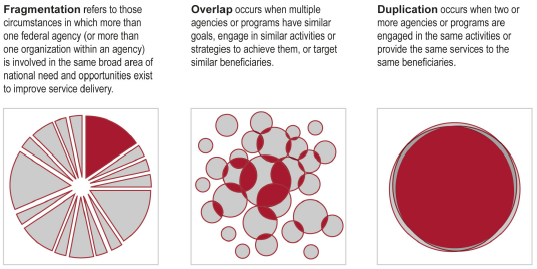
CaptureBeginning in 2011, Senator Coburn has prevailed upon the Government Accounting Office to issue annual reports entitled “Actions Needed to Reduce Fragmentation, Overlap and Duplication and Achieve Other Financial Benefits.”  Now, after four years, a total of 226 specific actions have been recommended by the GAO.  GAO’s Action Tracker shows that the government has addressed about 19% of the efficiency recommendations made by the GAO.  Be thankful for small progress!
His latest, finest and presumably last major effort along these lines is a 320 page report, the “Tax Decoder” which is intended to “decode the tax code for every taxpayer.  It reveals more than 165 tax expenditures costing over $900 billion this year.”  Although more than $1.7 trillion in tax revenue was collected by the government in 2014, the IRS will be unable to collect an additional $500 billion that is owed.  This would have been enough to cover the $483 billion deficit for fiscal year 2014!
As Senator Coburn points out in the introduction to this document, “ideally Congress would throw out the entire tax code and start over.  But at the very least, Congress should make the tax code simpler, fairer and flatter.”
It is rare that a single member of Congress makes such an extraordinary contribution to our country’s welfare!

We Agree There Is a Huge Debt Problem! How Do We Fix It?


Yesterday I gave my second “Fix the Debt” presentation, this time to the Greater Omaha Kiwanis Club.  The main slide (just below)
Captureis all they needed to appreciate the magnitude of the problem.  Their main interest was “How do we fix it?”  They listened politely to a bipartisan list of possible actions:

  • Policies that grow the economy
  • Health care cost containment
  • Social security reform
  • Defense spending cuts
  • Other spending cuts
  • Tax reform and tax expenditure cuts
  • Budget process reform

Then one member asked, “How about a balanced budget amendment?” and this became the focus of the discussion. A balanced budget amendment going forward would not pay off the debt but would stop adding to it.  It would shrink the debt over time as a percentage of GDP as the economy continues to grow.  This is the best we can do in a practical sense and represents a satisfactory solution. There are lots of problems, however, associated with passing a Balanced Budget Amendment:

  • First of all, it will be difficult to accomplish. It requires approval by a 2/3 vote of each house of Congress and ratification by ¾ of the states. This means that it could be stopped by just 13 state legislatures.
  • How would a BBA be enforced? By having the Supreme Court step in and require specific actions to raise taxes or cut spending? This seems problematic.
  • There would have to be a provision for override in the case of emergency (war or other catastrophe). A 2/3 vote by each house of Congress would be a logical way to handle a situation like this. But such a system could easily be abused.

The goal is to significantly shrink the debt as a percentage of GDP over time as the economy grows.  This does not require a balanced budget but only that annual deficits be lower on average than annual growth of the economy.  Representative Paul Ryan’s “Roadmap” plan, for example, would shrink the debt by 30% over a 20 year period without a single annual balanced budget. The important thing is to shrink the debt as a percentage of the economy, and to get going on this as soon as possible.  If it requires a somewhat rigid amendment to get this done, then that’s what we need to do!

Status Quo on the Budget Is Not Good Enough II. Look at the Big Picture!


In my last post, “Status Quo on the Budget Is Not Good Enough,” I discussed a report from the outgoing chair of the Senate Budget Committee, Patty Murray (D-WA), and explained how it epitomizes the lack of progress made on the massive debt problem which has developed since the Great Recession of 2008 -2009.
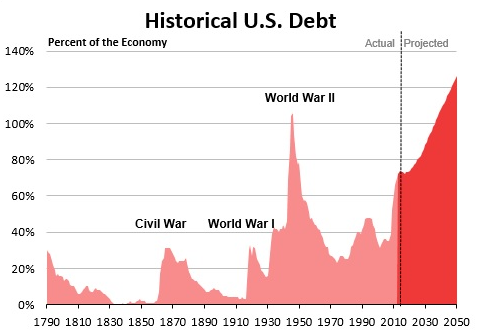
CaptureThe basic problem is that Senator Murray’s analysis simply does not recognize the seriousness of our debt problem as shown in the above chart.  Right now our public debt (on which we pay interest) is “sitting” at 74% of GDP for a year or two, before it continues its rapid increase.  This projection assumes an historically “normal” growth rate of 3% and no new recessions, neither of which assumption is assured.  It also assumes that the sequester budget cuts and new top tax rate of 39.6% stay in effect.  In other words it is a best case scenario based on current policy.
Breaking it down, the debt will continue to increase because annual deficits will continue to exceed the rate of growth of the economy.  The main driver of these increasing deficits is the cost of the health care entitlements of Medicare and Medicaid.  Medicare costs will increase rapidly because of the aging of the American people.  Medicaid costs will increase rapidly because: 1) more low-income people are being covered by the ACA and 2) since the recession there are more low-income people to be covered.  I certainly support expanded healthcare coverage but we have to figure out how to pay for it!
How do we contain the increasing costs of Medicare and Medicaid?  We do it by controlling the overall rapid growth (at twice the rate of inflation) of healthcare costs in general, i.e. for private healthcare. How do we do this?  See a couple of my recent posts either here or here.
Senator Murray, along with many other progressives, argues that we need more deficit spending in order to stimulate the economy and create new jobs.  More jobs are badly needed but more deficit spending is the wrong way to get them.  Then how?  With tax reform among other things.
Based on the outcome of the 2014 elections, I am optimistic that something along the lines of what I have just described will be tried by the next Congress.  We’ll soon find out!