Responsibility Goes Along With the “Good Life”


The New York Times recently compiled a map rating each of the 3,135 counties in the U.S. according to the following six factors:  educational attainment, median household income, unemployment rate, disability rate, life expectancy and obesity.  As can be seen (below) the whole state of Nebraska (motto: the Good Life) comes out very well in this rating scheme.
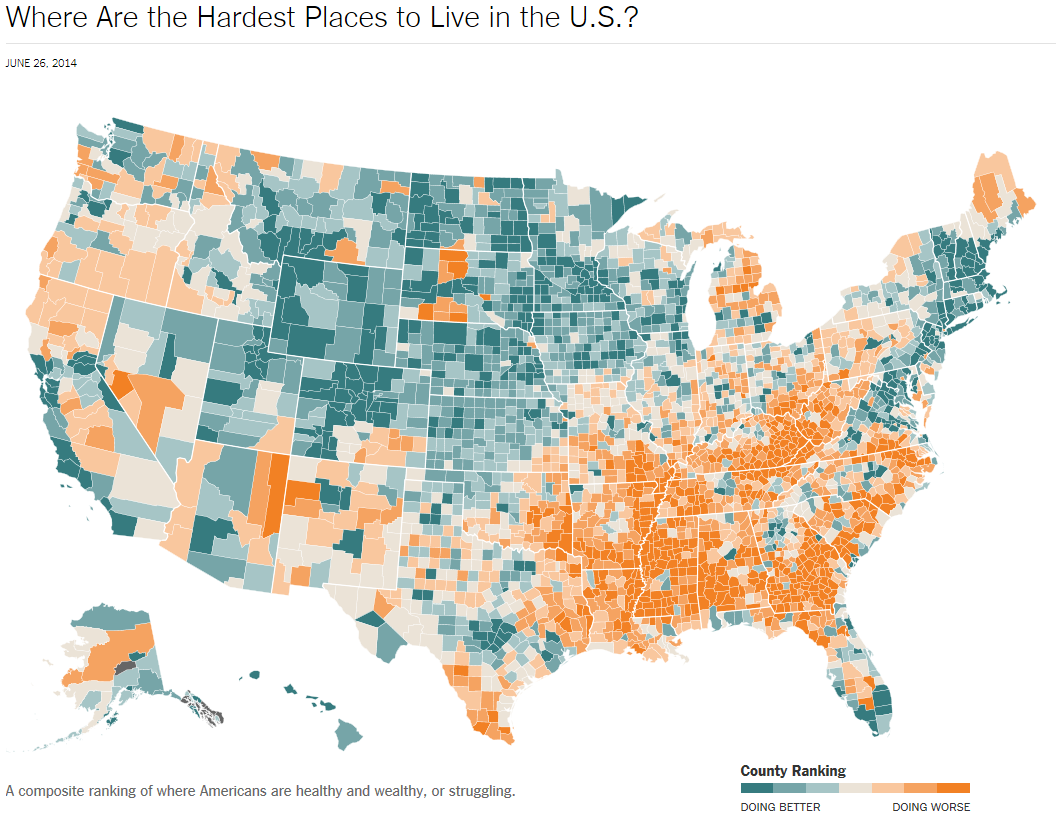
CaptureOn the other hand, Omaha has the highest black child poverty rate in the country at 59.4% (Omaha World Herald (4/15/2007)).  Partly for this reason the Nebraska Legislature established the Learning Community of Douglas and Sarpy Counties in 2008 whose purpose is to close the academic achievement gap between middle class and low-income students in the Omaha metro area.
Just a few days ago the Learning Community Coordinating Council approved an early childhood education plan developed by the Superintendents of the 11 Omaha area school districts to help children in poverty in the metro area.  It will cost about $2.5 million per year and will fund 29.5 full-time equivalent positions.  The plan will be managed by the newly established Buffett Early Childhood Institute in Omaha.  The increase in the property tax throughout the two county area to support this program will amount to $5 per year for the owner of a $100,000 house.
It is quite appropriate for an overall wealthy community like Omaha in a very well off state like Nebraska to pitch in, in this way, to help out its less fortunate residents.  It represents an example of how state and local governments can and should step in and take more responsibility for addressing their own problems without help from the federal government which is broke and needs to cut back on what it does.
If the Early Childhood Education plan lives up to its high expectations (as I believe it will), it is likely to receive much national attention and will become a model for other parts of the country.  Nebraskans should be proud of supporting such a forward looking initiative!

Barack Obama vs Paul Ryan: Who Is Moving Us in the Right Direction?


“If you give a man a fish you feed him for a day.  If you teach a man to fish you feed him for a lifetime.”
Chinese Proverb

Several weeks ago my post, “How to Improve America’s Welfare System,” described a new proposal from the House Budget Committee (Chair, Paul Ryan) to let selected states experiment in consolidating separate federal programs such as SNAP, TANF, child-care and housing assistance programs, into a new composite Opportunity Grant Program.  The idea is to let participating states choose qualified providers who would then be held accountable for moving people off of assistance, out of poverty and into productive employment.
CaptureA recent report from the Tax Foundation compares what families pay in taxes with what they receive in government benefits.  In 2010, 60% of American families (with incomes up to $86,000) received more in federal benefits than they paid in federal taxes.  However in 2012, this percentage grew to 70% (those families with incomes up to $109,000).  In other words, the trend under Obama is for more people to be net receivers of benefits than net payers of taxes. There are two basic problems with this trend towards more and more benefits for more and more people:

  • As it stands right now, we’re making people more dependent on government programs. Instead we should be helping them become more independent and more capable of supporting themselves on their own. This would improve their quality of life.
  • Our federal government is spending way too much money and not collecting enough tax revenue to pay the bills. According to report after report from the Congressional Budget Office, the trajectory of growing debt is getting much worse and the problem will become harder and harder to rectify as we continue down this path.

My natural inclination is to be optimistic that our political process will respond to this bleak current path we’re on and that things will be turned around before we have another financial crisis.  But it is easy to imagine a course of events where this does not happen.
It’s clear what we need to do but how will this get done?


An Inequality Culprit: Single-Parent Families


It is generally agreed that income inequality in the U.S. is bad and getting worse.  Before we can address it effectively, we have to understand what is causing it.  In this regard the Wall Street Journal had an article recently, “Ignoring an Inequality Culprit: Single-Parent Families”, by two scholars, Robert Maranto and Michael Crouch, from the Department of Education Reform at the University of Arkansas.
CaptureMr. Maranto and Mr. Crouch call attention to what they call “the strongest statistical correlate of inequality in the United States: the rise of single parent families during the past half century. … In 1960, more than 76% of African-Americans and nearly 97% of whites were born to married couples.  Today the percentage is 30% for blacks and 70% for whites. … This trend, coupled with high divorce rates, means that roughly 25% of American children now live in single-parent homes, twice the percentage in Europe (12%).  Roughly a third of American children live apart from their fathers.” In addition, “more than 20% of children in single-parent families live in poverty long-term, compared with 2% of those raised in two parent families.”  It is estimated “that 41% of the economic inequality created between 1976-2000 was the result of changed family structure.”
The authors wonder why there is not more public attention given to this depressing state of affairs and conclude that

  • Intellectual and cultural elites lean to the left and it is primarily social conservatives who promote traditional family structure.
  • Family breakup has hit minority communities the hardest. Therefore public discussion can be characterized as being racist.
  • This is a very hard problem to solve. Marriage and childrearing involve highly personal choices which cannot be dictated by society.

In this regard, my March 11, 2014 post “A balanced and Sensible Antipoverty Program”, emphasizes the need to at least remove marriage penalties from government welfare policy.
As the authors conclude, “The first step is to acknowledge the problem.”

A Balanced and Sensible Anti-Poverty Program


The American Enterprise Institute’s Robert Doar recently testified before the U.S. Senate Committee on the Budget with ”Back to Work: How to improve the prospects of low-income Americans”.  His recommendations are based on the four principles:

  • Work requirements as a condition of public assistance.  The work first approach has been shown to have better outcomes with regard to attachment to the labor force than even approaches which focus on training and education.
  • Robust work supports for those who are working at low wages.  The Earned Income Tax Credit accomplishes this and should be extended to childless adults.
  • Business growth and investment.  Policies that raise the cost of doing business and deter growth do little to create what the poor need most: jobs.
  • Foster married, two-parent families.  We need to mitigate marriage penalties in public assistance programs and we need to be honest about the consequences for children of single parenthood.

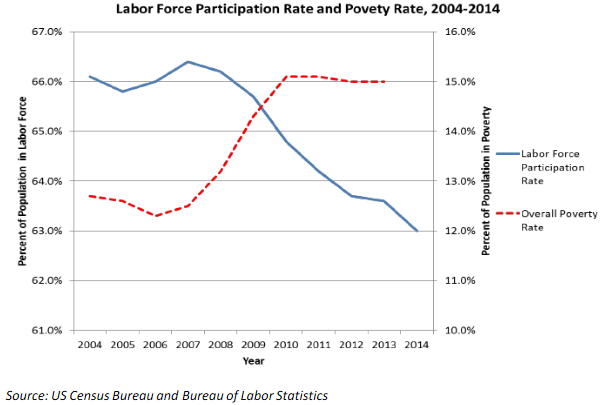
Mr. Doar points out that 10.2 million American’s are unemployed at the present time, 3.6 million have been jobless for more than 27 weeks, 7.3 million are involuntarily working part-time and 837,000 workers are so discouraged that they have stopped looking for work.  Labor force participation has dropped from over 66% in 2007 to 63% today while the poverty rate has risen from 12.5% to 15%.
CaptureRaising the minimum wage will not help the job prospects of most poor Americans.  Only 11.3% of individuals who would benefit from raising the minimum wage are living below the poverty line.  The Congressional Budget Office estimates that raising the minimum wage to $10.10 per hour would lead to 500,000 people losing their jobs.  CBO also estimates that the Affordable Care Act will reduce full-time employment by 2.3 million by 2021.  Given the strong anti-correlation (see the above chart) between labor participation and poverty, this means that the poverty rate may go higher yet.
The conclusion to draw from this excellent poverty synopsis (with lots of references) is that there are intelligent and effective ways to fight poverty and also much poorer ways to try to do it.  Good intentions are not enough!

Trash Talk from the New York Times


The Budget Committee of the House of Representatives has just issued a report “The War on Poverty: 50 Years Later”, providing an excellent summary of federal antipoverty programs and their cost at the present time (budget year 2012).  Highlights are:

  • The federal government spent $799 billion on 92 different programs to combat poverty
  • Over $100 billion was spent for 15 different food aid programs
  • Over $200 billion was spent on cash aid
  • Over $90 billion spent on education and job training (over 20 programs)
  • Nearly $300 billion spent on healthcare
  • Almost $50 billion spent on housing assistance

The report also points out that many low-income households face very high effective marginal tax rates, approaching 100%, if any members are employed, because making more money means losing welfare benefits.  This discourages low-income individuals from working at a time when the labor-force participation rate has fallen to a 36-year low of 62.8%.
CaptureHere’s the situation: we have a rapidly growing federal budget with huge deficit spending (see above chart), a stalled economy with low labor-force participation, and an inefficient welfare system which encourages people not to work. Surely our goal should be to motivate welfare recipients to become productive citizens by returning to the workforce.  So doesn’t it make sense to revamp our welfare system to be more efficient as well as to create more incentives for recipients to get and hold a job?
Apparently this does not make sense to the New York Times.  Two days ago they ran an editorial “Mr. Ryan’s Small Ideas on Poverty”, castigating Paul Ryan for “providing polished intellectual cover for his party to mow down as many antipoverty programs as it can see.”  The editorial goes on to say that “it’s easy to find flaws or waste in any government program, but the proper response is to fix those flaws, not throw entire programs away as Mr. Ryan and his Party have repeatedly proposed. . . . For all their glossy reports, Republicans have shown no interest in making these or any other social programs work better.”
Putting it as charitably as possible, the NYT is being unhelpful.  It is a beacon of progressive thought for millions of Americans.  But it is apparently unwilling to give any credence to a sincere effort by fiscal conservatives to reform a major government program to make it operate more efficiently and effectively.

Poverty, Inequality and the Minimum Wage II. Cities Are Expensive!


Poverty and inequality are getting worse in the United States.  The question is what to do about it.  One proposal is to raise the minimum wage from its current value of $7.25 per hour to $10.10 per hour.  The Congressional Budget Office has studied the tradeoffs in doing this.  Approximately 16 million people, at the bottom end of the wage scale, would see their incomes go up.  But 500,000 people would see their incomes go down because they’d lose their jobs!  Does the positive outweigh the negative?  It’s not clear!
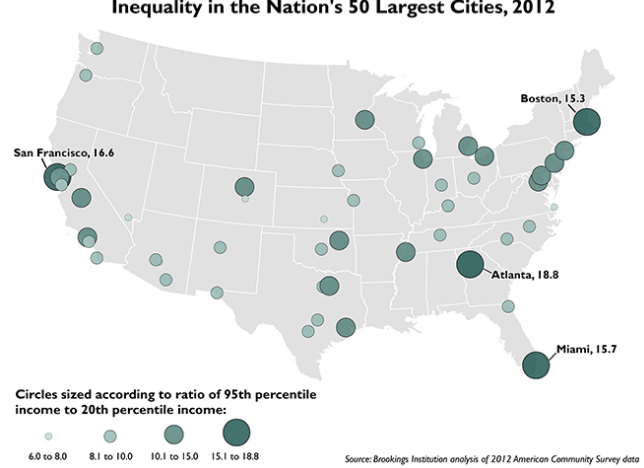
CaptureBut here is another aspect of the problem.  The Brookings Institution has just published a new study “All Cities Are Not Created Unequal”, pointing out that the 50 largest cities in the U.S. have higher rates of inequality than does the country as a whole.  Brookings looks at the so-called 95/20 ratio between the 95th percentile of wage earners compared to the 20th percentile.  The national average for this ratio is 9.1 with the 95th percentile earning (in 2012) $191,770 and the 20th percentile earning $20,968.  But many large cities such as San Francisco (16.6), Boston (15.3) and New York City (13.2) have much higher ratios.  The midsized city of Omaha has a ratio of 8.2 which is below the national average.
In other words the problems of poverty and inequality are much worse in some parts of the country than in others.  This suggests that at least part of the solution to addressing this problem should come at the state and local level.  It makes sense for California, Massachusetts and New York, for example, or at least San Francisco, Boston and New York City, to establish their own higher minimum wages.
This is not to say that a higher minimum wage at the national level is not also needed (more coming).  But the whole country cannot be expected to bail out a few major cities where the problem is much worse than elsewhere.

Poverty, Inequality and the Minimum Wage


Poverty and income inequality are getting increasingly worse in the United States and need to be seriously addressed by our political system.  In my last post on February 16, I presented data from the Heritage Foundation which shows that the War on Poverty has been quite successful in eliminating destitute poverty in the U.S.  What this means is that most low-income families have the basic necessities of enough food to eat (96%), a refrigerator (99%), a telephone (96%), air conditioning (81%), a car (74%), etc.  Of course, these “amenities” are provided at a great cost to society of about $1 trillion per year in social transfer payments.
CaptureCan we do a better job in helping the poor in the near term?  The conservative writer and political activist, Ron Unz, thinks we can.  He has just written a perceptive blog post “The Conservative Case for a Higher Minimum Wage”, proposing a national minimum wage of $12 per hour.  His reasoning is as follows.  Low wage jobs are primarily in the non-tradable service sector and so these jobs are hard to outsource and also hard to automate.  Therefore the unemployment effects of such a minimum wage increase would be minimal.  Mr. Unz estimates that, Walmart could accommodate a $12 per hour minimum wage with a one-time price hike of just 1.1%.  The grocery prices of home-grown agricultural products would rise by less than 2%.
A $12 per hour wage for a full time 40 hour per week worker would mean an annual salary of $25,000 per year or $50,000 per year for a couple.  At this income level, the family would be paying more in taxes and receiving fewer government benefits.  This would turn many net tax recipients into net taxpayers and thereby raise their stakes in the American way of life as well as lowering the deficit.
I emphasize that this is a program to alleviate poverty in the U.S.  It will not do anything to help the middle class worker whose wages have been stagnant ever since the recession started six years ago.  This is a much harder problem which will require politically charged changes in U.S. economic policy.
Stay tuned!

Poverty, Inequality and Mobility in a Free Society: Can We Do Better?

There has been a lot of public attention given to these topics recently.  Our stagnant economy since the end of the recession almost five years ago has meant high levels of unemployment and underemployment which naturally causes widespread discontent.  The 50th anniversary of President Johnson declaring War on Poverty provides an opportunity to look back and evaluate its success.
A very good summary of where we stand on poverty was given two years ago by Robert Rector and Rachel Sheffield of the Heritage Foundation: “Understanding Poverty in the United States: Surprising Facts about America’s Poor”.  The authors used 2010 census data for their study.  Poverty was defined to be a cash income of $22,314 or less for a family of four in 2010 (which increased to $23,550 in 2013).  They pointed out, for example, that “96% of poor parents stated that their children were never hungry at any time during the year because they could not afford food.”  The chart below shows that poor households, in general, have many of the common amenities.
CaptureIn other words, the close to $1 trillion spent per year ($871 billion in 2010) by federal and state governments on means tested assistance for the poor has largely eliminated destitute poverty in the U.S.  Further progress will require successfully addressing both the collapse of marriage and the lack of parental work in low-income communities.  These very difficult problems can only be addressed with a long term educational effort to turn poor children into productive citizens.
Conclusion:  the War on Poverty has had reasonable success at huge cost and further gains will be more expensive and more drawn out over time.  We’ve already started on this second phase by emphasizing early childhood education and so the focus now should be to implement this new direction.
Next step: it’s now time to direct our serious attention to the issues of inequality and mobility.  That will be the subject of my next post!