More on Inequality: How Bad Is It and Why?


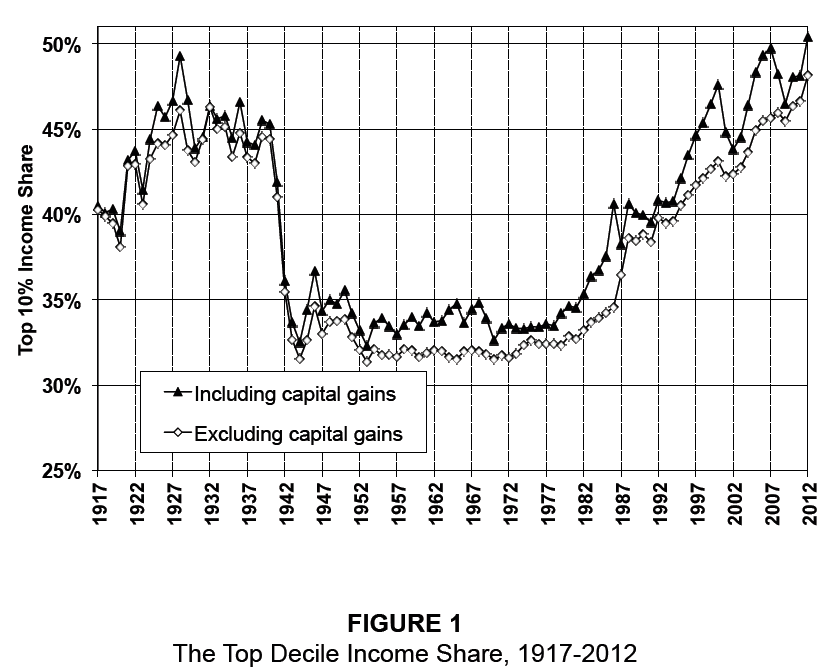
A recent article in Bloomberg View by Cass Sunstein, “How Did the 1 Percent Get Ahead So Fast?“, discusses the significance of new research by the economist Emmanuel Saez, ”Striking it Richer: The Evolution of Top Incomes in the United States”.  Referring to Saez’s table and chart below, the conclusion is that income inequality has been getting steadily worse since the early 1980s and has been especially pronounced since June 2009 when the Great Recession ended.
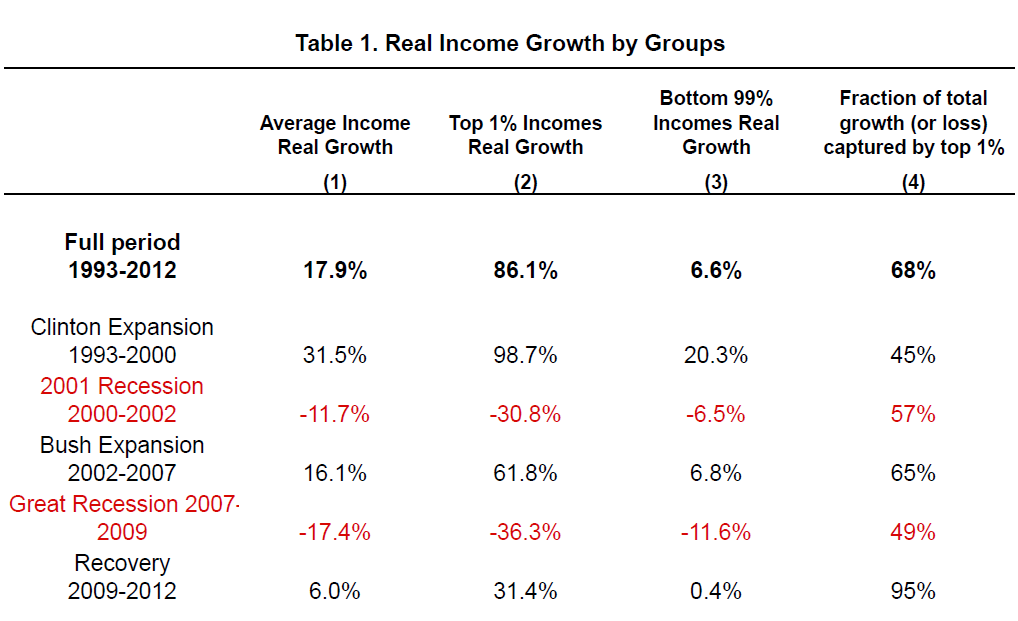
Capture1Capture2In particular, 95% of all income gain in the last four years has gone to the top 1%.  This is a much greater disparity than during the so-called Clinton Expansion, from 1993 – 2000 (45% to the top 1%) or during the Bush Expansion, from 2002 – 2007 (65% to the top 1%).  According to Mr. Sunstein, “one point is clear: through 2012 the gains from the current recovery were concentrated among the top 1 percent, and that pattern, extreme though it is, fits with a general surge in economic inequality over the last 40 years.”
CaptureBut there is more to the story!  Looking at the final chart, just above, it is clear that the economy grew much faster during the Clinton Expansion than during the Bush Expansion, and, in turn, much more slowly during the Obama Recovery.  In other words, the way to reduce inequality is to speed up economic growth.  There are tried and true ways to speed up growth (e.g. tax reform with lower rates, emphasis on deregulation, boosting entrepreneurship, etc.).  It is unfortunate that too many in Congress, as well as the President have ideological blinders which prevent them from moving in this direction!

How Do We Fight Economic Inequality? By Restoring Growth!

The liberal economist Paul Krugman returns to one of his favorite topics in yesterday’s New York Times, “Why Inequality Matters”.  “On average, Americans remain a lot poorer today than they were before the economic crisis.  For the bottom 90 percent of families, this impoverishment reflects both a shrinking economic pie and a declining share of that pie.”  The problem with Mr. Krugman’s analysis is that he offers no solution beyond more fiscal stimulus: “the premature return to fiscal austerity has done more than anything to hobble the recovery.”
CaptureBut there is another route to recovery and it is propounded in today’s Wall Street Journal by George Osborne, the United Kingdom’s Chancellor of the Exchequer, “How Britain Returned to Growth”. “We cut spending and top tax rates, and now deficits are down and jobs are being created at a healthy clip … at the rate of 60,000 per month, roughly equivalent to 300,000 in the U.S. … The corporate tax rate is being cut to 20% from 28%. … As a result, more international firms are moving their headquarters to Britain and investment is flowing into our country.”
Yes, as Mr. Krugman says, economic inequality in the U.S. is bad and getting worse.  The question is what to do about it.  Shall we try to improve the situation with artificial stimulation, increasing government debt, already very high, for future generations?  Or shall we address this inequality by encouraging businesses to grow and expand and thereby raise wages and hire more people.
The good news is that America is the success story of the 20th century.  The bad news is that everyone else in the world has figured this out and is now copying our own best methods.  Either we can compete, innovate, stay on top and thrive, or else we can get lazy, stagnate and sink down in the pack.
Will it be more inequality or more growth?  The choice is up to us!

Should the Minimum Wage Be Raised?

In today’s New York Times, the economist Arindrajit Dube has an Op Ed column in the Great Divide series, “The Minimum We Can Do”, pointing out that today’s minimum wage of $7.25 per hour is only 37% of today’s median hourly wage of about $20 per hour.  This compares with the 1968 minimum wage of $10.60 per hour (in today’s dollars, adjusted for inflation) which was 55% of the median wage at that time.  This is in line with the current Democratic proposal to raise the minimum wage to $10.10 per hour.
The standard argument against raising the minimum wage is that it will reduce employment because “when labor is made more costly, employers will hire less of it.”  However Mr. Dube offers empirical data which “suggest that a hypothetical 10% increase in the minimum wage affects employment in the restaurant or retail industries by much less than 1 percent” and therefore very little.
Basically Mr. Dube is arguing that raising the minimum wage won’t hurt the economy and it will help many low-paid workers.  The problem with this point of view is that it distracts attention from what we really should be doing: namely, everything we possibly can to speed up economic growth.  By far the best way to raise wages is to increase the value of labor by creating more jobs!
I may sound like a broken record, repeating the same thing over and over again, but we badly need to concentrate on the fundamentals of growing the economy: lowering tax rates, individual and corporate, to stimulate business investment and risk taking by entrepreneurs; removing onerous regulatory burdens, especially on new businesses and existing small businesses; and emphasizing career education and job training to fill the millions of high skill job openings which exist.
There are strong headwinds facing our economy: bad demographics (rapidly retiring baby boomers), pressure from technological progress and globalization which put a high premium on education and advanced skills, and massive national debt which will become a huge burden as interest rates inevitably increase.
These strong headwinds aren’t going away.  To overcome them we need national leaders who are able to rise above ideology and focus on the fundamentals.
Conclusion: we should raise the minimum wage when unemployment drops to 6% or, perhaps, tie a raise in the minimum wage to a tax reform measure which significantly lowers tax rates.

The Floundering of America


In yesterday’s Wall Street Journal, columnist William Galston talks about “The Floundering of America”.  Based on recent reports from the Congressional Budget Office, Mr. Galston says that “Today we are hurtling toward a less dynamic economy, a meaner society and a riskier world.”
His argument is based on these observations:

  • For the past 40 years, 1970-2010, the labor force expanded at an average rate of 1.6% per year.  It will soon slow to only .4% annual growth, because of more retirements and a plateauing of women’s labor-force participation. This means that growth in GDP will slow down to about 2% annually from its historical average of over 3%.
  • America is aging very fast.  Today there are 57 million Social Security beneficiaries which will increase to 76 million in 2023.  Obviously this will rapidly increase entitlement spending on retirees.
  • America already spends 18% of GDP on healthcare costs and the CBO projects that this will grow to 22% by 2038.

“In sum, current trends and policies will yield lower rates of economic growth, painfully slow gains in real incomes, huge increases in outlays for expenses related to an aging population, and a health sector that devours more and more of the national product”, he says.
These trends are all contributing to an explosion of the national debt.  The only current strategy to keep this debt even roughly stable during the next decade, let alone reduce it, is to shrink discretionary spending through sequestration.  This will lead to a decline in discretionary spending to 5.3% of GDP by 2023.  This means roughly 2.6% of GDP for national defense with an equal share or all other domestic purposes.
“This is pure folly”, says Mr. Galston. “The country needs a new national strategy for a viable future.”
How do we achieve a new strategy?  Immigration reform will increase the size of the workforce.  Tax reform could boost the economy by encouraging business expansion, risk taking and entrepreneurship.  True (consumer-driven) healthcare reform could dramatically lower the cost of healthcare.  In other words there are potential policies out there that address our national floundering. We simply need leaders who are capable of going beyond partisanship in order to help create a better future!