Why Faster Economic Growth Is So Important III. Speeding Up Anemic Wage Growth


The U.S. economy is in a peculiar and potentially perilous situation:

  • On the one hand, overall economic growth has averaged only 2.1% since the end of the Great Recession in June 2009.
  • On the other hand, the unemployment rate has dropped from 8% in early 2012 to 5% today.
  • But wages and salaries have grown by only 2% in the past year and near that rate for the past four years.

What explains our relatively low, and steadily dropping, unemployment rate when overall economic growth, and wage growth in particular, are so slow?
Capture2It is low productivity growth as the New York Times’ Neil Irwin, has recently pointed out: here  and here.

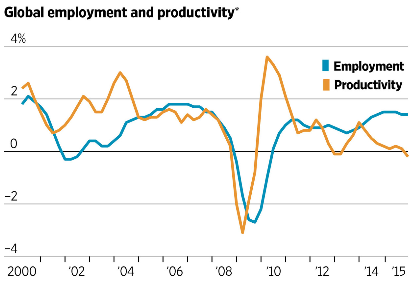
  • GDP is up 1.9% in the past year. But the number of hours worked by Americans is also up 1.9% in the past year. This means no increase in labor productivity in the past year.
  • For the past five years labor productivity has only advanced by .4% annually, far below the 2.3% average annual growth since the 1950s.
  • Most job growth in the last decade has been in (low productivity) services rather than (high productivity) manufacturing.

We do not have to accept low productivity growth as immutable. As I have recently discussed here, and here, better government policies can boost labor productivity and therefore boost economic growth as well.  Here is a brief summary of what needs to be done:

  • Decrease regulation: the Dodd-Frank Act and Affordable Care Act, for example, are hampering growth by increasing the inefficiency of the financial and healthcare sectors of the economy.
  • Reform taxation: growth oriented taxation would have the lowest possible rates paid for by shrinking deductions.
  • Reform immigration: giving legal status to millions of illegal immigrants would turn them into far more productive citizens.

In other words, our severe slow growth predicament can be greatly ameliorated if we would adopt more sensible economic policies. It is a shame that this is so hard to do!

Follow me on Twitter
Follow me on Facebook

After Donald Trump


It looks more and more likely that Hillary Clinton will be our next President. She is almost certain to be the Democratic nominee and unlikely to be indicted for mishandling classified information.  If Donald Trump is the Republican nominee, she will trounce him because his negatives are much worse than hers.  If Mr. Trump is denied the Republican nomination, he is likely to run as an independent candidate and take votes away from the Republican nominee, thereby also electing Mrs. Clinton.
Capture0What happens then?  The Republicans will regroup by broadening their base to better appeal to Mr. Trump’s constituency of disaffected white working class voters.  Yuval Levin, editor of National Affairs, has visualized what policies a reconstituted conservative party might want to embrace to replace the no longer affordable progressive model:

  • Healthcare: a new approach would liberate insurers and providers to offer many different models of coverage and care and empower consumers to choose between them.
  • K-12 Education: a new approach would allow parents to make choices for their children and reshape the educational system around their preferences.
  • Welfare: a new system would empower local problem solvers to mix resources, advice, experience and moral leadership in a process of bottom-up experimentation.
  • Higher Education: a new model would no longer reinforce a cycle of rising tuition and declining value with inflationary federal loans. Rather it would open up accreditation to allow for more options and offer aid to the needy which rewards high value rather than high prices.
  • Cultural Issues: moral traditionalists should emphasize building cohesive and attractive subcultures, offering alternatives to the chaos of the mainstream permissive society.
  • Diminished Opportunity for the Working Class: Improvements to Trade Adjustment Assistance and Job Retraining programs (wage insurance?) will have to be embraced.

Conclusion. The disruption caused by Donald Trump could lead to a new and more broadly based Republican Party better equipped to address the emerging problems of the 21st century.

Follow me on Twitter: https://twitter.com/jack_heidel
Follow me on Facebook: https://www.facebook.com/jack.heidel.3

What Might Fundamental Tax Reform Look Like?


All four of the major presidential candidates have tax plans. Hillary Clinton would make small tweaks in our current tax system.  Bernie Sanders would raise current taxes substantially.  Both Donald Trump and Ted Cruz would both radically reduce the size of the federal income tax but would also greatly add to the national debt over the next ten years.
I have been trying to make the case on this blog that fundamental tax reform is the best thing we can do to get the economy growing faster in order to create more and better paying jobs.  I have also discussed a specific way to accomplish fundamental reform, namely the so-called Competitive Tax Plan proposed by the tax law expert, Michael Graetz.  It is a progressive consumption tax, a so-called Value Added Tax.
Capture2As reviewed in yesterday’s Wall Street Journal by Reihan Salam, the editor of the National Review, the Graetz Plan has these features:

  • A broad-based VAT of about 14% on goods and services.
  • Families earning less than $100,000 per year are exempt from the income tax. The tax rate would be 15% for incomes between $100,000 and $250,000 and 25% above this level.
  • The payroll tax (supporting Social Security and Medicare) would be greatly reduced for all workers earning less than $40,000 per year.
  • The corporate tax rate would be lowered to 15%, making it among the lowest in the world.
  • The Graetz Plan is revenue neutral as verified by the Tax Policy Center.

Think of the incredible advantages of such a tax plan. Of the expected 145 million tax returns for this year, 120 million would no longer be necessary.  Extravagant deductions such as for mortgage interest would have much less political support. The low corporate tax rate would bring jobs back to the U.S. instead of sending them overseas.  The rampant cronyism involved in tax breaks being handed out by Congress would be greatly reduced.
What is not to like about the Graetz Plan?

Follow me on Twitter: https://twitter.com/jack_heidel
Follow me on Facebook: https://www.facebook.com/jack.heidel.3

Trade Makes America Great


Two leading presidential candidates, Bernie Sanders and Donald Trump are running against trade expansion because they say it costs American jobs. I pointed out in my last post, that there is a strong correlation between international trade and global GDP growth.
Capture2Today I will focus on the direct benefits to the American economy of expanded international trade.  First of all, I refer to a recent article in the Wall Street Journal by Frederick Smith, the CEO of FedEx Corp.  Says Mr. Smith:

  • From less than $50 billion in total trade in 1966, the U.S. now imports and exports over $4 trillion annually in goods and services, out of a global trade market which exceeds $15 trillion annually.
  • NAFTA has clearly been an economic success. U.S. trade with Mexico and Canada has risen to $1.2 trillion in 2014 from $737 billion twenty years ago.
  • History shows that trade made easy, affordable and fast always begets more trade, more jobs and more prosperity.

The U.S. typically runs a trade deficit of about $500 billion per year. The New York Times journalist, Neil Irwin, explains what this means. Says Mr. Irwin:

  • The dollar is a global reserve currency, meaning that it is used around the world in transactions which have nothing to do with the U.S.
  • This creates upward pressure on the dollar for reasons unrelated to trade flows between the U.S. and its partners. That, in turn, makes the dollar stronger and American exporters less competitive.
  • In other words, trade deficits with other countries serve as their reserve dollars.
  • Maintaining this global reserve currency creates lots of advantages for the U.S., including lower interest rates and higher stock prices.
  • The centrality of the dollar to global finance gives the U.S. power on the global stage which no other country can match.

There certainly are workers who lose their jobs because of trade competition. We can and should do more to help these workers get back on their feet.  This will increase popular support for free trade and allow its growth to continue unimpeded.

Follow me on Twitter: https://twitter.com/jack_heidel
Follow me on Facebook: https://www.facebook.com/jack.heidel.3


Growing Employment, Shrinking Productivity: What Does It Mean?


I know that I occasionally repeat myself, but I can’t help it! In my opinion there are two major problems facing our country:

  • Slow economic growth which has averaged only an anemic 2.1% since the end of the Great Recession seven years ago.
  • Exploding national debt, now the highest it has been since the end of WWII. Unless we can quickly shrink our annual deficits down to zero, and therefore stop adding to the debt, interest payments on the debt will eventually rise to horrendous levels.


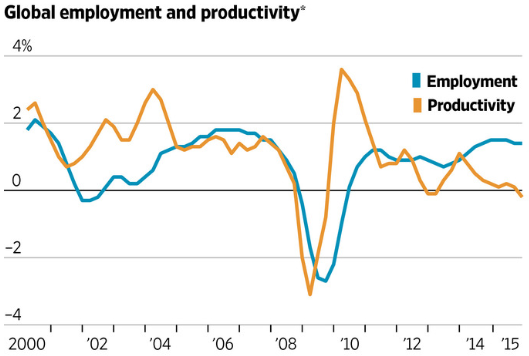
Two recent newspaper articles address the slow growth problem. Greg Ip, writing in the Wall Street Journal, points out that (worldwide) employment growth is up while productivity growth is down (see chart below).
Capture0Neil Irwin, writing in the New York Times, explains this dichotomy by pointing out that most job growth in the last decade has been in (low productivity) services rather than (high productivity) manufacturing. In other words, the U.S. economy is now producing lots of new temporary and contract jobs which do not add very much to the overall economic growth which produces higher wages and overall prosperity.
The economist John Cochrane has clearly described  why productivity growth, and therefore overall economic growth, has stagnated in recent years.  Here is a short summary:

  • Over-regulation. The Dodd-Frank Act and Affordable Care Act, for example, are hampering growth by strangling the financial and healthcare sectors of the economy.
  • Inefficient Taxation. Growth oriented taxation would have the lowest possible marginal rates paid for by shrinking deductions. Taxing consumption rather than income and savings would be even better.
  • Illegal Immigration. Solving our immigration problem would turn millions of illegals into productive citizens. An adequate Guest Worker program and e-Verify enforcement would solve this problem without the need for amnesty.

Conclusion: There are solutions to the severe economic problems facing our country. Does our political system have the flexibility to adopt these workable policies?

Follow me on Twitter: https://twitter.com/jack_heidel
Follow me on Facebook: https://www.facebook.com/jack.heidel.3


How to Lower Income Inequality


My last post provides evidence that income inequality has increased more under recent Democratic presidents than under Republican presidents.  Here is a brief summary of the argument:

  • Cheap money is of greatest value to those who have access to it.
  • The effects of the Bush housing bubble (in the 2000s) were more evenly distributed than for the Clinton stock market bubble (in the 1990s) or the Obama credit bubble.
  • Two earner households are the backbone of the American middle class.
  • During the first six years of the Obama presidency, the number of two-earner households declined, the number of single-earner households rose by 2.6 million and the number of no-earner households rose by 5 million. In other words, two-thirds of the increase in the number of households under Obama is accounted for by households with no-one working. This largely accounts for the shrinking middle class and the increase in inequality.
    Capture

Another way to consider this situation is to look at the labor force participation rate which has been steadily decreasing since the year 2000.  As the above chart shows, this trend is expected to continue indefinitely in the same downward direction.  Along with a slowing increase in the productivity rate, this constrains the U.S. economy’s capacity to expand. Clearly what is needed is faster economic growth in order to create more jobs and better paying jobs.  The way to accomplish this is with:

  • Tax Reform. Lower individual and corporate tax rates for all paid for by shrinking deductions and closing loopholes. More money in the hands of the middle class will stimulate demand. More money in the hands of small business will stimulate supply.
  • Expanded Earned Income Tax Credit. Putting more money in the pockets of low-income and marginally employed workers will encourage more of them to find work and stay in the workforce.

With all the headwinds holding the economy back, our national leaders (and would be leaders!) ought to be focusing much more attention on taking specific actions which would speed up economic growth.

Follow me on Twitter: https://twitter.com/jack_heidel
Follow me on Facebook: https://www.facebook.com/jack.heidel.3

Surprise! It Is Progressives Who Drive Income Inequality


The economist Lawrence Lindsey has an Op Ed in yesterday’s Wall Street Journal  analyzing Census Bureau data here, and here showing that income inequality rose more under Bill Clinton than under Ronald Reagan.  It also has risen much more under Barack Obama than under George W. Bush.
Capture6Here is the explanation for this:

  • Cheap money is a boon to those who have access to it.
  • Bill Clinton, George W. Bush and Barack Obama all presided over bubble economies fueled by easy monetary policy. But the effects of the Bush housing bubble were more evenly distributed than for the Clinton stock market bubble or the Obama credit bubble.
  • In 1968 government transfer payments totaled $53 billion or roughly 7% of personal income. By 2014, these had climbed to $2.5 trillion or 17% of personal income. Despite the redistribution of a sixth of all income, inequality is far higher today than in 1968.
  • Two earner households have become the backbone of the American middle class.
  • When families with children making between $20,000 and $50,000 attempt to have a second earner go back to work, the effective tax rate on the extra earnings, including lost government benefits, is between 50% and 80%. This “working class trap” is increasing income inequality and keeping the income of these households lower than they would otherwise be.
  • During the first six years of the Obama presidency, the number of two-earner households declined, while the number of single-earner households rose by 2.6 million and the number of no-earner households rose by 5 million. In other words, two-thirds of the increase in the number of households under Obama is accounted for by households with no one working. This is the reason the middle class has shrunk and that inequality is increasing.
  • A recent Brookings Institution study shows that boosting the top tax rate from 39.6% today to 50%, and redistributing the additional $95 billion in tax revenue to the bottom 20% of wage earners would reverse only 20% of the increase in income inequality under Obama.

As Mr. Lindsey concludes, “Attacking the rich and running against inequality may be a sensible political strategy. But in the end the programs to implement this strategy make the problem worse.”

Follow me on Twitter: https://twitter.com/jack_heidel
Follow me on Facebook: https://www.facebook.com/jack.heidel.3

Is the U.S. Economy Really in Good Shape?


The noted Harvard economist, Martin Feldstein, says in yesterday’s Wall Street Journal, that “The U.S. Economy Is in Good Shape.”
Capture0The reasons are that:

  • We are essentially at full employment with an overall unemployment rate of 4.9% and 2.5% among college graduates.
  • Real income (after government transfers and federal taxes) is up 49% between 1979 and 2010 for households in the lowest income quintile. Real income is up 40% between 1979 and 2010 for households in the middle three income quintiles.
  • The 70% decline in the price of oil since early 2015 will eventually have a positive impact on U.S. economic growth. The fall in gasoline prices alone has increased annual household spending power by more than $1000 per household. When consumers start spending this money, it will have a large impact.
  • The Fed’s quantitative easing program has led to artificially high stock prices which now are coming down as the Fed begins to raise short-term interest rates. The U.S. economy is strong enough to withstand this shock. It would be a mistake for the Fed to abandon its December forecast of four rate increases in 2016.

I would refer to Mr.Feldstein’s analysis as a somewhat rosy scenario. It ignores our low labor participation rate, our high (U-6) underemployment rate of 9.8% and the historically slow 2.2% growth of our economy since the end of the recession almost seven years ago.
Mr. Feldstein goes on to say that “the American economy does face long term problems.  High on the list is the large and growing national debt, rising from less than 40% of GDP before the recession to 75% now and heading to more than 80% in ten years.  But the big uncertainties which now hang over our economy are political, with presidential candidates threatening to raise taxes, increase fiscal deficits and pursue antibusiness policies.”
Conclusion. What Mr. Feldstein is really saying is that our economy is in satisfactory shape right now but that we must attend to its long term threats to make sure that things do not turn sour.  What the presidential candidates are saying in this respect is not encouraging.

Follow me on Twitter: https://twitter.com/jack_heidel
Follow me on Facebook: https://www.facebook.com/jack.heidel.3

What the Republican Presidential Candidates Should Be Saying


Thanks largely to Donald Trump the Republican presidential candidates are not taking the best approach to winning the White House in November. Instead of arguing with each other about who is the toughest on immigration or who is the most anti-establishment, they should be focusing on one issue where Republicans could have a big advantage: how to speed up our slow economic growth.
Capture9The Stanford economist, John Cochrane, makes very clear the value of doing this on his blog, The Grumpy Economist.  Says Mr. Cochrane:

  • From 1950 to 2000 the U.S. Economy grew at an average rate of 3.5% per year. Since 2000, it has grown at only half that rate, 1.7%.
  • The average American is more than three times better off than his or her counterpart in 1950. Real GDP per person has risen from $16,000 in 1952 to over $50,000 today, both measured in 2009 dollars.
  • If the U.S. economy had grown at 2% rather than 3.5% since 1950, income per person by 2000 would have been $23,000 not $50,000.
  • Even these large numbers understate reality. GDP per capita growth does not capture the increase in life span – nearly ten years – or other improvements in the quality of life such as health and environmental gains which we have experienced.

Says Mr. Cochrane, “Next to this increase in the standard of living, nothing the candidates are talking about – monetary policy, Fed, fiscal stimulus, minimum wage hikes, pay equity, and so on, even comes close to what growth can bring ordinary Americans.” The important question then is how to speed up economic growth.  Even though there are strong headwinds slowing down our modern economy, Mr. Cochrane has many excellent ideas on measures which can be taken to accomplish this.  This will be the subject of my next post.

Follow me on Twitter: https://twitter.com/jack_heidel
Follow me on Facebook: https://www.facebook.com/jack.heidel.3


Why the U.S. Strategic Defense Initiative Is So Important


North Korea recently launched another long-range rocket as reported by the New York Times, the Wall Street Journal, and the Washington Post The editorial boards of all three newspapers deplore this development but differ in suggesting how the U.S. should respond.

  • The NYT says that sanctions should be imposed to limit North Korea’s ability to finance warheads and missiles. Such sanctions would most acutely be felt by the Chinese companies doing business with North Korea.
  • The WP supports economic sanctions as well as deploying an advanced missile defense system in South Korea as quickly as possible.
  • The WSJ is concerned about the “rogue state” ICBM threat in general. North Korean missiles can now reach Los Angeles, Denver and Chicago. Iran recently conducted two ballistic missile launches in violation of the recent nuclear deal.

Ronald Reagan’s launch of the SDI in the 1980s helped win the cold war. The Bush Administration is responsible for the missile defenses which exist today, including long-range missile interceptors in Alaska and California and Aegis systems aboard Navy warships.  The Obama Administration has cut its missile defense budget request from $9.8 billion in 2016 to $9.1 billion for 2017.
Capture6Admiral Bill Gortney, Commander of the North American Aerospace Defense Command, says that “We’re ready 24 hours a day if he’s (Kim Jong Un) dumb enough to throw something at us.”  But any miss would be catastrophic and a 100% interception rate won’t happen without engineering advances and presidential leadership.
SDI should be a very high priority within the overall military budget.  Our national security depends on it!

Follow me on Twitter: https://twitter.com/jack_heidel Follow me on Facebook: https://www.facebook.com/jack.heidel.3