Passing a Balanced Budget Amendment to the Constitution


My last three posts have discussed the long term damage that will be caused by excessive spending in the recently passed 2016 federal budget and what should be done about it.
CaptureThere is at least one way to force Congress to act in a responsible manner, namely, by putting into effect a Balanced Budget Amendment to the Constitution.  Here is a brief history of recent efforts to do exactly this:

  • In the 1995-96 session of Congress, the House of Representatives passed (by a 2/3 vote) a BBA but it was defeated in the Senate by one vote.
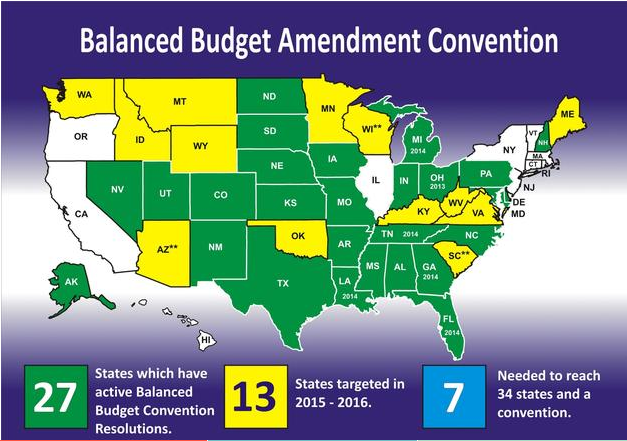
  • Application by 34 states requires Congress to call a Constitutional Convention to propose an amendment. At the end of 2009, 16 states had so applied. Each year since one or more new states have also applied and now there are a total of 27. An additional 13 states are actively considering applications for a BBA at the present time.
  • As the number of applying states gets close to the required 34, it becomes more and more likely that Congress will act on its own in order to preempt a “Con-Con.” This would avoid the messiness and uncertainties of such a convention, none of which have yet occurred in our nation’s history.
  • Once 34 states have applied, however, Congress must call a convention. Any fear of a runaway convention, exceeding a limited mission, should be alleviated by the fact that any proposed amendment(s) have to be ratified by 38 states.
  • In my opinion a proposed amendment should have no restrictions on how a balanced budget will be obtained. There will be far more political pressure to cut spending than to raise taxes. Let Congress hash out the proportion of each.

Fiscal responsibility does not require the budget to be exactly balanced each year. In fact, temporary deficits can be useful as a stimulus in time of recession.  However, deficit spending has gotten so far out of control in recent years that Congress must be forced to modify its behavior.

Follow me on Twitter: https://twitter.com/jack_heidel
Follow me on Facebook: https://www.facebook.com/jack.heidel.3
We Need a Balanced Budget Amendment to the Constitution!


“The Congress, … , on the application of the legislatures of two thirds of the several states, shall call a convention for proposing amendments, which shall be valid to all intents and purposes, as part of this Constitution, when ratified by the legislatures of three fourths of the several states, or by conventions in three fourths thereof  …”
Article V, The U.S. Constitution

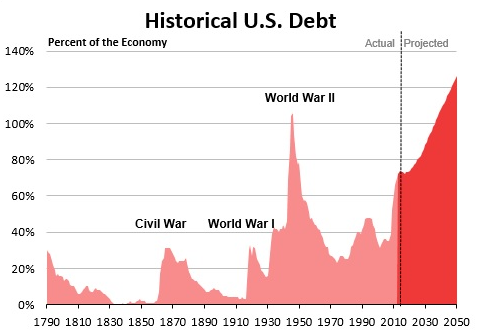
As I pointed out in my last post, under the current 2016 federal budget, just adopted by Congress and signed by the President, our public debt (on which we pay interest) is now projected by the Congressional Budget Office to increase from 74% of GDP today to 175% of GDP in 2040, just 25 years from now.
Of course, a new, and more severe, financial crisis is likely to occur long before we hit such a high level of debt but this serves to emphasize the extreme seriousness of our present situation and the need to address it without delay.
The best and simplest way to do this is for Congress to act on its own accord to pass balanced budgets.  In fact, the current Congress passed a multi-year budget plan last Spring which leads to a balanced budget in ten years, by 2025.  But the budget just passed last week for 2016 totally ignores this plan and actually increases the deficit for 2016 by $158 billion.
In other words, Congress on its own accord appears incapable of acting in a fiscally responsible manner.
Capture0As shown above, our founding fathers foresaw the possibility of congressional stalemate and provided for an alternative route to force Congress to act on critical issues.  As reported by the Balanced Budget Amendment Taskforce, 27 states have already called for a Constitutional Convention out of the 34 needed to force congressional action.
In my next post I will discuss in detail the ramifications of holding a constitutional convention, pro and con.
Merry Christmas!

Follow me on Twitter: https://twitter.com/jack_heidel
Follow me on Facebook: https://www.facebook.com/jack.heidel.3

Fix It Now: the Political Philosophy of Chip Maxwell


I have just recently come across the book, “Fix It Now: Rediscover the Constitution and Get America Out of Its Fiscal Death Spiral” by Chip Maxwell, a candidate for Congress in Nebraska’s Second District May 2016 Republican Primary.
Chip lays out his political philosophy very clearly.  It is to:

  • Adopt a Balanced Budget Amendment to the U.S. Constitution, phased-in over ten years.
  • Phase out Social Security and Medicare for those under age 55.
  • Dismantle over the next decade the rest of the federal welfare/entitlement system.
  • Provide social services at the state or local level.
  • Launch a national effort to build a majority in Congress of crusaders for limited government.
    Capture1There are some attractive features to Chip’s program but overall I think it is too radical to have much chance at implementation.
    I am very much in favor of a balanced budget amendment and a ten year phase-in period is quite reasonable. Furthermore, providing social services at the state and local level would be much more efficient than what we are currently doing and, even with federal support, would be a big help in balancing the budget.
    Social Security and Medicare are lifelines for tens of millions of people. We can and should strengthen these programs in order to make them more financially viable for future retirees. They are now part of our national fabric and are here to stay.
    Chip’s last principle, promoting limited government, has much appeal but I think is not practical in this day and age. From my perspective, simply passing a Balanced Budget Amendment is sufficient to do what is needed. A BBA will force Congress to set spending priorities and eliminate inferior programs.
    Chip Maxwell is to be commended in running for Congress. If elected, he would move the needle in the right direction, even though some of his ideas wont work.

Learning By Doing III. Limiting the Influence of Lobbyists


The eclectic entrepreneur/economist/law professor, James Bessen, suggests how to boost our stagnant economy in a new book, “Learning by Doing: the real connection between innovation, wages and wealth.” The idea is to make fuller use of new technology by putting more emphasis on practical vocational training, ending government favoritism for established businesses, and by removing regulatory roadblocks to job mobility and entrepreneurship.  He also thinks that the greatest hindrance to progress on these fronts is the influence of lobbyists and, more generally, “the growing role of money in politics.”
CaptureHow do we limit the ability of lobbyists, with their huge financial resources, to slow down the opening up of new technology to the broadest possible group of participants?  Some people would say this can only be done by curtailing the use of money in politics.  But this is virtually impossible.  Spending money to get your message out is really just a form of speech and the First Amendment to the Constitution says that “Congress shall make no law abridging the freedom of speech.”
Rather than trying to restrict the ways in which lobbyists can spend their money, we could alternatively try to immunize our elected representatives from its effect, in one or both of these two different ways:

  • Pass a Balanced Budget Amendment to the Constitution. Such an amendment would likely create the discipline needed for Congress to be able to set priorities and decide what is more or less important with regard to the overall economy. Spending programs, tax revenue, and the effects of regulation would all have to be considered together to maximize economic efficiency. Lobbyists would have far less power to push one particular program independently of how it relates to everything else.
  • Term Limits for national office. Knowing that one’s time in office is limited would help provide the strength to make the difficult tradeoffs necessary for good legislation and make officeholders more immune to special interest influence.

Conclusion:  Rather than making a likely futile attempt to reduce the amount of money in the political process, change the process sufficiently so that money doesn’t have as much influence!

We Agree There Is a Huge Debt Problem! How Do We Fix It?


Yesterday I gave my second “Fix the Debt” presentation, this time to the Greater Omaha Kiwanis Club.  The main slide (just below)
Captureis all they needed to appreciate the magnitude of the problem.  Their main interest was “How do we fix it?”  They listened politely to a bipartisan list of possible actions:

  • Policies that grow the economy
  • Health care cost containment
  • Social security reform
  • Defense spending cuts
  • Other spending cuts
  • Tax reform and tax expenditure cuts
  • Budget process reform

Then one member asked, “How about a balanced budget amendment?” and this became the focus of the discussion. A balanced budget amendment going forward would not pay off the debt but would stop adding to it.  It would shrink the debt over time as a percentage of GDP as the economy continues to grow.  This is the best we can do in a practical sense and represents a satisfactory solution. There are lots of problems, however, associated with passing a Balanced Budget Amendment:

  • First of all, it will be difficult to accomplish. It requires approval by a 2/3 vote of each house of Congress and ratification by ¾ of the states. This means that it could be stopped by just 13 state legislatures.
  • How would a BBA be enforced? By having the Supreme Court step in and require specific actions to raise taxes or cut spending? This seems problematic.
  • There would have to be a provision for override in the case of emergency (war or other catastrophe). A 2/3 vote by each house of Congress would be a logical way to handle a situation like this. But such a system could easily be abused.

The goal is to significantly shrink the debt as a percentage of GDP over time as the economy grows.  This does not require a balanced budget but only that annual deficits be lower on average than annual growth of the economy.  Representative Paul Ryan’s “Roadmap” plan, for example, would shrink the debt by 30% over a 20 year period without a single annual balanced budget. The important thing is to shrink the debt as a percentage of the economy, and to get going on this as soon as possible.  If it requires a somewhat rigid amendment to get this done, then that’s what we need to do!

How to Control Federal Spending II. A General Approach


“Life’s tragedy is that we get old too soon and wise too late”

Benjamin Franklin, 1706 – 1790

CaptureThe above chart from the  Congressional Budget Office’s latest budget forecast “Updated Budget Projections: 2014 to 2024” shows very clearly how the public debt (on which we pay interest) has climbed dramatically in the last six years, as a percentage of GDP, and is projected to keep on growing indefinitely.  As the economy improves and interest rates return to normal levels, interest payments on the debt will skyrocket and become a permanent drag on future growth.
In a recent post “How to Control Federal Spending: The Highway Trust Fund” I pointed out that thanks to the Budget Sequester Act from 2011, it is unlikely that the $35 billion Highway Trust Fund, supported by an 18.2 cent per gallon federal gasoline tax, will be supplemented by general government revenue, paid for by increasing the deficit. In other words, discretionary spending is under control at the present time due to the ten year sequester limits.
But this makes up less than 1/3 of the federal budget, the rest being “mandatory” entitlement spending, for such programs as Social Security, Medicare and Medicaid.  This is where the huge projected future growth in overall federal spending comes from and therefore where we need to focus on budget control.  The huge challenge is that the number of Americans who are retired, now about 50 million, is growing rapidly.  Furthermore, older citizens vote in greater proportion than any other age group and don’t want their benefits to be cut. Elected representatives need help to resist the pressure from senior citizens for greater benefits.  Here are two possible ways to provide this help:

  • A Balanced Budget Amendment to the U.S. Constitution. It would have to be flexible enough to allow overrides for emergencies by a supermajority vote, but otherwise it would force Congress to either cut spending or else raise taxes to bring in more revenue. The tradeoff between these two alternatives would create the discipline to make the hard choices required.
  • Term Limits for national office. I would choose 12 year limits for both the Senate and the House of Representatives but other choices are possible. Knowing that one’s time in office is limited will help provide the strength to make the difficult decisions to either cut spending or raise tax revenue. New members of Congress are more independent thinking than the careerists whose main goal is to get reelected.

Either of these two possible changes in the rules would help turn things around.  We need to do something before we have another financial crisis much worse than the last one!

The Long Run and the Short Run


“I agree with you that something must be done now. The trick is what will work the best in the short term to trigger the agreement between the fiscal conservatives and the modern liberals to cut costs and balance the budget that we both agree on. We can agree to disagree on the solution details but I hope you are successful in achieving the short term goals you are working tirelessly on.
Just as big a question is what will work the best in the long run to prevent it from happening again. I will continue to work on changing the intellectual environment that I see as a precondition to solidifying your short-term gains and preventing a re-occurrence.”
Capture
These are the words of my Omaha libertarian friend, David Demarest, with whom I have an ongoing dialogue.  He wants to cut back and limit the scope of government.  I’m willing to have a more expansive government as long as we’re willing to pay for it.
The secret to solving many of our current problems (stagnant economy, high unemployment, massive debt, increasing inequality) is to grow our economy faster.  The best way to accomplish this is by boosting investment and entrepreneurship with broad-based tax reform, by lowering tax rates for both individuals and corporations, paid for by eliminating deductions and closing loopholes.
But some people think that lowering tax rates means lower taxes on the rich.  To counteract this perception, and at the same time to raise additional tax revenue to lower the deficit, I propose to  levy a new wealth tax of 1% of assets with an exemption of $10 million per person to make sure that the tax only applies to the “truly wealthy.”
I believe that a program along these lines is the best way to get our economy back on track.  But, at the same time we need to figure out how to avoid falling back into another slow growth, high debt trap anytime soon.
A good way to achieve long run protection is with a balanced budget amendment.  It would need to be flexible, allowing for emergencies, and also phased in over several years to allow citizens and legislators time to make the necessary adjustments to spending and taxes.

One Way to Solve the National Debt Problem

In today’s New York Times, the economists Glenn Hubbard and Tim Kane write that “Republicans and Democrats Both Miscalculated”.  They say that “when the Congressional Budget Office recently lowered its forecast of future deficits, many voices on the left claimed that the problem had been overblown by ‘austerity scaremongers’” and that “some voices on the right have renewed calls to ‘starve the beast’ now that deficits are under control.”  But they point out that just because the deficit is likely to shrink for the next couple of years, CBO also projects that it will soon be back up to a trillion dollars per year indefinitely into the future.  And this is all optimistically assuming full employment, robust growth and moderate interest rates.
The Hubbard/Kane solution is to amend the Constitution with a flexible Balanced Budget Amendment.  Its features would include: 1) a provision that spending in a given year would not exceed income averaged over the previous seven years, 2) no restriction on tax rates which would have to be hashed out by Congress and 3) an exception to spending restraint for national emergencies.
There are, of course, valid objections to a Balanced Budget Amendment to the Constitution.  It reduces the flexibility of Congress and the President to act as needed.  It would be much better for Congress to act in a fiscally responsible manner on its own initiative.  But we all know that this doesn’t happen.  The pressure is always to adopt new spending programs and never to cut existing programs, no matter how ineffective they are.
Debt is the “single biggest threat to our national security” declared Admiral Mike Mullen, the former Chairman of the Joint Chiefs of Staff.  Many other prominent citizens express similar thoughts on a regular basis.  It is really just basic common sense that no governmental unit can flagrantly ignore this fundamental economic principle year after year without very serious repercussions.  It is (well past) time to force our national leaders to bite the bullet and do what almost every sane person knows what must be done.

Is America in Decline?

A new book by the two economists Glenn Hubbard and Tim Kane “Balance: The Economics of Great Powers from Ancient Rome to Modern America” analyzes the decline of many of the great empires and civilizations in human history.  According to the authors, they all declined (or are now declining!) primarily for internal economic reasons rather than from external military threat.  The authors conclude that America’s own existential threat is fiscal.  Our lowest debt level in recent years was 23.9% of GDP in 1974 ($344 billion) which has climbed to 75% of GDP today ($12 trillion) and is predicted to keep growing worse in the years to come.
Our political system is too polarized to solve our huge debt problem.  Republicans want lower taxes; Democrats want higher spending.  If Republicans succeed in cutting spending, it upsets the voters and gives the Democrats an advantage.  If Democrats succeed in raising taxes, it upsets the voters and gives the Republicans an advantage.  So we end up with low taxes, high spending, fiscal imbalance and political stalemate.  This is the dilemma we are in.
But the authors propose a solution: a flexible balanced budget constitutional amendment where total outlays for a year do not exceed the median annual revenue collected in the seven prior years.  A three-fifths supermajority of each house of Congress can declare a one-year emergency exemption.  Additional one-year exemptions may be approved only by escalating votes in each house of Congress.  The amendment would take effect in the seventh year following ratification by the states.  During the seven year transition period the deficit would be reduced gradually each year until it reached zero.
Messrs Hubbard and Kane provide an excellent, nonpartisan analysis of the deep predicament in which our country now finds itself as well as an attractive means of extricating ourselves from this precarious situation.