
The Grand New Party


With the presidential election tightening and Hillary Clinton still the favorite to win, more and more attention is being devoted to trying to figure out what will happen to the GOP after Donald Trump. William Galston from the Brookings Institute sees a three-headed Republican party:

  • Wall Street i.e. establishment (fiscal) conservatives.
  • Main Street i.e. small government conservatives who think that government is the main obstacle to growth.
  • Populists i.e. non-ideological working class people who feel left behind by the modern world.

The Wall Street Journal is analyzing the Trump phenomenon with a series of articles, “The Great Unraveling” based on an underperforming U.S. economy:

  • Technology has not led to broadly shared prosperity.
  • The Federal Reserve did not foresee the financial crisis and hasn’t delivered adequate growth.
  • Trade with China has put millions of Americans out of work.

Today’s WSJ, “Republicans Rode Waves of Populism until They Crashed the Party,”  describes the transformation of the Republican party all the way from Richard Nixon’s southern strategy, Pat Buchanan’s anti-immigration appeal in 1992, the Tea Party uprising in 2009 and 2010 until today’s populist rebellion against the establishment.

capture76The map above shows the huge political realignment which has taken shape between 1996 and 2012 and is undoubtedly even more pronounced in 2016. The main question for me is whether and to what extent the three main Republican factions can come together on important policy issues such as immigration and trade:

  • Immigration. In the last debate Mr. Trump said that after the border is secured, and the “bad guys” are deported, then we’ll figure out what to do with the rest of the undocumented immigrants. This suggests a workable approach to the illegal immigration problem.
  • Trade. The challenge is to figure out how to make the proposed Trans Pacific Partnership trade agreement compatible with the interests of working Americans.

Conclusion. Regardless of the outcome of the November 8th election, Donald Trump has had a huge effect on American politics.  Whichever party is most successful in appealing to the core working-class Trump voters will have a huge advantage in the 2020 elections.

Follow me on Twitter
Follow me on Facebook


The Three-Headed Republican Party


One of my favorite political and economic writers is the Brookings Institute’s William Galston who writes a regular weekly column in the Wall Street Journal.   Most recently his article, “The Three-Headed GOP After Trump, “ is particularly lucid.

capture75
Mr. Galston sees three factions in today’s Republican party:

  • Establishment conservatives who favor free trade, immigration reform, are broadly internationalist, believe in climate change, want corporate and individual tax reform, and also support entitlement reform. They would accept tax increases as part of a “grand bargain” to address our debt problem.
  • Small government conservatives ala House Speaker Paul Ryan and his “A Better Way” plan for American renewal. They believe that government is the principal obstacle to growth, especially with excessive regulation. They want major tax cuts and reductions in domestic spending as well as structural changes in Medicare and Medicaid. They are more nationalist than internationalist in outlook and oppose corporate welfare such as the Export-Import Bank.
  • Populist conservatives ala Donald Trump, many of them working class. They distrust all large institutions but do not have an ideological preference for small government. They strongly support Social Security, Medicare and Disability Insurance. They view the world outside the U.S. as more of a threat than an opportunity, and therefore oppose trade agreements and large scale immigration. “America First” is their demand.

Can these three groups coalesce into a single working majority? As I see it, Mr. Trump might have been able to accomplish this but has fallen short because he is such a sleazy individual.  Mr. Galston thinks that, after Trump, the second and third groups will be able to come together but only without the first group. I see the challenge as the traditional Republican Party, consisting of the first two groups, figuring out how to join forces with the third group.
Conclusion. A prosperous and secure future for our country depends on having a strong and viable (fiscally) conservative party.  How will this be achieved?

Follow me on Twitter
Follow me on Facebook

Donald Trump Should Withdraw from the Presidential Race


Like many other fiscal conservatives I have been overlooking Donald Trump’s moral failings in hopes of electing a president who would be able to disrupt our current economic stagnation and move the U.S. towards faster growth which is the only way to achieve broad-based prosperity.
capture72But at some point we all have to say that enough is enough and the appearance last week of the video with lewd remarks about women is the tipping point for me.  Even though I can no longer support or vote for Mr. Trump, I would like to summarize where I agree (and disagree!) with him on various issues. In decreasing order of importance:

  • Massive Debt. Mr. Trump at least talks about our almost $20 trillion national debt (and large annual deficits) even though he has made no proposals to deal with this problem. Mrs. Clinton has shown even less interest in this issue.
  • Tax Reform. Mr. Trump wants to lower tax rates for both individuals and corporations in order to stimulate economic growth. This is a very good idea as long as the tax rate cuts are made revenue neutral by closing loopholes and shrinking deductions. The Republican House has an excellent plan, “A Better Way” to accomplish just this. Hillary Clinton talks far more about economic inequality than about growth.
  • Regulatory Reform. Mr. Trump specifically mentions both the ACA and Dodd/Frank as being harmful to economic growth whereas Mrs. Clinton defends them.
  • Trans-Pacific Partnership trade deal. Mr. Trump opposes both TPP and NAFTA. Fair trade deals create more jobs than they destroy. Furthermore they produce lower priced products for everyone which boosts the economy. Wage insurance and better retraining programs will help those who lose their jobs due to foreign competition.
  • Immigration Reform. We need to solve our illegal immigration problem and Mr. Trump would probably be able to accomplish this, one way or another.

Conclusion. At this point it is pretty clear that Mrs. Clinton will be our next president. If the Republicans retain control of the House of Representatives, and she is willing to work with them, there is at least a chance to make progress on the growth issue.

Follow me on Twitter
Follow me on Facebook

The Obama Economic Record


The readers of this blog know that I focus on what I consider to be the two biggest problems affecting our economy: 1) slow growth averaging just 2% per year since the end of the Great Recession and 2) our massive debt now equal to 75% of GDP (for the public part on which we pay interest) and predicted to keep growing steadily under current policy.
I have also made it clear that I am not pleased with the economic policies of either of the two main candidates for president, Hillary Clinton or Donald Trump.  Whichever one of them is elected, our best hope for the future is that she or he will have to work with the Republican House of Representatives which has an excellent plan, “A Better Way,”  for renewal.
capture71But, of course, the next president will take up where Barack Obama has left off.  The current issue of the Economist has an essay, “The Way Ahead,” in which Mr. Obama identifies several challenges:

  • Boosting productivity growth. The above chart from his essay shows how much productivity growth has declined in the last ten years. He claims that the corresponding lack of investment is caused by an anti-tax ideology which rejects new funding for public projects, which in turn can be blamed on a fixation on deficits in spite of our skyrocketing debt problem. The House plan correctly identifies tax and regulatory reform as what are needed for progress.
  • Combatting rising inequality. An expanded Earned Income Tax Credit will definitely help here but mainly what is needed is overall faster economic growth.
  • Insuring that everyone who wants a job can get one. Wage insurance and better retraining programs for laid off workers are good ideas. But again, faster economic growth is what is really needed.
  • Building a resilient economy which is primed for future growth. Mr. Obama says that “America should also do more to prepare for future shocks before they occur.” This is exactly why we urgently need to start shrinking our debt now before the shock of higher interest rates leads to huge increases in interest payments on our rapidly growing debt.

Conclusion. Let’s give Mr. Obama credit for avoiding another depression after the Financial Crisis. But his poor policies are to blame for the very slow rate of recovery ever since.

Follow me on Twitter
Follow me on Facebook
 

Fiscal Irresponsibility: Our Country’s Most Fundamental Problem


As a fiscal conservative, I am worried about our nation’s future. The public debt (on which we pay interest) is now 75% of GDP, the highest level since right after WWII, and growing steadily.  Furthermore, our economy has just barely recovered from the Great Recession and is expanding too slowly to revive widespread prosperity.  Neither of the two main presidential candidates, Hillary Clinton nor Donald Trump, is talking seriously about our huge debt and neither has a credible plan to boost economic growth.

capture70
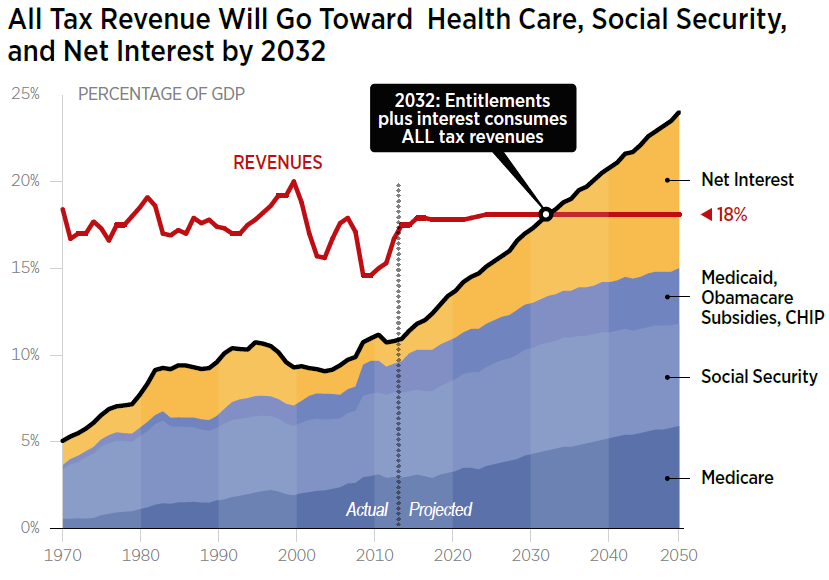
The above chart from the Heritage Foundation is a vivid way of illustrating this problem:

  • Already entitlement spending (Social Security, Medicare and Medicaid), and interest payments on our debt, use up 2/3 of all federal tax revenue. And spending on each of these entitlement programs is growing faster than the economy as a whole. Interest rates will eventually rise from their current rock bottom level. When this happens, interest payments on our growing debt will increase rapidly.
  • In 2032, just 16 years from now, spending on entitlements and interest payments is projected to consume all federal tax revenues, assuming a steady 18% of GDP level for tax revenue.

There are three possible ways to offset this bleak picture:

  • Speed up economic growth. This should, of course, be possible but it will take a major shift in thinking to accomplish.
  • Increase federal tax revenue. Suppose that federal tax revenues were raised by 1% of GDP, or $180 billion per year. This would at least temporarily put our debt on a downward path (as a percentage of GDP). But it would be very hard to accomplish politically. Mrs. Clinton, for example, has proposed raising taxes by $100 billion per year which she wants to spend entirely on new programs rather than reducing our annual deficits.
  • Reform entitlement programs. This is by far the best way to address our debt problem, and the only effective way in the long run.  But, again, it will be very hard to accomplish politically.

Conclusion. If the U.S. cannot get its debt and slow growth problems under control, it risks losing its status as the world’s major superpower. This would be a calamity for both our own national security and the peace and stability of the entire world.

Follow me on Twitter
Follow me on Facebook
What Should A Fiscal Conservative Do?

From a reader of my blog:

“I personally believe Mr. Trump is grossly unfit to serve as President and if elected, it would be more than a huge problem. Since he lies or changes his mind on most everything, I worry when you say anything such as your comment that he won the debate. He is for the second amendment, he favors tax cuts, etc and there is nothing that sheds light on whether he even understands the complexity of these issues, let alone has any notion of how to create and implement a policy to accomplish these things. I believe many people are making comments that have the effect of normalizing his behavior and candidacy.”

I began writing this blog, It Does Not Add Up, almost four years ago, right after the presidential election of 2012.  By now I have written over 500 posts, mostly on fiscal and economic issues but occasionally branching out into important social issues as well.
As I see it, I have four choices when I vote for president this year.  I can:

  • Vote for Hillary Clinton. She is safe and predictable but the policies she promotes will do very little, if anything, for the faster economic growth which we so badly need. She wants to raise taxes on the wealthy. Fine, but this is only in order to increase spending for new programs, which is likely to lead to even bigger annual deficits and more accumulated debt.
  • Vote for Donald Trump. Like so many others, I assumed initially that his candidacy was a joke and that he would quickly fade away. But now he is a major party nominee and has some good policy ideas as well as some very bad ones! As president he would be constrained by Congress. In particular the Republican House has many excellent ideas on how to get our economy back on track.

    capture66

  • Vote for Gary Johnson. The Libertarian candidate also has good ideas on how to solve our fiscal and economic problems but has essentially no chance of being elected.
  • Refrain from voting for president.  But voting is a citizen’s first duty. 

    Conclusion. I fully agree that Donald Trump is a very risky bet for president. But the alternative is to elect Hillary Clinton and hope for a better choice in four years. What should I do? 

Follow me on Twitter
Follow me on Facebook

Why Slow Economic Growth Is So Dangerous


In my last post I said that Donald Trump won the first presidential debate, in spite of his uneven temperament, because he was more correct on the issues.
One of the biggest problems our country faces is slow economic growth, averaging only 2% per year since the end of the Great Recession in June 2009.  This compares with an average rate of growth of 3.5% from 1950 – 2000.
In fact, even the recent job growth we have seen is now leveling off.
capture65Such slow growth is very dangerous long term for many reasons:

  • Massive Debt. Our public debt, on which we pay interest, is now 75% of GDP, the highest it has been since right after WWII. CBO predicts that this percentage will keep getting steadily worse without major policy changes. Faster growth means more tax revenue and therefore smaller annual deficits. It is imperative to put our accumulating debt on a downward path.
  • The Need for More Jobs and Better Paying Jobs. The best way to achieve broad based prosperity, and minimize populist disruption, is to create a tight job market where employers have to compete for employees. This is accomplished by making the economy grow faster.
  • Keeping Ahead of China. In 2009 China’s economy was 1/3 the size of ours; now it is 60% as big. In other words, China will soon surpass us economically if we are unable to grow faster. This would risk losing our worldwide lead in such crucial areas as new technology and financial depth, as well as our superpower status.
  • Reducing Student Loan Debt. The best way we can help former students pay off their college debt is to have good jobs waiting for them when they leave school. The faster our economic growth, the better we can do this.

Conclusion. Both our own individual success in life as well as the overall status of our nation depends upon the availability of opportunity. This is why economic growth is so important and why it is dangerous to let it lag.

Follow me on Twitter
Follow me on Facebook
Who Won the First Presidential Debate?


I want to be as clear as possible that I have not yet endorsed either Hillary Clinton or Donald Trump for President and I am not doing so now. Each of them has strengths and weaknesses which I am still weighing:

  • Mrs. Clinton has extensive experience and a steady temperament but her policy prescriptions are unlikely to lead to the faster economic growth needed to boost prosperity.

    capture64

  • Mr. Trump lacks government experience and has a volatile temperament.   However many of his policy proposals make very good sense.

Pre-debate expectations were very low for Mr. Trump, based on his assumed lack of familiarity with many important issues. Nevertheless he showed that he does have a solid understanding of both national and international affairs.  On the three general debate topics:

  • Achieving Prosperity. Mr. Trump was very clear in stating what needs to be done to create more jobs and better paying jobs. He advocates individual tax reform to stimulate more business investment as well as corporate tax reform to encourage multinational companies to bring their foreign earnings back home for reinvestment.
  • America’s Direction. Mr. Trump made several references to our massive national debt of $20 trillion even though he didn’t say what he’ll do about it. He also stated very strongly that he is opposed to the Trans-Pacific Partnership and the North American Free Trade Agreement as well. Let’s hope that Mr. Trump’s bluster is just a ploy to improve his bargaining position with other countries.  Otherwise he could set off a major new recession.
  • Securing America. Mr. Trump is very clear on the need to destroy ISIS and to do so as quickly as possible. He believes that our 27 NATO allies should be contributing more towards our mutual defense. He also supports “stop and frisk” police policy as the best way to cut down on crime and violence in our inner cities.

Conclusion. Mr. Trump’s clearly stated views on these major national issues in last night’s debate were very impressive. By establishing so well his qualifications to be president, he won the debate.

Follow me on Twitter 
Follow me on Facebook 
 

Donald Trump Needs a More Positive Message


As regular readers of my blog posts know, I am not enthusiastic about either of our two main presidential candidates because neither of them has a good grasp of our two biggest economic problems which are:

  • Slow economic growth, averaging just 2% per year since the end of the Great Recession in June 2009. Faster growth would solve or alleviate many other problems, especially by creating more new jobs as well as delivering faster wage growth for all middle- and lower-income workers.
  • Massive debt now at 75% of GDP, the highest it has been since right after WWII, and projected by the Congressional Budget Office to get steadily worse unless big changes are made in spending and tax policies. Such major changes are difficult to make without presidential leadership.

Hillary Clinton promises “equitable” growth but her policy proposals will lead to a big increase in spending (bad idea) on projects of dubious value in speeding up economic growth. Donald Trump would hurt the economy with immigration controls and trade restrictions.  His proposal for lower tax rates (good idea) needs much improvement to avoid increasing annual deficits.
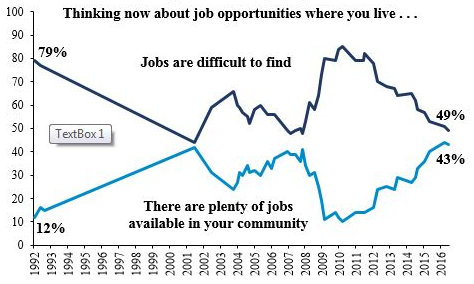
capture40Mr. Trump’s biggest problem, however, is his negative message about life in America today. Yes, we need stronger border security but we don’t need a Fortress America.  As the American Enterprise Institute has just reported, worker satisfaction is greatly improved since 2009 and workers are now much less anxious about job security than just a few years ago.
There is a really good way for Mr. Trump to sound a more positive note.  He could very easily take up the major themes of the Republican House Plan, “A Better Way” for solving America’s major economic problems.
Conclusion. There is an overwhelming desire for change in America, for new leadership which breaks out of the corruption, cronyism and elitism so rampant in Washington DC today.  But Americans are natural optimists and want a leader who can look forward to a bright future for our country.

Follow me on Twitter
Follow me on Facebook
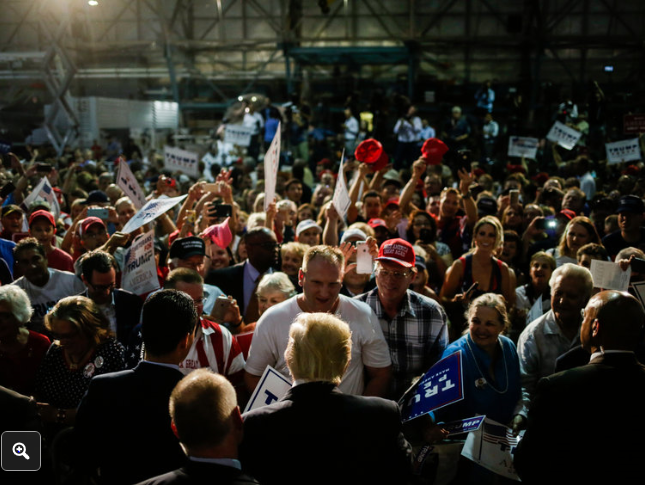
The Republican Party beyond Donald Trump


My last several posts have discussed the strengths and weaknesses of the U.S. economy and where the presidential candidates stand on the main issues.  As Donald Trump now slides further and further behind in the polls due to his juvenile tit-for-tat personality, his personal views matter less and less.
Capture31What does matter now is how the Republican Party will use the Trump disruption to broaden its appeal in the future. Here is a restatement of several of my ideas, influenced by two recent articles in the New York Times, here and here:

  • Reject tax cuts for the wealthy. But rather support tax rate cuts across the board, paid for by shrinking deductions which primarily benefit the wealthy. Such tax reform will give a sorely needed big boost to the economy.
  • Help workers displaced by foreign trade with expanded retraining programs and wage insurance. Increased globalization will also boost economic growth but it will stall without greater public support.
  • Acknowledge that universal health care is here to stay but push for market-oriented changes such as eliminating the mandates required by the ACA.
  • Disavow mass deportations but set up a firm border security program along with an adequate guest worker program to provide businesses the workers whom they are unable to hire locally. Again, legitimate immigration reform will boost the economy.
  • Admit that Invading Iraq was a mistake but nevertheless insist on a muscular foreign policy. U.S. economic and military strength provide peace and stability for the whole world including us.
  • Loosen up on social policy. Insist on restrictions on abortion (e.g. a 20 week cutoff) rather than abolition and work requirements for social welfare recipients rather than cutbacks in aid. In general turn over more social policy regulation to the individual states.

Conclusion. The U.S. badly needs more fiscally conservative national leaders. But conservatives will not prevail in the political process without using more common sense.

Follow me on Twitter
Follow me on Facebook