Amazing! Some Progressives May Actually Understand Economics


I have to constantly remind my readers that I am a non-ideological fiscal conservative. I simply want our national leaders to address our two most serious fiscal and economic problems which are:

  • Massive Debt. Our (public, on which we pay interest) debt is now 75% of GDP, the largest since WWII and steadily getting worse. When interest rates go up, as they surely will before long, interest payments on the debt will increase by hundreds of billions of dollars per year and become a huge drain on the federal budget, eventually leading to a new financial crisis, much worse than the last one.
  • Slow Economic Growth. The economy has grown at the average rate of only 2.1% since the end of the Great Recession in June 2009. Such slow growth means fewer new jobs for the unemployed and underemployed and smaller raises for all workers.

My last several posts, here and here have pointed out that neither of our two main presidential candidates is adequately addressing these issues.  Both of them claim that they want faster growth but their policy proposals will just make our humongous debt even worse.
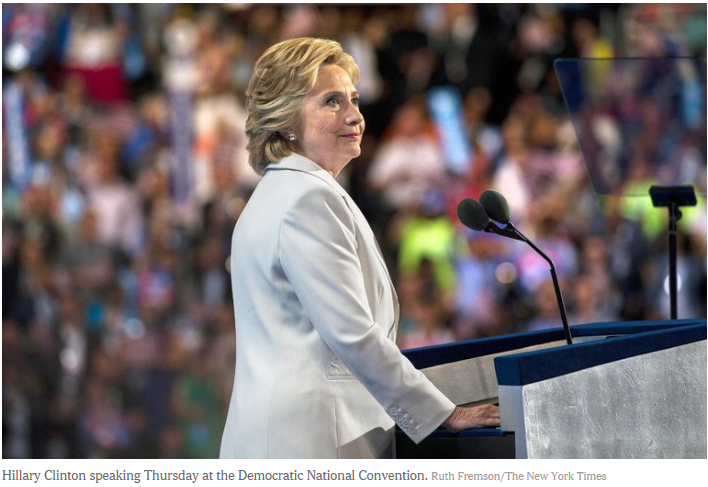
Capture31So I was quite surprised by a column in yesterday’s New York Times by Thomas Friedman, “How Clinton could knock Trump out,” trying to “push Clinton to inject some capitalism into her economic plan.”  Says Mr. Friedman:

  • Clinton could be reaching out to center-right (and anti-Trump) Republicans with a real pro-growth, start-up, deregulation, entrepreneurship agenda.
  • If Clinton wins, she will need to get stuff done, not just give stuff away.
  • The concerns of the Sanders supporters with fairness and inequality can only be addressed with economic growth; the rising anti-immigration sentiments can be defused only with economic growth; the general anxiety feeding Trumpism can be eased only with economic growth.

Conclusion. I am pleased to hear such sensible thoughts from one of the leading columnists of the NYT. If Clinton wins the election (as I expect) and if the Republicans continue to hold the House of Representatives (as I fervently hope), there could be much common ground for constructing an intelligent agenda going forward.

Follow me on Twitter 
Follow me on Facebook

The Presidential Candidates Are Clueless on the Economy


My last several posts, here and here, have discussed the economic plans of both Hillary Clinton and Donald Trump.  In short,

  • Ms. Clinton wants “equitable” growth meaning huge new public spending on such things as infrastructure, free public college tuition universal pre-K education as well as increasing the minimum wage to $15 per hour nationally and mandating paid family leave. More public spending and new mandates will provide only minimal economic growth.
  • Mr. Trump wants to restrict the labor force with immigration controls and raise the price of imports with new tariffs. He would also cut tax rates across the board (good idea) but in such a way that would increase the national debt by $10 trillion over the next ten years (very bad idea).

They both need to take our actual current economic situation into account as follows:

  • The U.S. is in its weakest recovery since post WWII. The average growth rate of 2.2% for 2012 – 2015 has now stalled in the past year to just barely 1%.

    Capture25

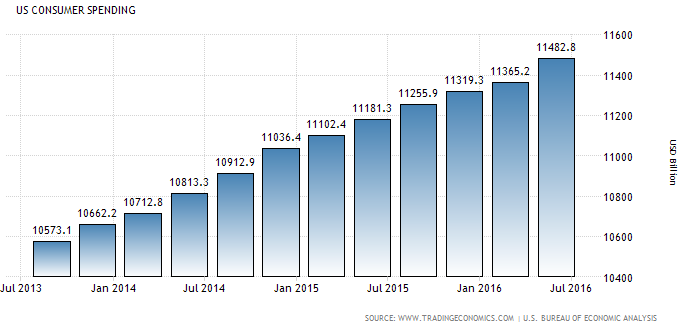
  • Consumer spending has been increasing steadily and rose 4.2% in the second quarter of 2016. In other words, consumer demand is at a high level.

    Capture26

  • The problem is that business investment, i.e. supply, has decreased.

    Capture24

The House Republicans have “a better way.” Their tax reform plan, among many other good features, would

  • Lower the top corporate tax rate from 35% to 20% and establish a territorial system, to encourage multinational corporations to produce in the U.S. as well as bringing their foreign earnings back home for reinvestment.
  • Provide a tax-free return on new investment by allowing, for the first time ever, for full and immediate write-offs.

Conclusion. The House Republicans have a sensible plan for getting our country back on a much faster economic growth track. Regardless of who is elected president, the House is likely to stay under Republican control.  I am waiting to see if either of the presidential candidates will figure this out and adjust their campaign messages accordingly.

Follow me on Twitter
Follow me on Facebook
 

The Clinton Plan for “Equitable” Growth


I have tried to make it clear in my post that I have not endorsed either of the two main presidential candidates.  In fact I am waiting to see a credible plan for simultaneously spurring economic growth and getting our very large and growing national debt under much better control.
Capture12Capture13
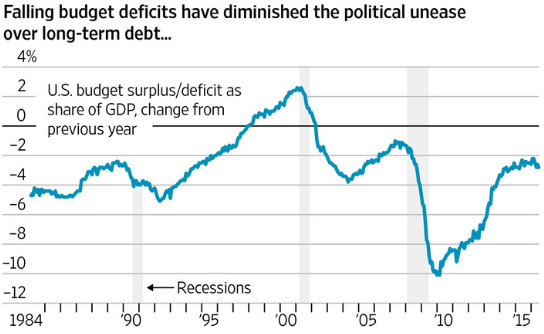
The debt problem is real and cannot be sloughed off as many try to do.  The two charts below show that while annual deficit levels have returned to what may be considered “normal” since 1984, they are still much too high and will lead to a rapidly increasing level of debt even if interest rates remain low which is by no means assured.
In other words, it is not good enough to just make the economy grow faster, it needs to be done in a fiscally responsible way.
I’ve already discussed how the Trump tax plan is unacceptable because it will substantially raise deficits and therefore make the debt much worse.

The same thing is true for the Clinton plan for “equitable” growth, but in a different way.  She wants

  • $250 billion in new spending for infrastructure.
  • Free public college tuition.
  • Universal Pre-K education.

Regardless of their individual attractiveness, it is irresponsible to propose new programs, with new spending, when deficits are already way too high and the debt is steadily climbing.

She also wants to:

  • Raise the national minimum wage to $15 per hour.
  • Mandate paid family leave.

The problem here is that both of these measures will increase unemployment and therefore slow down economic growth. Many states and cities are raising the minimum wage on their own and this way is preferable because it is locally determined.  Paid family leave should be left up to individual employers to use as an incentive to attract and retain good employees.

Conclusion. Hillary Clinton does want to make the economy grow faster which is highly desirable.  But she would do it with new federal spending and new mandates.  The new mandates will actually slow growth.  The new spending programs will add to the debt.  Both approaches are counterproductive.

Follow me on Twitter
Follow me on Facebook

Donald Trump’s Best Chance to Win in November


As I occasionally remind my readers, I am a non-ideological fiscal conservative and a registered independent. In November I will vote for the presidential candidate who has the most credible plan to address what I consider to be our country’s two more serious problems:

  • Slow Economic Growth, only 2.1% per year for the past seven years since the end of the Great Recession in June 2009. Faster growth will create more jobs and bigger wage gains for America’s workers.
  • Massive Debt. Our public debt (on which we pay interest) is now 75% of GDP, the highest it has been since the end of WWII, and likely to keep getting worse unless strong measures are taken to prevent this from happening.

According to current polls, Hillary Clinton is strongly predicted to be elected our next president. However her policy proposals will do little, if anything, to stimulate economic growth and are likely to make our debt much worse than it already is.
Capture8Donald Trump has a strong base of support among working class whites who are suffering in today’s economy and blame illegal immigration and unfair foreign trade for their woes.  However this base of support, while large enough for Mr. Trump to win the Republican nomination, is not nearly large enough to bring victory in November. The only way Mr. Trump can win is to greatly expand his base of support by appealing to moderate Republicans and Independents who are highly concerned about the direction our country is taking.
Capture9The best and most direct way for him to do this is to endorse the reform program, “A Better Way,” developed by the Republican House of Representatives, under Speaker Paul Ryan. This reform program has already unified the fractious Republicans in the House, and could easily serve as a vehicle for unifying the entire Republican party as well as many independents.
In my next post I will delineate how the Trump platform could easily mesh with “A Better Way.”

Follow me on Twitter 
Follow me on Facebook
Who is Responsible for the Rise of Donald Trump?


It is generally agreed that Donald Trump’s great success as a presidential candidate is his strong appeal to working class white voters, often described as white voters without a college degree. It is also widely agreed that Mr. Trump is unsuited to be president, based on his unstable temperament as well as a poor understanding of many basic issues.
Capture0As I have described in a previous post, the quality of life for working class white men has been declining for many years. Nevertheless it has gotten even worse since the Great Recession of 2007-2009 and our slow recovery from it.
Steven Rattner, in yesterday’s New York Times, blames the Republican Congress for the rise of Mr. Trump because of Republican opposition to President Obama’s economic agenda as follows:

  • Opposition to the American Jobs Act of 2011 which proposed a $447 billion package of measures including payroll tax cuts and the creation of an infrastructure bank which would have created thousands of construction jobs.
  • Opposition to continuing federal emergency benefits for the large number of long-term unemployed.
  • Apparent opposition to a recent plan for wage insurance. Under this proposal a worker who lost a job and was forced to take a lower wage job which paid less than $50,000 per year, would receive half of the lost wages for two years, up to $10,000.

These aren’t necessarily bad ideas. In fact I think wage insurance is an excellent idea, as long as it is paid for and does not add to deficit spending.  The problem is that these measures do not generally address the basic problem of slow economic growth, averaging just 2.1% of GDP since the end of the recession in June 2009.  Only by speeding up economic growth, with fundamental tax reform, both individual and corporate, can our economy support both the new jobs and higher paying jobs that will create broad-based prosperity in the United States.
It is both detrimental and inaccurate for supporters of President Obama to blame political opposition for the plight of working class Americans.

Follow me on Twitter: https://twitter.com/jack_heidel
Follow me on Facebook: https://www.facebook.com/jack.heidel.3

The Appeal of Donald Trump


Donald Trump is having a huge impact on the 2016 U.S. presidential race and lots of people are trying to understand why. In a previous post I wrote that the Republican Party needs to figure out where all of the Trump supporters are coming from and then try to keep these people under a perhaps larger Republican tent.
Capture1
A very good explanation of the Trump phenomenon comes from the AEI social scientist, Charles Murray, writing in yesterday’s Wall Street Journal. Says Mr. Murray:

  • The long time American Creed of egalitarianism, liberty and individualism is losing its authority and its substance. One of the most widely acknowledged aspects of American exceptionalism is the lack of class consciousness.
  • This lack of class consciousness has now been replaced by the emergence of a new upper class, a new lower class and the plight of the working class caught in between.
  • The new upper class is characterized by its condescension toward ordinary Americans. Mainstream America is fully aware of this condescension and contempt and is irritated by it. It may mean that American egalitarianism is coming to an end.
  • In the 1960s, white working class men in their 30s and 40s were almost all working and almost all married. But, as shown in the chart, these high labor participation and marriage rates have dropped dramatically in the past 50 years.
  • The success of the civil rights and feminist movements, both classic invocations of the American Creed, have led to a large scale ideological defection from the pillars of liberty and individualism. The problem is that affirmative action demands that people be treated as groups. Equality of outcome trumps equality before the law.
  • By the 1980s Democratic elites largely subscribed to an ideology in conflict with liberty and individualism. This produced the Reagan Democrats.
  • During the past half-century, American corporations exported millions of high-paying jobs while the federal government allowed the immigration, legal and illegal, of tens of millions of competitors for the remaining working class jobs.

As Mr. Murray says, “if you are dismayed by Trumpism don’t kid yourself that it will go away if Donald Trump fails to win the Republican nomination. Trumpism is an expression of the legitimate anger that many Americans feel about the course the country has taken.”

Follow me on Twitter: https://twitter.com/jack_heidel
Follow me on Facebook: https://www.facebook.com/jack.heidel.3

Why the GOP Should Reconcile with Donald Trump II. How to Do It.


As I have stated over and over again on this blog, It Does Not Add Up, my greatest concern for our country is the lack of fiscal responsibility amongst our national leaders.  The public debt (on which we pay interest) is $13 trillion, which is 74% of GDP.  This is way too high for peacetime and, furthermore, it is very likely to just keep getting worse until serious steps are taken to shrink it (as a percentage of GDP).
CaptureIt is my opinion that the Republicans are more serious than the Democrats about fixing this problem.  Therefore I want the Republicans to nominate a presidential candidate who has a good chance of being elected in November.  I don’t know if Donald Trump is that candidate but he is attracting a whole new group of people to the Republican cause.  They are working class whites who have fallen away from the Democratic Party.
Republicans can reach these voters, as Trump is doing, with suitable policies such as:

  • Immigration. Rather than “Comprehensive Immigration Reform” which would put most of our current illegal immigrants on a path to citizenship, we should adopt the principle, “All the immigrants we need but only the immigrants we need.”  A tightly constrained Guest Worker program, enforced with border control and eVerify, would accomplish this.
  • Free Trade. Trade agreements are still possible but need to include provisions like Trade Adjustment Assistance or other programs to help retrain laid-off workers for the millions of well paying, high skill jobs in the U.S. which are hard to fill.
  • Tax Policy. Rather than skewing tax cuts mainly for the wealthy, as most of the Republican candidates propose, they should be applied equally to all income levels, and fully paid for by shrinking deductions which mostly benefit the wealthy. This would put more money in the pockets of all middle income workers and create more and better jobs at the same time by speeding up economic growth.

Conclusion. Donald Trump has lots of negatives as a presidential candidate but Republicans can, and hopefully will, learn a lot from his very successful campaign so far.

Follow me on Twitter: https://twitter.com/jack_heidel
Follow me on Facebook: https://www.facebook.com/jack.heidel.3

Why the GOP Should Reconcile with Donald Trump


I am a non-ideological fiscal conservative. I don’t judge government as being either too large or too small.  I just want to pay for however much government we do have without going into debt.  Such an approach normally leads to political compromise whereby Congress tries to operate efficiently and hold costs down, only raising taxes as a last resort when it is impossible to squeeze any more low priority programs out of the system.
Such common sense used to be a fundamental operating principle, adhered to by both political parties.  Unfortunately in recent years we have moved away from this model.  In fact our public debt (on which we pay interest) has rapidly accumulated to $13 trillion, 74% of GDP, and will continue to grow much higher unless we strongly change our ways.
In some ways our current presidential campaign is following a conventional path.  Both of the major Democratic candidates, Hillary Clinton and Bernie Sanders, want to expand federal programs and raise taxes to pay for the new spending.  The Republican Tea Party candidate, Ted Cruz, is a constitutional and social conservative and wants to cut back on government programs.  The leading Republican establishment candidate, Marco Rubio, supports modest new programs, such as expanding the Earned Income Tax Credit, and also modest tax reform to stimulate the economy.
Capture0The wild card in the presidential race is Donald Trump.  He is a secular populist with unconventional and even contradictory policy views.  He not only leads the Republican field in most polls, he is steadily pulling ahead.  He is doing all this by attracting huge support from working class white voters who have fallen away from the Democratic Party.  In other words, he is potentially expanding the Republican base and therefore should be taken very seriously.
Question. Can a fiscal conservative (who just wants to balance the budget!) but who also wants to address the very serious social problems in American society, support a Donald Trump candidacy for president?  I am struggling with this question.  Stay tuned!

Follow me on Twitter: https://twitter.com/jack_heidel
Follow me on Facebook: https://www.facebook.com/jack.heidel.3


Donald Trump’s Tax Plan: More Bad than Good


Republican presidential candidate Donald Trump has just released his tax plan. Some of its basic features are:

  • Lowering and consolidating seven current tax brackets into three: 10%, 20% and 25%.
  • The corporate tax rate would be cut from the current level of 35% to just 15%.
  • The income tax on all businesses would be cut to 15% as well.
  • Taxing carried interest at ordinary income tax rates instead of at the lower capital gains rate.
  • Eliminating the Alternative Minimum Tax as well as the Estate Tax.
    Capture8

The nonpartisan Tax Foundation has analyzed the Trump plan and predicts the following positive long term effects:

  • 11.5% higher GDP,
  • 29% increase in capital investment,
  • 6.5% higher wages and
  • 5.3 million more full-time equivalent jobs.

The tax Foundation also performed an analysis of Jeb Bush’s tax plan and found roughly similar economic benefits except for a lesser number, 2.7 million, of new jobs created. But the Tax Foundation also predicts that the Trump plan would cut tax revenue by $11.98 trillion over ten years on a static basis or $10.14 trillion on a dynamic basis (accounting for economic growth effects of the plan). This compares with a loss of revenue of $3.6 trillion over ten years (static) or $1.6 trillion over ten years (dynamic) for the Bush plan.
In other words, for a substantially larger growth in new jobs under the Trump plan, there is an enormous cost in additional deficit spending.
Conclusion: I have previously criticized the Bush plan for increasing deficit spending and therefore adding to the debt when we should be shrinking it. The Trump plan is much, much worse in this respect, running annual deficits of over $1 trillion per year, moving in exactly the wrong direction.
The Bush tax plan, while needing changes to make it revenue neutral, is far superior to the Trump plan, which simply blows off any concern for deficits and debt.