The Republican Way Forward: Restoring Constitutional Order


We have a pretty good idea of what President-elect Trump’s priorities are:

  • Faster Economic Growth, accomplished with tax and regulatory reform, to create more jobs and higher paying jobs for the blue-collar middle class.
  • Rethinking NAFTA and TPP to make sure that American companies and workers are not being penalized by unfair trade agreements.
  • Immigration Reform to make sure that law-breaking illegal immigrants are deported and then figuring out some sort of legal (guest worker?) status for the remainder.

What remains to be determined is the role of Congress under the new administration. Utah’s Senator Mike Lee makes a very strong argument that one of the biggest problems with American government is the weak authority of Congress in recent years and the need for Congress to reassert itself.

capture11
With a new president who is more populist than partisan, now is an excellent opportunity for Congress to do exactly this. Here is what Congress should do:

  • Reinstitute annual budgeting and appropriations for executive branch agencies. This is essential for controlling how the funds are spent.
  • Pass new legislation for healthcare, tax reform, immigration policy and financial regulation, giving up lazy policy delegation to the executive branch and relearning the art of legislating and collective choice.
  • Cry foul if President Trump tries to settle these and other momentous matters through Obama-style executive decrees without legislative input.

Conclusion. Our system needs the disruption which Donald Trump will provide and that is why he got elected.  But at the same time Congress has a golden opportunity to restore its prerogatives which have withered away in recent years.  It would be a shame if Congress doesn’t take this golden opportunity to get this done.
Follow me on Twitter
Follow me on Facebook

The Importance of Shrinking Our Debt and How to Do It


President-elect Donald Trump is on record as favoring tax and regulatory reform in order to speed up economic growth and I have made it clear that this can be accomplished without increasing our debt.
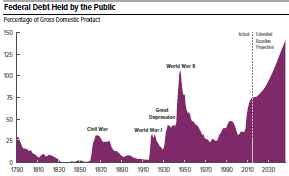
But what is really needed is to grow our economy faster and actually shrink our debt at the same time.  It will be very difficult, essentially impossible, to accomplish this with growth alone or even by raising taxes because the magnitude of our debt, 76% of GDP and rising, is so great.

capture70
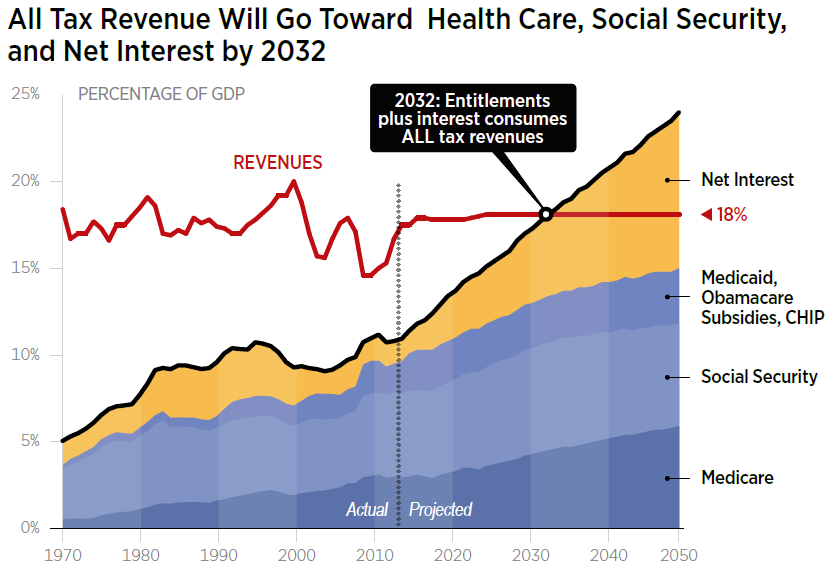
There is really only one way to begin to shrink the debt and this is to get entitlement spending under control.  The above chart shows that, without major changes, by 2032 all tax revenue will go towards healthcare, Social Security and net interest. Here is what needs to be done:

  • Social Security is already paying out $100 billion per year more than it collects in payroll taxes. Its Trust Fund will run dry in 15 years unless major changes are made and all benefits will drop by about 25% when this happens. We need to either increase the eligibility age for full benefits and/or raise the income cap on payroll taxes. These changes can be phased in but the sooner we get started the less painful it will be.
  • Medicare is an even bigger problem than Social Security. Either we have government rationing, i.e. “death panels,” or else rationing by price meaning some form of premium support. This simply means that we will all have more “skin in the game,” in the sense that we will all have a financial incentive to minimize our own healthcare expenses.
  • Medicaid should be block granted to the states so that the federal government is not obligated to a fixed match for all state Medicaid expenses. Again, cost control is the object of such a change.

Conclusion. It needs to be emphasized as strongly as possible that the reason for stringent cost control of entitlement programs is to preserve them for posterity, not destroy them.  Our prosperous way of life is severely threatened by our unwillingness to recognize this problem.

Follow me on Twitter
Follow me on Facebook


Can the Economy Grow Faster without Increasing Our Debt?


As I have been saying over and over on this blog for several years, America’s two major fiscal and economic problems are:

  • Slow Economic Growth, averaging just 2% since the end of the Great Recession in June 2009.
  • Massive Debt. Our public debt, on which we pay interest, is now $14 trillion or 76% of GDP, the highest it has been since the end of WWII.

President-elect Donald Trump campaigned on the issue of slow economic growth and will surely work with the Republican Congress to institute various tax and regulatory reform measures needed to speed up growth.

capture15But during the campaign Mr. Trump also introduced a specific tax reform plan which would lead to an estimated $4.4 trillion in new debt over the next ten years. Such a very large amount of new debt is highly undesirable and hopefully will be rejected by Congress.
In fact, as described by the Tax Foundation, there are some very good ways to use tax reform to improve growth without increasing debt. Fox example:

  • Allowing the full and immediate expensing of capital investments will grow the economy by 5.4% at a cost of $881 billion over ten years.
  • Lowering the top corporate tax rate to 20% will grow the economy by 3.3% at a cost of $718 billion over ten years.
  • Eliminating all itemized deductions except the charitable and mortgage interest deductions will slow economic growth by only .4% and increase tax revenue by $2,268 billion over ten years.

Conclusion. Just these three specific tax reform measures would grow the economy by about 8% while producing $600 billion in new tax revenue over a ten year period.  There are other ways as well of achieving similar growth and revenue levels.  The point is that the changes our country needs can be accomplished without increasing the national debt and perhaps even reducing it instead.

Follow me on Twitter
Follow me on Facebook

Trumponomics II. Debt


As I discussed in my last post, Donald Trump’s primary mandate from the presidential election is to get the economy growing faster in order to help out his base of blue-collar workers who have suffered wage stagnation for many years and especially since the end of the Great Recession in June 2009.  The tax and regulatory reform needed to accomplish this urgent task will undoubtedly turn out to be the first plank of Trumponomics.

capture2
But there is another equally urgent task which must not be overlooked by the incoming Trump Administration.  Our national debt, the public part on which we pay interest, is now 75% of GDP, the highest level since the end of WWII, and projected by the nonpartisan Congressional Budget Office to keep growing rapidly in the years just ahead (see chart above).
As Barron’s has pointed out, “Saving America, Part 1”, in its current issue:

  • Today’s public debt of $14 trillion will grow to $45 trillion in just 20 years’ time on the basis of current entitlement programs like Medicare and Medicaid, without any new spending programs or tax cuts.
  • The annual interest on a $45 trillion debt load would be about $750 billion at today’s super low interest rates. If interest rates rise to more typical levels, the interest payment on this level of debt would be about $1.5 trillion a year. This represents almost half of all federal spending during the current 2016-2017 budget year.

Conclusion. Such a high level of interest payment on our debt is unthinkable. This means that either we make fundamental reforms in government entitlement programs in the next few years or else we will have a severe fiscal crisis on our hands in less than twenty years’ time. We have some stark choices to make and hopefully the incoming Trump Administration will not shy away from what needs to be done.

Follow me on Twitter
Follow me on Facebook

What Trumponomics Will Look Like (Hopefully!)


Donald Trump won the presidential election because of his strong support from blue-collar workers who feel aggrieved by the U.S. economic system. Many have lost their jobs in recent years due to technology and globalization.  Many others have suffered wage stagnation.  Helping this large group of voters is surely Mr. Trump’s primary mandate from the election.

capture79
The best way to do this is to make the economy grow faster by implementing smart policies such as:

  • Corporate tax reform. Reducing the top rate from 35% to about 20% will make the U.S. competitive with other developed countries and induce American multinational companies to bring their overseas profits back home for reinvestment. This will create more jobs and better paying jobs. This can be paid for by eliminating various deductions.
  • Business tax reform. Allow full expensing of capital investments, paid for by eliminating the deductibility of interest payments. This will strongly encourage more business investment and therefore increase worker productivity.
  • Individual tax reform. Lower marginal tax rates across the board by 10%, paid for by eliminating most deductions. This would give an automatic increase in pay to the two-thirds of taxpayers who do not itemize deductions and, since most of the pay increase would be spent, grow the economy by stimulating demand.
  • Regulatory reform. Much can be done to alleviate the regulatory burden on business, see here and here.
  • International trade rules. “Tearing up NAFTA” would be a huge mistake because the U.S. exports $600 billion annually to Canada and Mexico with a trade deficit of only $40 billion. But NAFTA can be updated with side agreements to address concerns of fairness. Expand retraining programs for workers who lose their jobs to foreign competition.
  • Immigration reform. Secure our southern border and deport the illegal immigrants who are lawbreakers as Mr. Trump wants to do. Then give guest worker visas to law-abiding employees of legitimate businesses and use eVerify to enforce them.

Conclusion. Changes such as these will give a big boost to the economy and therefore create many new jobs and better paying jobs.

Follow me on Twitter
Follow me on Facebook


Bush Failures Led to Obama and Obama Failures Led to Trump


As I have previously stated, I voted for Hillary Clinton because Donald Trump is so crude and sleazy even though our country will now greatly benefit from the change which Mr. Trump represents.  This is the way the political process often works.

capture79 Consider that after eight years of George Bush we had:

  • Ongoing war in Iraq and Afghanistan, of which the Iraq war was an unnecessary mistake.
  • $2.5 trillion of additional debt, even after Mr. Bush started out with a budget surplus, compliments of Bill Clinton.
  • An expensive new Medicare Part D prescription drug plan which just makes overall Medicare even less affordable than it already is.
  • The Financial Crisis of 2007-2008 which the Bush Administration could have seen coming if they had been more vigilant.


Under such political circumstances, the 2008 election of the Democratic nominee, Barack Obama, over the Republican nominee, John McCain, was almost inevitable. But then in the next eight years we have experienced:

  • Slow economic growth averaging only 2% per year, ever since the end of the Great Recession in June 2009. The unemployment rate has fallen to 4.9% but there is still a lot of slack in the labor market which holds wages down. This is the main reason for the huge support Mr. Trump had from white blue-collar workers in the election.
  • Massive debt, now 76% of GDP (for the public debt on which we pay interest), the highest since right after WWII and double the debt in January 2009 when Mr. Obama entered office. Such a high debt level means greatly increased interest payments as soon as interest rates go up which they are likely to do anytime. The high annual deficits contributing to the debt mean little budget flexibility for new programs.

Conclusion. Democrats like to say that slow economic growth is “the new normal” which can only be overturned with budget busting new fiscal stimulus. This is a pessimistic point of view which refuses to consider other alternatives.  This is what led to Ms. Clinton’s defeat on November 8.

Follow me on Twitter
Follow me on Facebook

Disruption Involves Taking Chances


I am a fiscal conservative (I want to balance the budget) and a social moderate. I voted for Hillary Clinton for president because Donald Trump is a sleazy person and has such a volatile temperament.  But I’m also in favor of making big changes and Mr. Trump will certainly do this.

capture79As the Economist points out, “his voters took Mr. Trump seriously but not literally, even as his critics took him literally but not seriously.”  The Economist goes on to point out some of the risks involved in making the kinds of changes Mr. Trump is talking about:

    • If Obamacare is repealed, 20 million Americans will lose their health insurance. Yes, but it’s not going to happen this way. Obamacare will end up being modified and improved, not abolished.
  • His tax cuts would chiefly benefit the rich and would greatly increase our national debt. Yes, but the House of Representatives has a much better plan to do this and it is Congress, not Mr. Trump, which will develop a detailed plan.
  • Even if he does not actually deport illegal immigrants, he will foment the divisive politics of race. The illegal immigration problem needs to be solved and Mr. Trump is likely to get this done, with or without a wall.
  • Mr. Trump has demanded trade concessions from China and NAFTA. If he causes a trade war, the fragile world economy could tip into a recession. Blue collar workers, his strongest base of support, have had stagnant incomes for years and deserve some help. If he can increase our exports, blue collar workers will benefit.
  • He wants to reverse the Paris agreement on climate change which would harm the planet and undermine America as a negotiating partner. Global warming is real but the Paris accord does essentially nothing to slow it down. Increased coal use in China and India will more than negate what the U.S. and Western Europe are doing to cut back on fossil fuels.
  • Mr. Trump has demanded that other countries pay more towards their security or he will walk away. NATO members should be doing more on their own and if he can prod them to do this, then NATO will be stronger as a result.


Conclusion. Mr. Trump’s expressed views should be interpreted as initial bargaining positions. They are likely to have the effect of leading to progress on many serious problems which need to be addressed.  The risks involved in the negotiation process are worth taking

Follow me on Twitter
Follow me on Facebook

We Need Fundamental Change and Now We’re going to Get It!


I want to emphasize that I voted for Hillary Clinton on Tuesday because Donald Trump has such a sleazy and mercurial personality. But Mr. Trump was clearly the change candidate and we need change big time.  His strongest base of support is the white working class which has not really recovered from the Great Recession of 2008-2009 and he will surely try to help out these people.

capture79
Here are the changes we need in order of importance:

  • Grow the economy faster. Tax reform, individual and corporate, and regulatory reform are what are most needed. Mr. Trump and the House Republicans are in rough agreement on both of these major initiatives and hopefully the new Republican led Senate will go along. The best kind of tax reform means to lower tax rates and shrink deductions enough to avoid losing tax revenue. This can be accomplished if a real effort is made to do it this way.
  • Begin to shrink our massive debt. This can only be done by major entitlement reform, meaning to control the costs of Social Security, Medicare and Medicaid. Medicare should be transitioned over from a single payer system to a premium support system, consistent with a reformed Affordable Care Act. Healthcare costs can only be contained by giving consumers more skin in the game, meaning higher deductibles supplemented with health savings accounts.
  • More assertive foreign policy. Worldwide peace and stability depend on our own economic and military strength. Right now China, Russia and Iran think they can push us around. President Trump will not let this happen.
  • Trade and immigration policy. Most knowledgeable people agree that international trade is generally beneficial. We simply have to do a better job of retraining American workers who lose their jobs to foreign competition. The key to immigration reform is tougher border security plus an effective guest worker visa program.

Conclusion. The Republican House of Representatives has an excellent plan, “A Better Way,” for American economic, fiscal and social renewal and Mr. Trump is largely supportive of it. This augers well for fundamental progress in the next four years.

Follow me on Twitter
Follow me on Facebook

Clinton Is Not As Bad As Trump


I’ve been saying for several months that I would endorse one of the two main presidential candidates before the election and that “Donald Trump Should Withdraw from the Presidential Race” because of his personal sleaziness and that, in any case, I could not vote for him.
But it is worse than this.  As the Wall Street Journal stated recently, “Mr. Trump would start out with more than half of the country disliking him, and most of his advisors lack governmental experience.  Too many blunders or an early recession (especially one caused by trade restrictions) could cause voters to sweep out the GOP Congress in 2018, setting up a return to an all-progressive government in 2020.” In other words the disaster of 2009-2010, when President Obama had a filibuster-proof Congress, could easily happen all over again.

capture79
Mrs. Clinton has said that she wants, ”higher taxes, more spending on entitlements, more subsidies and price controls in ObamaCare, more regulations on business, more limits on political speech, and more enforcement of liberal cultural values on schools and churches.”  The likely result of such an agenda would be more lost years of slow economic growth.  And “the costs of slow growth are corrosive.  Flat incomes lead to more social tension and political enmity.  The fight to divide a smaller pie would get uglier in a country that once was accustomed to rising possibilities.”  This is a highly conceivable result of four years of a Clinton presidency.
Conclusion. I am not exactly enthusiastic about Mrs. Clinton.  But she is predictable and much less risky than Mr. Trump.  As long as the House of Representatives remains under Republican control, which is very likely, Mrs. Clinton will have to negotiate with it to implement much of her agenda.  This could conceivably lead to bipartisan progress on such major issues as tax reform and entitlement cost control.

Follow me on Twitter
Follow me on Facebook


The Political Predicament We Are In


I am an optimist by nature. I am used to having things go well.  If they’re not quite right, I try to imagine how they can get straightened out.  I’m also a realist.  As long as things are moving in the right direction, I am satisfied with the status quo.
Although my optimism is natural and intuitive, I find an intellectual justification for it in, for example, the work of Matt Ridley: “The Rational Optimist: how prosperity evolves.”  He makes a persuasive argument that not only has the humane race made huge strides in recent times but that this progress is intrinsic to evolved human nature and is likely to continue indefinitely.
The British historian, Andrew Roberts, has a cogent essay in yesterday’s Wall Street Journal, “1776: Would You Like to Reconsider?”, expressing consternation about the horrible choice we have for president this year between vulgarity and corruption.

capture77
Mr. Roberts admonishes Republicans to:

  • Somehow find party leaders and candidates who confront people like Mr. Trump seriously from the start and do not coddle him in the vain hope that he’ll collapse.
  • Avoid having debates controlled by TV channels who want the GOP to split and the Democrats to win.
  • Avoid talking down America, even in an election year, which is likely to be misinterpreted abroad.
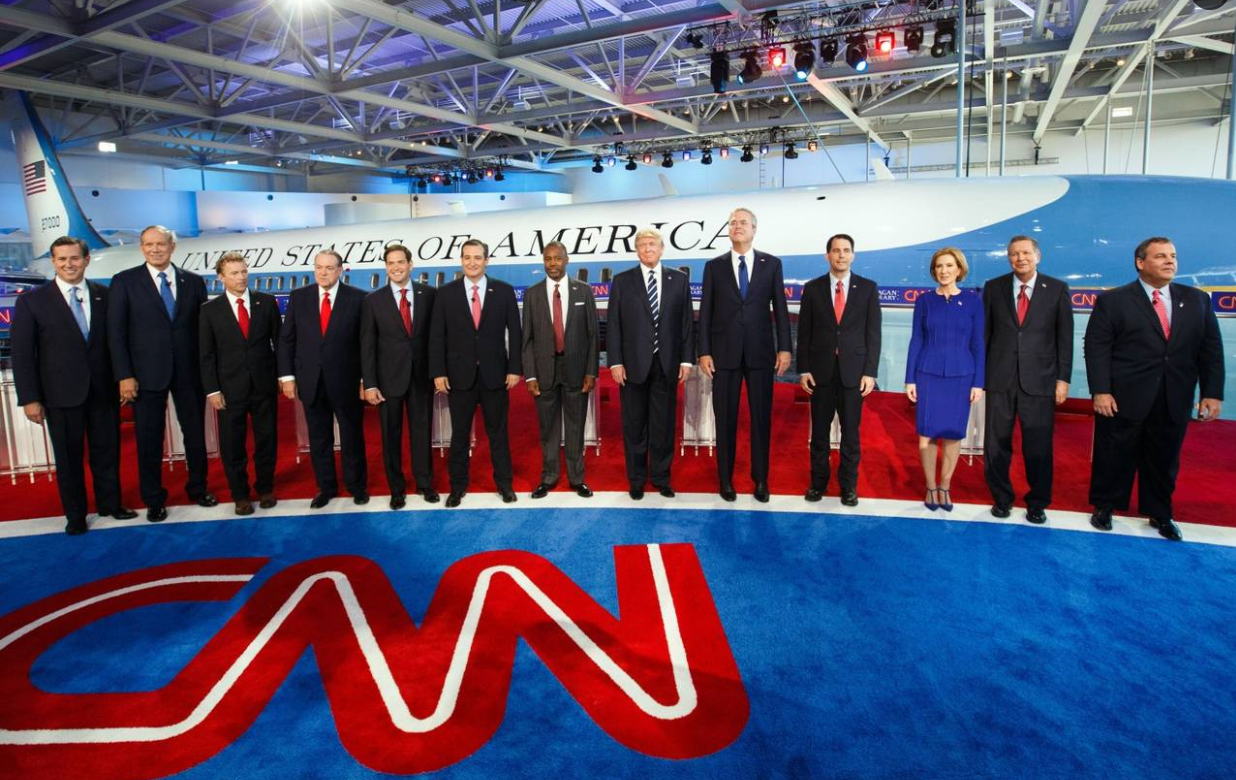
  • Drastically raise the percentages of support that guarantee a candidate a place in the debate in order to avoid too many candidates and moronically low standards of debate.
  • Figure out how to exclude candidates who have neither held public office nor held any previous significant (appointed) public position.
  • The Republican Party machine should have the last say on who is or is not a Republican and who can therefore stand under the Republican banner.

Of course, Mr. Robert’s suggestions are impractical because they are not sufficiently democratic! But he is pointing to a huge problem which must be addressed:  Right now democracy, as a political system, is on trial and is “losing out to the ideas of totalitarian state directed corporatism that seems to be delivering much higher growth and much better leaders.”
Question. Can democracy be saved with democratic methods?

Follow me on Twitter
Follow me on Facebook