Austerity’s Grim Legacy?


There is a very important debate going on in the country right now as I have discussed in my last three posts:

  • The Republican presidential candidates are proposing big tax cuts to stimulate the economy but at the cost of huge increases in annual deficits and the accumulated debt.
  • The Democratic candidates want to raise taxes on the wealthy but even raising the top tax rate from 39.6% to 50% would have only a modest effect in lowering income inequality.
  • The Tax Foundation has an excellent plan to lower tax rates for all in a revenue neutral manner by closing loopholes and limiting deductions. Their plan would give the economy a big boost and actually lower deficits by bringing in more tax revenue.

Now comes Paul Krugman in Friday’s New York Times, “Austerity’s Grim Legacy”  saying that “Some of us tried in vain to point out that deficit fetishism was both wrong-headed and destructive, that there was no good evidence that government debt was a problem for major economies, … And we were vindicated by events.  More than four and a half years have passed since Alan Simpson and Erskine Bowles warned of a fiscal crisis within two years; U.S. borrowing costs remain at historic lows.”
Capture12How can such an obviously intelligent and articulate economist miss what is so very, very clear to so many lesser mortals?  Interest rates will not stay low forever!  And when they do go up, interest payments on our rapidly expanding debt will skyrocket! The Congressional Budget Office estimates that the interest payment on our debt will increase from 1.7% of GDP today to 3.6% of GDP in 2025, or $827 billion in 2025 compared with $227 billion in 2015.  Where will the money to pay this new $600 billion expense come from?
It is absolutely crazy not to take our enormous debt seriously.  We simply must put this huge debt on a downward path as a percentage of GDP.  It can be done but it will take a concerted effort by our national leaders to do it.

                                    Follow me on Twitter: https://twitter.com/jack_heidel
                         Follow me on Facebook: https://www.facebook.com/jack.heidel.3
Are Democratic Presidents Better for the Economy than Republicans?


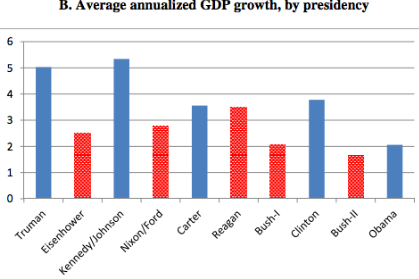
In his usual provocative manner, Paul Krugman reminded us yesterday that, according to a recent study by Alan Blinder and Mark Watson, ever since President Truman the economy has grown faster under Democratic presidents than under Republican presidents.  There are a lot of different explanations for this, not necessarily demonstrating better economic policies by Democratic presidents.  Nevertheless, it is a noteworthy finding which fiscally conservative, fix-the-economy types, need to be aware of.
CaptureAmong other things, Republican presidential candidates must become more credible about their economic policies than they have been so far.  They have all proposed big cuts in tax rates to stimulate the economy. But their plans lose trillions of dollars in tax revenue.  At a time of huge deficits and a rapidly growing national debt this is simply unacceptable.
In today’s Omaha World Herald, the economics journalist, Robert Samuelson, reports on a new Brookings Institute study about the effect of raising the top individual tax rate from 39.6% to 50%.  Such a tax hike would raise as much as $100 billion per year.

  • However, if used to lower deficit spending, it would cover less than ¼ of current deficit spending ($439 billion in 2015, for example).
  • If used to reduce income inequality for the poorest 1/5 of Americans, it would give such households an average of $2,650, and the overall effect on income inequality would be very modest.

The point is that neither costly tax cuts to boost economic growth nor a sizable tax increase on the wealthiest Americans represents a viable program to straighten out our economic problems. What we need to grow the economy is:

  • Revenue neutral tax reform, lowering rates across the board, paid for by closing loopholes and shrinking deductions.
  • Lightening the regulatory burden at least on small and mid-size businesses in order to speed up business growth and entrepreneurship.
  • Trade expansion and immigration reform to increase productivity.

Fiscal conservatives are badly needed to implement such policies effectively but neither party can get the job done alone. It will take both parties working together to make progress.

                                Follow me on Twitter: https://twitter.com/jack_heidel
                      Follow me on Facebook: https://www.facebook.com/jack.heidel.3

The Republicans Need to Get Real about Tax Reform


The Republican presidential candidates have been releasing tax plans and they have been analyzed by the nonpartisan Tax Foundation. It turns out that most of these plans lose revenue over a ten-year period even on a so-called dynamic scoring basis where the stimulatory effects of the plan are taken into effect.  Such callous disregard for the huge annual deficits we are now running, and our huge accumulated national debt, is totally unacceptable especially from the political party which bills itself as being fiscally responsible.
CaptureThe left-leaning New York Times points this out yesterday in its lead editorial, “Why the Republican Tax Plans Won’t Work.”  According to the NYT:

  • Tax Revenues will need to increase by 40% over the next 10 years just to keep federal spending even with inflation and population growth.
  • Further additional revenues will be needed to pay for health care for the elderly, transportation systems, climate change and likely increased interest payments on the national debt.
  • Thus taxes will have to go up and can only be imposed realistically on the wealthy who have had the biggest income gains in recent years.
  • Democratic presidential candidates do propose tax cuts but only for low- and middle-income Americans.
  • Democrats are calling for new taxes on financial transactions.
  • Democrats also propose to raise wages, support higher minimum wages, support unions and expand profit-sharing and employee ownership.

This is the program the Democrats will be pushing if they win the presidency next year. It has some attractive features but the likely overall outcome will be increased deficit spending, a rapidly increasing debt and a continued stagnant economy.
Meaningful tax and regulatory reform will both be needed to get the economy growing faster than the 2% average of the past six years.  Any credible tax reform program simply must be at least revenue neutral so that, combined with spending restraint, it will put our national debt on a downward path.

Follow me on Twitter: https://twitter.com/jack_heidel
                   Follow me on Facebook: https://www.facebook.com/jack.heidel.3
The Budget Deal: A Win for the Big Spenders


A tentative budget deal has just been reached by Congress and the President to 1) suspend the debt limit until March 2017, and 2) loosen the budget sequester caps by $112 billion over the next two years.  $80 billion of the increased spending will be balanced by spending cuts elsewhere in the budget with details to be worked out later by various appropriations committees.  Specifically:

  • The current debt ceiling of $18.1 trillion will be lifted until March 2017, after a new president takes office. This will allow an expected increase in the debt of about $900 billion to take place over the next 1½ years.
  • Both military and discretionary non-military spending will increase by $40 billion each over the next 2 years with the military receiving an additional $32 billion for Overseas Contingency Operations.

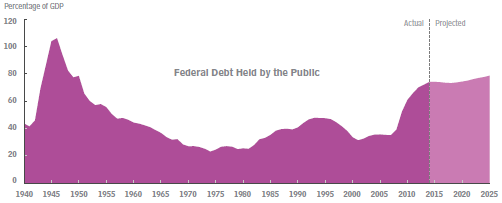
The problem is that such a deal essentially just maintains the budget status-quo. It does nothing to begin shrinking annual deficits in order to put our accumulated national debt on a downward path as a percentage of GDP.  Our current debt of 74% of GDP is very high by historical standards and simply must be brought down significantly in the near term.
Capture1As I explained in my last post, Congressional Republicans, with majorities in both the House and the Senate, should be able to apply much more leverage than was used in the deal just reached, as follows:

  • Yes, extend the debt ceiling for two years. We need to pay our debts. But insist on spending discipline from now on.
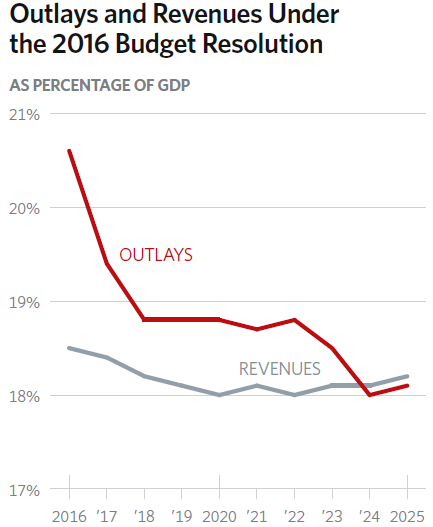
  • Allow only brief temporary budget extensions at current levels until a plan is adopted to put deficits and debt on a downward path. The Republican ten year plan for a balanced budget would be a good place to start.

It’s time for fiscal conservatives to stand up and be counted!

Follow me on Twitter: https://twitter.com/jack_heidel
                       Follow me on Facebook: https://www.facebook.com/jack.heidel.3

Why the Federal Government Fails So Often


This blog is about the major fiscal and economic problems of our country and specifically our stagnant economy (2% real growth for the past six years) and massive federal debt (the public debt, on which we pay interest, is 74% of GDP, the highest since WWII). My major sources of information are the New York Times and Wall Street Journal but I also make use of reports from various think tanks. Today’s source is the recent report, “Why the Federal Government Fails,” by the Cato Institute’s Chris Edwards.
CaptureAccording to Mr. Edwards, there are five main reasons for this:

  • Top-Down Coercion. Federal agencies impose more than 3,000 regulations each year. Total regulations now span 168,000 pages. Benefits are distributed through more than 2,300 programs. Federal policies are often based on guesswork. Failed policies are seldom weeded out because they are funded by taxes and are not contingent on performance.
  • Lack of Knowledge. Private markets operate efficiently on the basis of price information. Government subsidies and regulations throw a monkey wrench into the price mechanism.
  • Political Incentives. Congress focuses on the benefits of programs but does not consider the full costs because benefits are delivered to narrow groups while the costs are spread widely. There are too many fiscal illusions to hide costs such as: paying with debt rather than higher taxes, taxing businesses which then just raise prices, conferring benefits by regulation (e.g. requiring employers to provide healthcare) rather than direct subsidy.
  • Bureaucratic Incentives. There are too many rewards for inertia and not enough for the creation of value such as the absence of profits and losses, rigid compensation, lack of firing, red tape, agency capture, etc.
  • Hugh Size and Scope. The $4 trillion annual budget is 100 times the average state budget of $40 billion. It is simply too vast for members of Congress, and other top officials, to understand what is going on. The more programs the government has, the more likely they will work at cross-purposes.

Mr. Edwards concludes that “the most important way to improve federal performance would be to greatly cut the government’s size” and to do this by shifting federal activities back to the states. With this recommendation I heartily agree!

Cutting the Federal Budget, an Example: The Highway Trust Fund


As an advocate of cutting federal spending, people sometimes ask me exactly what I would cut to save money and lower the deficit. I have two standard answers to this question:

  • Often I will respond, it is up to Congress to figure this out. The important thing is to shrink the deficit one way or another. It doesn’t matter from a fiscal point of view exactly what is cut.
  • Another answer I like to give is that with the sequester already slowing down discretionary spending, we should concentrate on finding savings in entitlement programs like Social Security, Medicare and Medicaid.

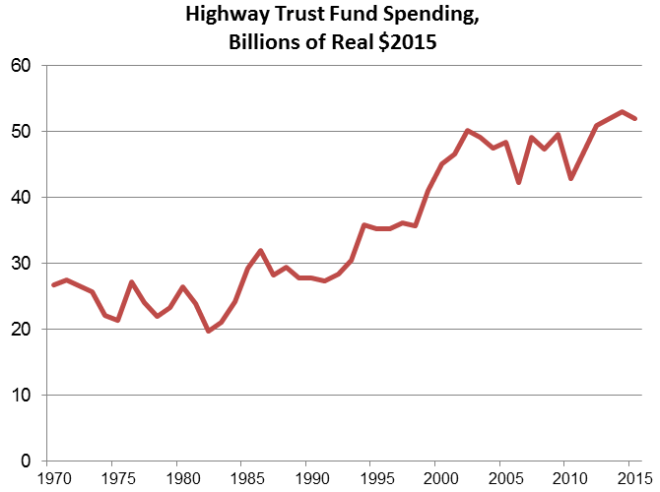
While both of these answers have validity in a general sense, nevertheless I do look for ways to cut back on discretionary spending as well. Here is a good idea from Reason magazine’s Veronique de Rugy, “Let States Build Their Own Highways.” The rationale is very simple. The federal gasoline tax of 18.4 cents/gallon brings in about $40 billion per year which goes into the Highway Trust Fund. But the HTF is spending $53 billion per year, meaning that federal gas tax revenue is being supplemented by $13 billion from general revenues. This additional $13 billion per year can be viewed as an unjustified federal expense merely adding to the deficit.
Capture2The way to address this issue is to:

  • Abolish the federal gasoline tax of 18.4 cents/gallon as of some specific date in the future, say in a year from the time such a law is enacted.
  • Turn over all responsibility for highway construction to the states.
  • States can then decide individually how much of the federal gasoline tax they wish to continue as a state gasoline tax in order to finance their own highway funding.
  • Minimal federal guidelines could be maintained if desired to insure uniform quality control by the states.

Of course, a $13 billion annual budget savings could be looked at as a drop in the bucket, not nearly large enough to make a sizable dent in the federal deficit (latest projection for fiscal year 2015: $426 billion). That would be too cynical. There are undoubtedly many other smart ways to cut back federal spending. I am constantly looking for them!

The Six Issues That Could Cause a Government Shutdown


It is now just ten days until the new government fiscal year begins on October 1 and Congress has not yet passed a budget for the new fiscal year. Although a temporary funding bill could be brought up and passed at any time, the Washington Post thinks that there are six big impediments to adopting a new budget.
CaptureThey are:

  • Planned Parenthood. 31 House Republicans insist that they will support no spending bill which has funding for Planned Parenthood. Short term funding should not be in danger because the Democrats will step in if necessary to keep the government open.
  • The Sequester. This is a much tougher issue because the Democrats want to break the 10 year Sequester spending limits. It’s the Republicans strongest leverage and they should insist on dollar for dollar spending cuts elsewhere in order to relax the Sequester cuts.
  • A Challenge to Boehner. The anti-Planned Parenthood caucus is threatening to try to oust John Boehner as Speaker if they don’t get their way. Hopefully the Democrats would help to keep Boehner because any replacement would be more conservative and less accommodating to them. I personally think that John Boehner is a miracle worker given the hyper-partisanship in Washington at the present time.
  • The Iran Nuclear Deal. Republican desire to express opposition to the Nuclear Deal could surface as a bargaining chip in budget negotiations. As bad as the Nuclear Deal is, this is a bad budget strategy.
  • The Export-Import Bank. The Ex-Im Bank expired in June. Its supporters might try to refund it as part of a budget deal for next year. It should be allowed to die unless it undergoes reform to remove subsidies for big businesses such as Boeing and GE.
  • The Highway Trust Fund. The problem is that the 18 cent/gallon federal gasoline tax is insufficient to fund our infrastructure needs. The most sensible approach is to raise the gas tax by a few cents per gallon. Attempts to provide funding from other sources should be resisted.


Bottom Line: Republicans should be flexible except on overall spending limits. It is absolutely essential to the future wellbeing of our country to strongly focus on eliminating budget deficits.

The Second Republican Presidential Debate


Although I am a registered Independent, I lean strongly conservative on fiscal and economic issues. I hope the Republican Party ends up with a nominee who can make a compelling case for fundamental reform.
CaptureHere is my take on last night’s debate and the current state of the race.

  • Rand Paul. He stands up strongly for the Tenth Amendment (State’s Rights) but he is much too isolationist to take over after eight years of Obama.
  • Mike Huckabee. His social conservatism appeals to evangelicals but he has a weak grasp of economic and fiscal issues.
  • Marco Rubio. He is certainly a gifted political communicator. He is able to talk tough while also appearing moderate and reasonable at the same time. But some of his policy ideas are gimmicky.
  • Ted Cruz. He claims to be a true conservative because he won’t compromise on his basic principles, even if they lead to government shutdown. As such he is much too radical for my taste.
  • Ben Carson. I don’t see what his attraction is outside of a compelling personal story. His grasp of issues is quite weak.
  • Donald Trump. Leading in the polls, he is the wild card for the 2016 election cycle. As much as he disgusts me, his performance is improving. He has pledged to support the eventual party nominee, and not run as an independent. He also hurled fewer insults in the second debate than in the first.
  • Jeb Bush. Policy-wise, with his detailed tax plan and generally moderate views, he is outstanding. But it’s not clear that he can overcome the populist, anti-elite mood of the electorate.
  • Scott Walker. His outstanding record in Wisconsin gave him an early boost. But he hasn’t made the transition to national policy issues very well.
  • Carly Fiorina. She expresses herself in a crisp manner and has a good, general grasp of the issues. She’s rising in this campaign but still has a long way to go.
  • John Kasich. He has a superb background as a former Congressman and now as a very successful two term governor of Ohio. He expresses compassion for ordinary people. He deserves to climb in the polls but will he?
  • Chris Christie. He’s tough talking but his record in New Jersey isn’t that great. His obesity and reputation as a bully are turnoffs for me.

In short, I don’t want Trump to be the Republican nominee but who is going to emerge from the pack to defeat him? It isn’t clear if anyone will be able to do this.

Jeb Bush’s Tax Plan: Both Good and Bad


Republican presidential candidate Jeb Bush has just released his tax reform proposal, “My Tax Overhaul to Unleash 4% Growth.” It has many good features such as:

  • Lowering and consolidating seven current tax brackets into three: 10%, 25% and 28%.
  • Essentially doubling the standard deduction for most filers, thereby achieving huge simplification for millions of average income filers.
  • Eliminating the state and local income tax deductions and capping all others, except for charitable deductions, at 2% of Adjusted Gross Income.
  • Doubling the Earned Income Tax Credit for childless filers, thus encouraging more low income people to work.
  • Exempting taxpayers over the age of 67 from the employee-side payroll tax, encouraging them to stay in the workforce longer.
  • Cutting the corporate tax rate from 35% to 20%.
  • Allowing 100% immediate expensing for all capital investments, including inventories.
  • Creating a territorial tax system so that multinationals are not taxed on foreign earnings, and therefore incentivized to bring their foreign profits home.
  • Eliminating the deductibility of interest expenses.

The lower individual and corporate tax rates, together with the separate investment and work incentives, will create a significant economic stimulus estimated to raise GDP by at least .5% per year or higher, depending you who ask.
According to the Tax Foundation, however, the plan would reduce federal revenue on a static basis by $3.66 trillion over ten years, and even by $1.6 trillion on a dynamic basis, taking into account the new tax revenue generated by the plan.
CaptureThis is, of course, a huge problem. We badly need to speed up economic growth but we also need to lower, not increase, our annual deficit spending in order to put our debt on a downward path as a percentage of GDP.
The resolution of this quandary is to tighten up on those deductions, such as for mortgage interest, remaining in the code and also lessening the amount of the tax cuts if necessary in order to achieve overall revenue neutrality for the plan.

Paul Krugman: “Debt Is Good”


Every Monday and Friday morning when I pick up the New York Times, I immediately turn to the OP-ED page to see what liberal icon Paul Krugman is saying. In his most recent column, “Debt Is Good,” he says that “what ails the world economy right now is that governments aren’t deep enough in debt.”
CaptureHere is my response to his argument:

  • “The federal government can (now) borrow at historically low interest rates. So this is a very good time to be borrowing and investing in the future.” Our public debt (on which we pay interest) is now $13 trillion or 74% of GDP, the highest since the end of WWII, as shown in the above chart from the Congressional Budget Office. It is likely that interest rates will soon begin to go up. Every 1% rise will increase interest payments on our already existing debt by $130 billion per year. Where are the hundreds of billions of new dollars for debt service going to come from in an already tight budget? The more we add to the debt, the worse this problem will become.
  • “Having at least some government debt helps the economy function better.” I agree! But $13 trillion is way beyond what is needed for this. It is outrageously excessive!
  • “What we need are policies that would permit higher (interest) rates in good times without causing a slump. And one such policy would be targeting a higher level of debt.” The problem here is the conceit of Keynesians, like Mr. Krugman, that monetary policy alone can restore us to economic and fiscal health. Rather than accepting that the economy has entered a “new normal” with a permanently slow growth rate of about 2% (as has been the case since the end of the Great Recession in June 2009), we need policy changes such as individual and corporate tax reform (revenue neutral to be sure) and changes in the Affordable Care Act and Dodd-Frank Act to remove their job killing features.


Anybody with an ounce of common sense knows that excessive borrowing will eventually lead to disaster. Mr. Krugman seems to think that by constantly ridiculing his opponents, he can get away with denying this simple truth.