How the American Higher Education System Contributes to Inequality


Income inequality in the U.S. is a major problem, getting worse all the time.  There are many reasons why this is happening and many suggestions for how to deal with it.  On the other hand, it is well appreciated that a college degree is one of the best tickets for upward mobility into the middle class.  A new book by Suzanne Mettler, “Degrees of Inequality,” shows how American higher education is actually increasing the divide between the haves and have-nots.  She points out that:

  • There are too few college graduates in the U.S.  In 2010 Americans between ages 25 and 34 had a college graduation rate of 33%. At least 10 OECD nations have higher rates (see below). American world leadership in the future will be jeopardized if we don’t continue to be an educational leader as we have been in the past.

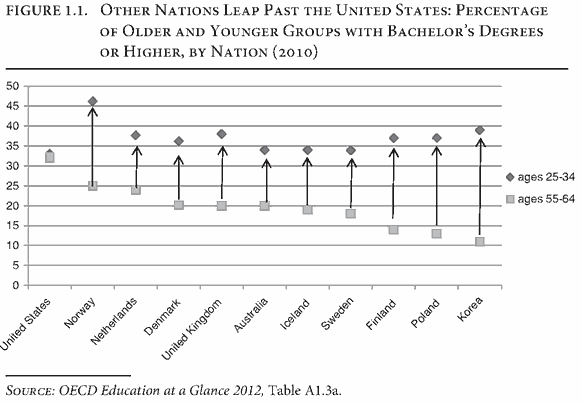
    Capture

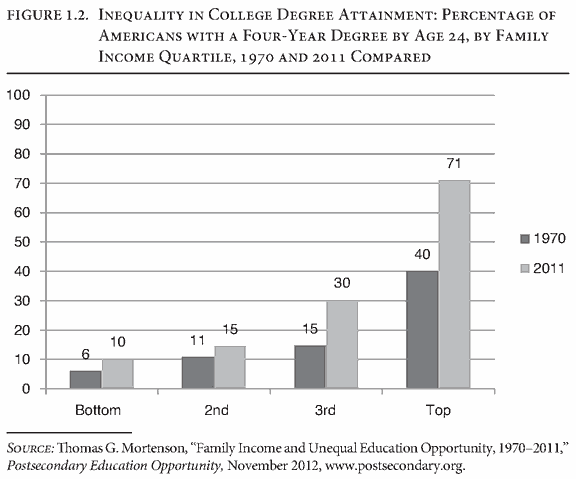
  • America is graduating inequality. College degree attainment has increased between 1970 and 2011 for all income groups. However this is happening much more quickly for higher income groups. 83% of 18 to 24 year olds now have a high school diploma and 75% of this group start college. But the completion rate by age 24 is only 47%, mostly from the higher income groups (see below).Capture1
  • Not all college degrees are created equal. Students at private, nonprofit institutions graduate at higher rates than students from public institutions who, in turn, graduate at much higher rates than students from for-profit institutions. And graduates of the for-profits have larger loan debt than for graduates from private nonprofit and public institutions.

Capture2

Students at for-profit educational institutions tend to be from lower-income families.  As noted, they have lower graduation rates and end up with higher debt levels.  Clearly the three tier system of American higher education has a harmful effect on the young adults who need the most help in moving up the economic ladder.
How should society address this major problem in an era of tight public spending?  One answer is to increase regulation of the government-run student loan program.  All educational institutions should be held at least partially responsible for the defaulted loans of their former students.
Another approach is to increase financial support for community colleges so that they can provide more programs for the low-income students who are most likely to attend them.
Too Much Income Inequality is Harmful to Society


It is well understood that income inequality is increasing in the U.S. and that there are lots of reasons for it.  Globalization provides low cost goods from around the world and thus puts pressure on low-wage workers in our own country.  Rapid technological advancement puts a high premium on educational attainment and skill acquisition and thus helps individuals who are highly motivated to succeed.  The Great Recession and our slow recovery from it have held back the growth of employment and wages increases for middle- and lower-income workers.
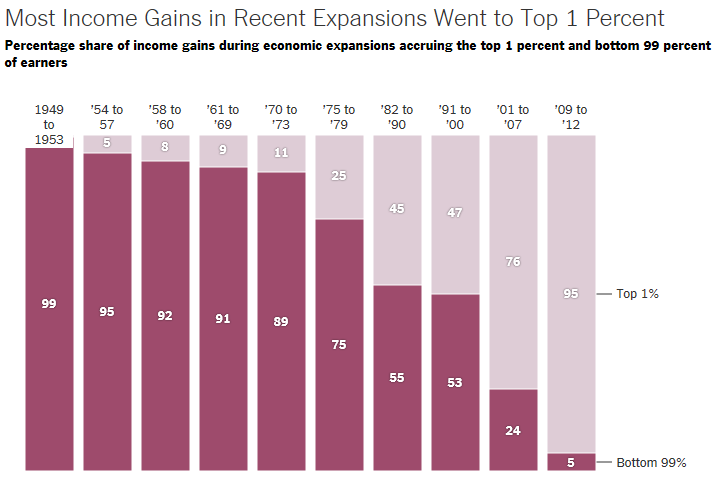
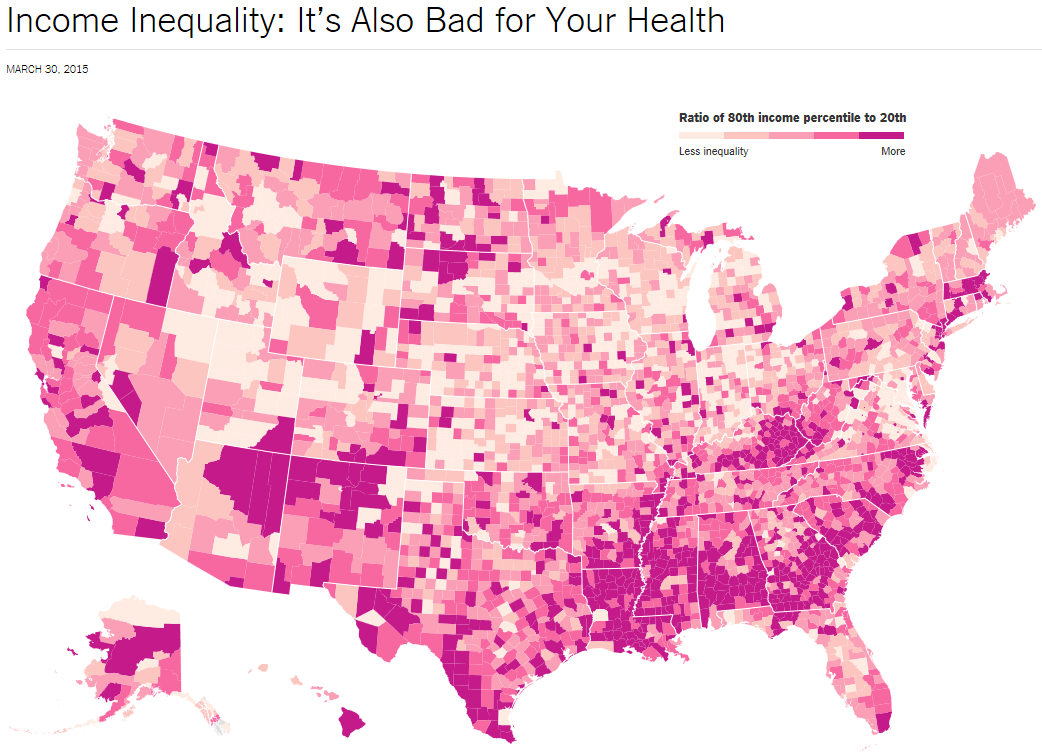
CaptureIncreasing income inequality is a pernicious social condition and has lots of unpleasant consequences.  A new study of U.S. counties has shown that there is a strong correlation between more inequality in a particular geographical area and shorter average live spans.  It is quite reasonable to expect that higher-income people will be more health conscious than lower- income people. Excessive inequality is bad for lots of reasons.
The question is what we can do about it.  Here are two good ways to address it:

  • Faster economic growth would help a lot. The American Enterprise Institute’s Michael Strain has recently proposed a fairly modest plan for increasing employment by cutting tax deductions for the wealthy, increasing the Earned Income Tax Credit for the poor and at the same time decreasing deficit spending. I have made a more substantial proposal along the same lines.
  • Boost educational performance across the board. College-ready middle class kids will take care of themselves so the emphasis should be on the 70% of young adults who will not go to a four year college. There are lots of good jobs available for the highly skilled and so we need more career education in high school. We also need more early childhood education to prepare kids from low-income families to get off to a good start in elementary school.

Increasing economic growth and expanding educational opportunities for the non-college bound will require little, if any, new federal spending.  Such policies as above are simply common sense ways to reduce income inequality and achieve a more inclusive society.

Inequality Does Not Reduce Prosperity


In the national elections this year four states: Alaska, Arkansas, Nebraska and South Dakota raised their state minimum wage rates above the national rate of $7.25 per hour and, at the same time, elected Republicans to the U.S. Senate, in three cases replacing Democratic incumbents.  Does this represent contradictory behavior by the voters?
CaptureThe American Enterprise Institute’s James Pethokoukis recently reported (see above) that the U.S. has the third highest rate of billionaire entrepreneurs behind only Hong Kong and Israel, as well as by far the most billionaires over all.  These are the high-impact innovators like Bill Gates, Steve Jobs and Mark Zuckerberg and the Google Guys.
These observations are put in context by the Manhattan Institute’s Scott Winship who recently reported that “Inequality Does Not Reduce Prosperity.” Here is a summary of his findings:

  • Across the developed world, countries with more inequality tend to have higher living standards.
  • Larger increases in inequality correspond with sharper rises in living standards for the middle class and poor alike.
  • In developed nations, greater inequality tends to accompany stronger economic growth.
  • American income inequality below the top 1 percent is of the same magnitude as that of our rich-country peers in continental Europe and the Anglosphere.
  • In the English-speaking world, income concentration at the top is higher than in most of continental Europe; in the U.S., income concentration is higher than in the rest of the Anglosphere.
  • With the exception of a few small countries with special situations, America’s middle class enjoys living standards as high as, or higher than, any other nation.
  • America’s poor have higher living standards than their counterparts across much of Europe and the Anglosphere.

Conclusion: Americans are fair-minded and would like to help the working poor do better.   But Americans also appreciate the value of innovation and entrepreneurship.  When there is a tradeoff between increasing prosperity and reducing inequality, greater prosperity comes first.

How Bad Is Income Inequality and How Do We Fix It?


The latest news on the American economy is mixed. The unemployment rate fell to 5.9% in September but the labor force also fell by 97,000 last month.  The labor participation is now down to 62.7%, a level last seen in 1978.  On the plus side 248,000 new jobs were created but the share of the population employed stayed at 59%, less than its 59.4% level at the end of the recession in June 2009.  In other words, job growth is definitely picking up but not fast enough.
CaptureHow about income inequality?  One simple way of describing and understanding the degree of income inequality in the U.S. is to look at median household income and how it changes over time.  The above chart from the WSJ shows how the median U.S. household income fell from an all-time high of $56,895 in 1999 to $51,939 in 2013.  However it also climbed back up to $56,436 in 2007 before dropping precipitously until 2012.
Capture1The Global Strategy Group discovered in a recent survey that registered voters overwhelmingly rate economic growth as a higher priority than economic fairness.  This means that any policy designed to speed up economic growth is likely to receive favorable support by the electorate.
In a recent post I describe a plan for broad-based tax reform specifically designed to speed up economic growth.  It would involve an across-the-board cut in tax rates totaling about $500 billion per year, but completely paid for by closing loopholes and deductions which primarily benefit the wealthy.  The 64% of taxpayers who do not itemize deductions would receive a tax cut.  And they would likely spend this extra money in their pockets because they are precisely the middle- and lower-income wage earners with falling incomes.
An income tax redistribution like this would greatly reduce inequality but in a way which is designed to give the economy a big boost!

Economic Expansion Is Not Enough


The Washington Post reporter Robert Samuelson gives our economy today a B-, because the unemployment rate has inched down to 6.1%, fulltime employment is up to 105.8 million in 2013 from 99.5 million in 2010, and full-time women’s pay reached a high of 78% of men’s pay in 2013.  The big negative, of course, is that median household income was $51,939 in 2013, down from $56,436 in 2007, just before the financial crisis.
The Bard College economist Pavlina Tcherneva, as summarized by the reporter Neil Irwin in yesterday’s New York Times, shows what has gone wrong with economic and monetary policy since the end of the Great Recession in June 2009. The American Recovery and Reinvestment Act of 2009 (an $850 billion stimulus package) did boost the economy but it primarily aided “the skilled, employable, highly educated, and relatively highly-paid wage and salary workers.”
Capture2On the other hand the Federal Reserve’s quantitative easing policies have kept interest rates remarkably low and have thereby caused investors to buy stocks rather than bonds in order to get higher returns.  This has artificially boosted stock prices and has been especially advantageous to the top 10% and, even more so, the top 1%.
CaptureWhat is needed, according to Ms. Tcherneva, is a targeted, bottom-up approach to fiscal policy, which provides more and better paying jobs directly to middle- and lower-income wage earners.  Her suggestion is for public works jobs, public service employment, green jobs, etc., all of which would require large infusions of federal money thereby worsening the federal deficit.
A much better approach would be broad based tax reform, lowering tax rates across the board, paid for by closing the loopholes and deductions which primarily benefit the rich.  Since the 64% of taxpayers who do not itemize deductions would receive an effective pay boost, this would amount to a tax reform program targeted to exactly the middle- and low-income wage earners who have not yet recovered from the recession.  These folks would most likely spend their extra income, thus further boosting the economy (see my previous post).

Which Is More Important: Increasing Growth or Decreasing Inequality?


The progressive Global Strategy Group has recently released a new survey report “Focus on Growth to Frame Priorities” with a valuable message for all political candidates, left, right and center.
CaptureGSG surveyed 3000 registered voters earlier this year and discovered that they overwhelmingly rate economic growth as a higher priority than economic fairness, economic justice, expanding the middle class, increasing wages or decreasing income inequality.  In fact, economic growth trumped all of these alternative policy strategies by wide margins as shown below.
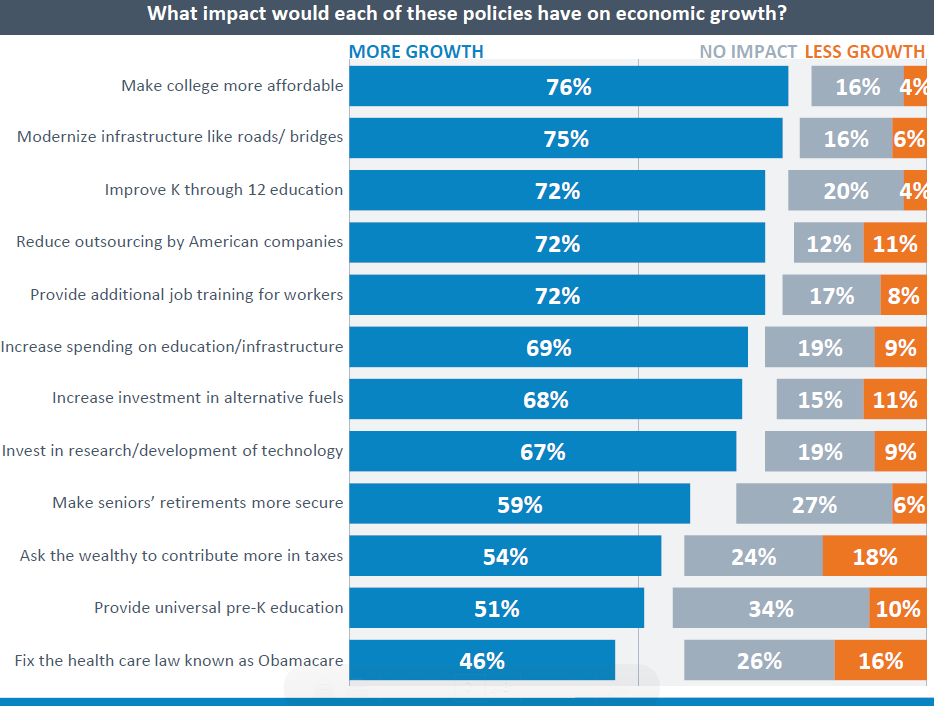
Capture1GSG then goes on to list various possible growth strategies in order of voter popularity such as making college more affordable, modernizing infrastructure, improving K-12 education and others (see below). This list of possible growth strategies is made up mostly of new spending programs.  The less costly might be doable by reforming existing spending programs.  But expensive new programs simply will not fly in today’s high deficit environment.
Capture2What is needed is a growth strategy which does not require new spending.  The obvious choice is tax reform.  For example, the fourth item in the above chart, reduce outsourcing by American companies, could be addressed by reforming corporate taxes.
But an even better growth strategy is individual tax reform whereby tax rates are lowered across the board, paid for by shrinking the many loopholes and deductions which primarily benefit the wealthy.
I described such a plan in detail in a previous post, but here is a brief summary: 64% of taxpayers do not itemize their deductions.  This means that any reduction in tax rates will put money in their pockets.  Since these are primarily the same middle- and lower-income workers with stagnant incomes, they will likely spend most of their increased pay, thus giving the economy a big boost.
In summary, the GSG report provides ammunition for political candidates of all ideological stripes.  Let’s have a contest to see which party can be the most pro-growth.  The winner will be the American people!

How to Increase Growth and Decrease Inequality at the Same Time!


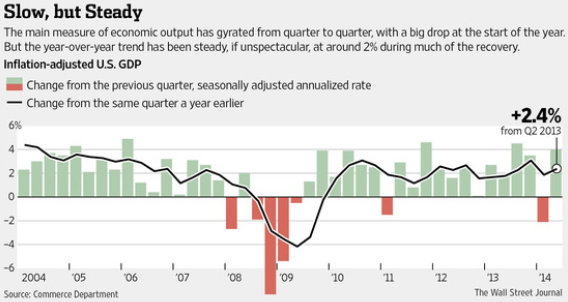
The Department of Commerce has just reported basic economic data for the second quarter of 2014.  As the chart below shows, the economy gradually lost steam from 2004 – 2008, sunk badly in 2008 and 2009, and has now grown at a slow but steady rate of about 2% during the period 2010 – 2014.
CaptureOne of my favorite journalists, the New York Times’ economics reporter Eduardo Porter, has just written again on the topic of inequality, “Income Inequality and the Ills behind It.”  He quotes the economist Tyler Cowen as saying “The right moral question is ‘are poor people rising to a higher standard of living?’  Inequality itself is the wrong thing to look at.  The real problem is slow growth.”  The economist Gregory Mankiw is quoted as saying that “Policies which address the symptom (of inequality) rather than the cause include higher taxes and a more generous safety net.  The magnitude of what we can plausibly do with these policy tools is small compared to the size of the growing income gap.”
What Mr. Cowen and Mr. Mankiw are both suggesting is that we can’t effectively attack income inequality without also increasing economic growth.  I believe that it is possible to address both problems at the same time by implementing broad-based tax reform as follows:

  • Individual income tax rates should be lowered across the board, paid for by closing loopholes and shrinking deductions, in a revenue neutral way.
  • The 64% of all taxpayers who do not itemize deductions will get a significant tax cut. Since they are largely the middle and lower-income wage earners with stagnant incomes, they will tend to spend their tax savings, thereby giving the economy a big boost.
  • At the same time the 36% of taxpayers who do itemize their deductions will, on average, see their income taxes go up. But these are, on the whole, the wealthier wage earners who can afford to pay higher taxes.
  • A plan such as this represents a shift of net after-tax income from more wealthy people to the less wealthy. It therefore reduces income inequality.

If we can cut tax rates, increase economic growth and reduce income inequality all at once, why can’t our national leaders come together and act along these lines?

Crony Capitalism and Economic Growth


“If there is one thing that populists on the left and right can agree upon, it is disdain for crony capitalism.  It is a distaste for the cesspool of Washington influence in which big-business lobbyists canoodle with lawmakers to get their way.  It is anger at corporate welfare enriching America’s biggest companies at the expense of the little guy.”  So says the economics journalist Neil Irwin in today’s New York Times, “Why we’re All Crony Capitalists, Like It or Not”.
Specifically he is talking about the current debate in Congress over whether or not the Export-Import Bank of the United States should be continued.  It mostly helps big corporations like Boeing and General Electric finance sales to other countries.  But there’s a trade off.  If it shuts down, then American corporations will be at a disadvantage compared with international competitors who get help from their own governments.
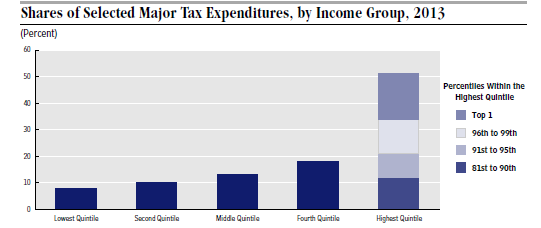
CaptureIn fact, crony capitalism has a much wider scope than this.  Each year deductions and loopholes in the U.S. tax code, referred to euphemistically as tax expenditures, total $1.2 trillion in lost tax revenue.  As the above chart from the Congressional Budget Office shows,  50% of these tax reductions are enjoyed by the highest earning 20% of all U.S. households, with 30% of the benefits going to just the top 5%.
Many experts say that our stagnant economy is caused by a lack of consumer demand, in turn caused by the huge loss of wealth during the Great Recession.  If lower and middle income people had more money, they would surely spend it and our economy would grow faster.  This line of reasoning suggests a way forward!
We should enact fundamental, broad-based tax reform, whereby individual tax rates are lowered across the board, in a revenue neutral way, paid for by greatly shrinking the deductions and loopholes enjoyed by the top 5% of wage earners.  The two-thirds of taxpayers who do not itemize their deductions will receive a correspondingly significant increase in income which they are most likely to spend.
A plan like this would not only boost the economy but also boost public morale by lessening inequality.  A win, win plan!

A Scarred U.S. Economy


Today’s New York Times has an article “U.S. Economic Recovery Looks Distant as Growth Stalls”, summarizing the predominant view of economic experts that annual growth of the U.S. economy in the future is now expected to be only 2.1%, about two-thirds of the historical rate of 3%.
CaptureThis is, of course, disappointing since it means continued stagnation of household incomes as well as high unemployment.  Much of the projected decline in GDP growth is attributed to structural factors such as:

  • The number of Americans receiving disability benefits has increased significantly in recent years. Few of these people will ever return to work.
  • Fewer immigrants are arriving. There are now two million fewer people over the age of 16 than had been projected in 2007.
  • The birth rate has declined each year from 2007.
  • Government spending on public investment has fallen by 8% since the recession started. Corporate investment has been lackluster.
  • Fewer businesses are being created and existing businesses are spending less on research and development.
  • Rising income inequality results in “secular stagnation” whereby there is insufficient consumer spending to stimulate economic growth.

There are lots of head winds slowing down the economy.  As the NYT article says, “for more than a century the pace of growth was reliably resilient, bouncing back after recessions like a car returning to its cruising speed after a roadblock.”  Treasury Secretary Jacob Lew says that the government now expects annual growth to be permanently slower.
Should we resign ourselves to this pessimistic attitude or should we consider whether or not there is any practical and feasible alternative?
There is, in fact, an easy way to speed up growth.  Broad-based tax reform would do it.  By this I mean lowering tax rates across the board paid for by closing loopholes and shrinking the deductions which primarily benefit the wealthy.  This would place more income in the hands of the two-thirds of taxpayers who do not itemize deductions.  These are typically middle and lower income folks with stagnant incomes.  They would spend their tax savings, thereby giving the economy a big boost.
This would also amount to redistribution from the rich to the poor, making us a more equal society in the process.  It’s a win-win for our economy and for social harmony.  What’s holding us back?

Raising America’s Pay II. How Can We Do It?


My last post “Raising America’s Pay” addresses a new report from the Economic Policy Institute, “Raising America’s Pay: Why It’s Our Central Economic Policy Challenge”.  Its starting point is the now generally accepted view that wages for the typical American worker have been flat ever since the early 1970s even though labor productivity has continued to rise steadily.
The EPI authors recognize that globalization and the growth of technology have contributed to wage stagnation even though they blame malign policy decisions as well.  I do agree with them that the resulting increase in economic inequality is detrimental to America.  I also agree with them that the way to address inequality is for wages to go up. The best way to accomplish this is to lower unemployment by increasing economic growth.  This will happen when large numbers of consumers start spending more money, thereby increasing demand.  Does this sound like a vicious circle?  It need not be!
CaptureThe above chart from the Wall Street Journal shows that the net worth of U.S. households has now more than recovered from the Great Recession.  The problem is that most of this new wealth has gone to the people with the highest incomes who are more likely to save it.  What we need to do is “redistribute” (gasp!) some of this vast sum of new wealth back to middle and lower income people who would be much more likely to spend it.
There is a straightforward way to do this.  Broad based tax reform!  Lower everyone’s tax rates paid for by closing loopholes and shrinking deductions which primarily benefit the wealthy.  This will be a pure gain in income for the two thirds of Americans, about 80 million, who pay income taxes but do not itemize deductions, most of whom are in the lower and middle income brackets.  These people are likely to spend most of their new income, thus giving the economy the big boost that it needs!
Our leaders in Washington should be able to figure this out!