The Clinton Plan for “Equitable” Growth


I have tried to make it clear in my post that I have not endorsed either of the two main presidential candidates.  In fact I am waiting to see a credible plan for simultaneously spurring economic growth and getting our very large and growing national debt under much better control.
Capture12Capture13
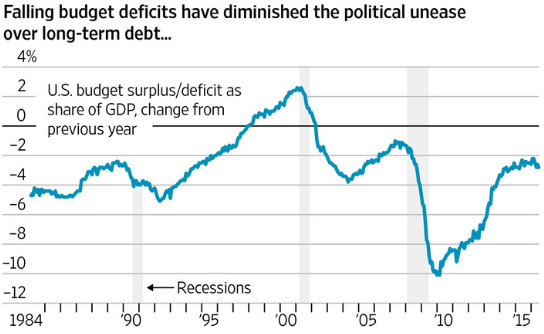
The debt problem is real and cannot be sloughed off as many try to do.  The two charts below show that while annual deficit levels have returned to what may be considered “normal” since 1984, they are still much too high and will lead to a rapidly increasing level of debt even if interest rates remain low which is by no means assured.
In other words, it is not good enough to just make the economy grow faster, it needs to be done in a fiscally responsible way.
I’ve already discussed how the Trump tax plan is unacceptable because it will substantially raise deficits and therefore make the debt much worse.

The same thing is true for the Clinton plan for “equitable” growth, but in a different way.  She wants

  • $250 billion in new spending for infrastructure.
  • Free public college tuition.
  • Universal Pre-K education.

Regardless of their individual attractiveness, it is irresponsible to propose new programs, with new spending, when deficits are already way too high and the debt is steadily climbing.

She also wants to:

  • Raise the national minimum wage to $15 per hour.
  • Mandate paid family leave.

The problem here is that both of these measures will increase unemployment and therefore slow down economic growth. Many states and cities are raising the minimum wage on their own and this way is preferable because it is locally determined.  Paid family leave should be left up to individual employers to use as an incentive to attract and retain good employees.

Conclusion. Hillary Clinton does want to make the economy grow faster which is highly desirable.  But she would do it with new federal spending and new mandates.  The new mandates will actually slow growth.  The new spending programs will add to the debt.  Both approaches are counterproductive.

Follow me on Twitter
Follow me on Facebook

“A Better Way” for Donald Trump to Make His Case


In my last post, “Donald Trump’s Best Chance to Win in November,” I said that the best way for Mr. Trump to broaden his appeal beyond working-class whites and to have any chance of winning the presidential election is for him to endorse the reform plan, “A Better Way,”  recently developed by the Republican House of Representatives.
Capture9Here is a brief and positive summary of the Trump platform so far:


  • His tax plan is highly pro-growth and will not cost nearly as much as the previously advertised $10 trillion over a decade.
  • He supports legal immigration and simply wants to solve the illegal immigration problem, one way or another.
  • He is not opposed to foreign trade per se but wants to negotiate, from a position of strength, with countries that manipulate their currencies, steal intellectual property or compel companies to disclose trade secrets as a condition of entering their markets.

His policy proposals so described are completely compatible with the House’s “A Better Way” reform plan whose planks are:


  • Poverty. Reward work. Tailor benefits to people’s needs. Improve skills and schools. Demand results.
  • National Security. Defeat the terrorists. Protect the homeland. Defend freedom.
  • The economy. Regulate smarter. End bailouts and cronyism. Put students and workers first.
  • The constitution. Make government more accountable and more representative. Restore constitutional checks on spending.
  • Health Care. More choices and lower costs. Real protections and peace of mind. Cutting edge cures and treatments. A stronger Medicare.
  • Tax reform. Simplicity and fairness. Jobs and growth.


These guiding principles are being fleshed out into complete policy documents. They do indeed represent a better way forward for our national government.  Donald Trump could do far worse than to endorse this comprehensive reform plan developed by the House Republicans.  It would show that he is serious about “Making America Great Again.”

Follow me on Twitter
Follow me on Facebook


Donald Trump’s Best Chance to Win in November


As I occasionally remind my readers, I am a non-ideological fiscal conservative and a registered independent. In November I will vote for the presidential candidate who has the most credible plan to address what I consider to be our country’s two more serious problems:

  • Slow Economic Growth, only 2.1% per year for the past seven years since the end of the Great Recession in June 2009. Faster growth will create more jobs and bigger wage gains for America’s workers.
  • Massive Debt. Our public debt (on which we pay interest) is now 75% of GDP, the highest it has been since the end of WWII, and likely to keep getting worse unless strong measures are taken to prevent this from happening.

According to current polls, Hillary Clinton is strongly predicted to be elected our next president. However her policy proposals will do little, if anything, to stimulate economic growth and are likely to make our debt much worse than it already is.
Capture8Donald Trump has a strong base of support among working class whites who are suffering in today’s economy and blame illegal immigration and unfair foreign trade for their woes.  However this base of support, while large enough for Mr. Trump to win the Republican nomination, is not nearly large enough to bring victory in November. The only way Mr. Trump can win is to greatly expand his base of support by appealing to moderate Republicans and Independents who are highly concerned about the direction our country is taking.
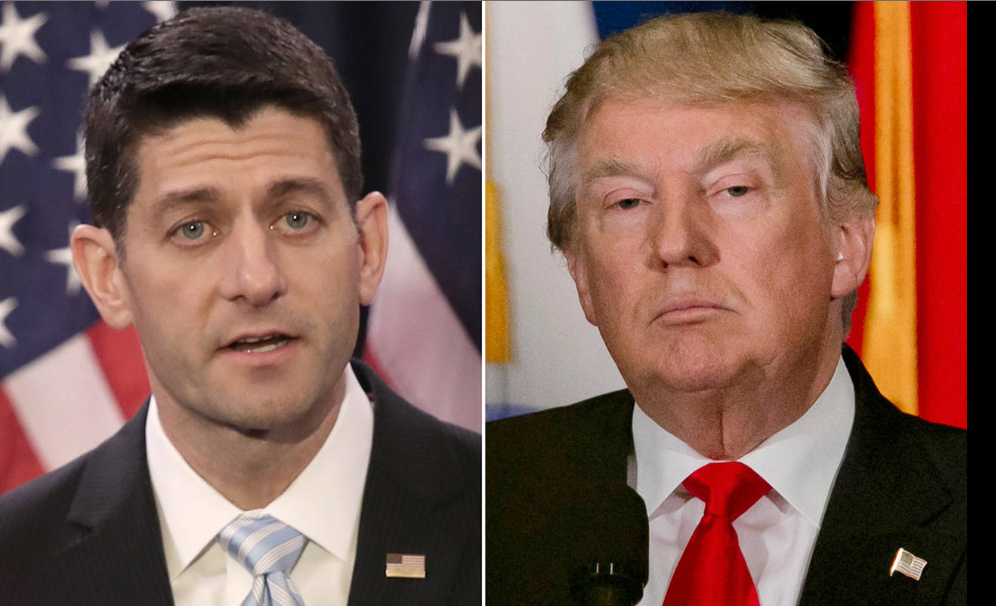
Capture9The best and most direct way for him to do this is to endorse the reform program, “A Better Way,” developed by the Republican House of Representatives, under Speaker Paul Ryan. This reform program has already unified the fractious Republicans in the House, and could easily serve as a vehicle for unifying the entire Republican party as well as many independents.
In my next post I will delineate how the Trump platform could easily mesh with “A Better Way.”

Follow me on Twitter 
Follow me on Facebook

Poor Education Is a Large Barrier to Black Progress


My last post, “Racism and Black Progress,” pointed out that, despite all of the racial tension in our society, especially bad at the present time, blacks have made much social and economic progress over the past half century.  All Americans of good will want this progress to continue.
I live in Omaha NE and am personally involved in a very promising public initiative to improve educational outcomes in inner city schools.  It is called the Learning Community and is an Omaha metro-wide effort to close the academic achievement gap between children from low-income families and those from the middle class.
Capture6The above chart shows clearly what the problem is.  Already in third grade FRL (free and reduced priced lunch) kids are behind on the NeSA (Nebraska State Assessment) reading test.  The gap persists into middle school and then gets much worse in high school.
Capture23A recent article in the Omaha World Herald reports that while black students make up 25% of Omaha Public Schools enrollment, they are responsible for 55% of disciplinary incidents.  Obviously, disruptive students are not learning what they need to know to succeed in school and in life.
A promising solution to this very difficult problem of improving educational outcomes for inner city students is early childhood education to prepare these kids to succeed in Kindergarten and then stay in school until graduation.  This is in fact the approach being taken by Omaha’s Learning Community.  But it is clearly a long range program which will take many years to show success.
Conclusion. A solid basic education is essential for success in today’s highly complex society.  Blacks will never reach full social and economic equality with whites until they achieve better educational outcomes.  Early childhood education has much promise in closing the academic achievement gap but will take many years to show significant progress.

Follow me on Twitter
Follow me on Facebook

Racism and Black Progress


At this time of heightened racial tensions in the U.S. it is worthwhile to step back and take a broader view of the economic and social status of blacks in America. The Washington Post’s Robert Samuelson has done just this in a recent column. As pointed out by Mr. Samuelson blacks have made much progress since the 1960s:

  • Poverty. Black poverty has dropped from 39.3% in 1967 to 26.2% in 2014, which was still double the white rate of 12.7%
  • Education. In 1950 only 13.7% of adult blacks had completed high school. By 2014 this had jumped to 86.7%. Over the same period the percentage of black adults with a four year college degree jumped from 2.2% to 22.8%. The corresponding percentage for whites in 2014 is 36%.
  • Upward Mobility. The black upper middle class (with incomes of $100,000 or more, inflation adjusted) has grown form 2.8% of households in 1967 to 13% in 2014. For the U.S. population as a whole it is now 31%.
  • Politics. In 1965, when the voting rights act was passed, there were five blacks in Congress, now there 46. Over the same time period, the number of black state legislators grew from 200 to 700.
    Capture22
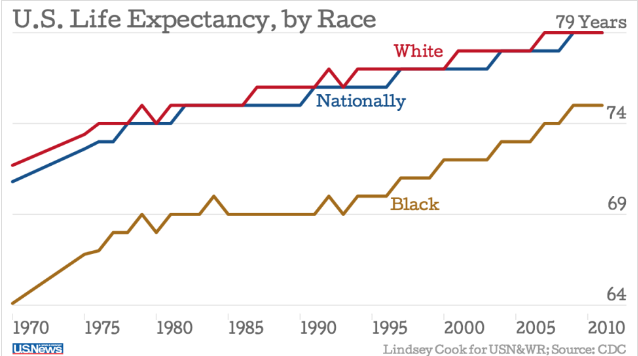
  • Life Expectancy. The life expectancy gap between blacks and whites shrank from 8 years in 1970 to 5 years in 2010.

Conclusion. Most people understand that life for blacks in America is more difficult than it is for whites. On the whole American society is trying to help blacks lift themselves up to be able to enjoy a more prosperous and satisfying life.  Much progress has been made in this respect in the last half-century but there is clearly still a long way to go in achieving full equality with white America. In my next post I will discuss one of the biggest barriers which remain in achieving equality between races.

Follow me on Twitter
Follow me on Facebook

Our Dire Fiscal Situation: A Summary


We are currently living in a high risk fiscal bubble. Low interest rates mean that our enormous and rapidly growing national debt is virtually “free” money.  When interest rates return to historically normal (much higher) levels, interest payments on the debt will explode putting us in a precarious fiscal situation.
As I have pointed out in the last few posts, it is the cost of entitlements and, in particular, health care entitlements, i.e. Medicare and Medicaid, which is driving our debt problem. The most effective way to control these entitlement costs is to control overall health care costs by insisting that all of us have more “skin in the game,” meaning that we must pay more of our health care costs directly from our own pockets as opposed to having them paid by third party insurance companies.
Capture20The latest report from the Congressional Budget Office, just a few days ago, shows that our debt problem is even worse than was projected just a year ago (see above).
Capture21The second chart (just above) shows the magnitude of the effort it will take to get our debt under control.  Just to stabilize the debt, i.e. to keep it from getting any worse than it is right now, will require a combination of spending cuts and/or revenue increases of 1.7% of GDP which amounts to $330 billion in 2016 dollars.
Conclusion. We have a huge national debt problem which is only going to keep getting worse until we make somewhat painful changes in federal policy.  We have to either restrain spending increases and/or increase taxes by significant amounts.  Health care entitlements are the biggest problem area and Medicare is worst of all.
Our two presumptive presidential candidates, Hillary Clinton and Donald Trump, are completely ignoring this grave problem.  And indeed their proposed policy initiatives will only make it worse!
Do we have the strength to deal with this dire problem short of another crisis?

Follow me on Twitter
Follow me on Facebook

The High Cost of U.S. Health Care


As I indicated in my last post, ”Entitlement Spending and the National Debt,” our national debt is much too high and steadily getting worse.  Furthermore, it is entitlement spending, especially Medicare, which is the fundamental driver of our increasing debt.  If we don’t solve this problem relatively soon, we will have another financial crisis on our hands, much worse than the last one in 2008.  When interest rates go up, as they will sooner or later, then interest payments on our accumulated debt will rise precipitously and threaten to bankrupt the nation.
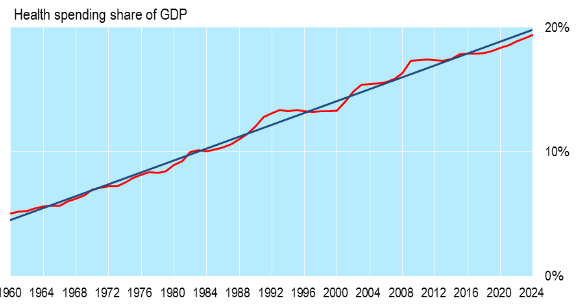
CaptureThe only effective way to control Medicare costs, however, is to control the overall cost of healthcare in the U.S., i.e. for private healthcare.  The above chart shows the nature of this problem.  Right now we are spending 17.4% of GDP on healthcare, public and private, and this is predicted to reach 19.6% of GDP by 2024.  This is almost twice as much as for any other developed country.
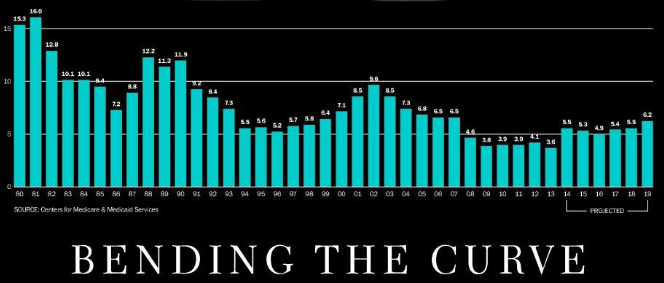
Capture6The Omaha World Herald had an article on Sunday, “Bending the Curve,” purporting to show that cost increases for total national healthcare spending are dropping (see just above).  The problem is that these supposedly low price increases in recent years are still twice the rate of inflation which is now averaging under 2% per year.  This means that even 4% – 5% price increases per year are much too high and need to be curtailed even further.
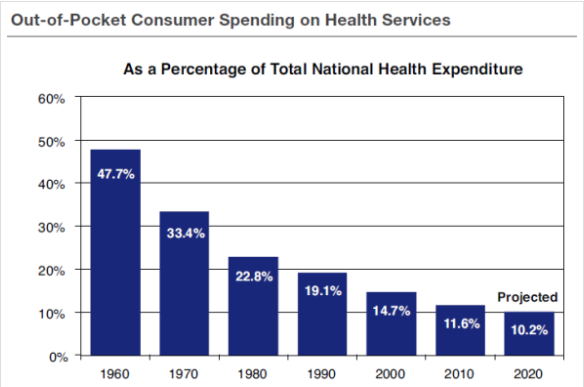
Capture10The fundamental reason why U.S. healthcare is so expensive is that Americans do not have enough “skin in the game.”  The above chart shows that our direct out-of-pocket costs for healthcare have been steadily dropping for the last fifty years as the role of health insurance has expanded.  This means that we simply don’t have enough personal incentive to hold down healthcare spending on our own.
Conclusion: We have to control entitlement spending, especially for Medicare, to get our national debt under control.  But this can only be done by limiting the steep spending increases in overall healthcare, public and private.  How will we be able to do this?  Be patient, we’re getting there!

Follow me on Twitter
Follow me on Facebook

Entitlement Spending and the National Debt


I discuss two fundamental economic and fiscal problems on this website:

  • The slow growth of our economy, only 2.1% per year since the end of the Great Recession in June 2009. This is largely responsible for stagnant wages for middle- and low-income workers, which is in turn responsible for the rise of the populist presidential candidates Bernie Sanders and Donald Trump.
  • Our massive national debt, now 74% of GDP for the so-called public part, on which we pay interest. This is the highest it has been since right after WWII.
    Capture2

Slow economic growth gets more public attention because of its direct and negative effect on so many people. However massive debt is more of an existential problem.  Right now our debt is almost “free” money because interest rates are so low.  But with debt predicted (by the Congressional Budget Office, for example) to keep climbing steadily under current policy (see the first chart) and with the inevitability of increased interest rates in the future, interest payments on the public debt are bound to rise precipitously.
Capture4The second chart just above (from the Concord Coalition) shows that interest payments on the debt will likely soon become the leading source of growth in federal spending.  But perhaps surprising is that the three non-interest sources of spending growth are the entitlement programs, Medicare, Social Security and the combined Medicaid, CHIP and ACA exchange subsidies.  All other government spending will decrease in relative terms.
Capture3Is it not readily apparent from this data that the only way to curtail a huge fiscal crisis in the not so distant future is to get entitlement spending under much better control?  The last chart, just above, (from the Trustees of SS and Medicare) shows the growth in general fund revenue required for Medicare and SS going forward.  In 2016 the discrepancy is 2.1% of GDP which amounts to $401 billion.  The discrepancy will double by 2040.  Of course, OASDI (SS) and HI (Medicare Part A) have trust funds paid into by payroll taxes.  But these trust funds are already paying out more than they take in and will be exhausted in a few years.

Conclusion. Spending on entitlement programs must be brought under much better control. How to do this will be the topic of my next post.

Follow me on Twitter
Follow me on Facebook

Evaluating the 2016 House Tax Reform Plan


The American economy is in a slow growth rut and needs to be revved up. Last week I surveyed a proposal for tax reform from the House Ways and Means Committee designed to do exactly this.
Capture11Its main features are:

  • Consolidate the seven current individual tax rate brackets into just three: 12%, 25% and 33%.
  • Dividends and capital gains are taxed at ½ of the above wage rates, depending on total income. This will encourage investment.
  • The standard deduction of $12,600 (for joint returns) is raised to $24,000 and the $4,050 personal exemption is eliminated. This means that fewer filers will itemize.
  • In fact, all itemized deductions for individuals are eliminated except for mortgage interest and charitable contributions.
  • The pass through tax rate for small businesses is capped at 25%. Full and immediate expensing for investments in new equipment and technology is allowed.
  • The corporate tax rate will drop from 35% to 20%, paid for by eliminating dozens of exemptions, including interest expensing. A territorial system will be established so that multinational firms will no longer be taxed on earnings both abroad and at home.

The non-partisan Tax Foundation has analyzed the House tax plan and concludes that:

  • The plan would significantly reduce marginal tax rates and the cost of capital which would lead over the long term to 9.1% higher GDP growth, 7.7% higher wages and an additional 1.7 million fulltime equivalent jobs.
  • The plan would reduce federal revenue over a decade by $2.4 trillion on a static basis and $191 billion on a dynamic basis.
  • On a dynamic basis, incomes for all income quintiles would increase by at least 8.4% over the long term.

Conclusion: TF’s analysis shows that the proposal is highly pro-growth.  But it should also be made revenue neutral by, for example, limiting the mortgage interest deduction as much as necessary to accomplish this. We need to make the economy grow faster but we also need to shrink our annual deficits.

Follow me on Twitter
Follow me on Facebook


How Progress Has Led to Discord


We were reminded by Robert Samuelson in yesterday’s Washington Post that America has made amazing progress in the last half century.
Consider that in 1960:

  • Men and Women held rigid gender roles.
  • African-Americans were restricted by legal segregation in the South and informal segregation almost everywhere else.
  • Homosexuality was virtually under the radar.
  • There was little environmental regulation.
  • Immigration was not an issue.
  • Defense made up 52% of government spending.

    Capture17

Think about all the (mostly) positive changes which have taken place in the meantime:

  • Women have taken paying jobs by the millions.
  • Racial segregation has been outlawed.
  • Gay rights have been established.
  • Environmental regulation has exploded.
  • Immigration, both legal and illegal, has increased.
  • Social spending has soared.
  • Defense is down to 16% of the federal budget in 2015.

Consider how our national politics is now stalemated:

  • The political system favors extremes.
  • Minorities live largely in big cities where they produce Democratic super-majorities.
  • Rural areas produce Republican super-majorities.
  • Incumbents are insulated from general election challenges which might pull them towards the center but are perpetually vulnerable to primary challenges from extremists who pull them towards the fringes.
  • Ideological purity trumps pragmatism. In the internet and cable-news era, politicians are constantly reassuring their constituents that they haven’t sold out.
  • The center sags and paralysis prevails.

Meanwhile serious national problems are getting much worse and not being addressed. Our public debt (on which we pay interest) is 74% of GDP, the highest since WWII.  The U.S. economy is growing only slowly at the rate of 2.1% per year ever since the end of the Great Recession seven years ago.  Neither presidential candidate has a credible plan to deal with these two most aggravating problems.
As a country we are in a huge mess.  How do we break out of it?  I wish I knew!

Follow me on Twitter
Follow me on Facebook