Janet Yellen vs Larry Summers


There is an informative article in the May 12, 2016 issue of Bloomberg Businessweek, “How to Pull the World Economy out of Its Rut.”  Recall that Janet Yellen succeeded Ben Bernanke as Chair of the Federal Reserve in January 2014. The other candidate for the post was Larry Summers.

Capture6They have rather different views about the role of a central bank:

  • Janet Yellen insists that economic conditions are returning to normal, even if slowly. She is neutral about the slow growth, secular stagnation hypothesis and using fiscal stimulus to overcome it.
  • Larry Summers argues that world growth is stuck in a rut because there is a chronic shortage of demand for goods and services. Growing inequality puts a bigger share of the world’s income in the hands of rich people who spend less. The new economy is asset-lite (Uber and Airbnb prosper by exploiting existing assets) and so needs less investment. Software doesn’t require the construction of new factories. He thinks that central bankers should spend more time and effort trying to influence fiscal policy. For example, more government spending on infrastructure, global warming and improving education. Also changing the tax code to put more money in the hands of lower- and middle-income families who would spend it.

I think that they are both partly right and partly wrong.

  • Janet Yellen is correct in believing that the Fed should stick to monetary policy. But she is too cautious in raising interest rates back to more normal levels. There will be some (stock market) pain in accomplishing this but it needs to be pushed faster regardless.
  • Larry Summers is correct in calling for action on the fiscal front. But his suggestions for how to do this are mostly off base because they will lead to massive new debt which must be avoided.

So what is the proper course to get out of our economic rut? It is what I’ve been saying over and over again but I’ll repeat it for good measure in my next post!  Stay tuned!

Follow me on Twitter
Follow me on Facebook

A Guaranteed Income for All: Good Idea or Bad Idea?


The social scientist and American Enterprise Institute scholar, Charles Murray, has an interesting article in yesterday’s Wall Street Journal, “A Guaranteed Income for Every American,” Mr. Murray proposes a Universal Basic Income (UBI) with the following features:
Capture6

  • Every American citizen age 21 and older would get a $13,000 annual grant deposited electronically into a bank account in monthly installments. $3000 would be applied towards health insurance.
  • UBI is financed by eliminating all other welfare programs: Social Security, Medicare, Medicaid, food stamps, housing subsidies, aid for dependent children, etc. as well as agricultural subsidies and corporate welfare.
  • People can make up to $30,000 a year without losing any part of the grant. Above $30,000 in earned income, the grant decreases to $6500 when the income reaches $60,000. The $6500 retained by all compensates for losing Social Security and Medicare.
  • The overall cost of UBI will be $200 billion per year less than the current system. By 2020 UBI would be nearly $1 trillion per year cheaper.

On the other hand, there are at least two possible drawbacks to the Murray plan, as discussed recently by Eduardo Porter in the New York Times:

  • It would probably discourage work. Right now 80% of Americans in their prime working years, 25 – 54, are employed. Work is not just what people do for a living, it organizes people’s lives. Making work more optional would impair this basic social structure.
  • A UBI divorces assistance from need. For example, a housing voucher could lead a family to move to a better neighborhood. A basic monthly income would probably not.
  • More generally, a single parent with several children would be strapped to get by for $10,000 per year without any additional welfare assistance. We can’t let the kids starve.

Conclusion: UBI appears to be an attractive way to simplify our vast welfare system and would save a significant amount of money (always important). But the poor would not be well served.  There are better ways to reform our public assistance programs.

Follow me on Twitter
Follow me on Facebook

The Challenges of American Health Care II. Specific Problems to Overcome


My last post, “The Challenges of American Health Care,” describes the huge demographic and cost pressures facing American healthcare  and lays out a comprehensive reform plan by the Hoover Institution’s Scott Atlas to address them.  Today I will give more details about these pressures on both private care as well as care subsidized by the Affordable Care Act.
Capture6For example:

  • The cost of providing health care to an average American family surpassed $25,000 for the first time in 2016, $1,155 higher than last year, and triple the cost in 2001.
  • A significant cost driver is the rapid growth in what health plans and insured people are paying for prescription drugs, now comprising $4,270 annually, or 17% of the total.
  • 80% of healthcare costs come from just 20% of the population.
  • The insurance company United Healthcare announced that it is withdrawing from most ACA exchanges because it lost $475 million on plans sold in 2015 and expects to lose another $650 million in 2016.
  • Overall $2.5 billion was lost by insurance companies on the exchanges in 2014. The government’s “risk corridors” program is insufficiently funded to reimburse these losses to the insurance companies involved.
  • The fundamental problem is politicization of the marketplace. Insurers were pressured to set premiums low initially to ensure that the rollout was not a flop. Now premiums are increasing rapidly to cover the initial losses. Households with income over 250% of poverty already find the plans offered on the ACA exchanges unattractive.

Conclusion: The overall rapid increases in the cost of healthcare, public and private, is unsustainable for individuals, families, employers and government. Something has to give.  We need a total reform of healthcare spending in the U.S.  Many good suggestions have been made for how to do this.  Now is the time to act!

Follow me on Twitter
Follow me on Facebook


The Challenges of American Health Care


America is facing great challenges in healthcare. Our national health expenditure is $3.1 trillion per year, 17.4% of GDP, and is projected to reach 19.6% of GDP by 2024.   Some 34% of Americans are obese (BMI>30), far more than in any other country. Their medical expenses will soar in the years ahead.  Medicaid now covers over 70 million low-income people at a cost of $500 billion per year.  Medicare spends $615 billion per year on the 42 million Americans over age 65.
CaptureThe Hoover Institution’s Scott Atlas has just published “Restoring Quality Health Care: a six-point plan for comprehensive reform at lower cost.”  He claims that his plan will save $2.75 trillion over a decade for private healthcare and an additional $1.5 trillion per decade for federal healthcare programs such as Medicare, Medicaid and the Affordable Care Act.
The elements of his plan are to:

  • Expand Affordable Private Insurance by allowing all insurers to offer high deductible, limited-mandate catastrophic coverage (LMCC) to all citizens, which would be owned by individuals and portable.
  • Establish and Liberalize Universal Health Savings Accounts (HSA) for all citizens, individually owned and portable.
  • Instill Appropriate Incentives with Rational Tax Treatment of Health Spending equal for all, whether individual, self-employed or employer-based, requiring LMCCs for all.
  • Modernize Medicare for the 21st Century by establishing a private insurance option with defined-benefit premium support based on regional benchmarks featuring cash rebates to individual HSAs if premium is less than benchmark, otherwise additional cost paid by enrollee.
  • Overhaul Medicaid and Eliminate the Two-Tiered System for Poor Americans by permitting all insurers to offer LMCC plans to entire state population as well as setting up government seeded HSAs for all Medicaid enrollees.
  • Strategically Enhance the Supply of Medical Care While Ensuring Innovation by stimulating private retail clinics and loosening practice restraints on nurse practitioners and physician assistants.


A plan along these lines would go a long way towards both improving the quality and lowering the costs of American healthcare.

Follow me on Twitter
Follow me on Facebook

How Will America Solve Its Biggest Problems?


As I repeat over and over again, our two biggest national problems, in my opinion, are slow economic growth (only 2.1% annual increases in GDP for the past seven years) and massive public debt (now 74% of GDP, the highest it has been since right after WWII).
Capture11Are these problems being addressed by our political system?

  • Our 2016 presidential race is clearly touching on them to some extent. The “Sandernistas” think that the Obama economic policies are not progressive enough and need to be doubled down on. Middle-income “Trumpsters” are revolting against the stagnant and falling wage growth of the past fifteen years.
  • The political scientist James Piereson thinks that the Democratic-welfare regime, in place since 1932, has now run its course and will necessarily be superseded by America’s Fourth Revolution which is imminent.
  • The social scientist Yuval Levin thinks that our “Fractured Republic” can heal itself peacefully if the left is willing to accept a less centralized, more federalist, governmental approach to solving economic and fiscal problems and the right is willing to accept that modern America is highly diverse and individualistic and where a significant degree of cultural fracturing, family breakdown and estrangement from tradition are inevitable.

My own opinion is that our huge and rapidly growing public debt (on which we pay interest) is unsustainable and will lead to another crisis much worse than the Great Recession of 2008-2009 unless it is curtailed. Without an adequate response in the meantime, the new crisis will occur when interest rates inevitably rise significantly and therefore lead to huge increases in interest payments on our larger and larger accumulated debt.
To avoid such a calamity we need to do a much better job of controlling federal spending.  It would also help to speed up economic growth in order to increase tax revenue.  Furthermore, faster growth would create more jobs and better paying jobs.  This would take much of the steam out of the appeal of populist candidates such as Bernie Sanders and Donald Trump.
I can’t foresee exactly how we will be forced to change course but it’s going to happen fairly soon.

Follow me on Twitter
Follow me on Facebook

The Fractured Republic II. Where Do We Go From Here?


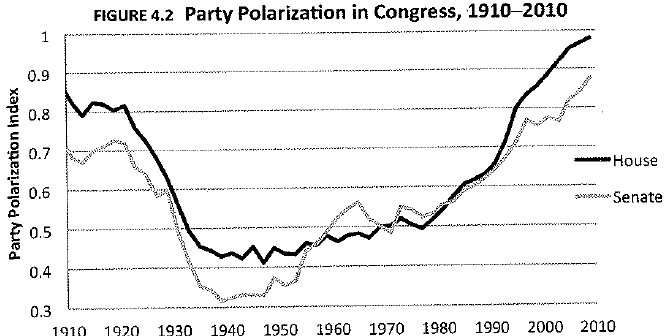
I normally take what I consider to be a straightforward non-ideological approach to solving our country’s major problems. But in my last post, “The Fractured Republic,” I consider a larger framework constructed by the writer, Yuval Levin, who argues that both conservatives and progressives are stuck in nostalgia for a mid-twentieth century way of life to which it is impossible to return. As Mr. Levin points out, the last 100 years of American life have seen a consistent pattern of

  • Drawing together and then pulling apart. Three particular aspects of this phenomenon are pictured in the three charts below concerning immigration, political polarization and income inequality.
    Capture14
    Capture16Capture15
  • Midcentury America straddling two broad trends: a consolidated society actively combatting some of its least attractive downsides like institutional racism, sexism, cultural conformity and a dearth of economic freedom.
  • A diffuse and still diffusing democracy. The problems we face today are the price of progress. In liberating many individuals from oppressive social constraints, we have unmoored them from their communities, work and faith. In accepting a profusion of options, we have unraveled the established institutions of an earlier era.
  • Hollowing out of the middle layers of American society has resulted from the diffusing and polarization of our national life. Solutions need to involve a recovery of these middle layers by means that are consistent with diffusion, diversity and decentralization.

These four conclusions about the current state of our society point towards an agenda for renewal:

  • The left will have to accept that the modern U.S. economy is decentralized, with diminished union power, higher income inequality, where cultural and economic pressures work against class mobility and large, centralized federal programs are a poor fit.
  • The right will have to accept that modern American society is highly diverse, individualistic, dynamic and deconsolidated where a significant degree of cultural fracturing, family breakdown and estrangement from tradition and religion is a fact of life.

Conclusion: Very succinctly, American social and economic progress in the future will require conservatives to accept ever expanding cultural pluralism (e.g. gay marriage and transgender rights) and progressives to accept a greater degree of economic freedom and decentralization.

Follow me on Twitter
Follow me on Facebook


The Fractured Republic


As readers of this blog will recognize, most of the time I write about what I consider to be America’s two major fiscal and economic problems at the present time: the slow growth of our economy (only 2.1% per year for the past seven years) and our massive and rapidly growing national debt (the public debt, on which we pay interest, is now 74% of GDP, highest since the end of WWII).
Every once in a while, I step back and take a broader view.  For example, last summer I reported on a new book by James Piereson, “Shattered Consensus: the Rise and Decline of America’s Postwar Political Order” which makes a strong case that only a new revolution, the fourth in our history, will suffice to turn our troubling fiscal and economic situation around.
Capture11Today I report on a book by Yuval Levin, of the Ethics and Public Policy Center, “The Fractured Republic,” which sees our current political paralysis as a result of nostalgia for the cohesive and unified America which emerged from the Great Depression and WWII.
Partisans on both sides of the political wars, both conservatives and progressives, want a reversal of some portion of the great changes in American life which have defined the postwar years, perhaps because American society has now achieved such a “perilous mix of over-centralization and hyper-individualism.”
“Progressives treasure the social liberation, cultural diversification, and expressive individualism of our time, but lament the economic dislocation and the rise of inequality and fragmentation. … Conservatives celebrate the economic liberalization, dynamism and prosperity, but lament the social instability, moral disorder, cultural breakdown and weakening of fundamental institutions and traditions.”
Mr. Levin sees a possible way out of our current conundrum which need not involve the revolution which Mr. Piereson foresees.  Basically he argues for a modernized politics of “subsidiarity,” a movement towards decentralization in our public affairs.
Stay tuned for more details!

Follow me on Twitter: https://twitter.com/jack_heidel
Follow me on Facebook: https://www.facebook.com/jack.heidel.3

Why Is the U.S. Economy Growing So Slowly?


The U.S. economy has only been growing at the rate of 2.1% since the end of the Great Recession in June 2009, almost seven years ago. Such a slow rate of growth means millions of unemployed and underemployed workers and only small salary raises for tens of millions of others.
Capture5The New York Times economic journalist, Eduardo Porter, observes that we have “A Growth Rate Weighted Down by Inaction.”  He points out that:

  • Our economy is adversely affected by the gradual shrinkage of the work force as a share of population as baby boomers retire and the one time surge of women into the workforce in the 20th century has ended.
  • A second factor is a persistent decline in productivity growth over the last dozen years.
  • A pessimistic forecast by the Economic Cycle Research Institute foresees growth of only 1% per year for the next five years. The Congressional Budget Office projects more optimistic productivity growth at 1.5% per year, which added to workforce growth of .5% per year, would amount to total growth of 2% per year for the next ten years.

Mr. Porter goes on to say that there are concrete reasons why productivity growth is so slow:

  • Hiring is growing faster than capital investment. This is because most job growth in the last decade has been in (low productivity) services instead of (high productivity) manufacturing.
  • Too many restrictions on educated immigrants. Relaxing these restrictions would increase entrepreneurship.
  • Too many onerous regulations.
  • Under training of skilled workers. We need more vocational and career education.

Many people, including myself, have pointed out ways to alleviate these problems and speed up economic growth, for example see here. It is most unfortunate that our dysfunctional national leadership cannot figure out how to work together to get this done.

Follow me on Twitter
Follow me on Facebook

Economic Freedom and Economic Growth


I have written several posts recently, here and here, about America’s current very slow rate of economic growth.  In fact:

  • From 1970 – 2000 our economy grew on average at the rate of 3.5%.
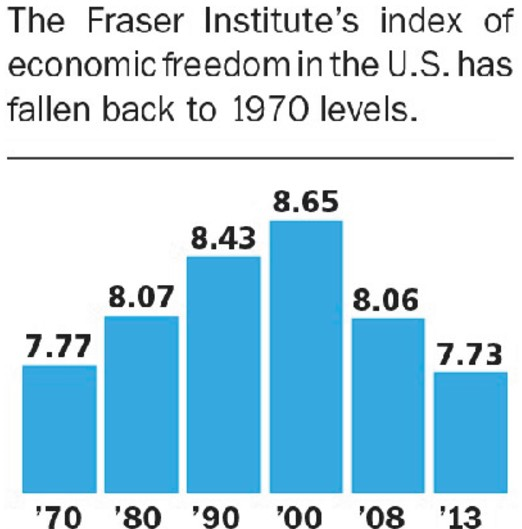
  • Since 2000 it has grown at only half this rate, 1.76% annually.Capture4

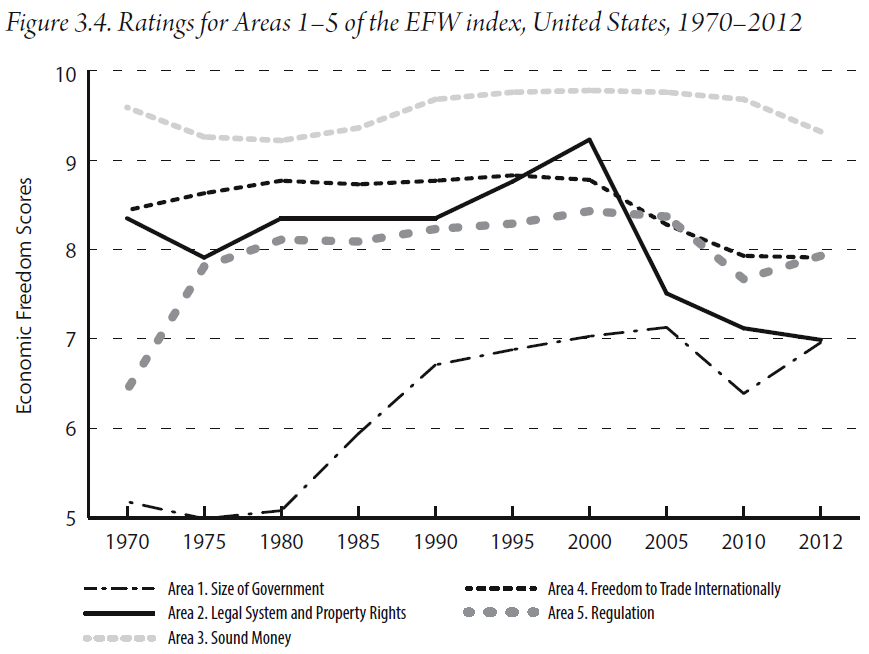
The economics journalist, Gene Epstein, writing in Barron’s, “The Real Reason Behind Slowing U.S. Growth,” points out the very strong correlation between our rate of GDP growth and the Fraser Institute’s Index of Economic Freedom in the U.S. This index is based on ratings in the five categories:

  • Size of Government.
  • Legal System and Security of Property Rights.
  • Soundness of Money.
  • Freedom to Trade Internationally.
  • Regulation of Credit, Labor and Business.

    Capture5

As shown in the chart above, the biggest reductions have occurred in the (2nd) Legal System, (4th) International Trade and (5th) Regulation areas.  Examples of freedom declines in the Legal System area are:

  • Judicial Independence: political interference in the bankruptcy proceedings of GM and Chrysler.
  • Impartial Courts: expanded use of Foreign Intelligence Surveillance Courts (FISA) where government requests are rubber stamped.
  • Property Rights: eminent domain made easier by the Supreme Court’s Kelo vs City of New London decision in 2005. The expanded use of civil asset forfeiture.
  • Military Interference in the Political Process: local police officers using excess military equipment.

According to the Fraser Institute, ”The effects of the Reagan and Thatcher political revolutions … led to increases in economic freedom and convergence among OECD nations. The so-called Washington Consensus of lower taxes, lower trade barriers, privatization and deregulation is quite evident in the data in the EF index.  The last decade has not been as kind to the cause of economic freedom.”
Such a huge correlation between the rise and decline of economic freedom and the concurrent rise and decline of economic growth is unlikely to be a coincidence.  Government policies strongly effect economic growth.  To ignore this self-evident truth is to invite economic decline.

Follow me on Twitter
Follow me on Facebook

Thank God for the Republican House of Representatives


It is now almost certain that Hillary Clinton will be the Democratic nominee for President and that Donald Trump will be the Republican nominee. The two biggest problems facing our country today are:

  • Slow economic growth, averaging just 2.1% since the end of the recession in June 2009, seven years ago. Even though unemployment is down to 5%, stagnant wages for the middle class have not nearly recovered from their pre-recession high.
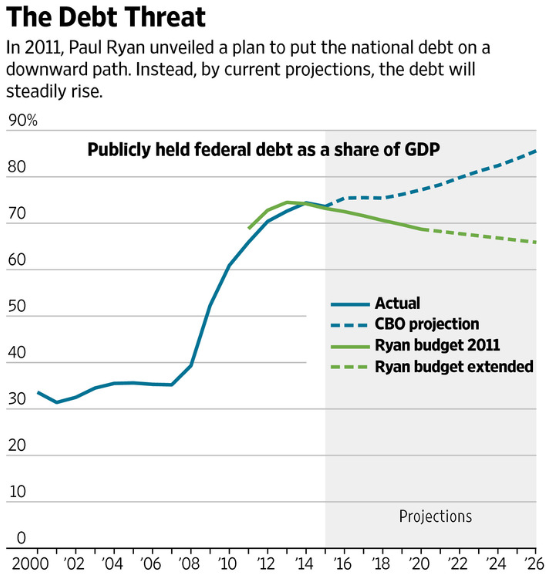
  • Massive debt. The public debt (on which we pay interest) is now at 74% of GDP and rising. When interest rates go up, as they surely will eventually, debt payment will rise by hundreds of billions of dollars per year and be a huge drain on government revenues.

The likely Presidential nominees are not adequately addressing these problems:

  • Hillary Clinton wants to increase government spending by about $100 billion per year to be spent on various new programs and raise the top tax rate to 45% to pay for them. This will do nothing to either grow the economy faster or shrink our already sizable deficit.
  • Donald Trump has promised to keep entitlements as they are and spend more on infrastructure and defense. He also sees debt as useful. “I probably understand debt better than anybody” he has stated. His tax plan (which he says is negotiable) will create massive new debt.

If Clinton is elected, she may pull the Senate Democratic along with her. But either way the House of Representatives will likely remain Republican with Speaker Paul Ryan.
Capture3Since the Republicans took over the House in 2010, they have consistently proposed budgets each year to shrink the deficit and produced a balanced budget within ten years.  The new President, either Clinton or Trump, will have to negotiate their own ideas on spending and taxes with a fiscally conservative House.
The country is indeed very fortunate for this circumstance.

Follow me on Twitter
Follow me on Facebook