
Why I Lean Republican


In the midst of a tumultuous presidential campaign season, it iscommon for partisans of the left and the right to question the integrity, motives and values of those on the other side of the political divide. For example, the rise of Donald Trump in the Republican primaries has led some observers to declare that the Republican Party has lost its way and no longer has any sort of basic, coherent and broadly acceptable political philosophy.
On the contrary, I think that Republicans do by and large share the following two general attitudes towards government which are favorite topics of discussion on this blog:

  • Economic growth in recent years has been much too slow and it should be a major goal of government to substantially speed it up.
  • Our national debt is much too high and Congress and the President should be making serious efforts to balance the budget on an annual basis.

The House Budget Committee has just made a big contribution towards the second goal with, “A Balanced Budget for a Stronger America. Fiscal Year 2017 Budget Resolution.”
Capture0Here are its basic components:

  • The federal budget will be brought into balance over a ten year period.
  • Devolving power back to the states.
  • Prioritizing the responsibilities of the federal government and concentrating on the most important.
  • Strengthening government functions that are critical to the health, retirement and economic security of millions of Americans.

Such a budget plan as this could make an excellent first step towards an eventual bipartisan agreement that would address some of our country’s biggest problems. Instead it is likely to be ridiculed or dismissed by the Democratic Party as mere political posturing by the Republican majority in Congress. What could be a beginning to real progress on urgent issues will probably just be washed down the drain.

Follow me on Twitter: https://twitter.com/jack_heidel
Follow me on Facebook: https://www.facebook.com/jack.heidel.3
Reviving the Working Class Without Building Walls


The strangest aspect of the current presidential campaign is the staying power of the highly unconventional and controversial candidate Donald Trump. There is wide agreement that the secret of his success is his strong appeal to the members of the white working class whose incomes have been in decline for many years.
The plight of the working class is often viewed in the context of the overall increase in income inequality in the U.S.  My last two posts, here and here, are part of that discussion.
Mr. Trump appeals to these disaffected voters by vowing to wall off Mexico and cut back on foreign trade.  But it may be possible to “Revive the Working Class Without Building Walls” as Eduardo Porter suggests in the New York Times.  According to Mr. Porter, what are needed are new government programs such as wage insurance or direct government employment.
CaptureAlternatively we could meet the illegal immigration and trade protectionism problems in a much more growth oriented way as follows:

  • Immigration Reform. Set up an adequate Guest Worker program to serve only those businesses and industries which can demonstrate that they are unable to recruit enough local workers to meet their employment needs. Once the Guest Worker program is functioning properly, eVerify would be enforced to weed out unauthorized illegal workers and deport them back to their home countries. At the same time the number of H1-B visas would be expanded in order to retain more of the highly skilled foreigners getting advanced degrees in the U.S.
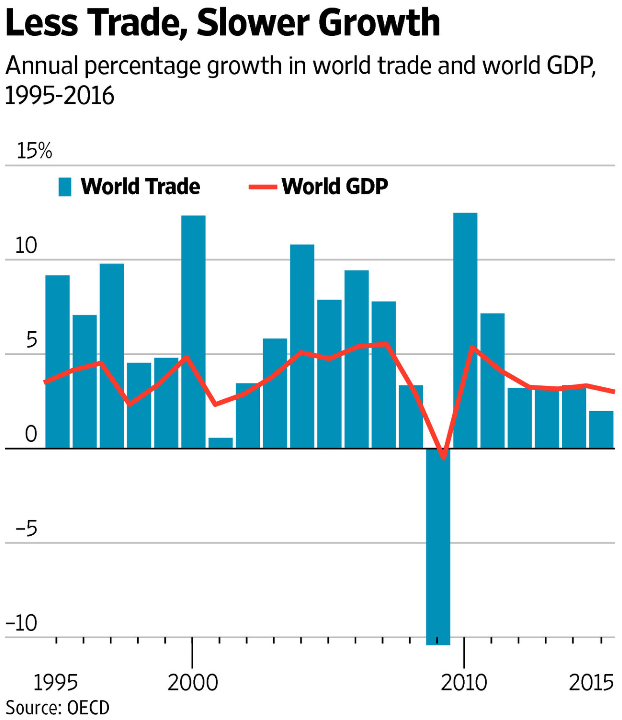
  • Foreign Trade. As the above chart shows, there is a close connection between world trade and world economic growth. And clearly the U.S. economy benefits from world-wide economic growth. The way to balance off job losses caused by foreign trade is with more effective trade-adjustment assistance and job retraining programs.

Whether or not Mr. Trump receives the Republican presidential nomination or is elected to be president in November, we should address the real grievances of his supporters in ways that benefit the entire economy.

Follow me on Twitter: https://twitter.com/jack_heidel
Follow me on Facebook: https://www.facebook.com/jack.heidel.3


How to Lower Income Inequality


My last post provides evidence that income inequality has increased more under recent Democratic presidents than under Republican presidents.  Here is a brief summary of the argument:

  • Cheap money is of greatest value to those who have access to it.
  • The effects of the Bush housing bubble (in the 2000s) were more evenly distributed than for the Clinton stock market bubble (in the 1990s) or the Obama credit bubble.
  • Two earner households are the backbone of the American middle class.
  • During the first six years of the Obama presidency, the number of two-earner households declined, the number of single-earner households rose by 2.6 million and the number of no-earner households rose by 5 million. In other words, two-thirds of the increase in the number of households under Obama is accounted for by households with no-one working. This largely accounts for the shrinking middle class and the increase in inequality.
    Capture

Another way to consider this situation is to look at the labor force participation rate which has been steadily decreasing since the year 2000.  As the above chart shows, this trend is expected to continue indefinitely in the same downward direction.  Along with a slowing increase in the productivity rate, this constrains the U.S. economy’s capacity to expand. Clearly what is needed is faster economic growth in order to create more jobs and better paying jobs.  The way to accomplish this is with:

  • Tax Reform. Lower individual and corporate tax rates for all paid for by shrinking deductions and closing loopholes. More money in the hands of the middle class will stimulate demand. More money in the hands of small business will stimulate supply.
  • Expanded Earned Income Tax Credit. Putting more money in the pockets of low-income and marginally employed workers will encourage more of them to find work and stay in the workforce.

With all the headwinds holding the economy back, our national leaders (and would be leaders!) ought to be focusing much more attention on taking specific actions which would speed up economic growth.

Follow me on Twitter: https://twitter.com/jack_heidel
Follow me on Facebook: https://www.facebook.com/jack.heidel.3

Surprise! It Is Progressives Who Drive Income Inequality


The economist Lawrence Lindsey has an Op Ed in yesterday’s Wall Street Journal  analyzing Census Bureau data here, and here showing that income inequality rose more under Bill Clinton than under Ronald Reagan.  It also has risen much more under Barack Obama than under George W. Bush.
Capture6Here is the explanation for this:

  • Cheap money is a boon to those who have access to it.
  • Bill Clinton, George W. Bush and Barack Obama all presided over bubble economies fueled by easy monetary policy. But the effects of the Bush housing bubble were more evenly distributed than for the Clinton stock market bubble or the Obama credit bubble.
  • In 1968 government transfer payments totaled $53 billion or roughly 7% of personal income. By 2014, these had climbed to $2.5 trillion or 17% of personal income. Despite the redistribution of a sixth of all income, inequality is far higher today than in 1968.
  • Two earner households have become the backbone of the American middle class.
  • When families with children making between $20,000 and $50,000 attempt to have a second earner go back to work, the effective tax rate on the extra earnings, including lost government benefits, is between 50% and 80%. This “working class trap” is increasing income inequality and keeping the income of these households lower than they would otherwise be.
  • During the first six years of the Obama presidency, the number of two-earner households declined, while the number of single-earner households rose by 2.6 million and the number of no-earner households rose by 5 million. In other words, two-thirds of the increase in the number of households under Obama is accounted for by households with no one working. This is the reason the middle class has shrunk and that inequality is increasing.
  • A recent Brookings Institution study shows that boosting the top tax rate from 39.6% today to 50%, and redistributing the additional $95 billion in tax revenue to the bottom 20% of wage earners would reverse only 20% of the increase in income inequality under Obama.

As Mr. Lindsey concludes, “Attacking the rich and running against inequality may be a sensible political strategy. But in the end the programs to implement this strategy make the problem worse.”

Follow me on Twitter: https://twitter.com/jack_heidel
Follow me on Facebook: https://www.facebook.com/jack.heidel.3

Is A Carbon Tax Practical?


The evidence for global warming is overwhelming and largely beyond dispute.  On the other hand, our industrialized world is highly dependent on the fossil fuels which produce it. This is what makes global warming such a hot political potato.
Capture9Yesterday the New York Times columnist Eduardo Porter described a carbon tax which has been implemented in British Columbia and has gained wide political acceptance.  Its general features are:

  • It was introduced in 2008 by the Liberal Party which is actually quite conservative. It survived a challenge by the left-leaning New Democratic Party in 2009.
  • The economy in British Columbia grew faster than its neighbors even as its greenhouse gas emissions declined.
  • The tax rose from $10 (Canadian) per ton of carbon dioxide in 2008 to $30 (Canadian) in 2012. It raised the cost of a gallon of gasoline by 19 cents (U.S.)
  • Despite the price increases, voters warmed to the tax. In 2015 only 32% of British Columbians opposed it, down from 47% in 2009.
  • Every single carbon tax dollar is returned to families and businesses through a variety of tax breaks.

British Columbia’s experience shows that a carbon tax can work in practice. Here are a couple of reasons why such a tax should appeal to a broad political cross spectrum in the U.S.

  • A properly calibrated carbon price in the United States could effectively replace all the climate-related regulations businesses hate so much, including renewable fuel mandates and President Obama’s Clean Power Plan.
  • A carbon tax could become part of a broad fiscal overhaul, using the revenue, for example, to offset cuts in payroll taxes.

Conclusion. The rapidly changing climate and weather patterns caused by global warming are a threat to human civilization. Reasonable measures can be taken to mitigate the effects with minimal economic disruption.  As the world’s strongest economy and leading superpower, the U.S. should be providing more leadership towards addressing this very serious problem.

Follow me on Twitter: https://twitter.com/jack_heidel
Follow me on Facebook: https://www.facebook.com/jack.heidel.3

Is America in Decline?


In recent posts, here and here, I have been discussing some of the big challenges facing the United States:

  • We have huge economic strengths (world’s largest economy) and, at the same time, huge economic weaknesses (massive and rapidly growing debt).
  • A chaotic Middle East (four civil wars going on, a refugee crisis swamping Europe, drone strikes against terrorists) with no coherent strategy to address the overall problem.
    Capture6A new book by Ian Bremmer, “ Superpower: Three Choices for America’s Role in the World” considers America’s various options for future leadership.  Says Mr. Bremmer:
  • Even though our foreign policy is in decline, America itself is not in decline. Our per- capita income is eight times China’s, our biggest rival. We have an entrepreneurial culture which is the envy of the world. More than 30% of all money spent on research and innovation in 2014, some $465 billion, was spent in the U.S. Nowhere is the American capacity for innovation more obvious than in energy production, the lifeblood of economic growth.
  • Another crucial advantage is that time is on America’s side. Europe, Japan and China are all aging much more quickly than the U.S.
  • Seventeen of the world’s top twenty research universities are based in the U.S. But 40% of the people receiving advanced STEM degrees from American universities are foreign nationals with no legal way to stay here. We should fix this problem!
  • More and more Americans are tired of spending so much blood and treasure on overseas problems. The central flaw in our current strategy, they say, is that we have no real priorities. But they mostly recognize that America can never really be safe in an unsafe world.

Conclusion. Along with its many daunting challenges, the U.S. also has many strengths and will likely remain the world’s primary superpower for many years to come.  But the U.S. needs to develop a more widely acceptable strategy for projecting economic and military strength around the world.  Worldwide peace and stability depend on us getting the job done right.

Follow me on Twitter: https://twitter.com/jack_heidel
Follow me on Facebook: https://www.facebook.com/jack.heidel.3

Fight or Flight: America’s Choice in the Middle East


The main concerns of this blog are the fiscal and economic problems faced by the U.S. How do we address the very serious issues of a slow economy and rapidly growing national debt.  But like it or not, what we do affects the whole world. If we fail to meet our responsibilities for world leadership, then everyone, including us, will suffer the many serious consequences.
Capture6The Brookings Institution’s Kenneth Pollack has an excellent article in the current issue of Foreign Affairs, “Fight or Flight: America’s Choice in the Middle East,” clearly making the case for strong American leadership.  According to Mr. Pollack, “The costs of stepping up are more manageable than the risks of stepping back, but either option would be better than continuing to muddle through.”  He explains that

  • The problem began after WWII when the Arab states either became secular republics (dictatorships) or monarchies.
  • By the 1990’s popular discontent had risen throughout the Middle East and exploded in the Arab Spring of 2011.
  • Now there are full blown civil wars in Iraq, Libya, Syria and Yemen with nascent conflicts in Egypt, South Sudan and Turkey.
  • Stabilizing the Middle East will require shutting down the current civil wars with at least small numbers of combat forces in Iraq and possibly Syria. Economic assistance and infra-structure development should be given only in return for political reform.
  • The advantage of a reduced U.S. presence in the Middle East is that it would reduce the threat from terrorism.
  • The great challenge to the U.S. in stepping back is the risk of the near-term collapse of Egypt, Jordan, Lebanon, Tunisia and Turkey.
  • The worst outcome of all is for the U.S. to continue muddling through, committing enough resources to enlarge its burden without increasing the likelihood of making things better.

The current European refugee crisis is perhaps the most glaring example of what happens when the U.S. fails to provide the leadership of which only it is capable. Let’s hope that our next president has the ability to turn around the chaotic situation which currently exists in the Middle East.

Follow me on Twitter: https://twitter.com/jack_heidel
Follow me on Facebook: https://www.facebook.com/jack.heidel.3

 

The Strengths and Weaknesses of the U.S. Economy


If the U.S. is going to be able to solve its serious economic and fiscal problems, there needs to be a realistic understanding of what they are. My last post, “Is the U.S. Economy Really in Good Shape?” discusses a recent Op Ed in the Wall Street Journal by Martin Feldstein.  Mr. Feldstein makes the case that it is in pretty good shape right now even though there are big problems on the horizon. Unfortunately, such an assessment is likely to lead to complacency and inaction towards our long term problems.
Capture0Let’s look at the overall situation.

Our Economic Strengths:

  • The world’s largest economy, twice as large as our nearest competitor, China. The 2.2% GDP growth since the Great Recession ended in June 2009 is not especially robust but it’s among the best in the developed world.
  • World leadership. The U.S. dominates international finance, technology, higher education and popular culture. Everybody else wants to emulate us and to have what we have.
  • The U.S. Dollar dominates world currency because of its strength and stability. This protects the value of the dollar relative to other currencies.

Our Economic Weaknesses:

  • Massive Debt. The public debt (on which we pay interest) now stands at 74% of GDP, the largest since right after the end of WWII. As our currently low interest rates inevitably continue to rise, interest payments on the debt will skyrocket creating a huge burden on future generations.
  • Demographic Challenges. Payouts for Social Security, Medicare and Medicaid are continuing to grow rapidly, thereby putting upward pressure on annual deficits as well as accumulated debt.
  • Slow Growth Environment. The economist Robert Gordon makes a persuasive case that the explosive economic growth which the U.S. enjoyed from 1870 – 1970 will be very difficult, perhaps even impossible, to duplicate in the future.


The big picture is that we are going to have to work hard to achieve the degree of economic growth which will be needed to propel American society forward in the future as it has in the past.

Follow me on Twitter: https://twitter.com/jack_heidel
Follow me on Facebook: https://www.facebook.com/jack.heidel.3
 

Is the U.S. Economy Really in Good Shape?


The noted Harvard economist, Martin Feldstein, says in yesterday’s Wall Street Journal, that “The U.S. Economy Is in Good Shape.”
Capture0The reasons are that:

  • We are essentially at full employment with an overall unemployment rate of 4.9% and 2.5% among college graduates.
  • Real income (after government transfers and federal taxes) is up 49% between 1979 and 2010 for households in the lowest income quintile. Real income is up 40% between 1979 and 2010 for households in the middle three income quintiles.
  • The 70% decline in the price of oil since early 2015 will eventually have a positive impact on U.S. economic growth. The fall in gasoline prices alone has increased annual household spending power by more than $1000 per household. When consumers start spending this money, it will have a large impact.
  • The Fed’s quantitative easing program has led to artificially high stock prices which now are coming down as the Fed begins to raise short-term interest rates. The U.S. economy is strong enough to withstand this shock. It would be a mistake for the Fed to abandon its December forecast of four rate increases in 2016.

I would refer to Mr.Feldstein’s analysis as a somewhat rosy scenario. It ignores our low labor participation rate, our high (U-6) underemployment rate of 9.8% and the historically slow 2.2% growth of our economy since the end of the recession almost seven years ago.
Mr. Feldstein goes on to say that “the American economy does face long term problems.  High on the list is the large and growing national debt, rising from less than 40% of GDP before the recession to 75% now and heading to more than 80% in ten years.  But the big uncertainties which now hang over our economy are political, with presidential candidates threatening to raise taxes, increase fiscal deficits and pursue antibusiness policies.”
Conclusion. What Mr. Feldstein is really saying is that our economy is in satisfactory shape right now but that we must attend to its long term threats to make sure that things do not turn sour.  What the presidential candidates are saying in this respect is not encouraging.

Follow me on Twitter: https://twitter.com/jack_heidel
Follow me on Facebook: https://www.facebook.com/jack.heidel.3

The Source of Economic Growth


In my last post, “What the Republican presidential candidates should be saying,”  I summarized the argument by the economist, John Cochrane, that “sclerotic growth is the economic issue of our time.” Mr Cochrane shows dramatically that even small differences in the growth rate over time can make a huge difference in raising living standards.
Capture0He goes on to say that

  • There is only one source of growth. Nothing other than productivity matters in the long run.
  • The vast expansion in regulation is the most obvious change in public policy accompanying America’s growth slowdown. Most recently under the Dodd-Frank Act and the Affordable Care Act, the financial and healthcare sectors of the economy have seen radical increases in regulatory intervention. But environmental, labor, product and energy regulation have all increased dramatically as well.
  • Regulation during the financial crisis did not fail for being absent. It failed for being ineffective.
  • The best way for the government to subsidize healthcare efficiently is to give straightforward vouchers which people can use to buy insurance or to fund health savings accounts. Such vouchers should replace Obamacare, Medicaid and Medicare.
  • The basic structure of growth-oriented tax reform is lower marginal rates, paid for by broadening the base by removing exemptions and loopholes. Several additional tax principles are:
  • The ideal corporate tax rate is zero. A high corporate tax rate hurts the workers more than anyone else.
  • A growth-oriented tax system taxes consumption, not income and savings.
  • Eliminating or moving away from taxing income, would lessen the value of personal deductions such as for mortgage interest or charitable donations.
  • The estate tax is a particularly distorting tax on saving and investment. The tax code should not give strong incentives to middle-age people to stop building their businesses or investing their money.
  • Solving our immigration problem would turn 11 million illegal immigrants into productive citizens. Guest worker and e-Verify enforcement are fixable problems.

How to speed up economic growth ought to be one of the basic issues in the presidential election campaign. Here are some good ways to do this.

Follow me on Twitter: https://twitter.com/jack_heidel
Follow me on Facebook: https://www.facebook.com/jack.heidel.3