America’s Fourth Revolution


The Manhattan Institute’s James Piereson has written a fascinating new book, ”Shattered Consensus: The Rise and Decline of America’s Postwar Political Order” in which he argues that the New Deal liberal consensus has broken down and will soon be replaced by a new model containing several specific features. The coming new model will be the result of a Fourth Revolution of comparable scope to the first three:

  • A Democratic-expansionist regime from 1800 until 1860 which dissolved in the midst of the slavery and secession crisis.
  • A Republican-capitalist regime from 1860-1930, which was brought down by the Great Depression.
  • A Democratic-welfare regime from 1932 until the present, although with faltering support after 1980.

America’s third regime is in the process of fading out or collapsing for three reasons:

  • Debt. The national debt of $18 trillion today, at about 100% of GDP, is comparable to the debt at the end of WWII. But once the war ended the government cut spending and stopped borrowing and the U.S. economy grew at 4% for the next 20 years. Nothing comparable to this major debt reduction is in sight today.
  • Demography. Today there are about 160 million people in the U.S. workforce of whom 120 million have full time jobs. The workforce will grow by 1 million per year for the next ten years while the number of people turning 65 will grow at nearly twice that rate. The nation will soon reach a point where 150 million working people will be paying payroll taxes to support 80 million people on Social Security and Medicare. Political leaders are doing nothing to address this looming crisis.

    Capture5

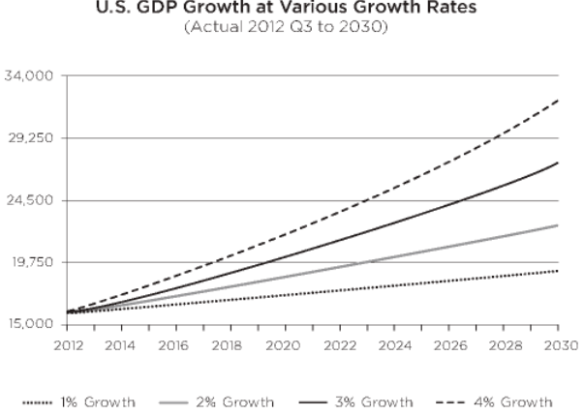
  • Slowing Economic Growth. The chart above shows how the U.S. economy has been slowing since the 1960’s. Since the end of the Great Recession in 2009, GDP has grown at only 2.2% and is likely (CBO) to continue growing indefinitely at this slow rate under current policies. The second chart shows the enormous difference between 2% growth and, for example, even 3% growth over time.
    Capture6Why don’t Congress and the President deal with these problems now, before they reach the point of crisis?   It’s because Congress has become increasingly polarized, with Democrats having moved leftward and Republicans moving rightward. Polarization is characteristic of regimes as they begin to tear themselves apart in conflicts which defy resolution within the existing structure of politics.
    My approach on this blog is that these very severe problems can be solved by politicians working together in a cooperative way. Mr. Piereson makes a very persuasive case that this is not likely to happen and that it will take a huge new crisis, a revolution, to straighten things out.
    I hate to say so but he may be right.

Should the National Minimum Wage Be Raised?


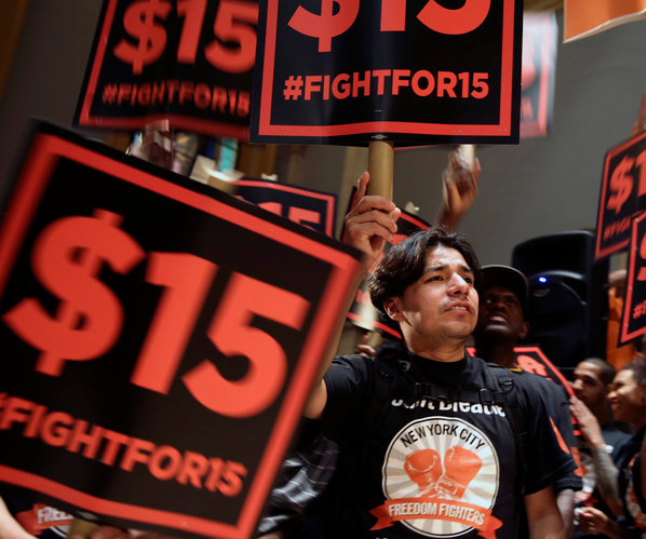
A recent column by David Brooks in the New York Times, “Minimum Wage Muddle,” is a good summary of the pros and cons of raising the minimum wage for the whole country. Mr. Brooks refers to a recent Congressional Budget Office report that a hike in the minimum wage to $10.10 per hour might lift 900,000 out of poverty but would also likely mean a loss of 500,000 jobs.
Capture5As suggested in a recent post, one of the things we could do to get beyond our political dysfunction at the national level is to:

  • Put a greater emphasis on state-centered federalism both to encourage experimentation and innovation in the American system and to remove issues from the national agenda which contribute to division, stalemate and endless controversy.
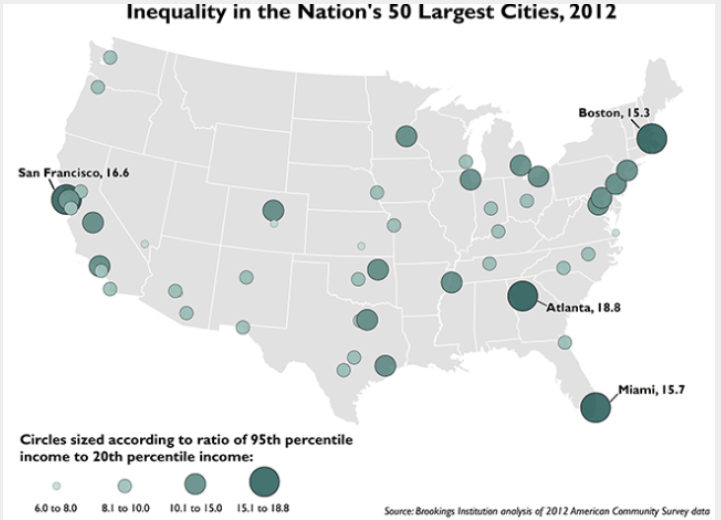
    Capture4Considering that income inequality varies so greatly from one part of the country to another, (see above), it makes a lot of sense to federalize the minimum wage issue. In other words, let cities and states set their own minimum wage levels based on their own local circumstances.
    For example, the state of Nebraska, with very little inequality and where I live, has just raised its minimum wage to $8/hour ($9/hour beginning January 2016). Nebraska’s lowest in the country unemployment rate of 2.6% means that hardly anyone will lose their job.
    As Mr. Brooks says, “Raising the minimum wage will produce winners among job holders from all backgrounds, but it will disproportionately punish those with the lowest skills, who are least likely to be able to justify higher employment costs.”
    Conclusion: raising the national minimum wage is not the best way to address the inequality and fairness issue. A better way is to create more jobs by boosting the economy overall. Then help low wage workers take home more money with a (perhaps expanded) Earned Income Tax Credit. Cities and states can establish their own individual minimum wages however they wish.

Richer and Poorer


As I often remind readers, this blog is primarily concerned with three basic fiscal and economic problems facing the U.S. They are: 1) our stagnant economy, 2) our massive debt, and 3) income inequality. Today I discuss inequality. The March 16 2015 issue of the New Yorker contains an extensive article on this topic by Jill Lapore, “Richer and Poorer.” However it suffers a common defect of only presenting one side of a complex issue.
There are facts about inequality which more people need to be aware of. For example:

  • The scope of income inequality is greatly reduced once incomes are adjusted for government transfers and federal taxes as shown in the following chart from the Congressional Budget Office.
    Capture
  • There is a strong correlation between inequality and growth as shown by the second chart just below from the World Bank.
    Capture2
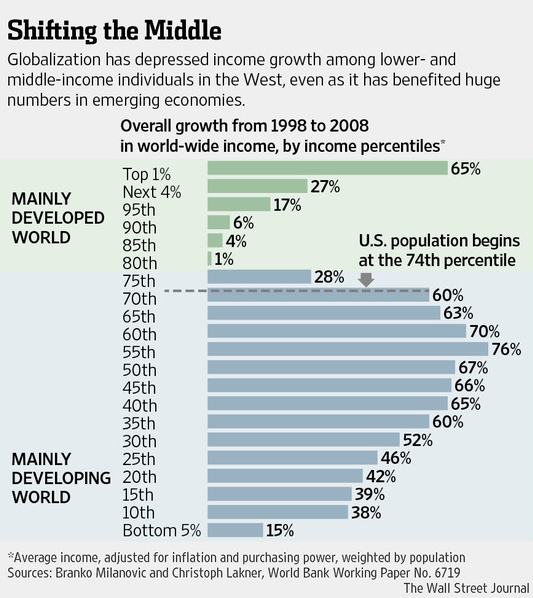
  • Globalization has had a dramatic effect on incomes world-wide as low skill work has shifted from the developed world to the developing world as shown in the chart below from the Wall Street Journal. Hundreds of millions of people in the developing world have been lifted out of poverty at the cost of lost jobs to low skill workers in the U.S. and other developed countries.
    Capture3Any effective strategy for decreasing income inequality needs to be reality based. Yes, it exists but its severity is exagerated. The Americans who need help the most are the ones unlikely to either attend or graduate from college. What they need most is vocational training to prepare them for the millions of high skill jobs going begging in the U.S.
    The best thing we can do to decrease income inequality in the U.S. is to get our economy growing faster. Since the end of the Great Recession in June 2009, it has grown at the historically slow rate of 2.2% of GDP and this slow rate of growth is predicted (by the CBO) to continue indefinitely under current government policies. A return to the historical 3% growth rate would create jobs and better jobs for millions of the unemployed and under-employed as well as providing bigger raises for the middle class as employers have to compete for qualified workers.
    How can we make the economy grow faster? I have addressed this critical issue many times and will return to it soon.

Fix It Now: the Political Philosophy of Chip Maxwell


I have just recently come across the book, “Fix It Now: Rediscover the Constitution and Get America Out of Its Fiscal Death Spiral” by Chip Maxwell, a candidate for Congress in Nebraska’s Second District May 2016 Republican Primary.
Chip lays out his political philosophy very clearly.  It is to:

  • Adopt a Balanced Budget Amendment to the U.S. Constitution, phased-in over ten years.
  • Phase out Social Security and Medicare for those under age 55.
  • Dismantle over the next decade the rest of the federal welfare/entitlement system.
  • Provide social services at the state or local level.
  • Launch a national effort to build a majority in Congress of crusaders for limited government.
    Capture1There are some attractive features to Chip’s program but overall I think it is too radical to have much chance at implementation.
    I am very much in favor of a balanced budget amendment and a ten year phase-in period is quite reasonable. Furthermore, providing social services at the state and local level would be much more efficient than what we are currently doing and, even with federal support, would be a big help in balancing the budget.
    Social Security and Medicare are lifelines for tens of millions of people. We can and should strengthen these programs in order to make them more financially viable for future retirees. They are now part of our national fabric and are here to stay.
    Chip’s last principle, promoting limited government, has much appeal but I think is not practical in this day and age. From my perspective, simply passing a Balanced Budget Amendment is sufficient to do what is needed. A BBA will force Congress to set spending priorities and eliminate inferior programs.
    Chip Maxwell is to be commended in running for Congress. If elected, he would move the needle in the right direction, even though some of his ideas wont work.

Predicting the Future


The postwar liberal consensus, beginning with President Roosevelt’s New Deal and extending through President Johnson’s Great Society, has broken down. The Reagan Revolution did not undo it and politics in the new 21st century have now become highly contentious with neither the Democrats nor the Republicans able to push their agendas very far.
Capture1The Manhattan Institute’s James Piereson has written a book, “Shattered Consensus: The Rise and Decline of America’s Postwar Political Order,” describing how we have arrived at our current impasse. Most interestingly, he predicts that “the Democratic blue model is unlikely to succeed at restoring growth and dynamism to the American economy” and that a new system will necessarily look more like the red model than the blue model, i.e. more sympathetic to business and private sector growth than to public employee groups and beneficiaries of public spending.
There will likely be at least three central elements to the new synthesis that must eventually replace the postwar order. They are:

  • A focus on growth, and the fiscal and regulatory policies required to promote it, as an alternative to the emphasis on redistribution, public spending and regulation.
  • An emphasis on federalism both to encourage experimentation and innovation in the American system and to remove issues from the national agenda which contribute to division, stalemate and endless controversy.
  • A campaign to depoliticize the public sector by eliminating or strictly regulating public employee unions.

Mr. Piereson promotes these three new principles of political organization on their intrinsic merits. For me there is the added attraction that each one would also improve our perilous fiscal condition by significantly reducing budget deficits. Growing the economy faster will increase tax revenue. Strengthening federalism means transferring spending programs from the national government (which is highly wasteful) to state governments which are far more efficient because they have to balance their budgets. Public employee unions are especially costly to state governments because of their strong negotiating power.
In short, the cost of government simply must be brought under much tighter control and Mr. Piereson has proposed three organizing principles which would accomplish this.

Inequality and Growth


In my opinion the two most serious problems facing the U.S. at the present time are 1) stagnant growth and 2) massive debt. As discussed by William Galston in yesterday’s Wall Street Journal, the U.S. presidential campaign is now beginning to address the first of these issues.  For example:

  • Bernie Sanders rejects “growth for the sake of growth” and says that “our economic goals have to be redistributing a significant amount back from the top 1%.”
  • Hillary Clinton says that we have to build a “growth and fairness” economy. “We can’t create enough jobs and new businesses without more growth, and we can’t build strong families and support our consumer economy without more fairness.”
  • Jeb Bush argues that there is nothing wrong with household incomes that 4% growth wouldn’t solve.

The readers of this blog will have little difficulty figuring out where I stand on this continuum of economic values. My view is illustrated by the chart just below from the World Bank which shows that countries with the fastest growing economies also have the least amount of inequality.
CaptureLet’s be more specific. Mrs. Clinton would achieve more fairness by:

  • Raising the minimum wage.
  • Guaranteeing child care and other family friendly policies.
  • Encouraging profit sharing.
  • Encouraging more innovation by increasing public investment in infrastructure, broadband, energy and scientific research.

These are attractive goals but how do we achieve them? The best way to raise wages is to get the economy growing so much faster that it creates a labor shortage. Then businesses will be competing for labor and wages will go up. This is exactly what is happening in Omaha NE where I live and the unemployment rate is down to 2.9% (2.6% in Nebraska as a whole).
Furthermore, in a tight labor market, businesses will automatically try harder to keep good employees by providing extra benefits such as childcare and profit sharing.
Public investment in infrastructure, etc. will be more easily affordable with the higher tax revenue generated by a faster growing economy.
Conclusion: faster growth is the best way to create a more fair and equal society!

“The Dung of the Devil”


My last post, “The Moral Case for Free Enterprise,” was motivated in part by a recent speech of Pope Francis comparing the excesses of global capitalism to the “dung of the devil.”
Capture2The scholar Mark Perry of the American Enterprise Institute has just published an interesting chart (just below) demonstrating an 80% reduction in world poverty in the 36 year period from 1970 to 2006.  He quotes AEI President Arthur Brooks that “if you love the poor, if you are a good Samaritan, you must stand for the free enterprise system, and you must defend it, not just for ourselves but for people around the world.  It is the best anti-poverty measure ever invented.”
CaptureIn a previous post, a year and a half ago, “A Global Perspective on Income Inequality,”  I referred to another chart (just below) to demonstrate the massive growth of income in the developing world.  To a large extent this is the result of economic globalization shifting low-skill employment from the developed world to the developing world where the cost of labor is less expensive. As Arthur Brooks says, “It was globalization, free trade, the boom in international entrepreneurship.  In short, it was the free enterprise system, American style, which is our gift to the world.
Capture1So, yes, the world as a whole is now much better off but American workers have paid a price for the global shift in low-skill work.  The answer is not to impede globalization but rather to:

  • Speed up the growth of our own economy in order to raise wages and provide more jobs for the unemployed and underemployed.
  • Improve K-12 educational effectiveness and expand career educational opportunities to better prepare present and future workers for the many new high-skill jobs being created all the time.

The world is changing rapidly but there are effective ways for the U.S. to adapt if only we have the good sense to move forward!

The Moral Case for Free Enterprise


Capitalism is under attack around the world as Greek socialists complain about their hard- hearted EU creditors, American liberals such as Bernie Sanders and Elizabeth Warren push the Democratic Party to the left, and Pope Francis compares the excesses of global capitalism to the “dung of the devil.”
CaptureOne of my favorite economic commentators is Arthur Brooks, President of the American Enterprise Institute.  One of his books is “The Road to Freedom: How to Win the Fight for Free Enterprise,” which examines the most important economic issues facing the United States from a moral point of view.  For example:

  • Getting the U.S. Economy Growing Again. Weak economic growth means the end of opportunity in America. Furthermore, weak growth disproportionately hurts those who most need new economic opportunities: the poor. One strategy says that the key to restarting economic growth is the state: more stimulus, more taxes, more borrowing. A second strategy says the source of economic growth is free enterprise: tax reform, less government regulation, policies that make it easier for entrepreneurs to succeed, and a smarter immigration policy.
  • Putting America Back to Work. Jobs are not just a source of money for Americans; they are a ticket to earned success. High unemployment is unfair because it robs people of their potential fulfillment. It is especially harmful to the poor and the young. The key to job creation is to get the economy growing faster.
  • Getting the United States Out of Debt. Unless the U.S. reduces deficits, it will have just three choices: steal from future generations, inflate the currency to lower the value of the debt or refuse to pay those to whom it owes the money. All of these options are immoral because they are unfair: they harm others who have done no harm to America. Three points here: 1) we have out-of-control entitlement spending, 2) debt crises are more successfully dealt with through spending reductions than with tax increases and 3) there are no quick fixes.

Considering basic economic and fiscal issues from a moral perspective adds an important new dimension to the discussion.  We might disagree on the details of how to proceed but it is imperative to take effective action of some kind!

The Root of Greece’s Problem (and Ours)


Will it be the Euro or Drachma for Greece?  It’s down to the wire as Greece and the European Union negotiate the necessary conditions for Greece to remain in the Eurozone.  I have devoted several recent posts to the Greek fiscal crisis, pointing out the parallels between the Greek situation and our own.
Greece needs a bailout because its public debt is nearly 180% of GDP.  Our own public debt is “only” 74% of GDP at the present time but is predicted by the CBO to reach 175% of GDP by 2040, just 25 years from now.  Furthermore, Greece is currently receiving very favorable lending conditions from the European Central Bank, much better than are likely to apply in the U.S. in the long term.  This means we’re likely to have another deep crisis on our hands much sooner than 25 years from now.
CaptureConsider the data in the above charts from today’s Wall Street Journal.  It shows that Greece is spending 14.4% of GDP on pensions, more than any other major European country.  Furthermore, the efficiency of its VAT revenue collection is the poorest in the EU.  In other words, Greece has a very high rate of entitlement spending and has a poor tax collection system to support it.
Capture1In a general sense the U.S. is in a similar situation.  Today we spend about 13% of GDP on mandatory, i.e. entitlement, programs, compared to a total tax revenue level of 18% of GDP.  Just entitlement spending alone is projected to rise to 18% of GDP by 2050, unless changes are made.
Just as Greece needs to tighten up on pension spending, improve revenue collection and get its economy growing faster, the U.S. needs to tighten up on entitlement spending and speed up its stagnant economic growth as well.
We’re not yet as bad off as Greece is today.  But we’re headed in that direction with no one to bail us out when we get there!

The High Cost of Less Austerity


All eyes are focused on the drama playing out in Greece.  The Greeks have just voted not to accept Europe’s latest offer to keep the credit flowing, amounting to a 5% of Greek GDP income transfer from their European neighbors, in return for additional economic reforms to put the country on a path to self-sufficiency.
Capture1The New York Times declares, “For Europe’s Sake, Keep Greece in the Eurozone,”  that the European Union should “offer some path forward for the Greek economy, starting by writing down its huge and unpayable debts.”  More than likely EU leaders will work out a new agreement with Greece to enable it to remain in the EU and the Eurozone.  Greece is lucky to be in such a position.
In a recent post, “Could the U.S. End up Like Greece? II. How Long Will It Take?”, I pointed out that the U.S. is likely to have a public debt of 175% of GDP by 2040, the same level as the Greek debt today.  Furthermore interest rates are likely to be higher than their unusually low level today which means that we will be making proportionally higher interest payments at that time.  In other words, we are likely relatively soon, within 25 years, to have a painfully high level of debt.
Who is going to bail us out when our own debt becomes “unpayable”?  Obviously, no one!  Right now the austerity and pain caused by the Greek debt is confined to the 11 million people in Greece.
Which is better?  For us to bite the bullet now and get our fiscal house in order by, for example, moving towards annual balanced budgets Or to wait until our debt becomes unbearable and there is no one to bail us out?
We are so big that if this ever happens and drastic measures have to be taken, much of the world will be drawn into the suffering along with us.  It won’t be a pretty sight!