The Connection between Taxes and Growth


One of my favorite economic journalists is Eduardo Porter of the New York Times who writes the weekly column Economic Scene. In his latest column.  He points out that taxes (federal, state and local) for the U.S. and the O.E.C.D. average were about the same 27% of GDP in 1969.  But now, almost 50 years later, the U.S. tax level has stayed the same while the O.E.C.D. average has grown by 7% (see chart below).
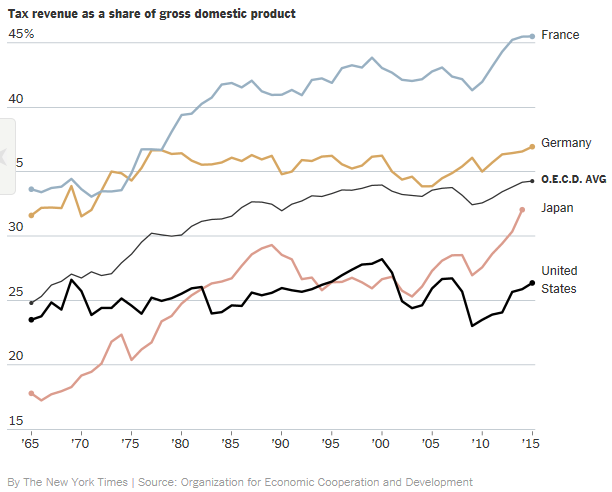

Mr. Porter says that according to Wagner’s Law “government spending as a share of the economy will increase as nations get richer and their citizens demand more and better public services.”
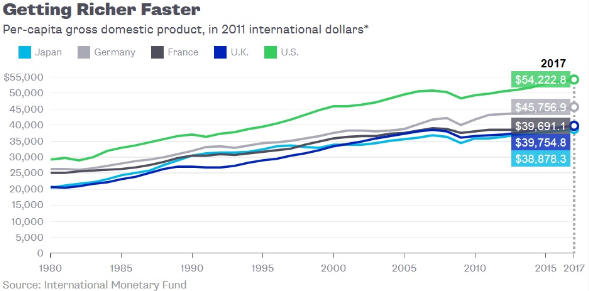
Americans may be receiving fewer public services than citizens of the OECD countries but we are also enjoying faster economic growth as pointed out by the AEI scholar James Pethokoukis using data from the International Monetary Fund (see chart below).

According to the Pew Research Center our median family wage is also one of the highest in the world (see chart below).


As pointed out by Mr. Pethokoulis, lower taxes are a fundamental reason for the superior performance of the U.S. economy.  Other (tax-related) reasons are:

  • The most competitive large economy as ranked by the World Economic Forum.
  • An entrepreneurial culture fueled by a willingness to take risks.
  • Labor markets which generally link workers and jobs unimpeded by excessively restrictive labor regulations.
  • A growing population fueled by immigration based on economic opportunity.
  • A culture and tax-transfer system that encourages hard work and long hours.
  • A favorable regulatory environment, relatively speaking.
  • A decentralized political system in which states compete both tax-wise and by other means.

Conclusion. Americans pay lower taxes than other developed countries and also enjoy faster economic growth and higher median wages than most. There appears to be a strong connection between these three fundamental measures of economic wellbeing.
Follow me on Twitter 
Follow me on Facebook 

Improving the Republican Tax Plan


The Republican tax plan has many good features and is now moving along in Congress. The best feature of all is reducing the top corporate rate from 35% to 20%.  This will make the U.S. internationally competitive and create a strong incentive for all multinational companies to conduct more business in the U.S. and for U.S. multinationals to bring their profits back home for reinvestment.
The Tax Foundation estimates that the Senate version of the Plan will lead to the creation of 925,000 new jobs and an after tax income gain of $2,598 for a middle-income family over a ten year period.
But there are several parts of the plan which could be significantly improved.  For example:

  • Revenue neutrality, at least on a dynamic basis (taking growth into account) is essential. Our national debt is way too large to ignore.

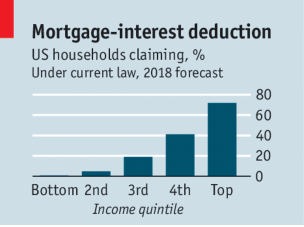
  • Shrinking more deductions, to achieve revenue neutrality. The mortgage interest deduction should be eliminated completely, not just limited to $500,000 mortgages. Same for the state and local tax deduction.
  • More progressivity. Keep the estate tax to bring in more tax revenue. Scrap the lower 25% rate for a pass-through business tax because it will be too easy to abuse.  The Congressional Budget Office has estimated that eliminating the individual mandate for the ACA will save $338 billion over ten years.  It will also save millions of Americans from having to pay a tax penalty of $695 or more for not having health insurance.
  • Emphasis on growth. Make expensing (i.e. immediate write-off) for new investment a permanent feature rather than limited to five years only.

Conclusion. There are lots of good features in the Tax Reform Plan. Several changes would make it even better.  As soon as it achieves stability in the legislative process, the CBO will analyze its fiscal and economic effects.  At this point revenue neutrality will be essential for achieving broad support.

Follow me on Twitter 
Follow me on Facebook 

Which Is Worse: Republican Hypocrisy about Debt or Democratic Complacency about It?


My recent posts about the American Idea have argued that our country has a great future before it.  We have a strong and prosperous economy and are the world’s leading innovator.  Furthermore there are clear cut and effective ways to address the income inequality and poverty which hold back many Americans from fully sharing the benefits of our remarkably successful society.
But there is one huge problem our political system is ignoring which will lead to a major crisis if left unattended much longer.


I am referring, of course, to our gargantuan:

  • National Debt, now sitting at 77% of GDP (for the public part on which we pay interest), the largest it has been since the end of WWII. It is predicted by the Congressional Budget Office to keep steadily getting worse without major changes in current policy. Right now all of this debt is essentially “free money” because interest rates are so low.

Republicans are very good at deploring the debt but quick to forget about it, when it gets in the way of cutting taxes.  Note that:

  • Economic growth is created by tax cuts but only 10-20% of the lost revenue from tax cuts is offset by new growth.

Democrats, on the other hand, don’t take the debt seriously, except when arguing against Republican tax cuts. Debt deniers claim that the risk of government overspending is inflation, not bankruptcy. What they don’t understand is that

  • Interest rates will return to more normal (and much higher) historical levels eventually and, when this happens, interest payments on the debt will skyrocket by hundreds of billions of dollars every year. This will crowd out all sorts of spending on popular domestic programs. It is likely to lead to a new fiscal crisis, much worse than the Financial Crisis of 2008.

Conclusion. For all of our nation’s great strengths, we are in a very serious fiscal pickle, with no clear cut path of orderly resolution. Realistically our debt problem cannot be wound down without committed Presidential leadership and this is unlikely to happen anytime soon.

Follow me on Twitter 
Follow me on Facebook 

Income Inequality in a Dynamic Economy


I have pointed out in a recent post that, not only is the U.S. the world’s most competitive large economy, but also that our per-capita GDP is growing faster than for our nearest rivals.
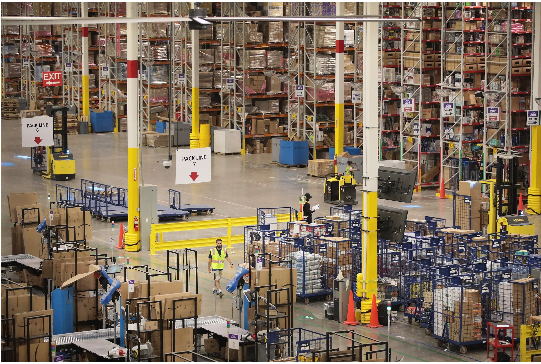
A particularly vivid example of this dynamism is ecommerce where both the adjusted (gains minus losses) size of the workforce and the average wage are increasing rapidly.
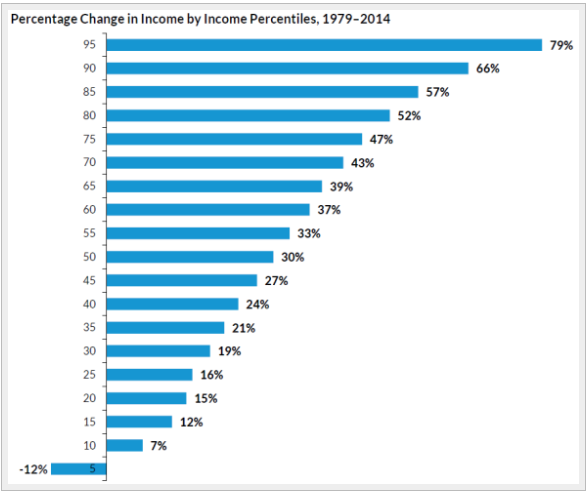
We also know that incomes in the U.S. are rising faster at the high end rather than further down (see chart below).  What to do about this has become a major political issue.


Here are my ideas (in rough order of importance):

  • Economic growth is too slow, averaging just 2% per year since the end of the Great Recession in June 2009. It is reasonable to expect that the regulatory reform already underway and the tax reform under consideration in Congress can increase growth to 2.5% per year.  Together with our low unemployment rate of 4.2%, this is already leading to more and better paying jobs.
  • Improve educational opportunities by, for example, making early childhood education widely available to low-income families and attracting the best teachers to the poorest performing schools with targeted bonus pay.
  • Better vocational and retraining programs to prepare the unemployed and underemployed for the millions of skilled jobs now going begging for a lack of qualified applicants.
  • Attempt to address the social inequality associated with income inequality, see here.  Marriage rates, civic involvement and public trust have all declined significantly in recent years for the lower class. A very difficult problem to solve!

Conclusion.   In a free society like the U.S., providing self-help opportunities for advancement is the natural and preferred way of lifting up people who need assistance. The U.S. does a okay job in this respect but there is plenty of room for improvement.

Follow me on Twitter 
Follow me on Facebook 


Democrats Need to Get More Serious about Economics


My last post makes the case that the “American Idea” is thriving, contrary to a sense of gloom from many quarters. For example, the Democratic Party is so tied up with complaining about Donald Trump, that it is failing to address the fundamental reason why Mr. Trump was elected President last fall: the plight of blue-collar workers.
For well-known reasons (globalization and the growth of technology), blue-collar workers are not yet enjoying the full benefits of rising prosperity as much as the college educated managerial and professional classes. The basic reason for this is:

  • Slow economic growth, averaging just 2% of GDP per year since the end of the Great Recession in June 2009. Our currently low unemployment rate of 4.2% and the prospects for regulatory reform and tax reform suggest that growth might start picking up soon.

Faster growth is already occurring in the area of ecommerce, see here and here.


Consider:

  • Fulfillment center weekly wages are 31% higher on average than for brick-and-mortar retail in the same area.
  • Ecommerce workers are not likely to be college graduates but need a mixture of physical and cognitive skills.
  • In the past two years the ecommerce industry has added 178,000 jobs in electronic shopping firms and another 58,000 jobs for express delivery companies. At the same time brick-and-mortar retail full time equivalent jobs have dropped by 123,000.
  • Americans spend 1.2 billion hours per week shopping in brick-and-mortar stores. Since 2007, roughly 64 million hours per week of these “unpaid hours” have shifted to fulfillment center workers and truck drivers. In this way unpaid household shopping hours are turning into paid market work.
  • The economics of manufacturing will likely soon be changed in a similar manner from producing and distributing goods in bulk to small-batch manufacturing closer to the customer.

Conclusion. “The internet of goods,” spearheaded by Amazon, has already increased the productivity and wages of many retail (fulfillment center) workers and will soon do the same thing in manufacturing. This is private enterprise at its finest.

Follow me on Twitter 
Follow me on Facebook 


Another Reason for Tax Reform to Be Revenue Neutral


My last post noted that with our unemployment rate down to 4.2% and with median household income having increased by 3.2% in 2016, the emphasis now should be totally directed to addressing our number one long term problem:

  • Massive national debt. With a deficit of $668 billion for Fiscal Year 2017, our debt now stands at 77% of GDP (for the public part on which we pay interest), the highest it has been since the end of WWII. It is predicted by the Congressional Budget Office to go much higher without significant changes in current policy.

Obviously our annual deficits are way too large and we need to shrink them dramatically. One way to start doing this is to speed up economic growth which will increase tax revenue especially by creating more jobs and better paying jobs.  Faster economic growth is quite feasible and this is one of the main goals of tax reform, now being considered by Congress.  But it needs to increase growth without increasing the deficit which is entirely doable.

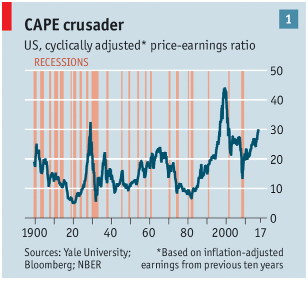
But there is another big reason for revenue neutral tax reform as well. The dollar has depreciated by 10% in 2017 while the stock market has increased by 13%.  The S&P price-earnings ratio has risen to 30 at present which is way above average.  All of this means that we are in a loose money financial bubble.  For Congress to make our annual deficits worse than they already are, with deficit increasing tax reform, would make this bubble even bigger and therefore be highly irresponsible.

Conclusion. When interest rates return to much higher normal levels, as they inevitably will, interest payments on our debt will grow dramatically and cause a huge budget crunch. If ignored, this situation will eventually lead to a new fiscal crisis, much worse than the Financial Crisis of 2008.

Follow me on Twitter 
Follow me on Facebook 

The Republicans Need to Adopt a Responsible Budget Plan for 2018


With the unemployment rate now down to 4.2% and household incomes having recently reached an all-time high, the first order of government business should be:

  • Fiscal responsibility which means to start reducing the size of the national debt, which is now 77% of GDP (for the public part on which we pay interest), the highest since the end of WWII. The only practical way to do this is to begin to shrink the size of our annual deficits from the very high level of almost $700 billion for the 2017 Fiscal Year which just ended on September 30.
  • A responsible budget for the 2018 Fiscal Year can have a deficit of at most $500 billion which amounts to 2.5% of our total GDP of $20 trillion. A realistic forecast for economic growth in the coming year is 2.5% of GDP which means that a deficit for the 2018 FY of $500 billion would at least not increase our debt as a percentage of GDP.

  • Budgets for later years need to actually shrink (not just hold steady) the debt. The goal should be to decrease annual deficits down close to zero which would mean achieving a balanced budget. The Congressional Budget Office projects that the cumulative deficits will climb by $10 trillion over the next ten years under current policy, pushing the debt up to 91% of GDP in 2027.
  • Tax reform, to be considered next by Congress, is likely to stall if it is not pursued within a sensible fiscal policy just as healthcare reform stalled last summer. Sensible tax reform, both growth enhancing and revenue neutral, is quite doable  and will make the debt problem that much easier to solve.

Conclusion. It cannot be emphasized too strongly that our rapidly growing debt puts us in a dire fiscal bind. We must change policy significantly and soon or else we will put our prized liberty and prosperity in grave danger.

Follow me on Twitter 
Follow me on Facebook 

Avoiding the Extremes on Either Side


Not only is Washington politics already hyper-partisan, but both parties are continuing to move to even greater extremes, see here and here.
Here are two examples of extreme positions now being espoused by major elements of one or the other of the two parties:

  • Single payer healthcare. The failure of the GOP effort to repeal the Affordable Care Act this past summer means that (the goal of) universal healthcare is here to stay. The ACA expands access to healthcare but does nothing to control costs. Single payer, Medicare for All, would control costs but then we end up with socialized medicine. The only way to establish a cost efficient free market healthcare system is to remove, or at least limit, the tax exemption for employer provided care and to set up high deductible catastrophic care supplemented by health savings accounts to pay for routine expenses. This would compel everyone to pay close attention to the cost of their own healthcare.
  • Tax cuts instead of tax reform. Tax reform, i.e. lowering both corporate and individual tax rates, paid for by closing loopholes and shrinking deductions, is an excellent way to speed up economic growth and thereby create more and better paying jobs. But it is imperative to do this in a revenue neutral manner, i.e. without increasing our annual deficits. Our debt (the public part on which we pay interest) now stands at 77% of GDP, the highest it has been since the end of WWII, and is predicted by the Congressional Budget Office to keep getting larger without major changes in public policy.

Conclusion. The U.S. badly needs a more cost efficient healthcare system and a simpler and more efficient tax system. But there are right ways and wrong ways to do both of these things.  Single payer healthcare and (unpaid for) tax rate cuts are the wrong way to proceed.  In each case, no action at all is much better than getting it wrong.

Follow me on Twitter 
Follow me on Facebook 

New Urgency in Deficit and Debt Control


The general theme of this blog is major fiscal and economic issues facing the U.S. such as slow economic growth and huge debt. But our currently low unemployment rate of 4.4% and several trends, here and here, suggest that economic growth may already be starting to pick up.
This means that our huge debt, now 77%, for the public part on which we pay interest, the highest it has been since right after WWII, is now one of the very biggest problems facing our country.
Consider:

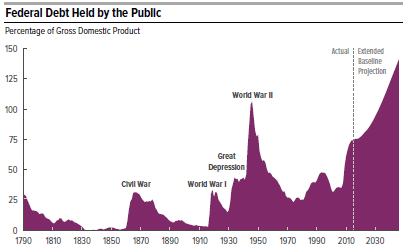
  • The only practical way to “solve” our debt problem (so to speak) is for each year’s annual deficit to be less than economic growth for that year. When this happens, then the debt will decrease as a percentage of GDP. If this pattern were to hold year after year, then debt would continue to shrink. This is exactly what happened from 1946 until about 1980 but since then the pattern has reversed and the debt has increased. It has grown especially fast since the financial crisis in 2008 (see chart).
  • The Fiscal Year 2017 deficit is $700 billion out of a total GDP of $20 trillion, which computes to 3.5% of GDP, well above the 2% annual growth of GDP for the 2017 FY. This means that our debt got worse in 2017.
  • Congress has already approved $15 billion in disaster relief for Hurricane Harvey. Now the White House is asking for $29 billion more ($12.8 billion for new disaster relief, especially for Puerto Rico, and $16 billion for the National Flood Insurance Program).  Congress has also approved a big increase in the Defense Budget, to $700 billion, for the 2018 FY.
  • Congress will soon be approving a budget for 2018 and then start working on a tax reform package. Given the likely increases in both military spending and disaster relief described above, it is now even more important for the new budget to show overall spending restraint and for the tax reform package to be revenue neutral.

Conclusion. Let’s hope that Congress gets the message about the new urgency of our debt problem and acts accordingly!

Follow me on Twitter 
Follow me on Facebook 


Fundamental Principle for Tax Reform II. What to Avoid


In my last post I made the case that the two fundamental principles for effective tax reform are:

  • Faster economic growth, to create more jobs and bigger pay raises.
  • Revenue neutrality, since more debt at this time is just too risky.

And then I went on to suggest the specific changes in the tax code which would achieve these goals:

  • Reducing the corporate tax rate to approximately 20%.
  • Full expensing for business investment replacing depreciation spread out over many years.
  • Simplification of rules for individuals such as fewer tax rates and fewer credits.
  • Achieving revenue neutrality by eliminating as many deductions as necessary to pay for the above tax rate cuts.

There are different ways to accomplish all this and I recently described one attractive plan put together by the Tax Foundation. The Republican Congressional Leadership (Big Six) has proposed a different plan which has been analyzed by the nonpartisan Committee for a Responsible Federal Budget.  Unfortunately CRFB concludes that this plan will cost $2.2 trillion over ten years in lost revenue.  But it could be modified in the following ways to become revenue neutral:

  • The mortgage interest deduction is maintained but limited to one dwelling and $500,000, down from the current limit of two homes and $1 million.
  • The tax exemption for employer provided health insurance is limited. This not only increases tax revenue but also forces the 150 million Americans who receive health insurance from their employer to take an active role in holding down the cost of healthcare.
  • Drop the proposal of establishing a maximum “pass through” rate of 25% for business owners. Any such proposal would be subject to wide spread abuse. Businesses would be benefitting from the full expensing provision above and their owners should pay taxes at the same rates as everyone else.
  • Keep the estate tax until annual deficits are greatly reduced. It only brings in $20 billion per year but every little bit helps.

Conclusion. These common sense changes in the Big Six plan would make it revenue neutral and still capable of achieving a significant boost to the economy.

Follow me on Twitter 
Follow me on Facebook