Tax Reform for Faster Economic Growth


Several of my recent posts have been devoted to the topic of faster economic growth, see, for example, here. One way to do this is by making it easier to start and grow a small business.  Another way is with broad-based tax reform.
Capture11House Republicans have just released the outline of a plan for fundamental tax reform, “A Better Way: A Pro-Growth Tax Code for All Americans.”  It has the following main features:

  • The current seven tax brackets for individuals are condensed to just three: 12%, 25% and 33%.
  • The standard deduction of $12,600 (for joint returns) is raised to $24,000 and the $4,050 personal exemption is eliminated. This feature means that fewer filers will need to itemize deductions.
  • In fact, all itemized deductions for individuals are eliminated except for mortgage interest and charitable contributions.
  • To encourage business creation and expansion, the pass through tax rate for small business will be 25%. Full and immediate expensing for investments in new equipment and technology will be allowed.
  • The corporate tax rate will drop from 35% to 20%, paid for by eliminating dozens of tax carve-outs and deductions, including net interest expensing. A territorial system will be established whereby multinational firms will no longer be taxed both abroad and at home for the same dollar of income. This will encourage the multinationals to keep production facilities in the U.S. and to bring home foreign profits for reinvestment here.

The purpose of this plan, according to Kevin Brady, Chair of the House Ways and Means Committee, is “to rev up the economy, cut taxes on business, simplify the code and let American families file on a postcard.” The authors of the report claim that this tax proposal is revenue neutral, i.e. will not lower tax revenue, on a dynamic scoring basis, taking resulting economic growth into account.  If this assertion holds up under nonpartisan analysis, then this is an excellent proposal which deserves broad support.

Follow me on Twitter
Follow me on Facebook


Can the U.S. Economy Do Better? IV. Let’s Try Tax Reform!

Image


After seven straight years of anemic, sub-par growth of 2.1% annual growth, one of the most important questions in public policy today is whether or not the U.S. economy can do better. I have devoted my last three posts, here, here, and here, to this question, presenting both positive and negative points of view.
Capture7There are very definitely strong headwinds slowing down growth but there are also specific strategies that are very likely to help speed up growth. One of these is tax reform.  The nonpartisan Tax Foundation (TF) has just issued an excellent report, “Options for Reforming America’s Tax Code” with many good ideas. Here are just three of the many different examples presented.  But they show the powerful effects that would be generated by significant tax reform.

  • Replace the Corporate Income Tax with a Value Added Tax (VAT) of 5%. This would be a huge change but it would also have a hugely positive impact. TF estimates that doing this would boost the economy by 5.5% in the long run as well as boosting tax revenue by a whopping $315 billion per year on average. Furthermore, all income groups from low to high would see equal gains in income.
  • Eliminate All Itemized Deductions Except for Charitable Contributions and Mortgage Interest and Lower the Top Individual Income Tax Rate to 27%. This change would grow the economy 1.1% in the long run and also create 496,000 new jobs. It would also increase tax revenues by $26 billion per year on average. It has the defect of raising incomes more for the affluent than for low- and middle-income groups. But this defect could easily be remedied by, for example, limiting the size of the mortgage interest deduction.
  • Cap the Total Value of Itemized Deductions at $25,000. This popular proposal would not help grow the economy but would bring in almost $200 billion a year in new tax revenue.

What is the better strategy? To be pessimistic and accept the point of view that faster growth is just too difficult or to adopt specific policies which are likely to help?

Follow me on Twitter 
Follow me on Facebook


Why Is the U.S. Economy Growing So Slowly?


The U.S. economy has only been growing at the rate of 2.1% since the end of the Great Recession in June 2009, almost seven years ago. Such a slow rate of growth means millions of unemployed and underemployed workers and only small salary raises for tens of millions of others.
Capture5The New York Times economic journalist, Eduardo Porter, observes that we have “A Growth Rate Weighted Down by Inaction.”  He points out that:

  • Our economy is adversely affected by the gradual shrinkage of the work force as a share of population as baby boomers retire and the one time surge of women into the workforce in the 20th century has ended.
  • A second factor is a persistent decline in productivity growth over the last dozen years.
  • A pessimistic forecast by the Economic Cycle Research Institute foresees growth of only 1% per year for the next five years. The Congressional Budget Office projects more optimistic productivity growth at 1.5% per year, which added to workforce growth of .5% per year, would amount to total growth of 2% per year for the next ten years.

Mr. Porter goes on to say that there are concrete reasons why productivity growth is so slow:

  • Hiring is growing faster than capital investment. This is because most job growth in the last decade has been in (low productivity) services instead of (high productivity) manufacturing.
  • Too many restrictions on educated immigrants. Relaxing these restrictions would increase entrepreneurship.
  • Too many onerous regulations.
  • Under training of skilled workers. We need more vocational and career education.

Many people, including myself, have pointed out ways to alleviate these problems and speed up economic growth, for example see here. It is most unfortunate that our dysfunctional national leadership cannot figure out how to work together to get this done.

Follow me on Twitter
Follow me on Facebook

Ending America’s Slow Growth Tailspin II. What It Will Take.


One of the biggest problems facing the U.S. today is the slow growth of our economy, averaging just 2.1% per year since the end of the Great Recession seven years ago, well below the 3.5% average from 1950 – 2000.
Capture11My last post introduced an excellent Wall Street Journal Op Ed by the Hoover Institution economist John Cochrane.  He says that “the U.S. economy needs a dramatic legal and regulatory simplification.”  In particular:

  • Tax reform. Instead of arguing over tax rates, what’s really needed is deep tax reform, cleaning out the insane complexity and cronyism.
  • Social programs. Rather than arguing over whether to increase or cut spending, what’s needed is a thorough overhaul of the programs’ pernicious incentives. For example, Social Security disability (almost 9 million beneficiaries in March 2016) needs to remove its disincentives to work, move or change careers.
  • Education spending. Rather than arguing about the level of public spending, America needs the better schools that come from increased choice and competition.
  • Over-regulation. Most of all the country needs a dramatic legal and regulatory simplification. Middle-aged America is living in a hoarder’s house of a legal system, including state and local impediments such as excessive occupational licensing.
  • Growth-oriented policies will be resisted. Growth comes from productivity which comes from new technology and new companies. These displace the profits of old companies, and the hefty pay and settled lives of their managers and workers.
  • The presidential frontrunners are not championing economic growth. But the House of Representatives, under Speaker Paul Ryan, is doing exactly this. Perhaps economic policy leadership can be transferred from the Presidency to Congress.

After two disappointing presidencies our economy is lagging far behind where it could and should be. This is the reason for the rise of Bernie Sanders and Donald Trump.  Regardless of the outcome of the 2016 presidential election, there is hope for better days ahead!

Follow me on Twitter
Follow me on Facebook

Why Faster Economic Growth Is So Important II. Replacing Factory Jobs


Populists such as Bernie Sanders and Donald Trump are doing so well in the 2016 presidential primaries because the middle class is suffering from the slow economic growth of the past 15 years.
Capture2My last post is based on the report of a typical victim.   Today’s post is based on an article by Eduardo Porter in yesterday’s New York Times discussing the loss of U.S. manufacturing jobs.  Says Mr. Porter:

  • Fifty years ago, 45,000 workers were employed in California to harvest 2.2 million tons of tomatoes. Now, with mechanization, it only requires 5000 workers to harvest 12 million tons.
  • In 1950, 24% of nonfarm jobs in the U.S. were in manufacturing. Today only 8.5% of nonfarm jobs are in manufacturing.
  • The same thing is true worldwide. Global employment in manufacturing is going down because productivity increases are exceeding increases in demand by significant amounts. The likelihood that we will get a manufacturing recovery is close to nil.
  • The U.S. has a trade surplus in manufacturing with the 20 countries with which it has trade agreements (which does not include China). We have an overall annual trade surplus in services of more than $200 billion.

In other words, an attempt to recover or save manufacturing jobs with smarter trade policies is simply impractical and will likely do more harm than good. What should be done instead is to:

  • Definitely do a better job of helping displaced manufacturing workers with Trade Adjustment Assistance and smarter job retraining programs.
  • Adopt policies to speed up overall economic growth from the anemic 2.1% annual growth rate since the end of the Great Recession in June 2009. Faster growth such as the 3.5% annual average from 1971 – 2001 will do wonders in creating more jobs and better paying jobs. For how to do this see an earlier post.

Our very serious economic problems can be solved if policy makers (and presidential candidates) would only get serious about it!

Follow me on Twitter
Follow me on Facebook
Is America’s Middle Class Really Shrinking?


For several years now Americans have been having a lively debate about income inequality and the supposedly shrinking middle class. The American Enterprise Institute scholar, Mark Perry, has an enlightening new post on this topic.
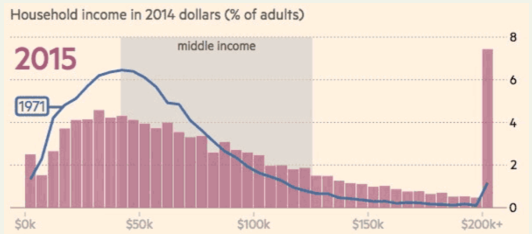
Capture0The AEI has produced a vivid graphic showing that the American Middle Class (defined as the middle 50% of Americans by household income) has dramatically increased in income from 1971 through 2001 but has been stagnant since the Great Recession in 2008-2009.
Capture1He has other charts showing that both the Low-Income group and the Middle-Income group have been shrinking since 1971 precisely because the High-Income group (defined to be households with $100,000 or more in income in constant 2014 dollars) has been growing so rapidly. Isn’t it obvious what we need to do to restore confidence to the Middle Class?  Clearly we need to speed up economic growth.  For example we could:

  • Implement broad-based tax reform. Lower the rates for both individual and corporate taxes, paid for by closing loopholes and limiting deductions. Better yet, shift from taxing income to taxing consumption.
  • Remove roadblocks to innovation by making it easier to start new businesses.
  • Improve K-12 education, especially for low-income kids who need extra help. Enhanced early childhood education, more emphasis on career (vocational) education, and charter schools in big cities are the way to get this done.
  • Make attending college more affordable. There are many good schools around the country which are not expensive to attend (the University of Nebraska at Omaha where I teach is one of them). College students and their families should make it a top priority to avoid huge debt. Attending a prestigious (and expensive) institution is simply not necessary to get a good education.

There are other more controversial ways to speed up economic growth such as increasing international trade and reforming our broken immigration system. But just the measures above will go a long way and shouldn’t be that difficult to implement.

Follow me on Twitter: https://twitter.com/jack_heidel
Follow me on Facebook: https://www.facebook.com/jack.heidel.3

What Might Fundamental Tax Reform Look Like?


All four of the major presidential candidates have tax plans. Hillary Clinton would make small tweaks in our current tax system.  Bernie Sanders would raise current taxes substantially.  Both Donald Trump and Ted Cruz would both radically reduce the size of the federal income tax but would also greatly add to the national debt over the next ten years.
I have been trying to make the case on this blog that fundamental tax reform is the best thing we can do to get the economy growing faster in order to create more and better paying jobs.  I have also discussed a specific way to accomplish fundamental reform, namely the so-called Competitive Tax Plan proposed by the tax law expert, Michael Graetz.  It is a progressive consumption tax, a so-called Value Added Tax.
Capture2As reviewed in yesterday’s Wall Street Journal by Reihan Salam, the editor of the National Review, the Graetz Plan has these features:

  • A broad-based VAT of about 14% on goods and services.
  • Families earning less than $100,000 per year are exempt from the income tax. The tax rate would be 15% for incomes between $100,000 and $250,000 and 25% above this level.
  • The payroll tax (supporting Social Security and Medicare) would be greatly reduced for all workers earning less than $40,000 per year.
  • The corporate tax rate would be lowered to 15%, making it among the lowest in the world.
  • The Graetz Plan is revenue neutral as verified by the Tax Policy Center.

Think of the incredible advantages of such a tax plan. Of the expected 145 million tax returns for this year, 120 million would no longer be necessary.  Extravagant deductions such as for mortgage interest would have much less political support. The low corporate tax rate would bring jobs back to the U.S. instead of sending them overseas.  The rampant cronyism involved in tax breaks being handed out by Congress would be greatly reduced.
What is not to like about the Graetz Plan?

Follow me on Twitter: https://twitter.com/jack_heidel
Follow me on Facebook: https://www.facebook.com/jack.heidel.3

Growing Employment, Shrinking Productivity: What Does It Mean?


I know that I occasionally repeat myself, but I can’t help it! In my opinion there are two major problems facing our country:

  • Slow economic growth which has averaged only an anemic 2.1% since the end of the Great Recession seven years ago.
  • Exploding national debt, now the highest it has been since the end of WWII. Unless we can quickly shrink our annual deficits down to zero, and therefore stop adding to the debt, interest payments on the debt will eventually rise to horrendous levels.


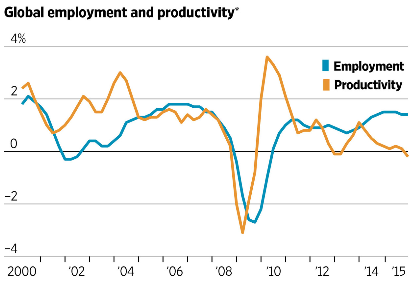
Two recent newspaper articles address the slow growth problem. Greg Ip, writing in the Wall Street Journal, points out that (worldwide) employment growth is up while productivity growth is down (see chart below).
Capture0Neil Irwin, writing in the New York Times, explains this dichotomy by pointing out that most job growth in the last decade has been in (low productivity) services rather than (high productivity) manufacturing. In other words, the U.S. economy is now producing lots of new temporary and contract jobs which do not add very much to the overall economic growth which produces higher wages and overall prosperity.
The economist John Cochrane has clearly described  why productivity growth, and therefore overall economic growth, has stagnated in recent years.  Here is a short summary:

  • Over-regulation. The Dodd-Frank Act and Affordable Care Act, for example, are hampering growth by strangling the financial and healthcare sectors of the economy.
  • Inefficient Taxation. Growth oriented taxation would have the lowest possible marginal rates paid for by shrinking deductions. Taxing consumption rather than income and savings would be even better.
  • Illegal Immigration. Solving our immigration problem would turn millions of illegals into productive citizens. An adequate Guest Worker program and e-Verify enforcement would solve this problem without the need for amnesty.

Conclusion: There are solutions to the severe economic problems facing our country. Does our political system have the flexibility to adopt these workable policies?

Follow me on Twitter: https://twitter.com/jack_heidel
Follow me on Facebook: https://www.facebook.com/jack.heidel.3


Solving America’s Most Basic Problems


My last two posts, here and here, argue that America’s two most critical problems are:

  • Speeding up economic growth in order to create more jobs and better paying jobs, especially for middle- and lower-income workers whose wages have been stagnant for the past 15 years.
  • Getting our large and rapidly growing national debt under control by shrinking annual deficit spending. This will put our debt on a downward path as a percentage of GDP.

Many Facebook comments on these posts inquire about how these goals will be accomplished. If tax reform is the best way to increase economic growth, how can this be done in a way that is fair to the non-wealthy. If spending cuts are necessary to balance the budget, what cuts should be made?  Here is a summary of my views on these questions:

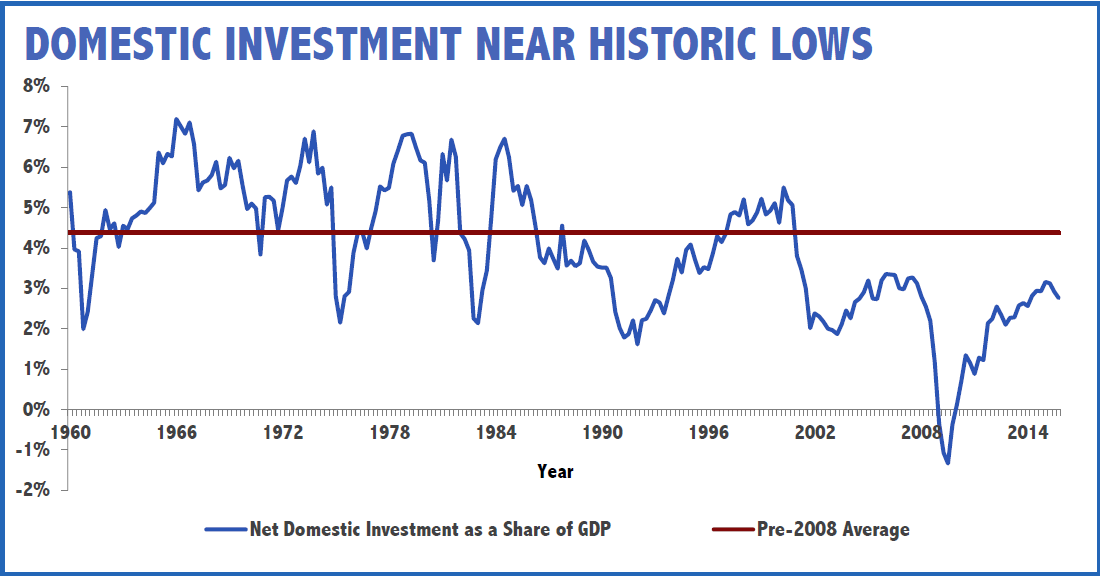
  • Growing the economy with tax reform. The best way to spur investment and business expansion is with the lowest possible tax rates on owners and investors. Broad-based tax reform, with lower tax rates for all, paid for (i.e. in a revenue neutral way) by closing loopholes and shrinking deductions, will accomplish this. The 64% of taxpayers who do not itemize deductions will increase their income with tax rate cuts. Lower tax rates for the affluent will be offset by shrinking deductions and closing loopholes.
  • The corporate tax rate should also be cut to internationally competitive levels, again paid for by drastically shrinking, if not totally eliminating, all deductions. This way all corporations (including GE!) would pay the same tax rate. And American companies would have much less incentive to move overseas.
    Capture0
  • Reducing our national debt. We have got to drastically shrink our annual deficits (now running about $500 billion per year) in order to put our national debt on a downward course, as a percentage of GDP. The House Budget Committee has recently passed a plan to balance the budget within ten years. Not everyone will agree with the details, but at least it’s a starting point. An alternative approach is to adopt a Balanced Budget Amendment to the U.S. Constitution. This would require Congress to make tradeoffs annually between either restraining spending or raising taxes.  A BBA will force them to do what they should be doing anyway!

Follow me on Twitter: https://twitter.com/jack_heidel
Follow me on Facebook: https://www.facebook.com/jack.heidel.3

How to Lower Income Inequality


My last post provides evidence that income inequality has increased more under recent Democratic presidents than under Republican presidents.  Here is a brief summary of the argument:

  • Cheap money is of greatest value to those who have access to it.
  • The effects of the Bush housing bubble (in the 2000s) were more evenly distributed than for the Clinton stock market bubble (in the 1990s) or the Obama credit bubble.
  • Two earner households are the backbone of the American middle class.
  • During the first six years of the Obama presidency, the number of two-earner households declined, the number of single-earner households rose by 2.6 million and the number of no-earner households rose by 5 million. In other words, two-thirds of the increase in the number of households under Obama is accounted for by households with no-one working. This largely accounts for the shrinking middle class and the increase in inequality.
    Capture

Another way to consider this situation is to look at the labor force participation rate which has been steadily decreasing since the year 2000.  As the above chart shows, this trend is expected to continue indefinitely in the same downward direction.  Along with a slowing increase in the productivity rate, this constrains the U.S. economy’s capacity to expand. Clearly what is needed is faster economic growth in order to create more jobs and better paying jobs.  The way to accomplish this is with:

  • Tax Reform. Lower individual and corporate tax rates for all paid for by shrinking deductions and closing loopholes. More money in the hands of the middle class will stimulate demand. More money in the hands of small business will stimulate supply.
  • Expanded Earned Income Tax Credit. Putting more money in the pockets of low-income and marginally employed workers will encourage more of them to find work and stay in the workforce.

With all the headwinds holding the economy back, our national leaders (and would be leaders!) ought to be focusing much more attention on taking specific actions which would speed up economic growth.

Follow me on Twitter: https://twitter.com/jack_heidel
Follow me on Facebook: https://www.facebook.com/jack.heidel.3