How to Counter Political Islam


Let me remind my readers that I am a non-ideological fiscal conservative and social moderate. My two main sources of background information for this blog are the New York Times and the Wall Street Journal both of which I read assiduously on a daily basis.  When they agree on a particular issue, I will probably agree with them.  Otherwise I’m on my own!


In last Saturday’s WSJ there appeared a powerful article, “Ayaan Hirsi Ali, Islam’s Most Eloquent Apostate.”   Ms. Ali explains that “The West’s obsession with ‘terror’ has been a mistake.  Dawa, the subversive, indoctrinating precursor to jihad, is a broader threat.” Here is the gist of her argument:

  • There are 1.6 billion Muslims in the world and at least 10% of them, or 160 million, are Islamists (who practice political Islam). Islamists want to impose Sharia (Islamic law) on society which is fundamentally incompatible with the U.S. Constitution: religious tolerance, the equality of men and women, and other fundamental human rights.
  • The ultimate goal of dawa is to destroy the political institutions of a free society and replace them with the rule of Sharia law. This is accomplished by subversion from within – the abuse of religious freedom in order to undermine that very freedom. The U.S. is in a weak position to combat nonviolent extremism because of the First Amendment which bars Congress from prohibiting the free exercise of religion, etc.
  • There are now 2.6 million Muslims in America and likely to be 6.2 million in 2030. Half say they think of themselves first as Muslims, second as Americans. A fifth of Muslim Americans say there is support for extremism in the Muslim American community.
  • The U.S. government should ally itself with genuine Muslim moderates and reformers, not with “nonviolent” Islamists. The FBI should scrutinize the ideological background and nature of all Islamic organizations. The DHS should deny entry to foreign individuals involved with or supportive of Islamism.

Conclusion. According to Ms. Ali, “We are dealing with a lethal ideological movement. … We have to grasp the gravity of dawa. Jihad is an extension of dawa.  It is dawa by other means.”

Follow me on Twitter
Follow me on Facebook


Trump’s Bark Is Worse than His Bite


The anti-Trump fervor seems to be slowly dying down as his appointees take hold of their agencies and begin to promulgate new policies. I have expected this to happen because of the excellent quality of many of the people he has appointed.
Here are a few recent developments:

  • Interior Secretary Ryan Zinke has said that “the border is complicated as far as building a physical wall” and there are all sorts of problems to be resolved before it can be done.
  • Reality is setting in with regard to Russia policy “given Russia’s continued provocations in terms of weapon’s deployments, overtures to Iran, cyber intrusions and intervention in Ukraine.”
  • The Brookings Institution has just issued a new report showing that school choice options are increasing in the country’s largest school districts. This indicates that Education Secretary Betsy DeVos is in the mainstream by supporting more choice.
  • Coal jobs Trump vows to save no longer exist.  In other words, cancelation of the Obama Clean Power Plan will have little effect on the huge drop in coal use because coal has become so much more expensive than natural gas.
  • Of course, the Trump 2018 Budget Proposal will be heavily modified by Congress but it does contain some good ideas. Agriculture, Foreign Aid and Community Development Block Grants are all ripe for big cuts.
  • The biggest unknown with respect to administrative action concerns trade policy. The question here is what concessions he can get from China and Mexico without starting a disastrous trade war.

What is mainly lacking at this point is any significant action by Congress on the Trump agenda. What will happen with healthcare reform, tax reform and deficit reduction, for example?

Conclusion. Trump is doing fine so far but it is on relatively straightforward issues under his control. Hopefully he will be able to make progress on the bigger issues as well which require working with Congress.

Follow me on Twitter
Follow me on Facebook


Maybe the GOP Really Is the Stupid Party


The Nobel prize-winning economist, Paul Krugman, more recently turned partisan flack for the New York Times, has occasionally referred to Republicans as “the stupid party.” After the debacle with the House’s American Health Care Act, maybe he is right.  This bill is far from perfect but is a step in the right direction.  Its major virtue is a serious attempt to get Medicaid spending under control.
According to an astute analysis by the Wall Street Journal:

  • The AHCA would put Medicaid on a budget for the first time since its creation in 1965.
  • Medicaid insures more than 72 million people, or one in every five Americans.
  • Medicaid is now the third largest, and fastest growing, program in the federal budget. Federal outlays are now $360 billion per year, more than three times as much as in 2000.
  • The federal government matches between 50% and 74% of state costs for Medicaid recipients, which means that the states have little incentive to control spending by allocating resources toward high quality care for the most vulnerable.
  • A 2013 study by the New England Journal of Medicine found that “Medicaid generated no significant health improvements,” compared to the uninsured.
  • The AHCA would transition federal funding to a per-capita block grant that would grow with an index of medical inflation. In exchange, governors would gain reform flexibility over the current rigid rules.

Conclusion. It is completely nonsensical for the House Freedom Caucus to oppose such an attractive reform plan just because it isn’t perfect. The members of the Freedom Caucus claim to be fiscal conservatives and to support balanced budgets.  And yet they refused to take a simple, practical step to work toward that goal.

Follow me on Twitter
Follow me on Facebook

The Necessity of Fixing Medicaid


As I have discussed in previous posts, here and here, the American Health Care Act, the GOP replacement for the Affordable Care Act, is a step in the right direction.


One of the best features of the GOP bill is its provisions to revamp the Medicaid program.  The problems of Medicaid are well described by the healthcare expert, Avik Roy, here and here:

  • Medicaid was established in 1965 and now provides healthcare benefits for individuals and families with incomes up to 133% of the federal poverty level.
  • The states pay 40% of the costs on average while only controlling 5% of how the program is operated.
  • The federal Medicaid law mandates a laundry list of benefits which the states must provide. States cannot charge premiums and copays and deductibles are minimal.
  • Medicaid is the largest or second largest line item in nearly every state budget. The only tool states have in controlling costs is to pay doctors and hospitals less than private insurers pay for the same care. This means that fewer and fewer doctors are accepting Medicaid patients.
  • Thus Medicaid enrollees have poor access to healthcare. In fact, their health outcomes are typically no better than for those with no insurance at all.
  • An able-bodied adult on Medicaid receives about $6000 a year in government health-insurance benefits. Yet CBO estimates that five million Americans won’t sign up for Medicaid if the ACA individual mandate is repealed as proposed by the AHCA.
  • AHCA block grants will give states more flexibility to manage Medicaid’s costs in ways which increase access to doctors and other providers. It would also decrease federal outlays for Medicaid by $880 billion in its first decade.
  • AHCA’s goal is to ultimately merge Medicaid for able-bodied low-income adults into the system of tax credits which the AHCA proposes for those above the poverty line.

Conclusion. The AHCA will make Medicaid into a much more efficient, flexible and effective program for serving low-income individuals and families. This represents a first step in the entitlement reform which the U.S. so badly needs.

Follow me on Twitter
Follow me on Facebook


Beating the High Cost of Higher Education and Student Debt


This blog addresses America’s too biggest problems:

  • Slow economic growth averaging just 2% since the end of the Great Recession in June 2009. Faster growth means more jobs and better paying jobs.
  • Massive federal debt now 77% of GDP (for the $14 trillion public debt on which we pay interest) and predicted to continue getting worse without a change in policy. As interest rates go back up to normal historical levels the interest payments on this debt will increase greatly and be a huge drag on the federal budget.

As I have reported recently, college costs are growing much faster than healthcare costs which are growing faster than the cost of living in general.  The excessive costs of education and healthcare are, in turn, holding back economic growth.


Regarding the student loan debt problem:

  • For every increased dollar of student aid, college tuition increases 60 cents.
  • Outstanding student loan debt has risen from $200 billion in 1996 to $1.3 trillion today.
  • The highest default rates on student debt occur for community college students (23%) and for-profit college students (18%).

The economist Richard Vedder has made some excellent suggestions for addressing this whole problem:

  • Simplify the entire federal student air system. There should be only two programs, one grant program (Pell grants) and one federal loan program (Plus loans, tuition tax credits, work study, etc.).
  • Give educational vouchers directly to students to empower recipients to weigh costs more closely. These would be strictly limited to low-income students and would be accompanied by modest academic expectations.
  • Require schools to have skin in the game. Schools with abnormally high loan delinquency rates should have to pay a tuition “tax” to the government to help cover costs.

Conclusion. “Financial aid has caused tuition to skyrocket. If we can’t abolish it, we can at least simplify it.”

Follow me on Twitter
Follow me on Facebook

The Strengths and Weaknesses of the GOP Healthcare Reform Bill


The American HealthCare Act, introduced in the House of Representatives on Monday, begins the process of looking for a replacement and improvement to the Affordable Care Act.  It moves in the right direction but also has some major shortcomings.


The Bill’s strengths are:

  • The Bill discards the ACAs web of mandates and regulations in favor of incentives to buy health insurance in a deregulated market.
  • The Bill replaces the ACA exchanges with refundable tax credits for individuals not covered by employer provided health insurance.
  • The Bill turns Medicaid into a block grant program for states with much flexibility for the individual states to run their own programs. This reverses the current system whereby the federal government matches each state’s spending on Medicaid and is thereby expensive for both state and federal government

The Bill also has major weaknesses:

  • There is no upper limit on the tax exemption for employer-paid premiums. This tax exemption amounts to a total drain of nearly $300 billion a year on U.S. tax revenues and is the biggest single reason why healthcare is so expensive in the U.S.
  • The inadequacy of financial support for the lowest income individuals and families. A $2000 annual tax credit for a minimum wage worker is simply not enough for her/him to be able to afford health insurance.
  • This huge discrepancy between the lavish tax treatment of employer-paid care and stingy tax credits for individuals is a matter of fundamental inequity as well as unsound tax policy. It would be much fairer to give all Americans the same equal tax credit roughly equivalent to the cost of catastrophic healthcare insurance.

Conclusion. The ACA increases access to healthcare insurance but does nothing to control costs. It is imperative for the Republican replacement plan to fix this glaring deficiency.

Follow me on Twitter
Follow me on Facebook

Donald Trump’s Popularity is Steadily Increasing


Like many things about Donald Trump, his approval ratings are contradictory and misleading. The Wall Street Journal reports that:

  • Only 44% of Americans currently approve of President Trump’s job performance (while 48% disapprove) which is historically low for a new President.capture107
  • On the other hand, the percentage of Americans who have positive feelings about him has been steadily increasing ever since he declared his candidacy in June of 2015, and has now reached a high of 43% (see chart). Since his State of the Union speech was generally well received, this rating is likely to go even higher.

Here is my own perspective. As I have said many times on this blog, I believe our country’s two biggest and most urgent problems are:

  • Slow economic growth, averaging just 2% per year since the end of the Great Recession in June 2009. This means fewer jobs, smaller raises for workers and less tax revenue to spend on important national initiatives.
  • Massive Debt, now standing at 77% of GDP (for the $14 trillion public debt on which we pay interest), the highest since right after WWII. The Congressional Budget Office predicts that this debt level will keep on steadily getting worse, without big changes in current policy. It is therefore a huge threat to our national security and prosperity.

I have great confidence that the Trump administration and Congressional allies will put a high priority on faster growth and are likely to be able to achieve it. I can’t yet tell if Trump understands the seriousness of our massive debt.  But the Tea Party and Freedom Caucus members in the House of Representatives do very strongly understand this problem and will insist on addressing it.  I believe that they will be able to persuade the President to support them in doing this.

Conclusion. At this point I am a supporter of President Trump because I think that our national government is moving in the right direction.

Follow me on Twitter
Follow me on Facebook

Is 3% Economic Growth Possible?


Donald Trump was elected President because of strong support from blue-collar workers in the battleground states such as Wisconsin, Michigan, Pennsylvania and Ohio. The American Enterprise Institute scholar, Nicholas Eberstadt, has explained clearly why this happened.  It is largely a result of a slowdown in economic growth in recent years which has hit blue-collar workers especially hard.

capture104
Can this recent slow growth trend be reversed?  The economist, Edward Lazear, has a positive answer to this question in today’s Wall Street Journal.  According to Mr. Lazear:

  • 3% growth is the long term norm. The annual growth rate in the 30 years preceding the 2007 recession was 3.1%. It has averaged just 2% annually since the end of the recession in June 2009.
  • GDP growth is the sum of two components: growth in productivity and in labor hours. Historically productivity has grown at a rate of about 2% per year and labor at about 1%.
  • Nonfarm labor productivity rose by a total of 7% between 2009 and 2016 which amounts to only 1% per year. It rose 18% between 2001 and 2008 or 2.3% per year.
  • Both President Trump and the House Republicans advocate business expensing (immediate tax write-offs for new investment) as an important part of tax reform. It has been estimated that just this one change in policy will induce an increase in GDP of from 5% to 9% over ten years. This would raise GDP from the current 2% annual growth to between 2.5% and 2.9% annually.
  • The Social Security Administration predicts no increase in the U.S. population age 20 to age 64 between 2020 and 2030.
  • But note that the labor participation rate fell during the recession by 2% among Americans between ages 25 and 54, the prime working age. Two drivers of this loss of workers are: 1) a large increase of the disability rolls and 2) the fact that the ACA will likely reduce the number of hours worked by about 2% between 2017 and 2024.
  • Eliminating burdensome business regulations will also help significantly.

Conclusion. There is clearly much that can be done to speed up both labor productivity and the number of hours worked by Americans. President Trump and the Republican Congress have a good shot at increasing economic growth to 3% annually.

Follow me on Twitter
Follow me on Facebook


What Donald Trump Is Doing Right


Amid the steady and intense criticism of President Trump, he is actually doing a lot of things right, as pointed out by the Hudson Institute’s Christopher DeMuth:

  • He has picked highly qualified and independent-minded assistants such as Jim Mattis for Defense (who considers Russia to be a threat), Rex Tillerson for State (who has urged action on climate change) and Mike Mulvaney for Budget Director (who wants entitlement reform). Mr. Trump has tweeted that “I want them to be themselves and express their own thoughts, not mine.”

    capture99

  • For a president to have strong willed assistants is in the best American tradition: Washington (with Jefferson, Madison and Hamilton), Lincoln (with Chase, Seward and Stanton), Roosevelt (with Acheson, Marshall and Stimson), and Reagan ( with Baker, Shultz and Weinberger) all wanted their cabinet members to engage in vigorous discussion about fundamental policy.
  • Trump forgoes ideology for simple cross-partisan principles such as America First, safety from terrorism and violent crime and better jobs and schools for the poor and working class, and defiance of self-serving elites.
  • He is comfortable with controversy and dissent and often incites it to advantage. His tweets and pronouncements can be outrageous and overstated but they demonstrate a healthy skepticism toward ossified orthodoxy and are designed to stimulate debate rather than to close it down.
  • His biggest mistake so far, the ill-advised travel ban for immigrants put on hold by a judicial Temporary Restraining Order, has been taken in stride by his administration while they reconsider how to proceed.

Conclusion. Ever since Mr. Trump’s election to the presidency, I have been saying  that his ultimate success in office depends on whether or not he can address our country’s two biggest problems: 1) slow growth and 2) massive debt.  At this point I am optimistic that he will succeed in doing these things.

Follow me on Twitter:
Follow me on Facebook:

Why America Needs Charter Schools


“We are the last generation, fighting the last big battle to make true on that – that a child born anywhere in America, from any parents, a child no matter what their race or religion or socio-economic status should have that pathway, should have that equal opportunity, and there is nothing more fundamental to that than education. That is the great liberation.”
U.S. Senator Cory Booker (D, NJ), May 2016
Two days ago Senator Booker voted no on confirming charter school advocate, Betsy DeVos, for Secretary of Education.

capture99
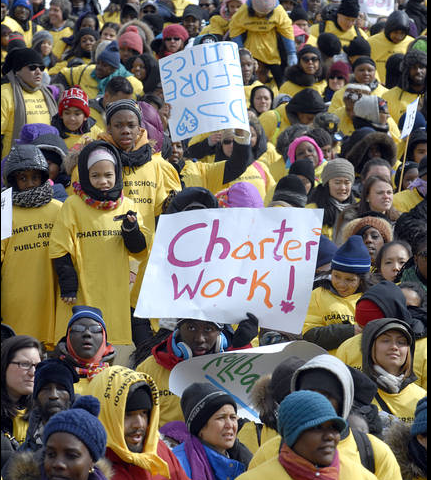
Charter schools are flourishing because poor inner city black parents are desperate to have their children attend a good school and the big city public schools are often very poor quality.
Stanford University recently conducted a study of charter schools in 41 regions around the country and found that:

  • Urban charter schools in the aggregate provide significantly higher levels of annual growth in both math and reading compared to their traditional public school peers.
  • Learning gains for charter school students are larger by significant amounts for Black, Hispanic, low-income and special education students in both math and reading.
  • Despite the overall positive learning impacts, there are urban communities in which the majority of the charter schools lag the learning gains of their traditional public school counterparts, some to distressingly large degrees.

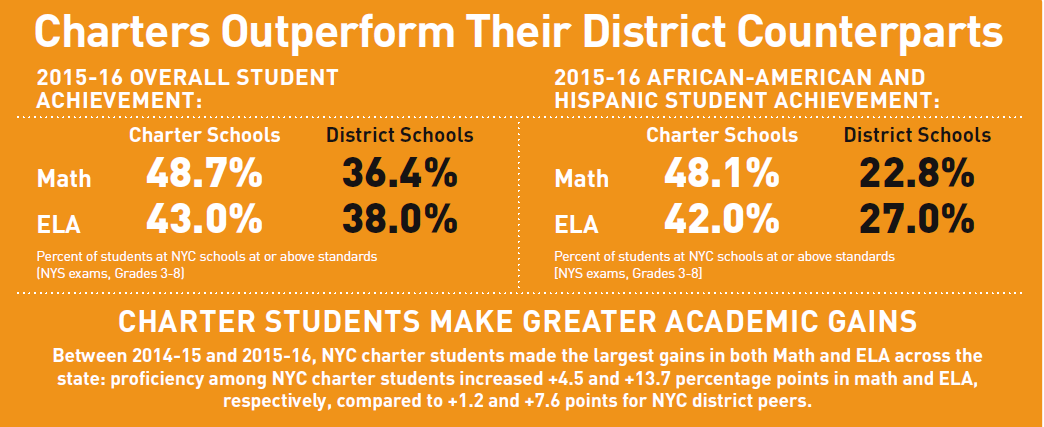
For example, charter schools are very successful in New York City and especially so for African-American and Hispanic students (see chart below).

capture100

Conclusion.  Charter schools work well when they are done right.  They work especially well for minority children in large urban areas.  These are generally the high-risk kids from low-income families who will benefit the most from a little extra help.

Follow me on Twitter
Follow me on Facebook