Needed: A New U.S. Foreign Policy


Wall Street Journal columnist Bret Stephens had a prescient article last November, “Yes, America Should Be the World’s Policeman” in which he said, “No great power can safely ignore chaos and disorder in key regions of the world. It is time for the U.S. to take a new approach – enforcing rules and standards but not trying to remake failed societies.”
CaptureAs illustrated in the photo just above from a recent soccer game, Germany is stepping forward and welcoming the masses of refugees now sweeping across Europe from the Middle East. But Germany’s generosity will just encourage yet many more refugees to attempt to escape from their failed societies.
The Hudson Institute’s Walter Russell Mead discusses “The Roots of the Migration Crisis” in yesterday’s WSJ. “The humanitarian question of refugees and asylum seekers cannot be separated from the bankruptcy of Western security policy in Syria and Libya, and the bankruptcy of Western security policy cannot be separated from the longstanding difficulties that many European states have in taking a responsible attitude toward questions of military security.”
“The utter failure of Western policy in both Libya and Syria has to be seen for what it is: not just a political blunder but a humanitarian crime.”
“It is impossible to have a humane and sustainable asylum policy without an active and engaged foreign policy that from time to time involves military action.”
“The dream of a liberal humanitarian peace that both the Obama administration and the EU share … certainly cannot be achieved with the kind of policies now in favor in capitals on both sides of the Atlantic.”
Or as Mr. Stephens said a year ago, “If the world’s leading liberal-democratic nation doesn’t assume its role as world policeman, the world’s rogues will try to fill the breach, often in league with one another.”
In other words, it is not just our own peaceful and prosperous way of life which is threatened by chaos in the Middle East, but our liberal-democratic values as well which are the foundation of progress for all of humanity.
The Evidence for Rapid Climate Change


My last post, “Why We Badly Need a Revenue Neutral Carbon Tax” makes the case for combatting global warming with a sensible free market mechanism such as a carbon tax rather than a hodge-podge of arbitrary national and state regulatory actions. Since many of the Facebook responders to this post deny the reality of global warming in the first place, I have decided to present the overwhelming evidence for its existence.
When ninety-seven percent of climate scientists worldwide agree that climate change is real and they have assembled a massive amount of measurement data to back up this claim, I think we have to take them seriously. For example:

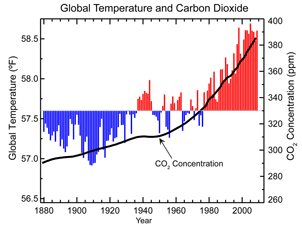
  • The Global Surface Temperature is Rising. Global average temperature has risen 1.4 F since the early 20th century as shown in the chart just below which also shows the close correlation with carbon-dioxide concentration.
    Capture2
  • The Sea Level is Rising. It has risen at an average rate of 1.7 mm/year over the last 100 years and at the rate of 3.5 mm/year since 1993 which is equivalent to one inch every seven years.
  • Global Upper Ocean Heat Content is Rising. The top 700 meters have warmed by .3F since 1969. Thermal expansion of the ocean water as it warms contributes to the sea level rise.
  • Glacier Volume is Shrinking Worldwide. Just Greenland and Antartica alone have lost at 150 cubic kilometers of ice annually in recent years.
  • Declining Artic Sea Ice. Both the extent and thickness of artic sea ice has declined rapidly over the last several decades (see chart below).
    Capture1I accept the reality of the scientific evidence for global warming but I am certainly no “alarmist” in terms of what our response should be towards addressing it. It will be many, many years before renewable energy sources like wind and solar are able to make a substantial dent in worldwide energy needs.
    The best thing to do in the meantime is to attempt to decrease carbon dioxide emissions from fossil fuels through carbon capture and storage. A carbon tax would create a huge economic incentive for the coal and oil industry to solve this problem. If and when they figure it out, it is likely that the technology involved would rapidly spread around the world.
    This would represent a real solution to a very serious problem.

Why We Badly Need a Revenue Neutral Carbon Tax


A large and steadily growing majority of Americans believe that global warming, caused by the burning of fossil fuels, is a serious problem which must be addressed. What remains is to figure out how to do this with the least possible amount of economic damage to ourselves and others.
Capture1Consider that:

  • Energy consumption will increase 56% worldwide by 2040, overwhelmingly with the use of fossil fuels. Biofuels are a very inefficient source of energy and wind energy isn’t much better. Solar energy is dropping in price but is still much more expensive than natural gas.
  • The Environmental Protection Agency has just issued its Final Rule for a Clean Power Plan to reduce carbon emission levels in 2030 by 32% below 2005 levels.
  • California is now considering drastic legislation requiring a 50% reduction in petroleum use by 2030 which is likely to do much damage to the California economy.
  • In 2008 the Canadian province British Columbia introduced a revenue neutral carbon tax which has succeeded in reducing carbon emissions without damaging the BC economy.
  • The advocacy group, Washington Carbon, is trying to put a carbon tax on the Washington State 2016 ballot. Initiative Measure 732 would institute a tax on fossil fuels of $25 per ton of carbon dioxide. According to the Seattle Times many environmentalists are opposed to this initiative because it would be revenue neutral!

Conclusion: humanity is faced with the very serious problem of global warming and the response so far is chaotic and totally inadequate. The developing world is rapidly increasing its use of fossil fuels while the EPA is trying to put the brakes on our own use. Meanwhile states (and Canadian provinces) are establishing their own individual energy policies.
Isn’t it clear that what is needed is a conceptually simple unified approach to create incentives for all of us to cut back on carbon dioxide emissions? Isn’t it also clear that the best way to do this is with a national carbon tax?
It is up to the U.S. and other developed countries to take the lead in doing this. Once we are clearly doing what is needed, then and only then can we begin to lean on less developed countries to follow our example.


Climate Change Requires N2N


I have been reporting for several days on a fascinating new book, “Smaller Faster Lighter Denser Cheaper” by Robert Bryce and, in particular, what it means for climate change.
CaptureHere are some key points:

As Mr. Bryce says, “It’s time to focus our inquiry on the key question: if we agree that too much carbon dioxide is bad for the Earth’s atmosphere – what are we going to do? What’s the best “no regrets” climate policy as we move forward?” Here’s how to proceed:

  • We will need much more energy in the decades ahead in order to raise the living standards of the more than two billion people who are still living in energy poverty.
  • Hydrocarbons now provide 87% of the world’s total energy needs. There are still no affordable, scalable substitutes for the vast quantity of hydrocarbons that we use today.
  • People in the industrialized countries cannot and should not hinder the efforts of the world’s poor to gain access to cheap, reliable sources of energy.
  • We must give a very high priority to adapting and hardening our cities, networks and structures so they can better survive severe weather events.
  • N2N (natural gas to nuclear) provides the best no-regrets energy policy because those fuels can provide significant environmental benefits with relatively low economic costs.
  • The combination of natural gas and nuclear energy has reduced America’s carbon footprint by 54 billion tons over the last six decades. By comparison, wind, solar and geothermal sources reduced emissions by just 1.5 billion tons over the same period.

In other words, we need to be practical about the new sources of energy which will be needed to meet growing world demand. Renewable energy sources cannot nearly provide what is needed. Exploiting the current abundance of natural gas while further developing nuclear energy is the best way to proceed.

Smaller Faster Lighter Denser Cheaper


I look at a lot of books and every once in a while I find one that I really like. Such is the case for “Smaller Faster Lighter Denser Cheaper”  by Robert Bryce, a scholar at the Manhattan Institute.
The book starts out: “We are besieged by bad news. Climate change, pollution, famine, water shortages, war and terrorism, the mess at Fukushima, political gridlock, and the ongoing debt problems and economic malaise in Europe and the United States are dominating the headlines.” This leads some people to embrace “collapse anxiety,” the feeling that our problems are so great that our prosperous Western lifestyle cannot be sustained and soon may crash.
Capture“This pessimistic worldview ignores an undeniable truth: more people are living longer, healthier, more peaceful, lives than at any time in human history. Amid all of the hand wringing over climate change, etc. the plain reality is that things are getting better, a lot better, for tens of millions of people around the world.”
“Dozens of factors can be cited for the improving conditions of humankind. But the simplest explanation is that innovation is allowing us to do more with less. We are continually making things Smaller Faster Lighter Denser Cheaper.” Computers are becoming smaller and faster. Nearly everything we use is getting lighter. Our engines and farms are getting denser. Innovators are driving down costs and making goods and services cheaper.
For example, how does the SFLDC perspective apply to energy use?

  • In July 2012 blackouts hit northern India leaving 600 million people without electricity, even though India’s coal use doubled between 2002 and 2012. India relies on coal for 2/3 of its electricity production and has enough coal reserves to last a century. In India and worldwide, coal use will almost surely continue to increase.
  • Consider the following power densities (footprints) of various forms of energy:
    i) biofuels: .3 watts per square meter
    ii) wind energy: 1 watt per square meter
    iii) solar photovoltaic panels: 6 watts per square meter
    iv) oil well: 27 watts per square meter
    v) natural gas: 28 watts per square meter iv) nuclear plant: 50 watts per square meter

Conclusion: From a power density point of view biofuels are a very inefficient source of energy and wind energy isn’t a whole lot better.
What is the best energy policy going forward? Stay tuned!

Biofuels are “A Crime Against Humanity”


Such has been called the burning of food crops to produce biofuels.
CaptureA recent research report by Capt. T.A. Kiefer, “Twenty-First Century Snake Oil: Why the United States Should Reject Biofuels as Part of a Rational National Security Energy Strategy” states that:

“Imagine if the US military developed a weapon that could threaten millions around the world with hunger, accelerate global warming, incite widespread instability and revolution, provide our competitors and enemies with cheaper energy, and reduce America’s economy to a permanent state of recession. What would be the sense and morality of employing such a weapon? We are already building that weapon – it is our biofuels program.”

Here are a few of the reasons for such a severe indictment of biofuels:

  • Liquid hydrocarbons are unmatched as transportation fuel. Using hydrocarbons to process biomass into transportation fuel is detrimental to civilization’s energy balance and must be avoided.
  • Not even today’s best liquid biofuels have any prospect of simultaneously attaining the 6:1 EROI (Energy Return on Investment) necessary to support a healthy modern civilization while also achieving the massive yields per acre necessary to supplant any significant fraction of the national energy supply.
  • Petroleum and natural gas are true primary energy sources and fuel modern agriculture. The use of petroleum to accelerate energy crop growth is ludicrous on its face, as the result is less overall efficiency of energy and greater net consumption of petroleum.
  • The best use of agricultural land and water is to produce sufficient food for the United States and a surplus for the rest of the world.
  • The only sensible use of biomass as fuel is to harvest unfertilized biomass from unmanaged land and consume it as is (e.g. firewood) without wasteful attempts to transform it into liquid fuel.
  • Mandating the use of higher-EROI fossil fuels to make lower-EROI biofuels requires the overall consumption of more energy to deliver the same power output. Current U.S. biofuels policy is accelerating rather than decreasing the use of fossil fuels.

“We must understand that a national energy strategy is nothing less than a national survival strategy.” Is it not obvious that all subsidies and mandates for biofuels, including ethanol, should be ended as quickly and expeditiously as possible?

The Slow Growth Economy We’re Stuck In


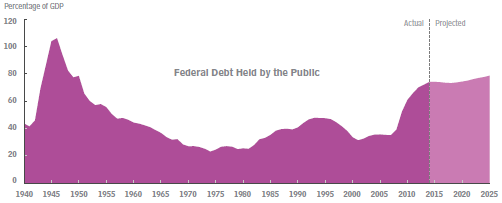
We have very high debt and Paul Krugman says in “Debt Is Good” that we need more! The Congressional Budget Office’s latest report this week, “An Update to the Budget and Economic Outlook: 2015 – 2025” predicts slow economic growth for the next ten years, averaging 2.1% per year (see chart below).
CaptureUnfortunately, high debt and slow growth are a deadly, self-reinforcing, combination. Today’s Wall Street Journal has a chart (pictured below) showing clearly how budget deficits are likely to increase over the next ten years. The public debt (on which we pay interest) is predicted to grow from 74% of GDP today to 77% of GDP in 2025, increasing by a total of $7 trillion over this time period.
Capture1Here is another connection between slow growth and high debt:

  • Slow Growth means higher than necessary unemployment and under-employment as well as minimal raises for employed workers. The resulting economic slack leads to
  • Low Inflation. But low inflation means that the Federal Reserve can maintain
  • Low Interest Rates to try to encourage more borrowing to stimulate the economy. This means, in turn, that Congress can run up huge deficits without having to pay much interest on this almost “free” money. This eventually leads to:
  • Massive Debt. But what happens when inflation does take off, which has happened before and is likely to happen again? Then the Federal Reserve is forced to raise interest rates quickly and we are stuck with huge interest payments on our accumulated debt. And meanwhile entitlement spending on Social Security, Medicare and Medicaid is also growing rapidly. At this point debt increases very rapidly which leads to a severe
  • Fiscal Crisis.

Of course things don’t have to happen like this. Congress might become more responsible and either cut spending and/or raise taxes and start shrinking our huge deficits. Or perhaps slow growth really is the new normal and interest rates will remain low indefinitely. But slow growth is not pain free; there are many millions of unemployed and under-employed Americans who want to work and whose lives are stunted otherwise.
Slow growth is a very destructive path to be following. We badly need to adopt policies to speed it up!

Paul Krugman: “Debt Is Good”


Every Monday and Friday morning when I pick up the New York Times, I immediately turn to the OP-ED page to see what liberal icon Paul Krugman is saying. In his most recent column, “Debt Is Good,” he says that “what ails the world economy right now is that governments aren’t deep enough in debt.”
CaptureHere is my response to his argument:

  • “The federal government can (now) borrow at historically low interest rates. So this is a very good time to be borrowing and investing in the future.” Our public debt (on which we pay interest) is now $13 trillion or 74% of GDP, the highest since the end of WWII, as shown in the above chart from the Congressional Budget Office. It is likely that interest rates will soon begin to go up. Every 1% rise will increase interest payments on our already existing debt by $130 billion per year. Where are the hundreds of billions of new dollars for debt service going to come from in an already tight budget? The more we add to the debt, the worse this problem will become.
  • “Having at least some government debt helps the economy function better.” I agree! But $13 trillion is way beyond what is needed for this. It is outrageously excessive!
  • “What we need are policies that would permit higher (interest) rates in good times without causing a slump. And one such policy would be targeting a higher level of debt.” The problem here is the conceit of Keynesians, like Mr. Krugman, that monetary policy alone can restore us to economic and fiscal health. Rather than accepting that the economy has entered a “new normal” with a permanently slow growth rate of about 2% (as has been the case since the end of the Great Recession in June 2009), we need policy changes such as individual and corporate tax reform (revenue neutral to be sure) and changes in the Affordable Care Act and Dodd-Frank Act to remove their job killing features.


Anybody with an ounce of common sense knows that excessive borrowing will eventually lead to disaster. Mr. Krugman seems to think that by constantly ridiculing his opponents, he can get away with denying this simple truth.

Debunking Several Social Security Myths


The Committee for a Responsible Federal Budget has just published a new report, “Debunking 8 Social Security Myths on Its 80th Birthday.” Here are several of the “myths” they report on:

  • Myth: Social Security does not face a large funding shortfall. Fact: Social Security’s trust funds are projected to run out of reserves within 20 years. Although the Social Security Trust Fund currently contains $2 trillion, it is being depleted at a rate of close to $100 billion per year. The looming insolvency is a result of the growing costs associated with an aging population.
  • Myth: Today’s workers will not receive Social Security benefits. Fact: Even if policy makers do nothing, the program will still pay about three-quarters of scheduled benefits. Once the trust fund is depleted, benefits would be paid only from incoming payroll tax revenue.

    Capture

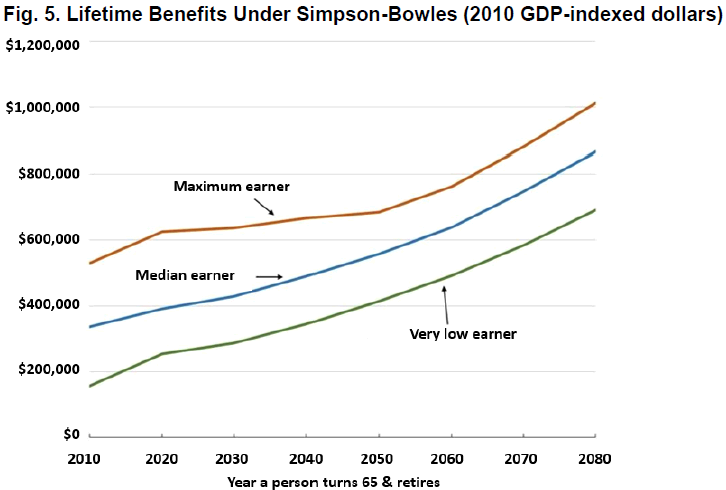
  • Myth: We don’t need to worry about Social Security for 20 years. Fact: there is a very high cost involved in waiting to reform Social Security. Substantial changes are needed to avoid the benefit cuts referred to above. The sooner we make these changes the less onerous they will be for both recipients and payroll tax payers (see above chart).Capture1
  • Myth: Social Security reform is code for slashing benefits, especially for the poor. Fact: under most reform plans, benefits would continue to grow faster than inflation. Most reform plans do not cut benefits from their current levels but rather slow the growth of benefits to reduce some of the pressure that wage-growth and rising life-expectancy place on the program. Under the Simpson-Bowles Plan, for example, benefits for low-wage earners will grow much faster, proportionally, than for higher-wage earners (see above chart).

Conclusion: It should be clear from the above discussion that Social Security can be fixed so as to continue to provide retirement benefits indefinitely into the future. It should also be clear that the sooner the needed reforms are implemented the less painful they will be for all concerned. We should tell our Congressional representatives that we want them to act now!

Minorities and Higher Education: a Severe Dilemma


In two recent posts, here and here, I have established that:

  • Rapid increases in federal student aid in recent years have led to tuition increases at both public and private educational institutions and for both undergraduate and graduate students.
  • American higher education is increasing the divide between the haves and the have-nots in the sense that college degree attainment is increasing much faster for those students from higher income families.
  • Furthermore, students at private, nonprofit (most prestigious) institutions have higher graduation rates and lower debt levels compared to students from public institutions who, in turn, have both higher graduation rates and lower debt levels than students at for-profit colleges (least prestigious).Capture

As if this isn’t bad enough, it gets even worse! The Federal Reserve Bank of St. Louis has just reported, “Why Didn’t Higher Education Protect Hispanic and Black Wealth?” that “White and Asian college grads do much better than their counterparts without college, while college-grad Hispanics and blacks do much worse proportionately.” (see above chart).
In short, the federal government is spending more and more money on higher education, which, in turn, is making colleges and universities more and more expensive. Whites and Asians from higher-income families are graduating in much higher numbers and with minimal debt, while college-grad blacks and Hispanics are mired in huge levels of debt.
How should society address this severe inequality in higher education?

  • Federal student loans should be limited to $30,000 for undergraduates and $60,000 for graduate students, the average amounts borrowed today for each category of student. Beyond these limits, students could still borrow from the private market, but with no subsidies or loan guarantees provided by the government. This single action alone will help to hold down college costs.
  • All students, and especially those from low-income families, should be encouraged to avoid excessive college debt. There are many high quality, low-cost educational institutions all around the country (e.g. UNOmaha where I teach) to meet their needs. It should be strongly emphasized that an expensive, prestigious institution is not needed to obtain a good education.