The Obama Economic Record


The readers of this blog know that I focus on what I consider to be the two biggest problems affecting our economy: 1) slow growth averaging just 2% per year since the end of the Great Recession and 2) our massive debt now equal to 75% of GDP (for the public part on which we pay interest) and predicted to keep growing steadily under current policy.
I have also made it clear that I am not pleased with the economic policies of either of the two main candidates for president, Hillary Clinton or Donald Trump.  Whichever one of them is elected, our best hope for the future is that she or he will have to work with the Republican House of Representatives which has an excellent plan, “A Better Way,”  for renewal.
capture71But, of course, the next president will take up where Barack Obama has left off.  The current issue of the Economist has an essay, “The Way Ahead,” in which Mr. Obama identifies several challenges:

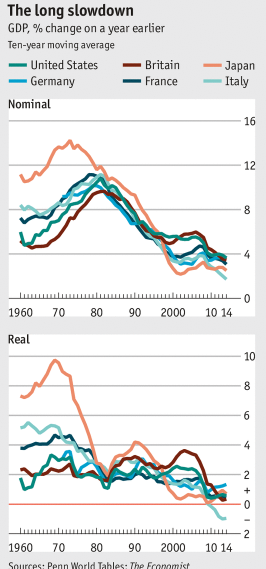
  • Boosting productivity growth. The above chart from his essay shows how much productivity growth has declined in the last ten years. He claims that the corresponding lack of investment is caused by an anti-tax ideology which rejects new funding for public projects, which in turn can be blamed on a fixation on deficits in spite of our skyrocketing debt problem. The House plan correctly identifies tax and regulatory reform as what are needed for progress.
  • Combatting rising inequality. An expanded Earned Income Tax Credit will definitely help here but mainly what is needed is overall faster economic growth.
  • Insuring that everyone who wants a job can get one. Wage insurance and better retraining programs for laid off workers are good ideas. But again, faster economic growth is what is really needed.
  • Building a resilient economy which is primed for future growth. Mr. Obama says that “America should also do more to prepare for future shocks before they occur.” This is exactly why we urgently need to start shrinking our debt now before the shock of higher interest rates leads to huge increases in interest payments on our rapidly growing debt.

Conclusion. Let’s give Mr. Obama credit for avoiding another depression after the Financial Crisis. But his poor policies are to blame for the very slow rate of recovery ever since.

Follow me on Twitter
Follow me on Facebook
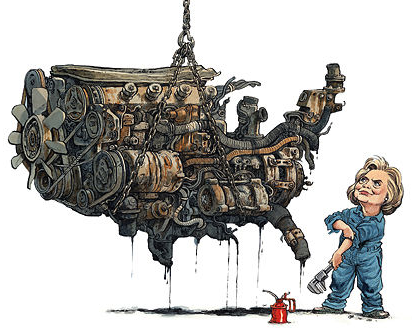
 

Can She Fix It?


As I have recently pointed out, Hillary Clinton is now likely to be our next president.  In my last post I provided vivid evidence that middle class income grew dramatically between 1971 and 2001 and has been either stagnant or declining since then.  The fact is that the years from 1971 – 2001 were a time of rapid economic growth, about 3.5% per year.
Capture2So it is obvious what needs to be done to fix America’s economic woes: grow the economy faster!  In its latest issue, the Economist asks, “Can she fix it?” The tentative answer suggested by the Economist is no, based on Mrs. Clinton’s tepid policy proposals to date:

  • She wants to make college more affordable, grant paid leave to parents, raise the national minimum wage to $12 per hour, and increase infrastructure spending. These are nice sounding proposals but will have only minor effects on growth or add greatly to the national debt (infrastructure spending).
  • She proposes a tax-credit for companies to encourage profit-sharing schemes. This would just make the tax code more complicated.
  • She wants an extra tax on the debt of big banks but simply increasing capital requirements on big banks would be more effective.
  • She wants to raise the top tax individual tax rate to 45% but shrinking deductions and closing loopholes would be a more efficient way to make the tax code more progressive.
  • She wants to abandon the Trans Pacific Trade Partnership rather than figuring out how to help those workers who lose from expanded trade with such measures as wage insurance or better job retraining.

As the Economist concludes, “A bigger plan to help American workers would start by boosting competition, both by slashing unnecessary regulations for small businesses, and by ensuring that big firms no longer operate in protected markets.”
If we are going to end up with another Clinton presidency, we certainly don’t want four more years of Obama-type economic stagnation!

Follow me on Twitter: https://twitter.com/jack_heidel
Follow me on Facebook: https://www.facebook.com/jack.heidel.3

The Best Way to Stop Donald Trump


The main sources of background information for my posts are The New York Times and the Wall Street Journal. I read the Economist but most of the time it is either too esoteric or else too far  removed from the specifics of U.S. fiscal and economic policy which I am interested in.  But this week they have hit the nail on the head regarding Donald Trump and his fellow right-wing populists around the world.
Capture0
Says the Economist:

  • Populists differ but the bedrock for them all is economic and cultural insecurity. Stagnant wages hurt a cohort of older working-class white men whose jobs are threatened by globalization and technology. Jihadist terrorism pours petrol on this resentment and extends populism’s appeal.
  • Nobody should underestimate how hard it is to take the populists on. It is a huge mistake to dismiss their arguments by calling them fascist or extremist. Such disdain risks suggesting that political leaders are uninterested in the real grievances the populists play on.
  • The best way to overcome resentment is economic growth – not putting up walls. The best way to defeat Islamist terrorism is to enlist the help of Muslims – not to treat them as hostile.
  • Voters are often more reasonable than the populist leaders who are trying to appeal to them. Most of them would sooner hear something more optimistic than rage against a dangerous world.
  • Politicians also need to deal with the populists’ complaint that government often fails them. Reluctance to deploy more troops against the ISIS caliphate in Syria and Iraq does not appear to be a serious strategy to defeat it.

Conclusion: There is a clear path forward for candidates with a positive message of openness and tolerance and realistic plans to make the economy grow faster. Who is best situated to deliver such a message?  Stay tuned!

Follow me on Twitter: https://twitter.com/jack_heidel
Follow me on Facebook: https://www.facebook.com/jack.heidel.3

America and the World: the Need for Leadership


As we are just getting started on what so far is a confusing presidential election campaign, it would be easy to forget how incredibly lucky we are in America.  Our country is very strong and we are isolated from many of the world’s problems.  The terrorist attacks in Paris over the weekend are a grim reminder of this fact.  But we still have responsibility for much of what is happening around the world.
Capture

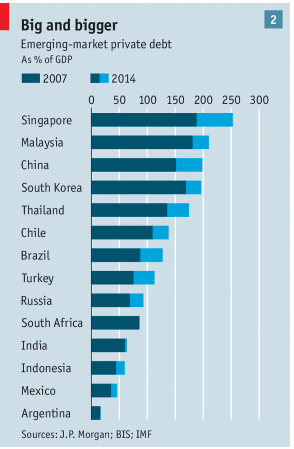
  • George W. Bush’s biggest failing is not the Iraq War, draining Medicare funds with a new drug benefit or ramping up deficits with tax cuts that lose revenue. His biggest failing is not foreseeing the financial crisis and at least mitigating it if not heading it off entirely. His financial advisors (Greenspan, Bernanke, Geithner, Paulson) were asleep at the switch. As the Economist makes clear in its latest issue, “First America, then Europe. Now the debt crisis has reached the emerging markets.”
    Capture0
  • Barack Obama’s biggest failing is not the stagnant economy or massive debt buildup which occurred on his watch, although he could have eased their burden with smarter policies. His biggest failing is his unwillingness to assert sufficient power in the Middle East to head off the chaos we observe today. The enormous European refugee crisis with all of its attendant horrors is largely the result of his inadequate intervention in Iraq, Libya and Syria.

The main concerns of this website are the internal fiscal and economic problems faced by the U.S.  We have to figure out amongst ourselves how to address these very serious issues.  But, like it or not, what we do affects the whole world.  If we fail to meet our responsibilities, the whole world, including us, will suffer with the consequences.

Follow me on Twitter:  https://twitter.com/jack_heidel
Follow me on Facebook: https://www.facebook.com/jack.heidel.3

Light at the End of the Tunnel


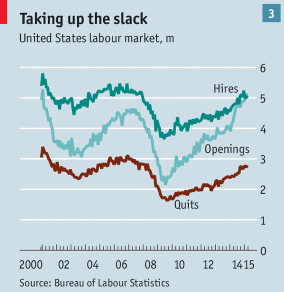
The Bureau of Labor Statistics has just reported very good news in its monthly Job Openings and Labor Turnover Survey.  For the first time since 2000, the number of job openings now exceeds the number of new hires, as shown in the chart just below.  This means that wages will start to grow faster as employers have to compete harder for new workers.
Capture1This is an early indication that our economy will likely soon resume a faster rate of growth than its average of 2.3% since the end of the Great Recession in June of 2009.  There will be many benefits.  The unemployment rate should continue to keep heading downward from its current level of 5.5%.  More unemployed and underemployed workers will be able to find satisfactory jobs.  The labor participation rate should start to head back up from its historically low current state.
The Federal Reserve is likely to begin raising short term interest rates sooner rather than later in order to keep inflation in check before it has a chance to heat up.  In other words we may be breaking out of the ambiguous state of slow-growth secular stagnation in which we have been trapped for six years.
All of this is very good news as long as Congress realizes that it is now even more urgent than ever to put our massive public debt of $13 trillion on a downward path, compared to the total economy, before interest rates begin to rise substantially and eat us alive with interest payments on this huge debt.
In this regard the Budget Plan approved by Congress just this Spring, which will lead to a balanced budget over ten years, looks very attractive indeed.  It will be a mammoth job to achieve such a milestone in fiscal restraint, but doing so will lead to a more secure and prosperous future for all Americans.

Are Economics and Social Progress Related to Each Other?


“Your (last post) is one of the most active and positive that I have read of yours. You do put your time to where your values are. Those of us who see you as too economically focused and ourselves as more humanely concerned need to act as well. Thanks for your focus and attention.”
from a reader of my blog

I am a fiscal conservative and a social moderate. The primary reason I write this blog is because I am so concerned about the fiscal recklessness of our national leaders. Our national debt is much too large and still growing too fast. We need to either cut spending or raise taxes (or do both).
But I am also a social progressive. I voted in favor of Nebraska raising its minimum wage last fall. I support gay marriage as a civil right. I support having Nebraska expand Medicaid in order to cover more low-income people (where Medicaid needs to be fixed is at the federal level).
CaptureThere is in fact a very close connection between having a sound economy and social progress. As the above chart shows, the U.S. ranks very high in both GDP per person and social progress. All of the countries which are most socially progressive also have sound economies. This is not a coincidence.
My last post talks about what society can do to help blacks improve their socio-economic status. This includes improving educational opportunity in the inner city. But improved educational opportunity needs to be closely directed toward improved economic opportunity. This means, for example, having good jobs available for new high school and community college graduates. But this, in turn, means having strong economic growth with intelligent tax and regulatory policies to encourage entrepreneurship and business expansion.
In short, a sound economy is essential for social progress.

Why Inequality Is Harmful and What to Do About It


I describe this blog as addressing our fiscal and economic problems, meaning deficits and debt on the one hand and slow economic growth on the other.  But these topics, while being of critical importance to our national welfare, are also somewhat on the dry side.  The subject of economic inequality stirs up lots more interest and response. In the Fall of 2012 The Economist declared that “a new form of radical centrist politics is needed to tackle inequality without hurting economic growth.”
CaptureSays The Economist:

  • There’s too much cronyism in the rich world. Banks which are “too big to fail” have an implicit subsidy. From doctors to lawyers, many high paying professions are full of unnecessarily restrictive practices. Social spending often helps the rich more than the poor. For example housing subsidies for the top 20% (mortgage-interest deductions) are four times the amount spent on public housing for the poorest 20%.
  • If income gaps become too wide, they can lead to less equality of opportunity, especially in education. The gap in test scores between rich and poor American children is 30 – 40% wider than it was 25 years ago.
  • If those on the top of the heap resist equalizing changes, it could lead to political pressure which serves nobody’s best interests.

Here are The Economist’s proposals for a True Progressive Agenda to attack inequality:

  • Compete.   A Rooseveltian attack on monopolies and vested interests is needed. School reform is crucial: no Wall Street financier has done as much damage to social mobility as the teacher’s unions have.
  • Target. Government spending need to be focused on the poor and the young. Governments can’t hope to spend less on the elderly but they can reduce the pace of increase.
  • Reform. Eliminate tax deductions which primarily benefit the wealthy such as for mortgage-interest; narrow the gap between tax rates on wages and capital income.

“The right is still not convinced that inequality matters.  The left’s default position is to raise income tax rates for the wealthy and to increase spending still further – unwise when sluggish economies need to attract entrepreneurs and when governments are overburdened with promises of future spending.”
Surely there is a better way!

Will Wage Stagnation Continue Indefinitely?


It is widely deplored that wages for both middle- and lower-income workers are stagnant and have not even recovered from where they were before the beginning of the Great Recession.  The latest issue of The Economist explores this problem, “When what comes down doesn’t go up.”
CaptureThe Economist sees several factors at work:

  • As the unemployment rate continues to drop, many new jobs are paying less than the old jobs that were lost.
  • In Germany “mini jobs,” paying under $440 per month, are skyrocketing. In Britain “zero hours” contracts, with no commitment to a fixed number of hours, are becoming more common.
  • In 2013 Kelly Services, which provides temporary workers, was the second largest employer in the U.S. with a staff of 750,000. 2.9 million temps account for 2% of all jobs in the U.S.

As The Economist points out, if low pay does in fact lock in, inflation will stay low even as the unemployment rate continues to fall.  The Federal Reserve will then be likely to keep interest rates low indefinitely as well.  But this means there will be far less incentive for Congress and the President to cut back on huge deficit spending because debt is almost “free money” when interest rates are low.  Long term, massive debt, is a huge threat to our security and prosperity.
Breaking out of this pernicious low wage trap will require a bold effort by Congress and the President to boost economic growth.  By far the best way to do this is with broad-based tax reform at both the individual and corporate levels.  As I have discussed in previous posts, what is needed is lower tax rates paid for by closing loopholes and deductions.  Hopefully, the new Congress is headed in this direction!

Will ‘Middle Class Economics’ Lift Us Out of ‘Secular Stagnation’?


‘Secular Stagnation’ is the expression, made popular by the economist Larry Summers,  to refer to the present time period, since the end of the Great Recession, with slow economic growth, high unemployment, stagnant middle-class wages and increasing inequality.  It is to be contrasted with ‘The Great Moderation,’ from 1982 – 2007, with a rapidly growing economy, rising wages and stable prices.
CaptureMy last post, “Does ‘Middle Class Economics’ Really Work,” discusses President Obama’s attempt to appeal to middle-class families with policies such as:

  • Tax and regulatory provisions such as tax credits for childcare, college tuition, and second earners in two parent households; also requiring paid sick leave and a higher minimum wage.
  • Expanding access to community colleges to make workers more productive.
  • Increased infrastructure spending to boost employment.

The problem with this strategy is that it is much too weak to combat the huge headwinds opposing it.  In addition to the well-known effects of globalization and technological advance, consider the demographical challenge described below:

OECD old age support ratio:  the number of workers aged 20-64 relative to those aged over 65
Capture1
As is very clear from this chart, the demographics are just going to keep getting worse and worse and will be very bad indeed by 2050.
Here is a surprising quote from Mr. Summers: “To achieve growth of even 2 percent over the next decade, active support for demand will be necessary but not sufficient.  Structural reform is essential to increase the productivity of both workers and capital, and to increase growth in the number of people able and willing to work productively.  Infrastructure reform, policies to promote family-friendly work, support for exploitation of energy resources, and business tax reform become ever more important policy imperatives.”
I would add several additional policy changes which would speed up change in this direction:

  • Reform (but not repeal!) the Affordable Care Act by eliminating all mandates. This would incentivize businesses to move part-time employees to full time. Tax credits and subsidies provide enough incentive for individuals to become insured.
  • Regulatory reform to make it easier to start a new business.
  • Raise the age limits for both Social Security and Medicare to encourage people to work longer.
  • Reform disability insurance to make it more difficult to be declared disabled.
  • Tighten up welfare requirements to require all able-bodied adult recipients without dependents to work.
  • Reform immigration with guest-worker visas for needed foreign workers.

We need to get serious about boosting our labor participation rate in order to grow the economy faster.  Happy talk about ‘middle class economics’ will simply not do the trick!

Stopping Corporate Tax Dodgers

Several large U.S. companies have recently announced that they are planning to merge with foreign companies and move their corporate headquarters to a low tax country such as Ireland or Great Britain.  The Obama Administration proposes to disallow such “tax inversions” by requiring that after such a merger at least 50% of the stock of the new company would have to be foreign owned.  Otherwise the firm would still be considered American for tax purposes.  Such a technical fix is unlikely to solve a much more fundamental problem.
As the latest issue of the Economist, “How to stop the inversion perversion,” makes clear, “America’s corporate tax has two horrible flaws.  The first is the tax rate, which at 35% is the highest among the 34 mostly rich-country members of the OECD. … The second flaw is that America levies tax on a company’s income no matter where in the world it is earned.  In contrast, every other large rich country taxes only income earned within its borders (a so-called ‘territorial system’).  Here, too, America’s system is absurdly ineffective at collecting money.  Firms do not have to pay tax on foreign profits until they bring them back home.  Not surprisingly, many do not: American multinationals have some $2 trillion sitting on their foreign units’ balance sheets.”
CaptureA relatively simple solution to this glaring problem would be to lower the corporate tax rate to 25%, the OECD average, and shift to a territorial system.  Revenue losses would be offset by closing loopholes and deductions.
A better, but likely more controversial, solution would be to completely eliminate the corporate income tax and then tax dividends and capital gains at the same rate as earned income.  This would avoid the double taxation problem whereby profits are taxed first at the corporate level and then again for individuals as dividends and capital gains.
The overall goal in this entire endeavor should be to boost the economy, thereby creating more jobs, and additionally to raise the tax revenue needed to pay our bills.  Fairness is important but growth is even more important!