
How to Control Federal Spending: The Highway Trust Fund


The federal Highway Trust Fund is almost out of money.  It takes in $35 billion per year from the 18.4 cents per gallon federal gas tax, which has not been raised since 1993.  Sometime this summer the government will have to cut back on payments to state highway departments unless Congress acts.
CaptureAs the above chart from the Economist  shows, the U.S. spends much less of GDP on roads than many other developed nations.  Something clearly needs to be done because we need many improvements in infrastructure.  But there are better ways and poorer ways to solve this problem.  Here are two good ways as described by Thomas Donlan in a recent issue of Barron’s:

  • A bill to raise the gas tax by 12 cents per gallon over two years has been introduced in the Senate by Bob Corker (R, Tenn.) and Chris Murphy (D, Conn.). Each penny added to the federal gas tax rate will raise $1.3 billion and this would solve the problem.
  • Repeal the federal gas tax and turn federal highway construction entirely over to the states. Each state could then increase its own gas tax and/or pay for construction with tolls on bridges and roads.

Here are two examples of poor ways to replenish the Highway Trust Fund:

  • Continue adding to the Fund with borrowed money. $54 billion has been borrowed since 2008 for this purpose. Presumably the Sequester will make it much harder to continue such deficit financing.
  • Rep John Delaney (D, Mary.) has proposed a tax break for repatriated foreign profits by multinational American companies if part of the money brought back was spent on infrastructure bonds. This would interfere with the urgent need to reform corporate taxes with significantly lower rates offset by lowering deductions, in order to make our corporate tax internationally competitive.

Conclusion: There is a good chance that the Budget Sequester established by Congress in 2011 to control discretionary spending, as well as the widely recognized urgent need for corporate tax reform, will lead to a “good” rather than “bad” solution to the shortfall in the Highway Trust Fund. This is just one specific example of the challenge to sensible budgeting by Congress.
A much broader approach is needed to really shrink the deficit.  Stay tuned!
Redistribution, Inequality and Growth


Most people agree that income inequality and wealth inequality are increasing in the U.S. Likewise anyone who’s paying attention is aware of our slow rate of GDP growth, averaging 2.2% per year, since the end of the recession five years ago.  Is there a connection between inequality and slow growth?  Maybe!
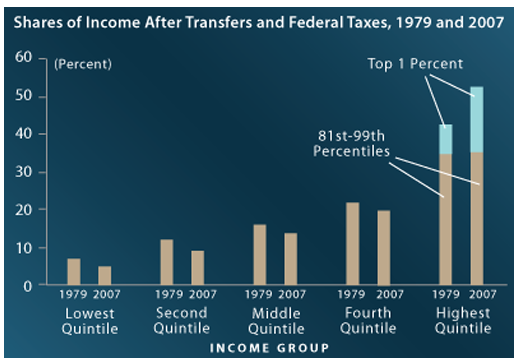
CaptureFirst of all, it is important to note that income inequality in the past 30 years has been greatly offset by federal taxes and transfer programs as shown in the October 2011 chart (above) from the Congressional Budget Office.
Capture1Secondly, the Economist discusses this situation in the article “Inequality v growth”.  The economists Jonathan Ostry, Andrew Berg and Charalambos Tasangarides have shown (see above chart) that a large amount of redistribution affects growth more negatively than a smaller amount of redistribution.
Economists generally agree that the recovery has been slowed down by a lack of demand by consumers for more goods.  So the recovery should speed up as less affluent consumers feel secure enough to spend more money.  Two things, to start with, can make this happen.  One is a restoration of the housing market so that homeowners have more equity (which can be borrowed and spent).  Another way to accomplish this is with government redistribution programs, such as food stamps and Medicaid, for low income people.
But there is an even better way to put money in the hands of people who will spend it, and at no cost to the government.  I am talking about broad based tax reform, whereby tax rates are lowered for everyone, offset by closing tax loopholes and shrinking deductions, which primarily benefit the wealthy.  For the two-thirds of taxpayers who do not itemize deductions, and who tend to be the less affluent, such a tax rate cut will put money in their pockets, most of which they will spend.
Such a tax program as this would be a direct shift of resources from the wealthy to everyone else, thereby lessening inequality.  It would stimulate the economy, creating millions of new and higher paying jobs, and thereby increasing tax revenue and lowering the deficit.  Win, win, win, win!

Labor’s Share of National Income Is Falling

The latest issue of the Economist shows quite dramatically in the article “Labour Pains” that labor’s share of national income is dropping.  In the U.S. workers’ wages have historically been about 70% of GDP.  In the early 1980s this figure started falling and is now 64%.  Similar declines are occurring in many other countries.
This phenomenon is closely related to what others are observing as I have reported recently.  Tyler Cowen’s new book “Average is Over” discusses the threat of technology to the middle class.  Daniel Alpert in “The Age of Oversupply” talks about the increase of competition from various global forces.  Stephen King’s “When the Money Runs Out” makes the case that “a half-century of one-off developments in the industrialized world will not be repeated.”
Historically the stability of the wage to GDP ratio “provides the link between productivity and prosperity.  If workers always get the same slice of the economic pie, then an improvement in their average productivity – which boosts growth – should translate into higher average earnings. … A falling labour share implies that productivity gains no longer translate into broad rises in pay.  Instead, an ever larger share of the benefits of growth accrues to the owners of capital.”
A shrinking share of a GDP which itself is slowing down is a double whammy.  The only way to address the problem effectively is to deal with the root causes.
First of all, we need to boost overall economic growth by the proven methods of broad based tax reform, especially including much lower corporate tax rates, making regulations less onerous, carrying out immigration reform, and giving special attention to helping entrepreneurs create new businesses.
How can we, additionally, help low skilled and low waged workers move up the ladder?  Long term the most worthwhile action is to change K-12 education by putting more emphasis on career education to produce more highly skilled workers.  Short term, we should provide crash job training for the estimated three million current job openings in the U.S. which require skilled workers.
Economic inequality in the U.S. is becoming progressively worse all the time.  There are fiscally sound ways to address this alarming problem and it is important that they be clearly and forcefully advocated.

A Pessimistic View of America’s Future


The George Mason University economist, Tyler Cowen, has written a provocative new book entitled “Average is Over”, which has just been reviewed by the Economist: “The American Dream, RIP?” .  His thesis is that the slow recovery of middle class jobs following the Great Recession of 2008-2009 portends a new economy more and more devoid of middle class jobs and broad prosperity.
Mr. Tyler says that “An elite 10-15% of Americans will have the brains and self-discipline to master tomorrow’s technology and extract profit from it.  They will enjoy great wealth and stimulating lives.  Others will endure stagnant or even falling wages as employers measure their output with ‘oppressive precision’.  Some will thrive as service providers to the rich….Young men will struggle in a labor market which rewards conscientiousness over muscle.”  Some highly motivated individuals, born poor, will be able to move into the elite group with cheap online education.  This creates overall a sense of “hyper-meritocracy” at the top which “will make it easier to ignore those left behind.”
What Mr. Cowen has done is to take the strong social and economic forces of globalization and technology, add to this mix emerging machine intelligence (Google is a prime example) and then to use his vivid imagination to conjure up an image of what life will be like in the not so distant future.  America will still likely be the dominant country in the world but the historically strong middle class will shrink as the rich become richer and the poor become poorer.
Is this pessimistic vision of America’s future inevitable?  Is there anything we can do to at least slow down if not to reverse these trends?
Speeding up economic growth is our only chance to turn things around and mitigate this grim future.  Better K-12 education (and therefore early child education as well) will help in the long run.  In the short run, broad based tax reform, healthcare cost control, relaxing overly burdensome regulations, and immigration reform are the four things which will help the most.  The same old basic stuff is what we need to do!  Tyler Cowen’s story just makes the need for such changes more compelling and more urgent!

Is Voucher Really a Dirty Word?


The current issue (May 25, 2013) of the Economist has an excellent article “Entitlements in America”, which tackles the broad issues of entitlement spending and health care inflation in America.  There are many aspects of this whole problem but let’s focus here on “Medicare, the hardest part of the budget”, as the Economist says and with which I totally agree.  We cannot get government spending under control, i.e. deficits on a steep downward path, until we figure out how to control the cost of Medicare.
The Economist makes some standard recommendations, such as increasing the eligibility age from 65 to 67 (as for Social Security) and raising premiums on the well-to-do (means testing).  These are good ideas but not large enough in scope to make a significant dent on the problem.  Somehow or other we need to convert Medicare from a defined benefit program (with no cap on expenses) to the same kind of limited defined contribution program which everyone else has through private insurance.  But how can we accomplish this within our political process?  Republican House Budget Chair Paul Ryan has taken an enormous amount of heat for proposing to make this switch with a premium support or “voucher” plan.  It is much too easy for Democrats to accuse him of trying to destroy Medicare when he’s really just trying to save it by making it financially sound.
The Economist proposes converting the Federal Employee Health Benefits program into a voucher system as an experiment to see if it saves money.  Right now FEHB offers unlimited benefits with federal employees paying 35% of the cost.  This makes FEHB open ended with no constraint on overall spending, which is exactly the problem with Medicare.  Each federal employee would have an annual health benefit amount and would have to decide on what kind of health insurance benefit to purchase with the fixed amount, supplementing with personal funds if desired.  If a voucher program for federal employees saves money for the federal government, as it undoubtedly would, then we could confidently convert Medicare to a similarly system.
We have to make big changes in our current Medicare program and here is an excellent suggestion for one possible way to do it!